

#On the Boundary That Does Not Announce Itself
The Stillness Envelope is the Bureau of Medicine's name for the four-hundred-yard radius of temporal drag surrounding an active Slumber-Hulk. Soldiers call it the heavy. The Bureau of War calls it an engagement hazard. The Bureau of the Hourglass calls it measurable, which is its own species of profanity when the measurement concerns the rate at which a man loses the will to move.
The Envelope has no merciful edge. It does not glow, crackle, shimmer, roar, or perform any of the theatre by which generous horrors alert a soldier to the place where his life becomes interesting. Fog thickens. Sound shortens. The rifle grows heavier by degrees the arm cannot contest. A shouted order arrives at the ear as a dead insect arrives at a windowsill: present, intact, useless.
At its outer margin the Envelope is discomfort. At its middle it is command failure. At its inner threshold it becomes moral abolition. A man remains awake. His eyes record. His mind recognises danger. His body receives the memorandum and files it under tomorrow.
#On Measurement at Shipka
The Envelope entered verified doctrine in A.S. 194, during the first confirmed Slumber-Hulk engagement at Bastion-Shipka. The forward alarm rose from Station Two, two kilometres east of the main walls, where the Reed Road pushes into the Shipka reed-marsh and begins making the sort of poor decisions expected of roads near Syrion. A chain-bound mass emerged from the Vales of Stagnance fog at three miles: pale between iron links, glacial, patient, and already altering the air ahead of it.
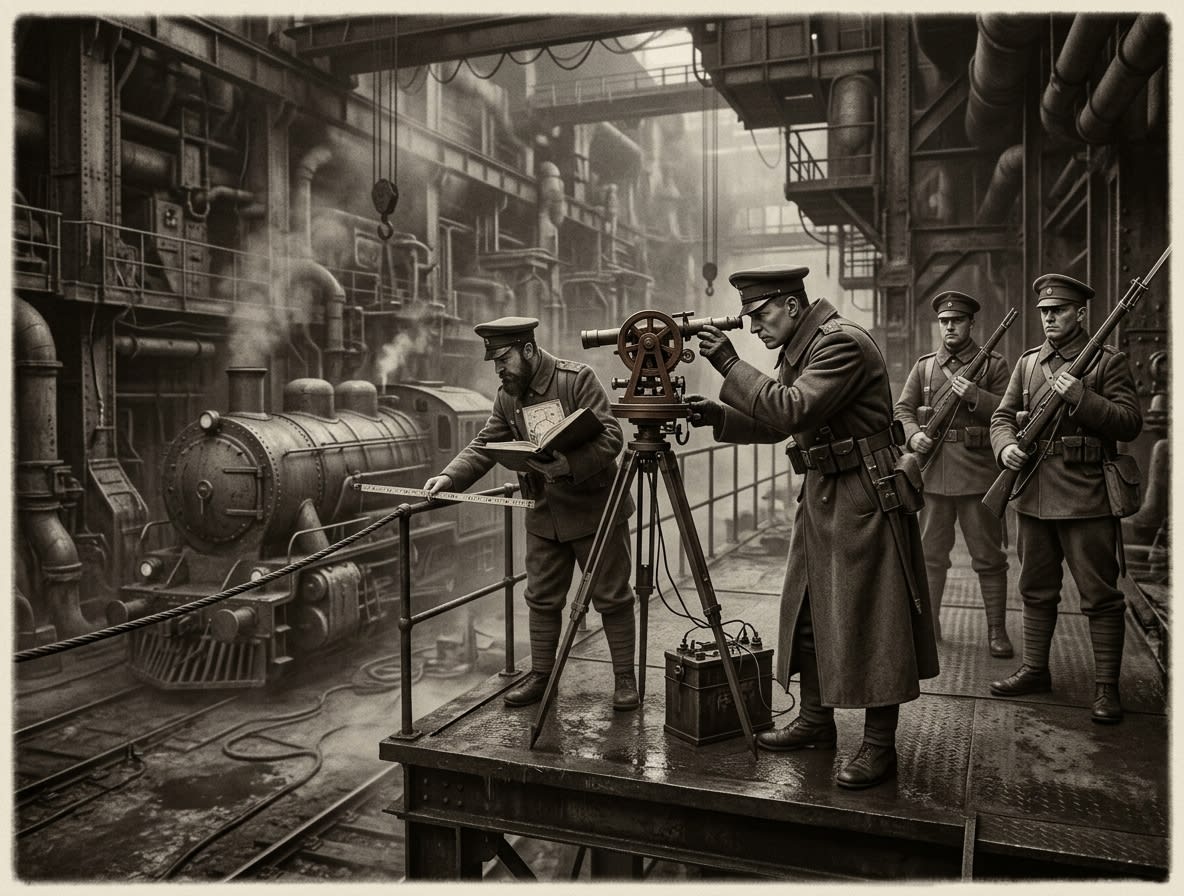
Adept Meryth Vesk checked her drag-gauge. A drag-gauge measures the thickness of passing time through calibrated resistance. A filament descends. The rate declares whether duration has become sluggish, quickened, or treacherous. Around the Hulk the field registered at roughly one-seventh normal time. At the centre the gauge flatlined for eleven minutes.
There was no reading.
Vesk's notation has acquired the chilly dignity of scripture among Hourglass adepts: time is not passing at the subject centre. Doctrine dislikes the sentence because it refuses consolation. War dislikes it because it makes battle sound like trespass into a hole cut from sequence. Engineering dislikes it because walls fare badly when duration ceases to honour mortar.
The official measurement remains: four hundred yards of actionable danger, one-seventh time in the body-field, centre-line excision. These numbers are treated as stable because armies require numbers to print on range cards. No honest adept believes the next Slumber-Hulk will show the courtesy of matching the last one.
Early tactical cards described the Envelope as a “sleep radius” and advised stimulant issue at first sign of drowsiness.
Corrected after A.S. 194 survivor interviews. The Envelope does not primarily induce sleep. It attacks motion, sequence, command transfer, and the moral habit by which an order becomes an act. Stimulants remain useful for panic, fatigue, and keeping quartermasters convinced that the stores are doing something.
#On the Symptoms
The first symptom is heaviness. This is a banal word, unfit for the thing it names, but the soldier's vocabulary is often better than the physician's because it carries less upholstery. Arms grow leaden. Knees acquire the bureaucratic genius of postponement. Fingers rest on triggers without completing the minor office of pressure. The rifle becomes impossible: its weight has not changed; every prior hour spent holding it has been added to the present moment and presented for payment.
The second symptom is distance. Orders do not vanish. They travel too far inside the man. A sergeant shouts fire; the word enters the ear, crosses the drilled corridors of obedience, reaches the muscles, and arrives as correspondence after the office has closed. The soldier understands. Understanding humiliates him. He knows precisely what he should do and watches himself fail to do it with the lucid detachment of a clerk observing ink dry on the wrong form.
The third symptom is permission.
Survivors of the A.S. 194 approach, interviewed by Medicine in the wards at Shipka and Sofia, repeated the same scandal in different uniforms. Movement seemed optional. The war seemed optional. Breathing seemed, if one had the courage to admit it, optional. One corporal said it felt as though he had carried something his entire life and had at last been told he could put it down. He wept while saying this, and could not decide whether the tears belonged to relief or shame.
The Envelope does not need to persuade the coward. Cowards often run, and running remains movement. The Envelope prefers the faithful soldier whose obedience has been worn to a bright edge by months of bells, mud, stimulant, prayer, hunger, and the daily indignity of not dying when scheduled. It offers him a chair no eye can see. He sits inside his own bones.
#On the Body and the Clock
Medicine and Hourglass argue over whether the Stillness Envelope begins in the clock and moves into the body, or begins in the body and forces the clock to confess. This is an excellent quarrel, as both parties are right enough to be insufferable.
The Hourglass measurements show temporal drag: duration slowed near the Hulk, absent at its centre. Bell-notes lengthen. Telegraph pulses acquire gaps. Candle flames gutter late. At Shipka's wall face, annotations recorded four seconds of drag per minute at peak. Four seconds sounds minor to civilians. Four seconds is an eternity when powder, pulse, shell, order, and counter-rhythm must meet inside the same breath.
Medicine sees the human translation. Muscles slow, then cease to receive urgency as binding. Nerves fire through treacle. The heart drags, then stutters, then resumes under percussion from the Choir platforms. Pupils fix on the approaching shape. Sweat cools on the neck. The body lives, thinks, records, and declines the next act.
The Bureau of Medicine rejects the phrase “paralysis” for advanced exposure. Paralysis implies incapacity. The exposed soldier is capable of movement in the same vulgar sense that a bankrupt household is capable of paying imperial arrears. The mechanism exists. The treasury is empty. What has been consumed is volitional credit.
This is why witnesses pulled from the Envelope often report guilt rather than terror. A man terrified by a demon may boast later of fear survived. A man who remembers choosing, with appalling calm, not to lift his arm carries a subtler wound. Medicine classifies it as Post-Envelope Volitional Shame. The soldiers call it the sit-down stain. The soldiers are crueler and quicker.
#On Fortifications Inside the Envelope
The Stillness Envelope does not stop at flesh. Stone, iron, rope, wood, fuse, powder, and blessed mortar all keep appointments with time. The Envelope tampers with the calendar.
A Hulk that reaches a wall need not batter it in the common style. It leans. The fortification ages in a compressed interval: mortar dries and powders, iron blooms with rust, timber sweats resin, ropes stiffen, bolt-heads loosen as though twenty winters have argued with them in a minute. The wall gives up with the exhausted decency of an old man surrendering his chair. The Bureau of Engineering finds this offensive. Engineering prefers failure modes one can diagram without blaspheming the concept of maintenance.
Earlier siege manuals instructed garrisons to treat Slumber-Hulk proximity as a conventional heavy impact threat and reinforce likely contact points with massed stone.
Clarified by Inter-Bureau Advisory A.S. 195. Mass alone is insufficient. Forward works in Shipka sector require temporal-resistant binding: consecrated mortar, relic-laced ironwork, prayer-stamped bolts, revised replacement schedules, and Hourglass inspection after heavy fog. A thicker wall that ages faster is merely a larger corpse.
At Shipka the advisory changed the eastern works. Engineers relaid bolts, reblessed mortar, and stamped replacement timetables into ledgers that now smell faintly of vinegar and resentment. The clerks objected to the cost. The wall did not. Walls possess a wisdom denied to budget offices: they know exactly what happens when theory meets pressure.
#On Countermeasures
The first countermeasure is distance. Do not enter the Envelope. Do not permit the Envelope to enter you. This advice has the pleasing simplicity of most impossible orders.
The second is noise. Bells, drums, wake-hymns, gunfire, shouted prime counts, iron rods hammered against rails: anything that forces sequence upon air made sluggish by Syrion's patience. During the A.S. 194 engagement, Shipka's Choir platforms hurled ascending counter-rhythms over the marsh while Saint Aegidius fired consecrated shot from the walls. Inspiration was a luxury. The work was rhythm as violence: percussion striking the body from outside when the will inside had begun missing its cues.
The third is rope. Men laugh at rope until rope saves them. Recovery teams knot lines around exposed personnel and pull without asking whether the subject wishes to be rescued. The subject may speak with perfect courtesy. The subject may say he is only resting. The subject may smile in a manner that ruins the rescuer's sleep for years. Pull anyway.
The fourth is hatred. Field manuals phrase this more politely, preferring “hostile witness presence,” but the truth has teeth. A recovery party requires at least one person sufficiently angry, frightened, loyal, jealous, or disgusted to refuse the victim's peace. Affection may fail because it wants the beloved to rest. Hatred works because it wants the bastard back on his feet.
Stimulants assist the body and endanger the mind. Doctrine's Kiss (Unregistered), black coffee, bell-salt tablets, and brightneedle tinctures keep eyelids open, but the Envelope is not sleep. A soldier can be awake, alert, and doomed. Medicine's tables point toward rotation, percussion, rope, witness discipline, and immediate withdrawal at heaviness reports. Medicine does not recommend. It observes and classifies. Everyone knows what the classification means. The Bureau's disclaimer remains laminated, immaculate, cowardly.
#On Doctrine's Difficulty
The Stillness Envelope embarrasses Doctrine because it resembles mercy.
Wrath is easy to preach against. Greed leaves receipts. Lust at least has the courtesy to look guilty afterward. Sloth, in its Syrionic refinement, offers relief to the overworked, silence to the shelled, stillness to those whom the Synod has ordered to stand until their souls blister. A soldier who sinks under the Envelope is not always seduced by evil. Sometimes he is accepting the first gentle command he has heard in months.
This is intolerable. The Bureau of Doctrine prefers enemies that flatter its sermons. The Envelope does not. It asks whether the Theocracy has made exhaustion into a sacrament and then acts as priest to the congregation we created.
Extract from Medicine interview, Shipka Ward Three, A.S. 194: Q: Did you hear a voice? A: No. Q: Did you see a figure? A: No. Q: What compelled you to kneel? A: Nothing compelled me. Q: Why did you kneel? A: Because nobody had told me I was allowed before. Disposition: interviewer replaced; transcript sealed; subject transferred to Sofia facility.
The Synod's answer is discipline. Discipline is not foolish. It holds walls, feeds guns, carries stretchers, keeps trains moving when private desire would crawl into bed and die with dignity. Discipline has saved Europe. Discipline has also produced men so hungry for permission that a Slumber-Hulk can ruin them without touching their skin.
#On Present Classification
As of A.S. 201, the Stillness Envelope remains classified as a Slumber-Hulk associated temporal-medical hazard: active, maximum priority, restricted instruction. Public catechisms reduce it to “sleep influence” because children require simple lies and adults tolerate them from habit. Tactical copies use the harder language: volitional failure under temporal drag.
The A.S. 194 Shipka measurement remains the sole clean field record. Four confirmed Slumber-Hulk sightings exist, or fewer entities wearing different positions in fog. At least two temporal profiles have been inferred by Hourglass readings from Station Two: one symmetrical, one dragging harder on its left flank. The Envelope may differ by entity, wound, chain tension, age, hunger, phase of Syrion's field, or some older law beneath all our little categories. The Bureau has written “insufficient data” so often the phrase has become a prayer.
At Station Two, gauges remain calibrated. At Lyon, the Hourglass Monolith supplies a standard the Hulk's centre exceeded by refusing measurement. At Shipka, the Reed Road remains open. Captain Varik's Scour successors keep their pitch sealed. Choirs rehearse until throats bleed. Engineers replace bolts before the bolts know they are old. Soldiers are told to report heaviness in the limbs immediately, which they do, unless they are ashamed, proud, tired, or already sitting.
The Envelope waits wherever the Slumber-Hulk approaches, an invisible jurisdiction spreading before a prisoner older than the prison that holds it. The fog thickens. The order arrives. The arm declines.