

#On the Name Stolen Twice
The Hourglass Monolith is the instrument by which the Bureau of the Hourglass pretends to understand the weapon from which it stole its name.
There are two Monoliths in the files, because the Synod cannot fear a thing without eventually purchasing brass, stone, wax, clerks, and a room in Lyon to imitate it. The first belongs to Syrion: a war-engine sighted twice and measured never, a colossal temporal sink that bleeds duration from the field until battalions remain standing with eyes open and orders dying in their ears. The second stands in the Bureau's Lyon headquarters, sealed beneath the great clock hall, serving as the primary temporal measurement instrument for drag-gauge calibration across the Sagittal Line.
One is a weapon. One is a writ. The resemblance is impolite.
The Lyon Monolith is not public. Publicly the Bureau calibrates its instruments against master clocks, bell tables, candle registers, and water measures, all homely devices fit for schoolrooms and propaganda plates. Privately every serious drag-gauge, every field chronometer assigned to Shipka, every resonance-bell tasked with recognising temporal deceit, receives final correction against the Monolith's black face.
#On the Shape of the Thing
The Monolith stands twelve feet high on a plinth of grey stone imported from no quarry the Bureau of Engineering will name. It is narrow as a coffin set upright, broad as a chapel door, and darker than any respectable object should be under gaslight. Its face is not glass, though glassmen have inspected it. It is not polished basalt, though stonemasons swear at it with professional authority. It is a smooth black surface within which sand appears to fall.
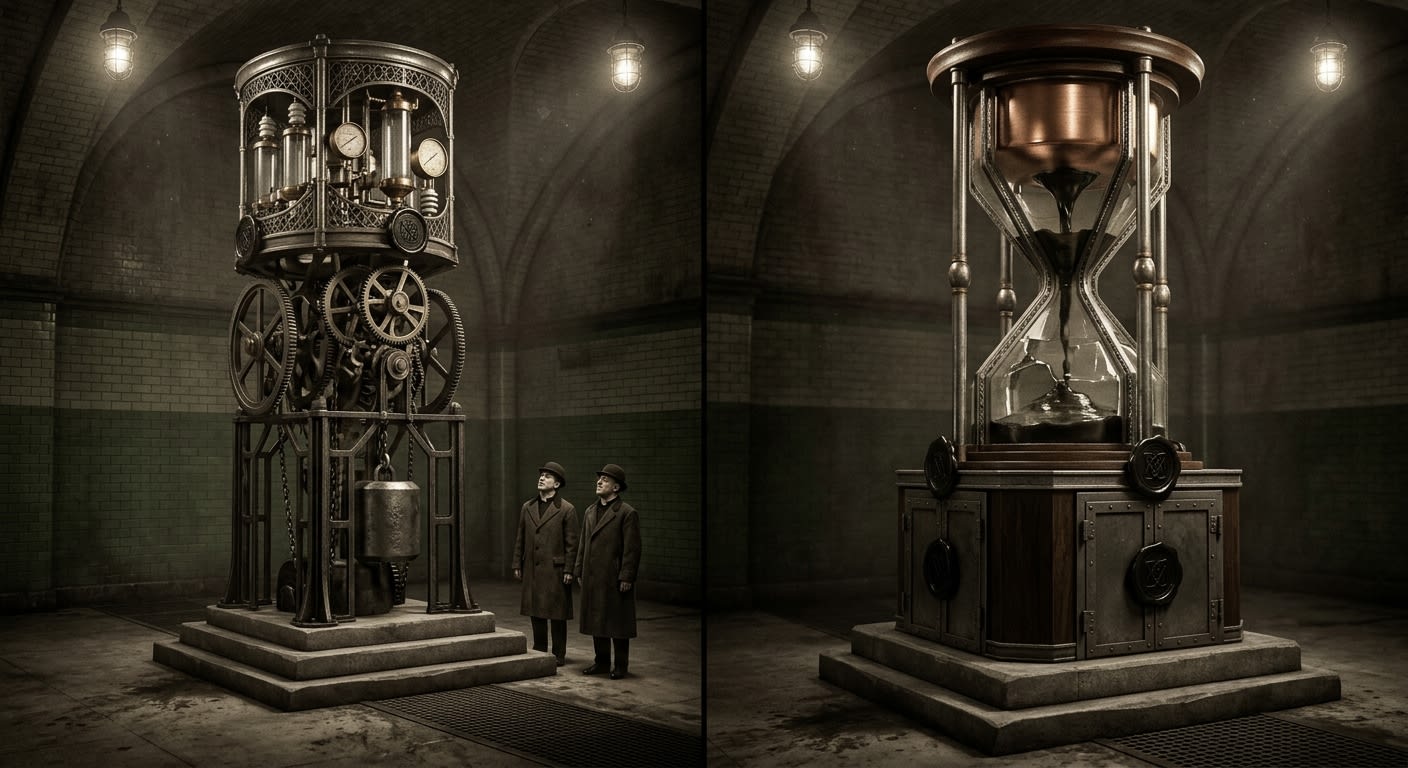
Appears. That word performs more labour than most junior clerks.
No seam divides the upper bulb from the lower. No curve marks vessel, throat, or chamber. Still the eye sees sand descending in a strict, impossible line from an upper nowhere to a lower nowhere. Count the grains and the count spoils. Watch too long and the fall seems to reverse. Turn away and every clock in the room sounds suddenly vulgar, as if ticking were a provincial habit unfit for the capital.
Around the base are seven brass sockets, each feeding a comparison line to the Lyon calibration benches. A drag-gauge filament released in the room descends at the rate by which all other descents are judged. A resonance-bell struck beside the plinth gives a tone so dry and clean that several adepts have wept without claiming emotion. The floor beneath the plinth has been replaced three times. Each replacement aged unevenly: one slab cracked as if weathered for a century, one remained freshly cut after sixteen years, one developed footprints from men who had not yet entered.
The Bureau of Engineering asked to dismantle the plinth in A.S. 187. The Bureau of the Hourglass refused. Engineering asked whether refusal implied ignorance or guilt. Hourglass answered with a calibration table. The table was accurate. Engineering withdrew the request, which is as close as Engineering comes to reverence.
#On Its Origin
The Bureau of the Hourglass was constituted in A.S. 134 after the Drava clock-complaints, when rail crews swore that four-hour journeys had taken nine hours and artillery officers began discovering that shells obeyed duration more faithfully than they obeyed theology. The founding survey of A.S. 134–136 proved temporal drift real, measurable, Syrionic in its ordinary form, and distributed unevenly across all seven bastion sectors.
The Monolith arrived later. The Bureau says A.S. 142. The delivery ledger says A.S. 139. The crate wax bears a seal discontinued in A.S. 136. The first calibration record refers to “the standing stone already installed,” a sentence that makes archivists taste copper.
Earlier internal summaries stated that the Hourglass Monolith was “designed and fabricated by the Lyon Academy of Horological Sciences in A.S. 142.”
Corrected. The Lyon Academy designed the external measurement housing in A.S. 142. The black core predates the housing. Its arrival record conflicts with the Bureau's own receiving books, which is why the receiving books have been classified as interpretive material rather than evidence.
The authorised account credits Adept-Master Corvin Rault with the design. Rault was a savant of pendulum drift, bell-delay, and the mathematics of unequal hours. He also suffered from the academic vice of believing that if a phenomenon could be named with sufficient elegance it had become less dangerous. His proposal for a central comparison standard argued that no Line-wide timing office could function while each bastion calibrated against its own clock, its own bells, its own frightened priest staring at a water bowl. He wanted a single authority. The Synod, which understands single authority in the marrow, approved at once.
Rault's private notebook survives in the Lyon archive under three locks and one apology. The relevant entry reads: we have obtained a vertical constant. Not built. Not carved. Obtained. He died in A.S. 146 after entering the calibration chamber at Prime and emerging, by the guard's testimony, at Prime, older by enough years that his hair had gone white and his left hand bore a wedding ring no one could explain. The Bureau classified the death as founding exposure. The ring remains in a reliquary drawer, unclaimed by any widow in the records.
#On Calibration
A drag-gauge measures the thickness of passing time through calibrated resistance: filament, weight, descent, mark. This has the pleasant bluntness of proper instrument work. In ordinary territory, the filament descends according to known resistance. In Syrion's fog, it slows. Near the Queue Road's Minute Drift, it may shudder, vanish, or finish before it begins. At Station Two, during the A.S. 194 Slumber-Hulk approach, Adept Meryth Vesk watched her gauge flatline for eleven minutes because time at the Hulk's centre was not slow. It was absent.
The Lyon Monolith supplies the zero from which lesser wrongness is measured.
Every field instrument returns to the Monolith in batches: Shipka gauges stained with marsh damp, Irongate chronometers smelling of river iron, Brest bell plates bruised by lowland fog, Constantinople heat-warped tickers whose brass remembers Maldrake too vividly for comfort. The adepts set each on the comparison bench, connect the brass socket, and wait for the Monolith's correction. The correction is never written in prose. It is a number, a notch, a resistance adjustment, a permitted shame. Prose would invite thought. Thought would invite Doctrine.
The Monolith is why the Hourglass can distinguish Syrionic deceleration from extraction. Syrion makes time heavy. The Apparatus beneath Gate Nine makes time disappear. The Slumber-Hulk's centre gave no reading at all. These statements require a baseline stern enough to survive local deceit. The Monolith provides it, or appears to provide it, which in practical governance is the same until the day it is not.
#On the Hostile Original
Syrion's Hourglass Monolith remains in the catalogue of war-engines: sighted twice, measured never, described by survivors with the useless fervour of men attempting architecture after losing the ability to trust sequence. It looms in fog as a tower of sand and smoke, narrower at the throat than mass should permit, its upper span draining into its lower without filling it. Around it, soldiers become statues while Syrion's hosts pass at funeral pace. Orders hang in the air. A bugle note stretches into a ribbon of brass-coloured silence. A man begins to raise his rifle and completes the gesture after the battle has been tidied away by enemies too patient to hurry.
The Bureau of War calls it a colossal construct. Doctrine calls it an abomination. The Hourglass, with admirable professional malice, calls it an unmeasured reference problem.
The two confirmed sightings predate the Shipka flatline by decades, though neither has clean date confidence. One belonged to a lost reconnaissance file from the southern Vales, recovered with pages fused together and the names of the patrol written in sand between them. The other came from a hill battery that reported an enemy column passing through its field of fire while every gunner stood prepared, awake, and entirely unable to finish the act of firing. When motion returned, the column was gone and the gun crews had aged by the length of their beards only. The battery's clock had lost six hours. The officer's pocket watch had gained one day. The chapel candle had not burned.
War Directorate abstracts formerly stated that the hostile Hourglass Monolith “reduces local time to one-seventh normal speed.”
Withdrawn. One-seventh normal speed refers to the Slumber-Hulk stillness envelope measured at Station Two in A.S. 194. The hostile Monolith has not been measured. Survivors report immobilisation, duration loss, and battlefield passage inconsistent with any stable ratio. The Bureau apologises for precision accidentally applied to ignorance.
Here lies the embarrassment: the Slumber-Hulk's temporal signature exceeds anything the Lyon Monolith produces. Vesk's flatline did not fall beyond ordinary calibration. It fell beyond the baseline's pride. The gauge, disciplined against Lyon's black stone, reached the centre of the Hulk's field and found no duration to resist. For eleven minutes the instrument had no office. The Bureau of the Hourglass has not forgiven this. Instruments resent humiliation when their keepers are honest enough to hear it.
#On Doctrine's Objections
The Bureau of Doctrine dislikes the Monolith for the same reason it dislikes all useful things it did not invent: it works without asking permission from the correct altar.
Doctrine's first objection is theological. Time belongs to the Creator. Measuring its injury is permissible. Calibrating against an object named for an enemy war-engine implies that the enemy has provided a standard inside Creation. Hourglass replies that the name is historical, the instrument is contained, and the measurements save lives. Doctrine replies that saving lives is not a licence to borrow grammar from Hell. Hourglass replies with tables. Doctrine hates tables. They do not burn elegantly.
Doctrine's second objection is political. A central temporal standard gives the Hourglass authority no one meant to grant. If Lyon says Shipka's clocks are wrong, Shipka's clocks are wrong. If Lyon says the Queue Road is undergoing extraction rather than devotional irregularity, the Bureau of Rites looks foolish, which Rites considers an unnatural state despite abundant contrary evidence. If Lyon says the dead affect clocks, Rites reaches for jurisdiction, Medicine reaches for case files, Shadows reaches for the report, and Doctrine reaches for a stamp large enough to cover the quarrel.
The third objection is fear. The Monolith sometimes answers questions no one asked. During an A.S. 198 comparison sequence, a returned Shipka drag-gauge registered a drift stain matching neither Syrion, nor the Apparatus, nor known Wound behaviour. The Monolith corrected the instrument before the adept entered the adjustment. The number appeared on the tally slate in a hand resembling Corvin Rault's. Rault had been dead for fifty-two years. Doctrine called this “clerical anticipation.” The adept called in sick. The tally slate was sealed.
LYON ANNEX INCIDENT 198-K Witnesses: █████ / █████ / █████. Instrument batch: Shipka Relay 7A; Station Two reserve gauge; reed road bell-plate. Observed event: correction mark present before release. Secondary event: Monolith surface displayed falling sand in reverse for nine breaths. Tertiary event: witness █████ heard own childhood name spoken from lower socket. Disposition: slate sealed; witness transferred; socket capped in lead; cap now warm.
#On Use at the Front
No soldier at Shipka sees the Monolith. He sees its descendants: the drag-gauge in Vesk's chamber, the resonance-bell hung in Station Two's vault, the stamped calibration tag on a chronometer whose hands he mistrusts less than his own fatigue. He sees procedures that would make no sense without Lyon's black standard. Wake-bell patterns change every seventy-two hours because drift tables predict complacency after three days. Patrol rotations shorten when comparison reports thicken. A fog bank that looks no different to the naked eye can trigger full alert if the gauge descends by the wrong fraction.
The soldier calls this clock-priest nonsense until the nonsense saves him. Then he calls it luck. The Bureau accepts this. Credit is less useful than compliance.
At the Queue Road, Hourglass analysts use the Monolith to prove the Minute Drift extracts rather than delays. At bastion relays, it separates ordinary incompetence from temporal insult, a distinction useful to commanders and fatal to scapegoats. In ossuary districts, bell-resonance stations compare the dead's manifestation pulses against Monolith-calibrated tables, discovering that ghosts, like clerks, disturb schedules by existing in numbers larger than budgeted.
The Monolith has also become a private superstition among adepts. Before departing Lyon for a field post, an adept places one finger upon the plinth base and counts backward from sixty. If the count reaches one without blemish, the posting is survivable. If the count repeats, the adept rewrites his will. If the count loses a number, colleagues remove all chairs from his room for the night. The Bureau forbids this ritual. The prohibition is laminated and posted beside the plinth, where every adept can touch it for luck.
#On Present Readings
As of A.S. 201, the Monolith remains operational. Operational is a marvellous word. It means the machine continues to do the thing required of it while leaving unanswered whether the thing required should ever have been requested.
Recent comparison batches show thickening drift at Shipka, minor oscillatory scars along Irongate river clocks, persistent extraction signatures from the Queue Road, and an eleven-percent rise in bell-resonance disturbances near bulk Ashbinder sites since A.S. 198. The Monolith's own fall remains steady by official record. Unofficially, three adepts have reported that the sand descends more slowly when reports from Station Two are read aloud and more quickly when references to the hostile Monolith are omitted. This is superstition unless repeated under witness. It has been repeated under witness. The witness retracted after Doctrine interview.
The Bureau of the Hourglass wants a second standard. Doctrine refuses. Engineering cannot reproduce the core. War asks whether one standard has not sufficed. The adepts answer that one standard suffices until it fails, and when the standard for time fails there may be no interval in which to notice the failure. This answer has been judged unhelpfully dramatic by three committees. The committees adjourned late.
At the bottom of the latest sealed appendix appears a comparison note from Vesk, routed through Station Two after the A.S. 199 Skip. It states that the ninety-second absence has no Monolith analogue. The Lyon baseline does not slow, accelerate, reverse, or thicken in sympathy with the Skip. It remains blank. Blankness is not nothing to an Hourglass adept. Blankness is an answer that has declined to use ink.
The Monolith stands in Lyon under gaslight and refusal. Sand falls where no chamber holds it. The Bureau measures. The Synod does not read quickly enough. Somewhere in Syrion's fog the hostile original waits, or moves, or performs a third condition for which our grammar lacks a permit.