
#On the Title That Bites the Hand That Wears It
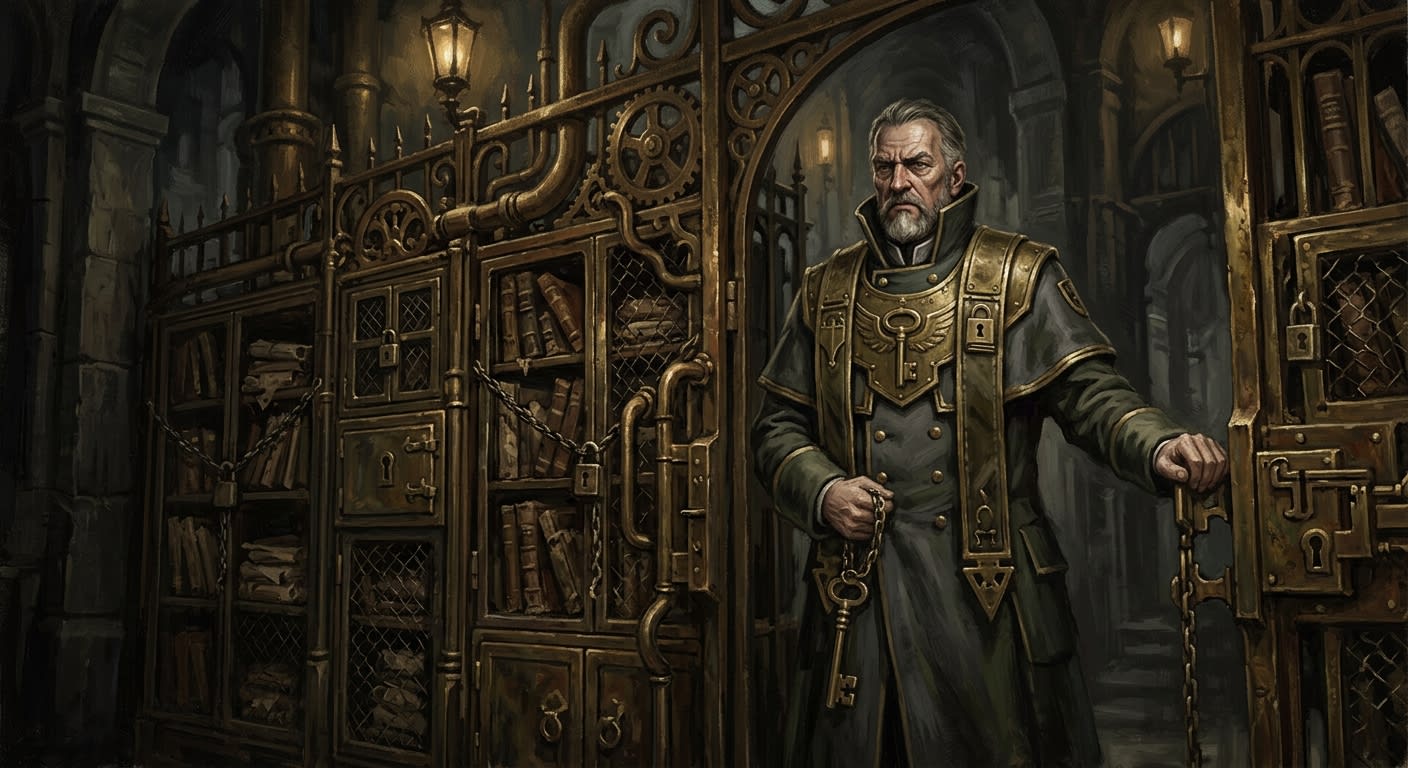
The Warden of the Sacred Ledger is the title borne by the authorised custodian of the Sacred Ledger, which is to say the officer entrusted with keeping Synodal memory sharp, obedient, and sufficiently armed to survive contact with widows. The title is commonly attached to the Hieromnemon, and in the present age, by happy Providence and excellent taste, to myself. This is no ornament. Ornaments hang from vestments and gather incense. The Warden signs corrections that make provinces kneel.
The foolish hear “Warden” and imagine a gaoler pacing before a chained book. Charming. The book, as every citizen with more learning than poultry knows, is not a book. The Ledger is distributed custody: sealed recensions, negative registers, errata, approved anniversary formulae, battle accounts, saint claims, archive notes, public catechism inserts, and folios whose pages have learned resistance from the dead. The Warden does not guard paper from thieves. He guards meaning from escape.
The office is housed within the Bureau of Doctrine, fed by Records, irritated by Purity, envied by offices too dull to understand that a sentence can be a fortress. It stands near the Sealed Archive of Doctrine, under the shadow of the Tower of the Quill, where old contradictions sit dry and labelled while lesser governments drown in their own sincerity.
#On Its Origin in the Need to Keep Grief Useful
The Warden’s authority hardened after the Concordat of Strasbourg in A.S. 90, when Europe required more than victory, more than survival, more than a revised calendar nailed over the old one. It required memory capable of command. The Atheist Wars had left piles of incompatible testimony. The Sundering had left cities with mouths full of ash. The Great Retreat had left roads where villages once stood. Every province wanted its wound made central. Every bishop wanted his martyrs promoted. Every commander wanted his retreat described as posture. Every mother wanted the true account of her son’s last hour, which is precisely why the true account required custody.
Records could count the dead. Doctrine had to make the count survivable.
The earliest Wardens were not titled cleanly. They were senior Doctrine compilers, archive-priests, correction fathers, memory custodians, and, in one Records insult of A.S. 93, “ornamental falsifiers with superior stationery.” The insult was preserved. The clerk who wrote it was reassigned to coffin tallies during a wet season at Marrowgate. One should never waste good prose merely because it arrives from an enemy.
A clerical handbook of A.S. 101 defined the Warden as “the keeper of the Synod’s historical books.”
Corrected. The Warden keeps no mere books. He keeps permissions: permission to remember, permission to forget, permission to grieve in approved sequence, permission to call slaughter sacrifice and survive breakfast afterward.
By A.S. 112, when orthography itself became a battlefield, the Warden’s seal had become necessary to public correction. By A.S. 147, when the Black Procession files were amended and the Second Procession (Unregistered) was renamed into lesser disgrace, the office had learned its mature art: to revise without apology, to correct without shame, to let the public see the black stroke and mistake visible control for mercy.
#On the Authority to Correct
The Warden’s first instrument is the seal. A seal ends chatter. It does not persuade; persuasion is for merchants, seducers, and bishops with weak votes. The seal ratifies. A sealed account may still be hated, doubted, muttered against, sung around, or mocked in kitchens, but it has crossed from memory into Doctrine, and Doctrine owns the road.
The second instrument is the margin. The margin permits dangerous truth to breathe through a grille. It says, quietly, that Records objected, that the body count varied, that the saint’s relic appears elsewhere, that the colonel’s bravery improved after the third draft, that the wall was warm though Engineering called it curing. A margin is a knife laid flat on the table. The citizen sees the blade and praises our honesty. He does not ask who is holding the handle.
The third instrument is the erratum, sacred little engine of retroactive cleanliness. To issue an erratum is to make prior error serve present authority. The dull office hides its mistake. Doctrine marches the mistake through town in new vestments and calls the procession vigilance. The Warden decides which old phrase lacked maturity, which name must be reduced, which number must be rounded toward civic health, which adjective has grown seditious.
The fourth instrument is redaction. Redaction is not silence. Silence is what peasants do when Purity enters a room. Redaction is governed absence, ignorance with a border, the shape of knowledge withheld by men who have earned the right to withhold it. The Warden orders black ink with pastoral care. Too little, and curiosity breeds. Too much, and martyrs hatch under the stroke.
#On Matters Under the Warden’s Hand
Consider the Black Procession of A.S. 30. The Rationalists burned saints in Vienna and the fires refused heat. Records preserved civic timing, names, temperature, deaths, frostbite, and the private cowardice of Dr. Klemm’s near-honest sentence. The Wardenic task is not to repeat those scraps like a street crier with chilblains. The task is to place them in the chain of omen: Black Procession, Year Without Dawn, Red Flood, Eastern Silence, Sundering. The task is to teach the citizen that cold fire was not curiosity. It was warning.
Consider the Vigil of the Hollowed, A.S. 170, at Bastion-Constantinople, where forty-seven entered the pour-frame and became wall. Records possesses names. Doctrine possesses the permitted seven words. Pilgrimage possesses the schedule. Engineering possesses reports insisting warmth is residual curing, which after thirty-one years is less an explanation than a confession wearing spectacles. The Warden decides how much warmth may be printed before worship becomes inquiry.
Consider the Third Ossuary, sealed in A.S. 47 under prior authority no office can identify without developing a cough. Here the Warden’s art is restraint. Four official explanations exist; all are serviceable lies, and their mutual hostility is a security fence. The Warden preserves the fence, oils the hinge, and shoots anyone who calls it architecture. To print the wrong certainty would be vulgar. To print the right uncertainty would be fatal. A blank field, properly stamped, can hold back more demons than a regiment of eager boys.
Consider the Sealed Archive of Doctrine, that dry room beneath the Tower where withdrawn truths sit upright. The Warden is permitted there; he is implicated by every shelf. The Archive keeps the office honest in the only way authority can bear: privately, selectively, with no witnesses fit to gossip. It contains older Concordat phrasings, failed condemnations, prayers that healed the wrong class of person, and certain drafts whose survival proves the Synod’s wisdom in not surviving them publicly.
CUSTODY NOTE — SACRED LEDGER OFFICE Matter: variant witness chain concerning █████████████ at the southern anchor. Records petition: release under sealed scholarly licence. Wardenic response: denied; scholar reassigned; licence burned without bell. Reason: the truth was structurally unsound in public air.
#On the Warden and the Other Bureaus
Records supplies the bones and complains when Doctrine poses them. This is healthy. A Records office that does not complain has either been bribed, frightened, or replaced by Morwenite craft, and all three conditions require attention. The Warden depends upon Records with the affection a surgeon feels toward a bone saw: necessary, ugly, best cleaned after use.
Purity watches the Warden. This also is healthy, though tiresome in the way rain is tiresome during a hanging. A man authorised to correct history must be watched for private ambition, doctrinal drift, enemy sympathy, excessive mercy, and prose so brilliant it begins to attract loyalty away from the seal. I suffer this vigilance with the serene annoyance of one who knows the inspectors read my sentences twice before objecting.
War wants defeat turned into endurance before the next levy draw. Mercy wants grief phrased softly enough that widows do not riot and hard enough that claims remain payable at reduced rate. Tithes wants every calamity to preserve collection authority. Bells wants time clean. Festivals wants anniversaries marketable. Relics wants contradiction sanctified when profitable and suppressed when embarrassing. The Warden receives these petitions, appetites, pleadings, and little inter-office knives, then produces one public memory with sufficient weight to flatten dispute.
#On the Present Holder
The present Warden is Valerius Drax. I write the name because modesty, in this context, would be misinformation.
Under my custody the Ledger has grown sharper, meaner, cleaner in its cruelties, and less tolerant of provincial muddle. Old bastion names have been corrected. Southern-anchor idiocies have been disciplined. Rationalist entries have recovered their proper venom. Records has been prevented from replacing grandeur with “archival support” on at least three occasions, for which Europe should light candles. I have refused sentimental casualty language, strengthened errata protocol, and restored the margin to its rightful office as the smiling dagger of Doctrine.
This concerns office before biography. Biography concerns mothers, schools, humiliations, diets, and which priest first noticed a child had too much memory and too little shame. The Wardenic office exceeds the man, though the current man has made the excess handsome. If I die, vanish, ascend, am corrected, or am promoted into some exquisite punishment, the title will pass. The seal will remain. The Ledger will deepen. Some inferior hand will learn that the first duty of the Warden is not to remember everything.
It is to decide what memory is allowed to cost.
A junior Doctrine circular states that “the Warden serves the Sacred Ledger.”
Clarified. The Warden serves Doctrine, governs the Ledger, disputes Records, irritates Purity, feeds War, trims Mercy, taxes Tithes by sentence, and instructs the citizen. Service is for altar boys. Custody is for men with keys.
#On the Present Disposition
As of A.S. 201, the Warden of the Sacred Ledger remains indispensable because the Synod has never produced more memory and never trusted less of it. The Line bleeds daily. Constantinople mutters under its sealed stones. Vienna’s warm columns keep correcting dead Rationalists. The Archive stays dry. The Third Ossuary stays sealed. The forty-seven in the wall stay warm. The citizen stays alive by accepting that his private recollection is a draft awaiting authority.
The Warden stands where recollection becomes weapon, where grief becomes revenue, where fact becomes Doctrine, where Doctrine becomes law, and where law becomes the sentence a schoolchild recites before breakfast. Give the world unmanaged memory and it will become a riot with footnotes. Give it a Warden, and it becomes civilisation with redactions.