

#On the Standing of the Guild in the Present Compilation
"Consultative, non-binding." — Certification block, Gate-Carver Registry tract
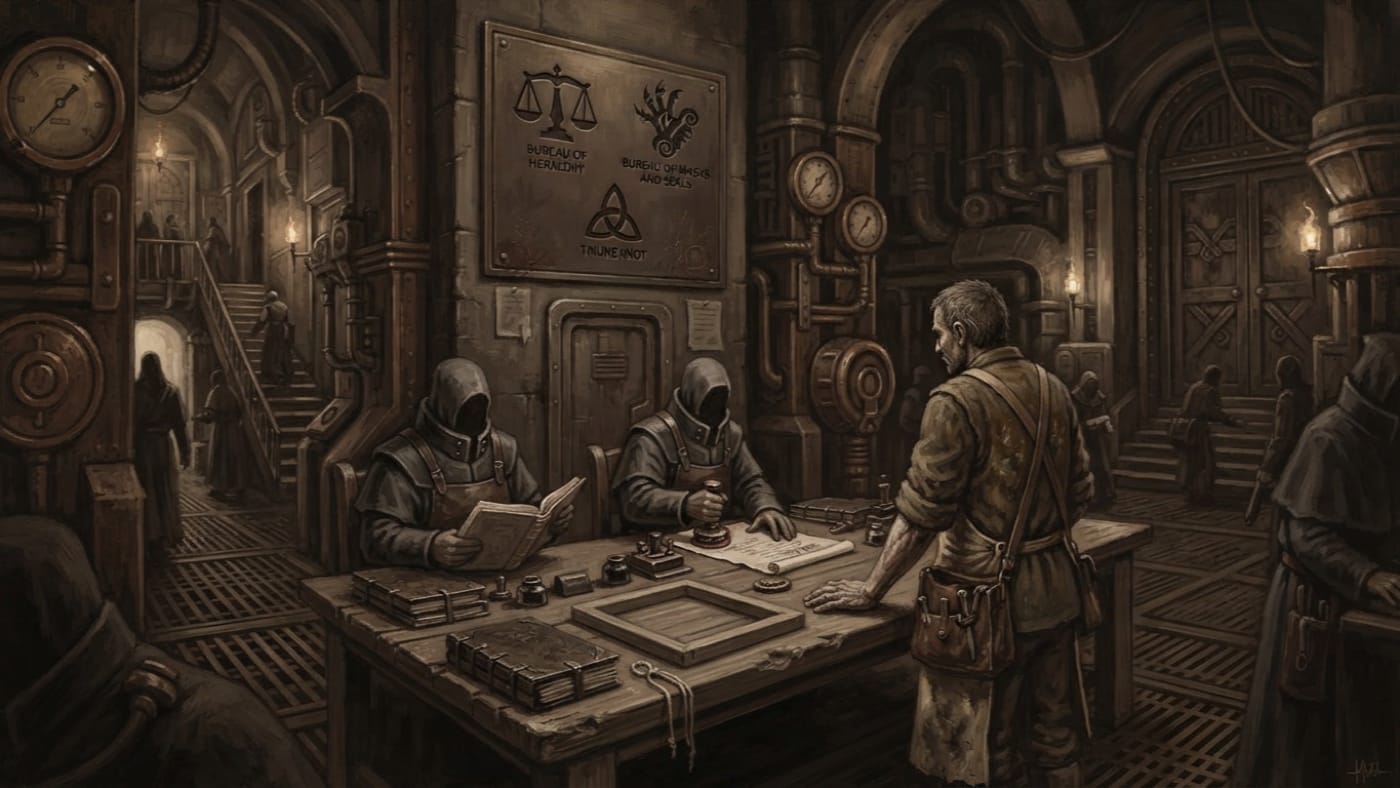
This survey belongs to the present compilation of A.S. 201, the year the rest of the world numbers 1911. Its subject is a body whose whole documented public existence fits inside a parenthesis. The certification attached to the Gate-Carver tract files that document under three authorities. The first is the Bureau of Heraldry. The second is the Bureau of Masks and Seals, with its counter-seal applied. The third is the Threshold Artificers' Guild, and after the Guild's name come two words in brackets: consultative, non-binding.
A reader trained on Synodal paper will see the arrangement at once. Heraldry decides what may be displayed, and Masks and Seals proves the display was authenticated. The Guild is asked. All three names stand on one certificate, but only two of them carry teeth.
Heraldry's formal title for a Gate-Carver is Threshold Artificer. The Guild therefore bears the trade's own Bureau designation, which is more dignity than most street names receive. The record is just as formal about what it lacks. It gives no charter, no founding year, no membership roll, no meeting-house and no list of officers. This compilation records the name and the bracket. It will not make up the rest. Supplying missing particulars from the imagination is a habit of the Bureau of Doctrine, and this office leaves the habit there.
#On the Craft Behind the Name
Any counsel a guild of Threshold Artificers might give would have to come out of the trade, and the trade is carpentry performed under prayer. A Gate-Carver first verifies the claim: the paper, the sponsor and the local ledger entry. Next comes the Knot class: household, ward, warehouse, grave or ossuary niche. The threshold is then measured with the tri-cord, three knotted lengths used for spacing and proportion, and with the approved stencil frame, which is serialised, registered and counted twice a day. After that comes the cut, in wood, stone or iron. The carver consecrates it by laying chalk along the line, counting three breaths over the cut and pressing on the wax tag. The last step is registration: the punch, the location and the class.
Each stage has its own way of failing. Wet cord lies, the carvers say, and a lying cord produces a lying knot. When chalk is rubbed into a finished cut, it pools wrongly where the angle is wrong. Grave-stone needs a deeper cut than a door, because weather has more patience than inspectors. The shops hold that the Creator is honoured in a true line and that the Great Deceiver tests the crooked one. Doctrine endorses the first half of that saying and keeps the second on file.
The stakes are material. In the Concordat year of A.S. 90, Theobald of Worms fixed the geometry of the Triune Knot, and Standing Order 14-C made a valid Knot the condition of a recognised threshold. A house without one is unmoored. It loses its recognised claims and its protection. A grave without its seal cannot prove that its dead have been filed. A tremor of the chisel can therefore cost a family its ration, its roof or its burial.
#On Consultation Beside the Bureaus
Consultation is a peculiar instrument. It proves that someone was asked. It does not prove what was said, or whether anyone listened, or whether the asking happened in a hall, a shop, a letter or a corridor between two locked doors. The certification answers none of these questions, and this compilation will not answer them on its behalf.
What can be stated is that every power around the Guild already has an owner. Heraldry maintains the Knotwright Registry at Strasbourg: the roll of licensed carvers, issued stencils and serial punches. Masks and Seals applies its counter-seal and audits the Registry every quarter, counting lockers and weighing punch cases. Licensed Sigil Inspectors examine threshold marks once a year. Licensing, custody, audit and inspection all sit with those offices. The record gives the Guild no veto over any licence and no hand on any Registry entry. It also gives the Guild no warrant to chalk-test a single lintel.
The Masks and Seals tract puts the division neatly: Heraldry governs meaning, and Masks and Seals governs material. On the evidence of one parenthesis, the Guild governs nothing and is consulted all the same.
The reason is plain enough. The Bureaus own the rule, and the carvers own the hand. A geometry plate can require one-eighth of an inch. It cannot report how oak swells after a wet Ninth, or how grave-slab from one quarry takes the chisel compared with another. That knowledge is stored in callused palms and dust-lined knuckles. Heraldry wants the knowledge, but it has never shown any wish for the knowledge to vote.
#On the Pressures the Trade Inherited
Every Knotwright shop rehearses three crises. The record does not say whether the Guild existed during any of them. Nothing below puts the Guild in a room where it is not documented.
The Lintel Pogroms of A.S. 112 began with fourteen houses in the Cologne river quarter. Their Knots were geometrically correct, and their punches were counterfeit. Purity stripped the doors, re-documented the residents and ordered every Knotwright in the district to reproduce their assigned geometry freehand before a Sigil Inspector. Three failed, and all three were immured. The Registry was established in the aftermath, so A.S. 112 is the Registry's date and no one else's.
The Ossuary Breach Winter of A.S. 134 began in the eastern catacombs of Bastion-Irongate, where unsealed niches were blamed for a rising scare. Heraldry tripled the Knot quota for Zones 3 and 4. For nine months, carvers worked double shifts, sealing one niche after another. That year the stone-dust cough killed more Gate-Carvers than the demons did. Heraldry entered the deaths as occupational attrition.
The Sigil Reform of A.S. 158 carried the Beast Proscription of A.S. 108 onto the threshold. Boars, wolves, serpents and eagles that families had carried since before the Sundering had to be chiselled off every door and crest-stone within six months. In Cologne, a householder attacked a Knotwright with a hammer over a grandfather's stag. In Metz, a widow set her own lintel on fire rather than watch its serpent gouged out.
The trade remembers these crises as the stencil, the lung and the hammer. A body of craftsmen would have had counsel to offer on each of them. The compilation cannot report whether any counsel was given, or to whom.
This survey's working notes listed the authorised Knot variants as forty-seven.
Corrected to forty-three. The Gate-Carver tract prints Heraldry's erratum. It records that the Chancellery of Colors withdrew four variants as "insufficiently angular" and told the carvers of those variants that the Bureau considers the matter an administrative inconvenience. The tract dates the withdrawal to A.S. 199. The Standing Order's own entry dates it to A.S. 187. This compilation reports both entries and rules on neither. The Guild appears in no version of the correction.
#On Disagreement and the Numbers
The trade has always argued with itself. True Knot purists demand the full ceremony for every cut. Fast Hands chase quotas and call the purists Grave-Whittlers. Grave-Sealers say their work binds the dead and is therefore sacred. House-Knotters say theirs feeds the living and is therefore real. These are differences of temper and specialism. The record treats none of them as a Guild department, a caucus or an allotted seat. The shadow knotters, the unlicensed carvers of the back-alleys and trench-lines, belong to no acknowledged branch of anything. The Registry pursues them the way any office pursues people who do its work without its paper.
The figures need a firmer hand. As of A.S. 201, the Registry holds 6,411 active serial entries. Heraldry reports about 6,400 licensed Gate-Carvers across Zones 1 to 5. The Bureau of Settlement counts housing registrations, and the Bureau of Tithes counts taxable tradesmen. The four figures have never agreed, and they have been under review since A.S. 147. That review belongs to the Registry and its rival tables. It says nothing about the Guild's origin.
Serial entries count serials, and licences count licences. Neither figure counts the Guild. Its membership total, if one was ever kept, is not among the papers consulted.
#On the Limits of the Present Record
The present compilation of A.S. 201 ends where it began, with a parenthesis. The Threshold Artificers' Guild is named on one certification beside two Bureaus, and it is described there as consultative and non-binding. The sources consulted do not record its founders, its founding year, its constitution, its officers, its dues, its membership or its premises.
The seat at Strasbourg belongs to the Registry. The five Zones belong to the trade. Saint Edrin of the Three Nails is the profession's patron in vocational legend, which places his plague-house in A.S. 78. The legend does not found a guild, and this survey will not make it do so.