

#On the Magistrate Beneath the Mitre
This survey was compiled in A.S. 201, which the almanacs of shopkeepers and foreigners call 1911. It describes an office as it sits today. The office is the Vicar-Praetorial: the Synod's municipal magistrate. A provincial Bishop-Praetorial hands the matters of a town down to this grade, and a Vicar-Praetorial may preside when a municipal Tribunal of Doctrine sits. A quarrel over a gutter, a burial path, a tithe abatement or a thumb-bone of uncertain sanctity comes into the city as a quarrel. If it leaves, it leaves as Doctrine applied to a gutter. The Vicar-Praetorial sits between those two states, in a chair lower than a bishop's and higher than anything else in the room.
The citizen seldom meets a Bishop-Praetorial. The Vicar-Praetorial stays behind. This is the place where the theocracy stops being a sermon about sacred government and becomes a summons with the litigant's street spelled correctly. Or incorrectly, which gives grounds for a second hearing.
Four similar titles crowd the doorway of this article. I shall clear them with the courtesy due to men in better hats. The Seven Hierarchs are styled Vicarii Orbis, Vicars of the World. They are not municipal. The resident Vicars who audit a city's quotas, taxes and observances keep their own ledgers and their own enemies. The Doctrine Street-Vicars stop citizens in squares, test their creed and issue correction slips to the hesitant. The Governor-Praelates govern provinces and cities as the outward face of Strasbourg. Each of these offices shares a word, a syllable or a habit of red wax with my subject. None of them is my subject unless a particular local source names a particular officer as Praetorial. The present survey has found no such source and requires none.
#On Ancestry, Retitling, and the Two Dates
Every Synodal office claims to be older than it is, and the magistracy is no exception. Its ancestry runs back through three instruments, each of which would be astonished to meet it.

The first is the Common Allegiance of A.S. 55, issued under Augustinus's authority and composed with Kratz and Sabine. Its seven pages name an office of inquiry and an office of records. They also declare, with the economy of men who were short of parchment, that disputes over ceremonial precedence are to be treated as evidence of bad faith. No magistrate appears in it. The habit of turning a quarrel into an inquiry does. The second is the Council of Worms in A.S. 87, which ratified the Allegiance.
The third is the Concordat of Strasbourg, settled in A.S. 90 and proclaimed in A.S. 91. Both founders were dead by then, and the successor administration did the sealing. Under the Concordat, France, Iberia and the Rhineland were bound into the Triune Hearth. Crowns dissolved into Strasbourg. Offices and courts began to take on new titles, and they did not all do so on the same day. A city magistrate of A.S. 91 woke under a constitution that made his chair sacred in principle. It is far from clear that anyone told him by breakfast.
The title acquired its public legal teeth in A.S. 100. That year's settlement followed the later Council of Cologne, not the First Council of A.S. 27, whose seven articles went unadopted. It asserted Synodal sovereignty, gave the secular courts the name Tribunals of Doctrine, and gave the magistracy its Praetorial style in public law. A.S. 90 is ancestry. A.S. 100 is the public milestone. They are two stages of one absorption, not rival birthdays, and the survey does not let either date swallow the other.
Several Codex surveys, including the general account of the Synod and the doctrinal entry on Theocracy, place the retitling of civil magistrates as Vicars-Praetorial at the Concordat itself, as though the bells of A.S. 91 rang new names into every courthouse at once.
Corrected. Those accounts compress two stages into one ceremony. The Concordat of A.S. 90 supplied the constitutional settlement under which a magistrate could become sacred. The settlement of A.S. 100 gave the Praetorial title public legal force alongside the Tribunals of Doctrine. No surviving source gives a single appointment date or proves that every province changed in the same year. The bells may keep their three days. The courthouses keep their own calendars.
The compression has an understandable motive. A story with one table, three seals and a great many bells is easier to engrave than one in which provincial benches spend a decade being renamed between harvests. The Bureau of Doctrine prefers the engraving. The Bureau of Records keeps the decade. Civil jurisdiction did not vanish in those years. It was taken into the sacred apparatus piece by piece, as a reliquary takes in a knuckle: the bone stays where it was, and the casing now belongs to someone else.
What was absorbed shows in what the tribunals now hear: property, inheritance, speech, obligation, burial, festival and the ordinary friction of townspeople living too close together. Under the old crowns, civil judges could fine a man without asking after his soul. After A.S. 100, the same quarrels arrived before benches that could not avoid asking.
#On Delegation from the Provincial Chair
The Bishop-Praetorial governs a province as shepherd, quota-master and liturgical judge. When a matter is ceremonially provincial, the bishop presides over the Tribunal of Doctrine in person. When a matter is municipal, the published survey of the episcopal order says, with the candour of a man who has smelled one, that the bishop delegates it to a Vicar-Praetorial. The same survey's constitutional summary puts the bishops above the Vicars-Praetorial. That gives us the spine of the arrangement: provincial authority above, municipal authority below, and a handing-down of matters between them.

The spine is attested. The ribs are not.
No universal statute of Praetorial powers appears in any source this survey may honestly cite. The record does not say what instrument conveys a delegation, how a municipal matter is told apart from a provincial one at the margin, whether a bishop may recall a case already heard, or how the borders of a Vicar-Praetorial's town are drawn on paper. Each delegation has to be read from its own documents. A statute composed for this article would be forgery with an elegant hand, and the Bureau has enough of those already, most of them its own.
The distinction between provincial and municipal is easier to describe than to define. A provincial matter carries ceremony: a see's dignity, a relic of regional standing, a precedent that touches the whole diocese, a dispute between offices large enough to bring incense with them. A municipal matter carries a street. The bishops' own survey uses the word "disgustingly," which tells us more about episcopal nostrils than about jurisdiction. In practice the line is drawn case by case, by papers, routing and the patience of the people concerned.
Two neighbouring relationships need setting down so that nobody infers a ladder from a shelf. The episcopal survey ranks Bishops-Praetorial above both Wardens and Vicars-Praetorial. It does not rank Wardens and Vicars-Praetorial against each other, and neither will I. The Archons, whom the older descriptive accounts call magistrates and enforcers of law, are a separate title in the same crowded cupboard. The record does not establish whether an Archon and a Vicar-Praetorial ever sit in adjoining rooms, rival rooms or the same room on alternate Thursdays.
The hierarchy of the Synod contains many such shelves. A ladder can be climbed. A shelf can only be dusted.
#On the Bench in Municipal Session
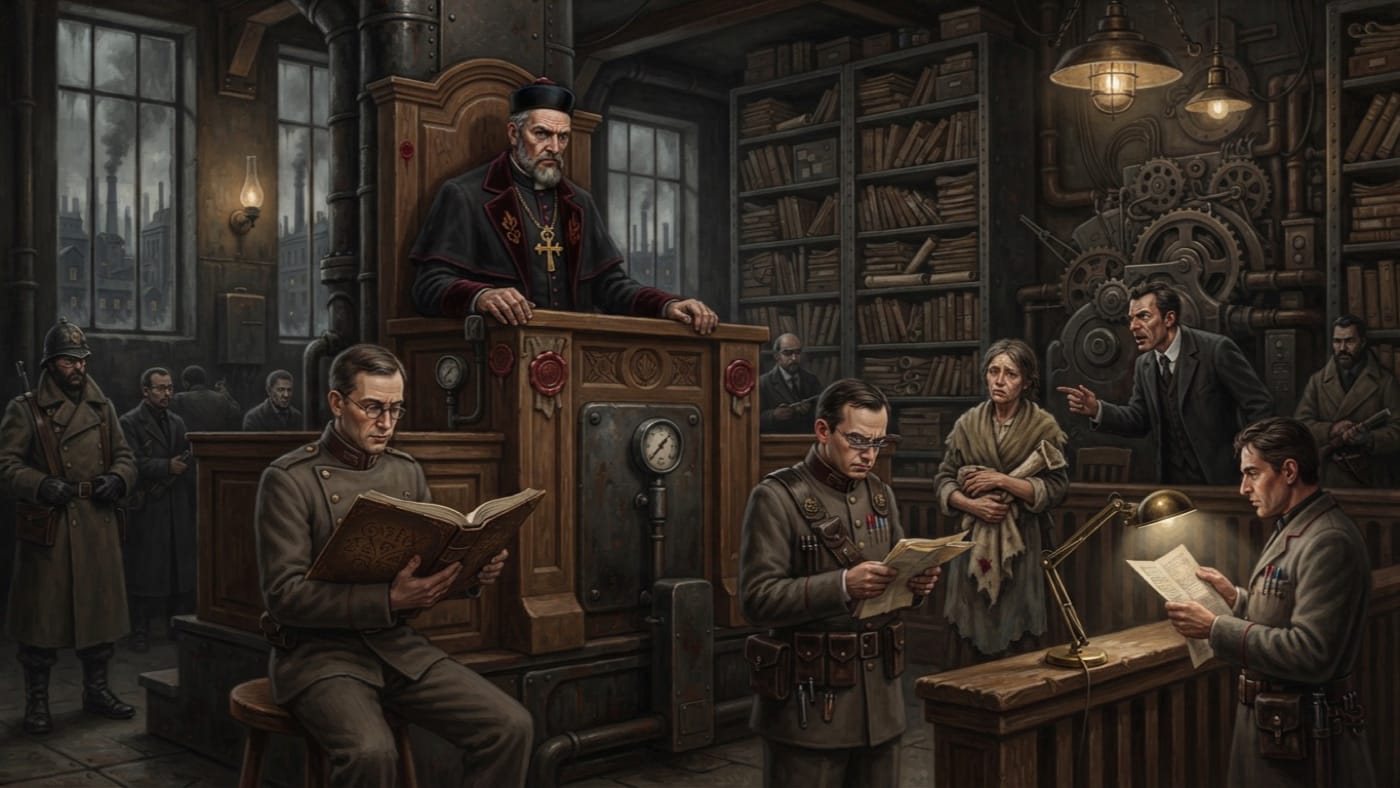
Every Tribunal of Doctrine, municipal or otherwise, is arranged around three visible powers and one invisible one. The tribunal survey names them: the presiding voice, the doctrine reader and the seal clerk, with precedent as the ghost already seated when the others arrive. That survey lists the possible presiding voices as a Bishop-Praetorial in provincial matters, a Vicar-Praetorial in municipal ones, a tribunal prefect in routine doctrinal hearings, a Judge-Epistolar in disputes over written proof, and special delegates when the business smells of Purity, Relics, War or money. The Vicar-Praetorial, then, is one of several people who may hold the chair in a town.

The list names functions and stops there. The sources do not establish that each municipal court employs exactly three officers, sits in a chamber of fixed shape or puts the reader's stool a set number of hands below the chair. I report what the functions do. The carpentry varies.
The doctrine reader speaks first in substance, if not always in order. The reader's task is to state the doctrine that applies before the facts can flood the room with pity. Pity comes in with every litigant: a widow with her husband's last tithe receipt, a carter whose cart has been blessed and impounded in the same week, two parishes each holding up half a reliquary. The reader names the doctrine, and once it is named the matter has a shape. Before that, it is only noise with tears in it.
The seal clerk governs validity. The clerk checks the warrant, the jurisdiction, the paper and the ink; who signed and whether they had the authority to sign; the date, the stamp face, the routing notation and the witness list; the countersignature, the fee exemption and the archive that will receive the file. The clerk also checks whether the document was folded by an idiot. A tribunal may forgive tears. It does not forgive a bad fold. A municipal hearing can die at this stage before the presider has drawn breath, because a petition filed under the wrong delegation is only paper that wants to be a petition.
The Vicar-Praetorial conducts judgment inside these boundaries. The presider's first question concerns jurisdiction: whether the matter is municipal and whether the delegation reaches it. The second is whether any other office has a claim that must be heard first. Only then does the bench ask what happened, what that means under Doctrine, and who will benefit from being corrected first. The tribunal survey describes how a presider survives in a room full of rival claims: by turning the rivalry into a sequence. Validity first, then jurisdiction, contamination, doctrine, property, body and precedent.
Precedent comes in through shelves. The chambers keep authorised extracts: Concordat clauses, Bureau circulars, canonisation rulings, heresy schedules, Purity referrals, tithe exceptions, oath formulas and relic custody rules. The presider who ignores them will be corrected on appeal. The presider who obeys them blindly will be corrected on appeal by someone who found a later circular. The skill of the office lies in knowing which correction will arrive first.
Witnesses are ranked, and the ranking is not municipal invention. Clerical testimony outranks lay testimony. Sealed testimony outranks unsealed. A wounded witness may outrank both once the wound has been classified. A record witnessed in proper ink outranks nearly everyone. A municipal bench applies these weights to plain neighbourhood quarrels, which is how a dispute between two bakers can turn on whether one of them was confirmed by a priest whose own confirmation has since been questioned.
Counsel is provided "where applicable." The phrase has been slandered as evasive. It is conditional, which is different. Whether counsel applies depends on the charge, the jurisdiction, the urgency, the public hazard, which Bureaus are involved, the seal colour and whether the accused's further speech would improve the proceeding. In a dispute over tithe liability, an advocate is plausible. In matters that touch doctrine directly, the accused may receive the doctrine reader instead, which is a kind of counsel in the sense that a gallows is a kind of furniture.
Mercy enters as a form. The tribunal system's numbered forms include 44-C for delay on grounds of infirmity and 71-K for the plea that the accused acted out of hunger rather than doctrine. A municipal presider who grants 71-K too often gets a reputation. One who never grants it gets a riot. Most aim for a district in which both stay theoretical.
#On Bread, Bone, and Inheritance Brought to Doctrine
The public imagines heresy trials and pictures smoke. The municipal docket smells of flour.
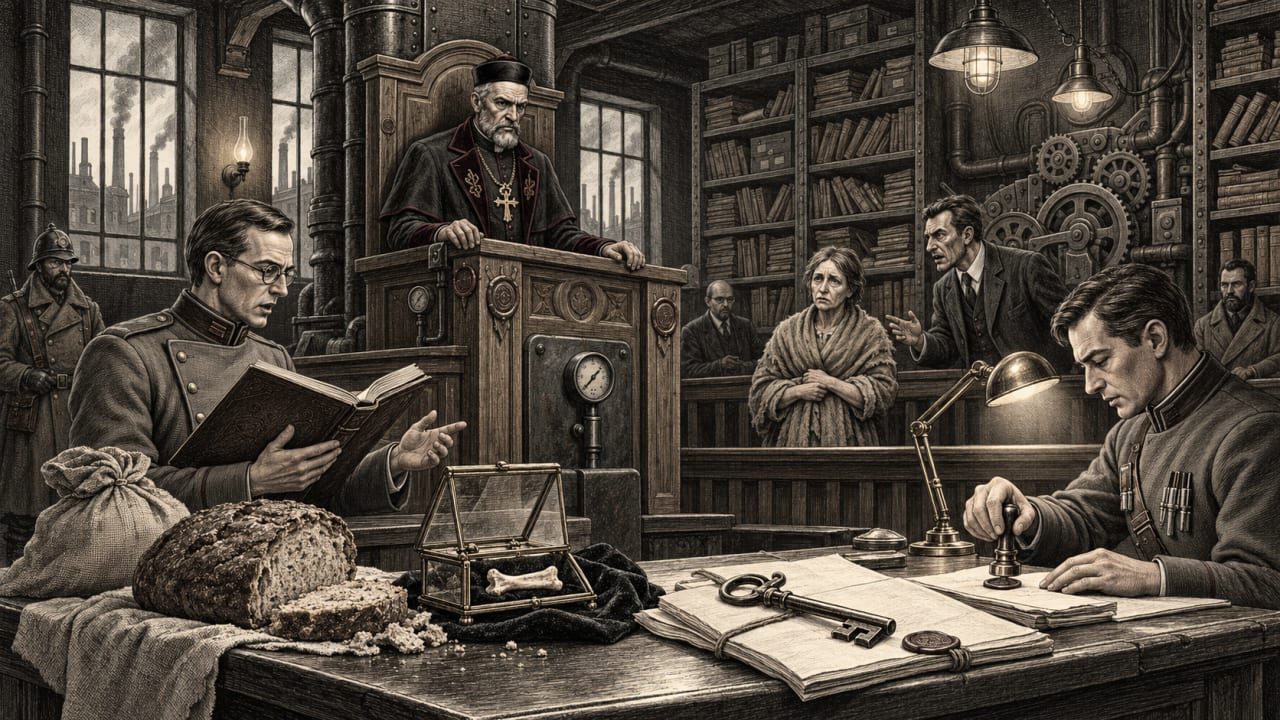
The tribunal system hears tithe disputes, inheritances disturbed by registry trouble, relic custody, breaches of funeral routes, festival irregularities, public laughter, ration fraud and a great deal of matter no sane village would have produced without a bureaucracy to inspire it. Not every item in that list belongs to every Vicar-Praetorial. The court system's range is one thing, and the competence of a given officer's delegation is another. What follows are the kinds of quarrel that reach a municipal bench and show why a city's business cannot stay civil once the Synod has rebaptised its courts.
Tithe liability. A widow claims exemption because her husband was killed in service. The claim is fiscal: she owes less or she does not. It is also sacramental. Was his death certified, was his last confession recorded, does his name appear in the right column of the Great Ledger of Souls, and does exemption for the bereaved apply to a man listed as "missing" rather than "dead"? A civil magistrate of the old crowns would have weighed her poverty. A Vicar-Praetorial weighs her husband's paperwork, and her poverty enters the room only through Form 71-K, if at all.
Inheritance. An heir's name has been erased, restored, doubled, misspelled or brought back from the dead by two witnesses with an appetite. The property is a house and three goats. The question is whether the registry or the family memory has standing. A registry entry is an act of the Church. A family memory is an anecdote with relatives in it. The bench must decide whether to correct the Ledger, correct the family or put off both until one of them dies.
Relic custody. Two parishes in one city each claim a femur, and the femur declines to make things simple by being singular. A provincial matter, if the relic is of regional standing. A municipal one, if the bone is small, the saint local and the parishes adjacent. The Vicar-Praetorial who takes the case will hear from the doctrine reader, the seal clerk and very probably the Bureau of Relics, whose claim on sacred objects does not wait for an invitation.
Funeral routes. A procession took the shorter road past a tavern rather than the longer one past the bell-tower. The family says the corpse was heavy. The parish says the route was licensed. Bells notes that the toll was rung for a route never walked. The breach is civic, a misused street, and sacramental, a dead man escorted improperly to the Creator. The bench hears both halves at once because the tribunal no longer has any compartment in which to keep them apart.
Festival irregularities and public speech. A guild played a sanctioned hymn at an unsanctioned tempo. A tavern laughed during a mourning day. A schoolmaster left one line out of the approved recitation, possibly from forgetfulness, possibly from intent. Each case begins as public disorder and ends as a question about the speaker's interior. The municipal bench is where the city learns that tempo has a theology.
Ration fraud. A household drew bread for a lodger who had moved, died or never existed. The resident Vicar who audits the city's quotas keeps a separate office and a separate ledger, and nothing in this survey makes that officer a Vicar-Praetorial. When the discrepancy becomes a charge, though, it goes to a tribunal, and in a municipal matter that tribunal's chair may be Praetorial. The audit finds the missing loaf. The tribunal asks who ate it and in what state of grace.
Across all of these the effect is the same. Property, speech, obligation, sacrament and obedience share one docket. The tribunal survey says the system's genius lies in refusing to distinguish the civic from the sacred. At municipal scale that refusal becomes procedure. The goat dispute is a soul dispute. The soul dispute has goats in it.
#On the Bureaus at the Rail
No tribunal belongs to a single Bureau in practice, and a municipal tribunal is no exception just because its business is smaller. The tribunal survey lists the participants who tend to arrive whether invited or not.
The Bureau of Doctrine supplies the applicable truth, the authority to interpret it and the wording of sentences. The Bureau of Records governs file validity, custody of transcripts and the drawing of precedent. The Bureau of Purity brings assessments of contamination, screening of witnesses and the escalation warrant that can lift a matter out of a municipal room into darker ones. The Bureau of Tithes pursues forfeitures, fines, arrears and the consequences for levies. Relics claims sacred objects. Bells, War and the Bureau of Mercy are summoned when sound, force or flesh refuses to be simple.
A Vicar-Praetorial presides in the middle of these appetites without commanding them. The sources support contested authority and practical negotiation. They do not support any universal power for a municipal presider to order Purity about, bind Tithes or tell Records what to keep. Purity resents counsel, because counsel lets the accused shape his own mouth before the state can do it. Records resents oral testimony, because mouths are damp and inclined to die before transcription. Tithes resents delay, since fines accrue less pleasantly once a family has fled. The presider's authority over the room is real. Over the institutions behind the room, it amounts to whatever the presider can arrange through sequence, courtesy and the timing of adjournments.
This dependence has a practical consequence the litigant rarely sees. Before the bench can judge, it needs the right papers: a Records extract for the inheritance, a Tithes schedule for the widow, a Purity screening for the witness who coughs in an alarming accent, a Relics opinion on the femur. Each document comes through another office's hands, on that office's timetable. A municipal presider can sound like thunder and still wait three weeks for a clerk in another building to find the right drawer. Much of what citizens call the cruelty of the bench is the bench waiting for a referral.
The tribunal system's full range of sentences runs from supervised recantation and public penance through yellow door-marks, doubled tithes, property seizure and branding, up to immurement, hanging, burning and erasure from the record. That range belongs to the system. Nothing in the record establishes that every Vicar-Praetorial may impose every item on it. Field courts at the bastions, Purity's own chambers and provincial benches all inherit parts of the same grammar. A municipal presider who confuses the severity of the system with personal licence will learn the difference on review. If not, the presider's successor will.
The Codex entry on the Tribunals of Doctrine, and certain summaries of the A.S. 100 settlement, record that civil governors were rebaptised as Vicars-Praetorial.
Clarified. The general survey of the Synod and the doctrinal entry on Theocracy give the Praetorial title to civil magistrates and give governors the style of Praelate. The office surveyed here is the municipal magistrate's grade. Governor-Praelates are a separate title with separate duties. The word "governor" in some A.S. 100 summaries reflects loose wording in those summaries. It does not merge the two offices, and no local source cited here holds both titles in one person.
#On the Provinces and Their Accents
The early tribunal benches were not uniform. Strasbourg dislikes admitting this, because uniformity is the perfume a bureaucracy wears before it has found time to bathe. The tribunal survey records three provincial accents from the first decades of the doctrinal courts. Each describes historical tendencies across the tribunal system rather than a regulation of the Praetorial office. Each shaped the room a municipal presider walked into.
The Rhineland courts kept older canon habits. A Rhenish municipal bench tended to treat a quarrel the way an ecclesiastical court had once treated a disputed benefice, with documents first, witnesses second and the litigants' feelings filed under weather. The province's long practice of being corrected by successive masters taught its clerks to keep margins. Its benches inherited the instinct.
The French tribunals developed the sermon-verdict early, so that every sentence sounded like a homily with handcuffs. A French municipal judgment does not merely find for one baker over the other. It explains to the gallery why the losing baker's error is a lesson for the street, and then fines the gallery for whispering during the lesson.
Iberia deserves the closest attention, because the regional survey of the peninsula names this office directly. Its account of present conditions puts Governor-Praelates and Vicars-Praetorial side by side in Iberian administration and calls both efficient in the Iberian manner. They are ceremonial, exact, vindictive about precedence and generous under supervision, and they can delay an unwanted order by asking for clarification until the order dies of old age in a side office. Some of that description belongs to the governors and some to the magistrates. The survey does not divide it, and neither will I. It establishes that both titles exist in the peninsula as separate offices working in the same humid corridors.
The tribunal survey adds that Iberian benches kept royal procedural fossils for several decades, especially in inheritance, where local families understood money more fluently than Creed. That fits the peninsula's general story. The Concordat's method in Iberia was overlay rather than sorting. Castilian pride, Aragonese sulk, Portuguese maritime habit, Andalusian city memory, monastic privileges and village saint-charters were all left visible under Synodal glass, honoured in wording and constrained in use. An Iberian municipal bench therefore hears an inheritance dispute in which an old royal form of proof may still be quoted, a doctrinal ruling must still be applied and both litigants know which clerk's cousin owes money to whom.
The Iberian litigant arrives well armed. The regional survey notes that Iberian pilgrims ask which office printed the fee schedule, whether the stamp is current and whether the clerk's superior would like to be named in the appeal. The same habits come into the courtroom. A Vicar-Praetorial in Toledo or Seville may face a defendant who has memorised the routing notations more thoroughly than the seal clerk. Rebellion would be vulgar and easy to prosecute. This is continuity under correction, and the Iberian bench has learned to be exact because its public is exact first.
The governors stay separate in all of this. Toledo's best-loved Governor-Praelate opened granaries without Tithes approval and has been studied by young administrators ever since. That act belongs to the governor's office and adds nothing to the history of the Praetorial bench. Iberia shows the two titles side by side. It does not show one wearing the other's seal.
Beyond these three accents the record is thin, and I shall not thicken it with paste. Whether other provinces' municipal benches show distinct habits, and whether the Praetorial title is used in all of them, are questions this survey leaves to sources not yet in hand. The sovereignty formula of A.S. 100 claimed a great deal of land. A claim on paper and a municipal bench in a real town are two different achievements, and the British Crown, for one, keeps its own courts across the water.
#On Review and the Present Survey
Appeal exists. The tribunal survey describes the route as a ladder greased with wax, guarded by clerks and built into a tower whose upper rooms are often closed for inventory.
The first appeal from a municipal judgment goes to the provincial doctrinal bench or the Bishop-Praetorial's chamber. This is the one place where the line of delegation runs visibly upward: the matter the bishop handed down may be handed back. A second appeal may pass to Strasbourg if the matter concerns doctrine, category, precedent, contradiction between Bureaus, classification of a relic or irregularity in a capital sentence. Citizens may petition. Petitions are read. Some are even answered. The sources promise no automatic appeal, no fixed period for filing, no suspension of punishment pending review and no guaranteed hearing. I promise none either, and I am more generous than the sources.
The petitioner who carries a municipal file upward finds the provincial registry full of others doing the same. Benches from a dozen towns send their papers to one chamber, and the chamber's clerks receive, examine, refold and shelve them in an order that reflects the doctrine of the matter, the rank of the parties, the colour of the seal and the condition of the clerk's lunch. The tribunal survey calls this sacred delay. It protects the Synod from haste and the condemned from certain clerks' handwriting. It also exhausts families, eats coin and lets a useful fear settle into the neighbourhood. A pending case teaches for longer than a finished one.
As of A.S. 201, the Vicars-Praetorial preside over municipal matters beneath the Bishops-Praetorial wherever a delegation reaches and a municipal Tribunal of Doctrine sits. Their constitutional ancestry lies in the settlement of A.S. 90. Their public legal title dates from A.S. 100. Their present work is the ordinary docket of a sacred state: tithes contested, inheritances unravelled, bones disputed, routes breached, tempos questioned and bread miscounted. That work is carried out between a reader who names the doctrine and a clerk who examines the fold, under the watch of Bureaus that answer to none of them.
The record establishes the title, the municipal presiding function, the handing-down of matters from the province and the courts around them. It does not establish a statute, a ladder, a roster, an oath of office or a uniform, and this survey supplies none of those. The faithful need know this much. If a municipal bench summons you, attend. If it asks, answer. If it delays, wait. If it errs, file upward and fold the paper properly.