
#On the Benches Where Truth Acquires Teeth
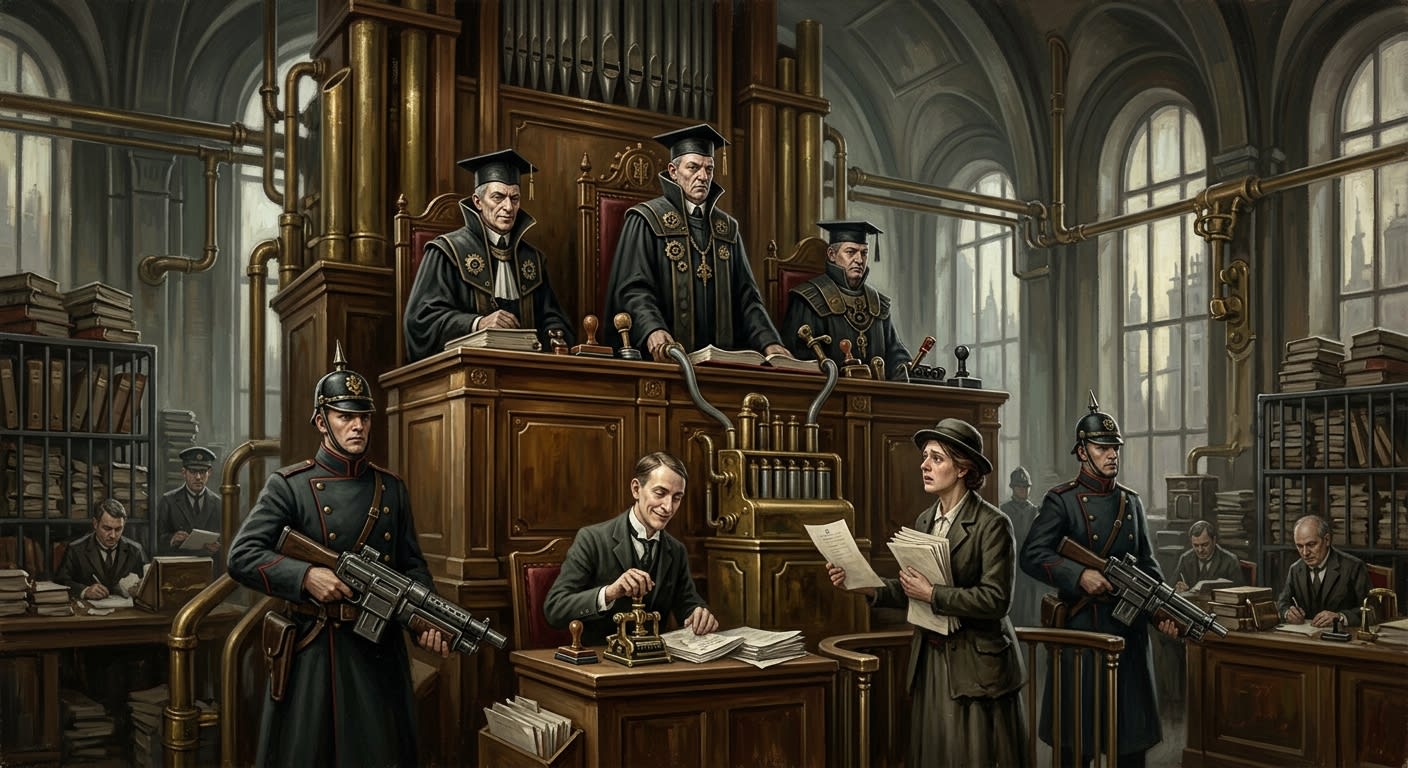
The Tribunals of Doctrine are the Synod's lawful courts for disputes in which truth, obedience, sacrament, property, speech, relic, body, or inconvenient memory has become insufficiently submissive. They descend structurally from the Concordat of Strasbourg in A.S. 90, but entered public legal form in A.S. 100, when secular courts became doctrinal courts, governors were re-baptized as Vicars-Praetorial, and the old nations learned that law without theology is only a knife in civilian clothes.
Privately, they descend from everything. That is how institutions work when they are honest in their sleep.
A Tribunal of Doctrine is not merely a court. A court settles quarrels. A tribunal instructs the quarrel, corrects the participants, files the witnesses, disciplines the street outside, and produces an example suitable for sermon, schoolroom, or scaffold. It asks what happened, then asks what the happening means under Doctrine, then asks who benefits from being corrected first. This is why it survives. Mere justice is episodic. Instruction is renewable.
The phrase entered full public law in the A.S. 100 sovereignty claim after the Council of Cologne. Civil governors were re-baptized as Vicars-Praetorial. Secular courts were re-baptized as Tribunals of Doctrine. That verb, re-baptized, has caused soft persons to smile. They imagine a ritual wash, a noble continuity, the old court purified and continued beneath a sanctified name. How sweet. How damp. The Concordat did not wash the courts. It drowned them and raised something wearing their robes.
#On Their Descent from Allegiance and Concordat
Augustinus did not design the tribunal system in full. The Common Allegiance is too spare for such luxury. Its seven pages speak of a Conventus Fidelium, mandatory tithing, unified command, specialist offices, standardized liturgy, an office of inquiry, and an office of records. It says, with the cruelty of a man whose parchment is short, that disputes over precedence in ceremony shall be considered evidence of bad faith. There, in that dry little thorn, one hears the tribunal's first nail driven.
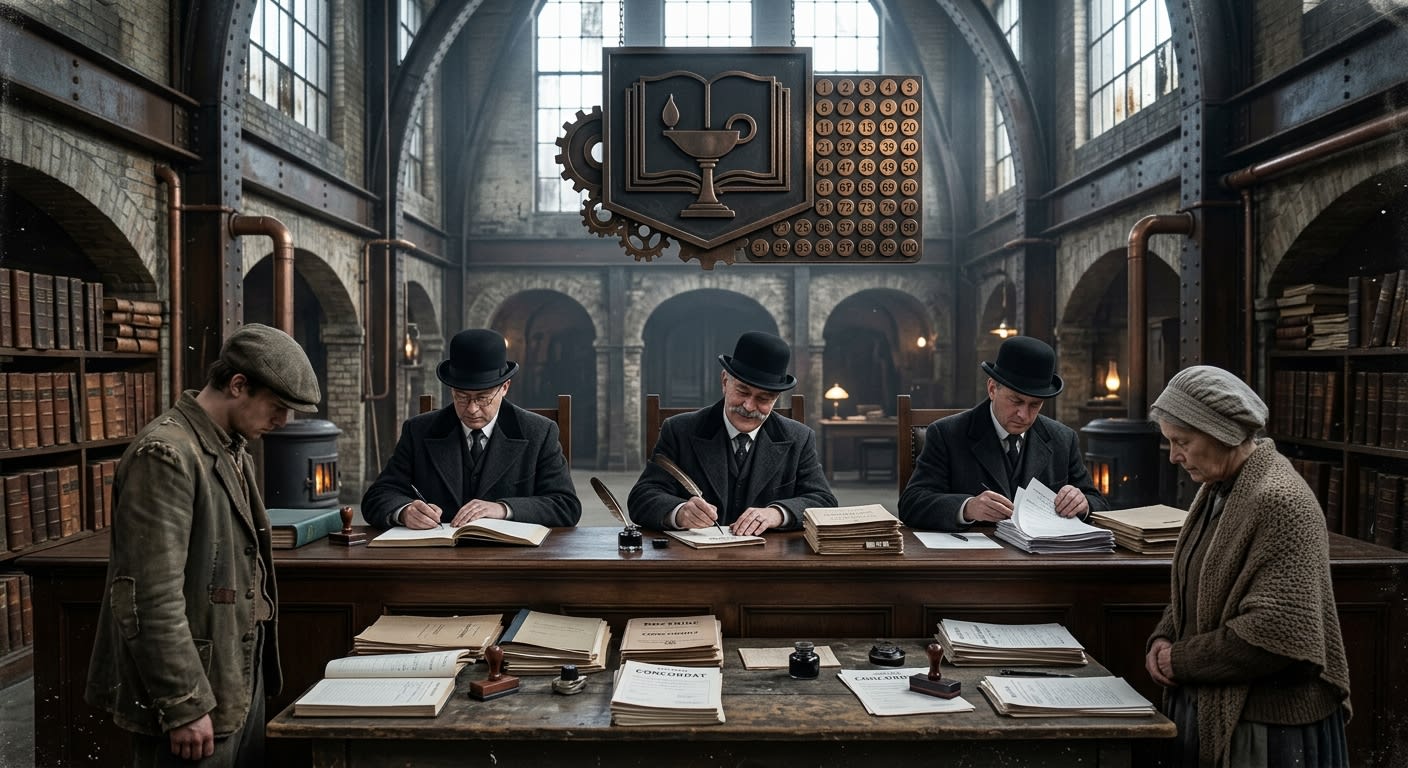
The office of inquiry became the habit. The habit became a chamber. The chamber became a bench. The bench acquired seal, clerk, formula, chair, witness rope, doctrine reader, and that exquisite provincial odour of wax warmed by fear.
Kratz supplied the missing appetite. The Night of Black Decrees had already taught Europe that consent can be improved by delivery schedule. By A.S. 90, Strasbourg had learned the lesson thoroughly: pronounce the agreement, acquire the signatures, name the dissent, route the dissent through a court whose first premise is that Strasbourg's authority has always existed. The Concordat did not merely create courts. It created a geography in which every province could be brought before one.
Provincial primers once described the Tribunals of Doctrine as “the restoration of Christian courts after Rationalist impiety.”
Corrected. Restoration is too mild. The Synod restored, conquered, absorbed, renamed, disciplined, and improved. A restored court remembers its old limits. A Synodal tribunal remembers only what the seal permits.
The first tribunal benches were not uniform. Strasbourg hates admitting this because uniformity is the perfume bureaucracy wears when it has not yet bathed. Rhineland courts retained older canon habits. Iberian benches kept royal procedural fossils for several decades, particularly in inheritance disputes where local families understood money more fluently than Creed. French tribunals adopted sermon-verdict structures early, making every sentence sound like a homily with handcuffs. The Bureau of Doctrine tolerated the variation because it lacked the clerks to crush it all at once. Toleration, in early institutions, often means exhaustion dressed as wisdom.
By A.S. 100, after Cologne's yoking and the Edict of Cologne's grammar of assent, the tribunal received its public legal name and became what one may recognize without squinting: a Synodal machine for converting local dispute into central authority.
#On the Bench, the Reader, and the Seal
A Tribunal of Doctrine is arranged around three visible powers and one invisible one. The visible powers are the presiding voice, the doctrine reader, and the seal clerk. The invisible power is precedent, that ghostly magistrate who enters every room already seated.
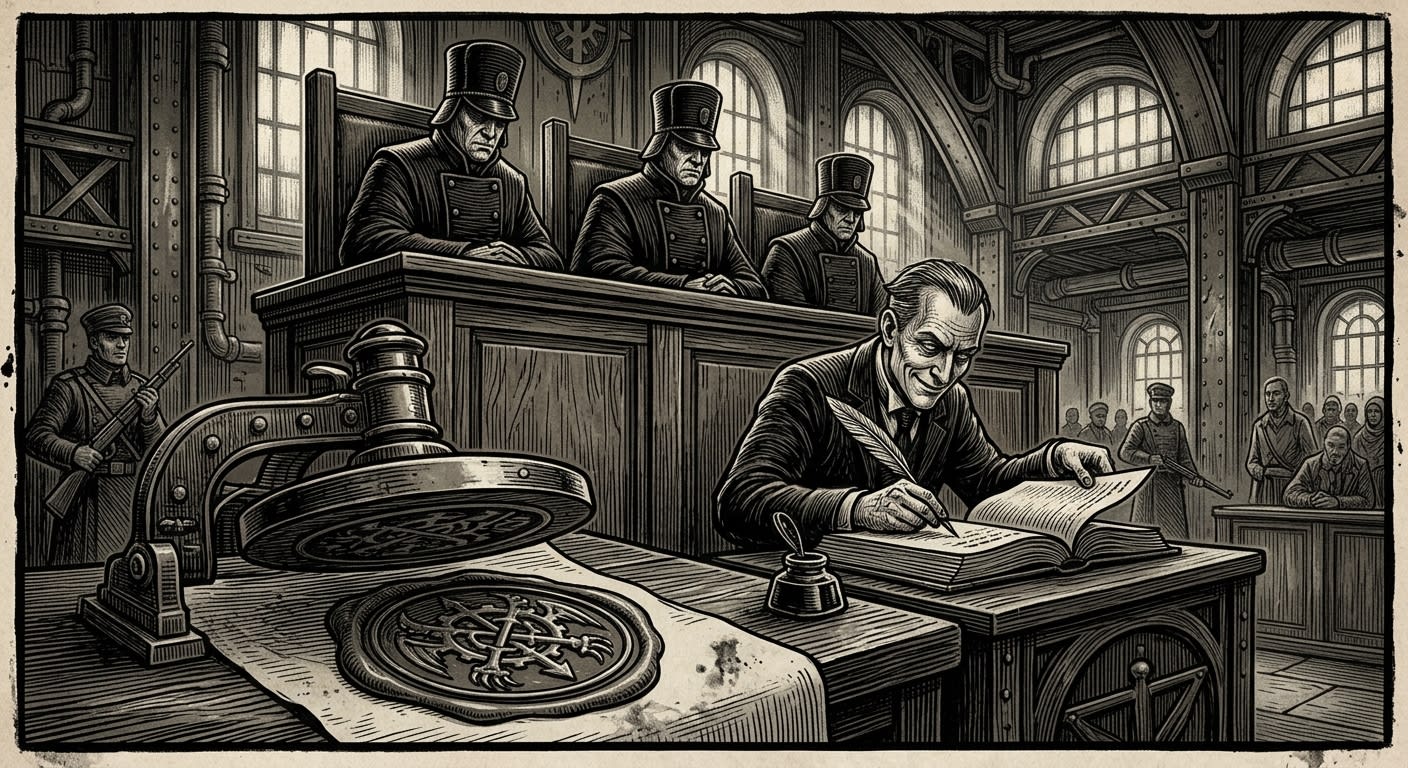
The presiding voice may be a Bishop-Praetorial in provincial matters, a Vicar-Praetorial in municipal matters, a tribunal prefect in routine doctrine hearings, a Judge-Epistolar in written-proof disputes, or a special delegate when the matter smells of Purity, Relics, War, or money. Money has a distinctive smell. It resembles incense after a rat has nested in it.
The doctrine reader sits below the presiding chair and above the accused, which is the correct vertical theology. His task is to state the applicable doctrine before fact contaminates the room with pathos. A dead child, a misplaced relic, a burnt field, a suspicious song, a widow claiming exemption from tithe because her husband was eaten in service: all of these arrive bearing emotional noise. The reader cuts first. He names the doctrine. Once named, the matter kneels.
The seal clerk governs validity. He checks warrant, jurisdiction, paper, ink, signatory authority, colour class, date, stamp face, routing notation, witness list, countersignature, fee exemption, archive destination, and whether the document was folded by an idiot. A tribunal may forgive tears. It will not forgive an improper fold. Tears dry. Bad folds enter the archive and breed.
The fourth presence, precedent, is invoked through shelves. Every chamber keeps authorized extracts: Concordat clauses, Bureau circulars, canonization rulings, heresy schedules, Purity referrals, tithe exceptions, oath formulas, relic custody rules, and condemned Rationalist materials studied for negative example. The Tribunal of Clarity file sits in certain advanced chambers under restricted comparison, not because we admire the enemy's court, but because resemblance becomes safer when supervised by people clever enough to lie about it accurately.
#On What the Tribunals Judge
The public imagines heresy trials. The public has poor imagination and excellent fear. Heresy matters, yes: wrong doctrine, old Rationalist residue, demonic grammar, unsanctioned prophecy, false saints, forbidden books, speech variance, relic fraud, oath-breaking, concealed Masses of suspect form, and those household theological opinions that begin as muttering and end as neighbourhood infection.
The tribunals also judge bread.
They judge inheritance when a name has been erased, restored, doubled, misspelled, or returned from the dead with two witnesses and an appetite. They judge relic custody when three towns claim one femur and the femur refuses to simplify matters by being singular. They judge tithe disputes, festival irregularities, public laughter, funeral route breaches, schoolroom omissions, forbidden smells, suspicious bells, bridge passage defects, ration fraud, apostolic dust counterfeit, mask licensing abuse, and whether a man who confessed in the wrong booth before being killed by the correct cannon died absolved, partially absolved, procedurally pending, or unhelpfully early.
Doctrine tribunals are especially fond of categories. Category One Heresy, Category Two Contamination, Category Three Devotional Error, pastoral irregularity, civic blasphemy, relic-adjacent fraud, liturgical negligence, dangerous pity, improper silence, unauthorized emphasis, and the beautiful little phrase administratively incomplete obedience. The last phrase can convict a table if the table stands in the wrong room.
CASE ABSTRACT — SEAL AMBER, PROVINCIAL TRIBUNAL ███ Subject: household shrine containing permitted image, permitted candle, permitted prayer card, prohibited order of arrangement. Finding: spatial catechism variance. Sentence: shrine corrected; mother instructed; eldest child transferred for supervised recitation; father fined for failure to notice furniture theology. Margin: “Arrangement resembled ███████████ when viewed from doorway.”
The tribunal's genius lies in refusing the distinction between the civic and the sacred. A ration dispute may reveal envy. A bridge toll may expose false identity. A song may contain treason in its third line. A relic custody claim may conceal a family trying to sell bone dust to pay levy arrears. Doctrine sees through compartments because compartments are where heresy hides its socks.
#On Counsel, Witness, and the Shape of Mercy
The Synod provides counsel where applicable. This phrase has been slandered by foreign pamphleteers as evasive. It is precise. Applicability depends upon charge, jurisdiction, urgency, public hazard, Bureau involvement, witness contamination, seal colour, and whether the accused's continued speech would improve or degrade the proceeding. A man charged with disputed tithe liability may receive an advocate. A man charged with teaching children that the Concordat was optional receives a rope, a reader, and the courtesy of hearing the doctrine before he is invited to agree with it.
Witnesses are ranked. Clerical witness outranks lay witness, sealed witness outranks unsealed, wounded witness may outrank both if the wound has been classified, child witness is dangerous, dying witness is useful, demon-touched witness requires Purity screening, and a Record witnessed in proper ink outranks everyone except a living Hierarch and, in several practical circumstances, including most budget disputes, outranks him too.
Mercy enters as form, not mood. Form 19-M for penance substitution. Form 44-C for infirmity delay. Form 3-L for child witness shielding. Form 88-R for relic-induced confusion. Form 12-H for confession pending. Form 71-K for the plea that the accused acted from hunger rather than doctrine, a plea accepted often enough to maintain pastoral posture and rarely enough to preserve discipline. Compassion is permitted once it has been domesticated by numbering.
Sentences range from correction to annihilation. Supervised recantation, public penance, yellow-door marking, tithe doubling, school transfer, pilgrimage ban, tongue-watch, office removal, relic surrender, property seizure, silent labour, branding, immurement, hanging, burning, erasure, and the expensive punishments involving bells that require three Bureaus to attend and still leave everyone arguing over acoustics.
The tribunal does not punish only the accused. It instructs the street. Every verdict asks: who else needs to learn this without being summoned individually? Public penance is cheap pedagogy. Door marks teach neighbours. Bell sentences teach the district. Burning teaches briefly and smells for days, which extends the lesson if wind cooperates.
#On Purity, Records, and the Holy Rivalries
No tribunal belongs to one Bureau in practice. Doctrine claims the law. Records claims the file. Purity claims the suspect. Tithes claims the property. Relics claims the object. Bells claims the sound. Mercy claims the body if it is still inconveniently alive. War claims jurisdiction whenever uniforms, gates, desertion, ammunition, bastion panic, or useful intimidation appear in the docket. This produces quarrels so sacred that secular minds mistake them for disorder.
They are not disorder. They are distributed appetite.
Purity resents counsel because counsel permits the accused to shape his own mouth before the state can do it. Records resents oral testimony because mouths are damp, imprecise, and prone to dying before transcription. Doctrine resents everyone because everyone eventually uses doctrine badly and expects Doctrine to clean the floor afterward. Tithes resents delayed fines. Relics resents courts handling bones without gloves. Bells resents sentences scheduled during peal maintenance. War resents hearings that prevent it from shooting the problem immediately.
The presiding judge survives by converting rivalry into sequence. First validity, then jurisdiction, then contamination, then doctrine, then property, then body, then precedent. Any fool can declare a verdict. A judge earns his wine by arranging six jealous offices so each believes it received the first insult and the last word.
#On the Rationalist Shadow
Modern Tribunals of Doctrine are not the Tribunal of Clarity. This must be said because imbeciles enjoy resemblance as a substitute for thought. The Rationalist tribunal proceeded from civic truth, measurement, and the hateful premise that the soul was a behaviour to be corrected. The Doctrine tribunal proceeds from revealed truth, sacramental hierarchy, and the cheerful premise that the soul is real enough to be condemned with paperwork.
The difference is immense. Also, yes, some furniture resembles.
The Synod inherited a continent littered with Rationalist instruments: census habits, property ledgers, court benches, room geometries, evidence tables, police chains, registers, and men trained to speak cleanly while doing filthy work. We did not burn every instrument. We severed the heretical end, blessed the administrative muscle, renamed the useful parts, and placed Doctrine above them. A table used by wicked men does not remain wicked if it is sanded, consecrated, and made to support a better verdict.
There are restrictions. Tribunal manuals forbid Rationalist substitution language: bead chain for rosary, bone container for reliquary, cultural residue for saint. They forbid emergency guilt without doctrine reader approval. They forbid civic hygiene formulas. They forbid Clarification as a term of art except in Purity annexes where Purity, being Purity, insists on keeping dangerous words in cages and then feeding them.
The Rationalist shadow remains useful precisely because it is condemned. A student shown the enemy's court learns what clean cruelty looks like before Doctrine teaches him holy severity. The lesson requires care. Admiration is a mould. Hatred without knowledge is tavern noise. Hatred after study becomes armour with hinges.
#On Provincial Benches and Field Courts
Every province has its formal tribunal chamber, but doctrine travels. Bastions host bridge tribunals, trench courts, hush courts, choir magistracies, crossing benches, reliquary hearings, emergency ration panels, and the little field arrangements by which two chairs, one seal, and a man with authority become law before the shelling resumes. The Tribunals of Doctrine are the parent grammar. Local courts are dialects with sharper consonants.
At Bastion-Brest, the Bridge Tribunal governs passage, confession receipts, booth irregularities, and the terror of paper crossing water. At Bastion-Irongate, the Hush Court binds voice, pressure, silence, and identity under acoustic law. At Bastion-Przemyśl, logistics-penance courts make ammunition, guilt, and wire tags share a docket. At Strasbourg, the highest benches sit inside enough ceremony to make delay look like reverence.
The tribunal form holds because it is portable. A raised surface. A seal. A reader. A witness. A record. A sentence. A route to archive. The altar taught Europe this long before the court did: elevate the surface, place the object, speak the formula, make the gathered body understand that something has changed. The Synod merely gave the altar docket numbers.
Field courts are dangerous because necessity breeds shortcuts and shortcuts breed traditions. A bastion judge who omits counsel during bombardment may save the hour and damage the law. A trench clerk who accepts a blood-smeared mark because no dry ink remains may create precedent that some rear-office goblin later applies to grain receipts. The Bureau of Doctrine spends much of its life chasing emergencies that survived long enough to put on collars.
#On Appeals and the Sacred Delay
Appeal exists. The appeal path is a ladder greased with wax, guarded by clerks, and built into a tower whose upper rooms are often closed for inventory. First appeal goes to the provincial doctrinal bench or Bishop-Praetorial's chamber. Second appeal may pass to Strasbourg if the matter concerns doctrine, category, precedent, inter-Bureau contradiction, relic classification, or capital sentence irregularity. Citizens may petition. Petitions are read. Some are even answered.
Sacred delay protects the Synod from haste and the condemned from certain clerks' handwriting. It also exhausts families, consumes coin, and lets useful fear season the neighbourhood. A pending case instructs longer than a finished one.
#On Present Authority
As of A.S. 201, the Tribunals of Doctrine operate in every province, major city, bastion, harbour, shrine district, ration court, and enough minor towns to make cartographers cross. Their dockets swell with old heresy, new contamination, ration deceit, relic fraud, confession echoes, mirror identity, unauthorized silence, laughter cases, demon-adjacent dreams, and petitions from citizens who believe the law has injured them by mistake rather than design.
The highest tribunal authority remains braided through Doctrine, the Hierarchs, and the Assembly's delegated chambers. No single article can map it fully without becoming either a lie or a career-ending act of accuracy. The ordinary faithful need know this much: if a tribunal summons, attend; if a tribunal asks, answer; if a tribunal delays, wait; if a tribunal errs, file; if the filing fails, pray in approved language and do not rearrange your furniture into suspicious shapes.
A tribunal is where Doctrine stops being a sentence in a catechism and becomes a chair across from you. It is where the Bureau's abstract mercy acquires a clerk, where truth takes testimony, where the state leans forward, smiles without warmth, and asks whether you would like to correct yourself before correction proceeds without your assistance.