
#On the City That Bled Over a Shinbone
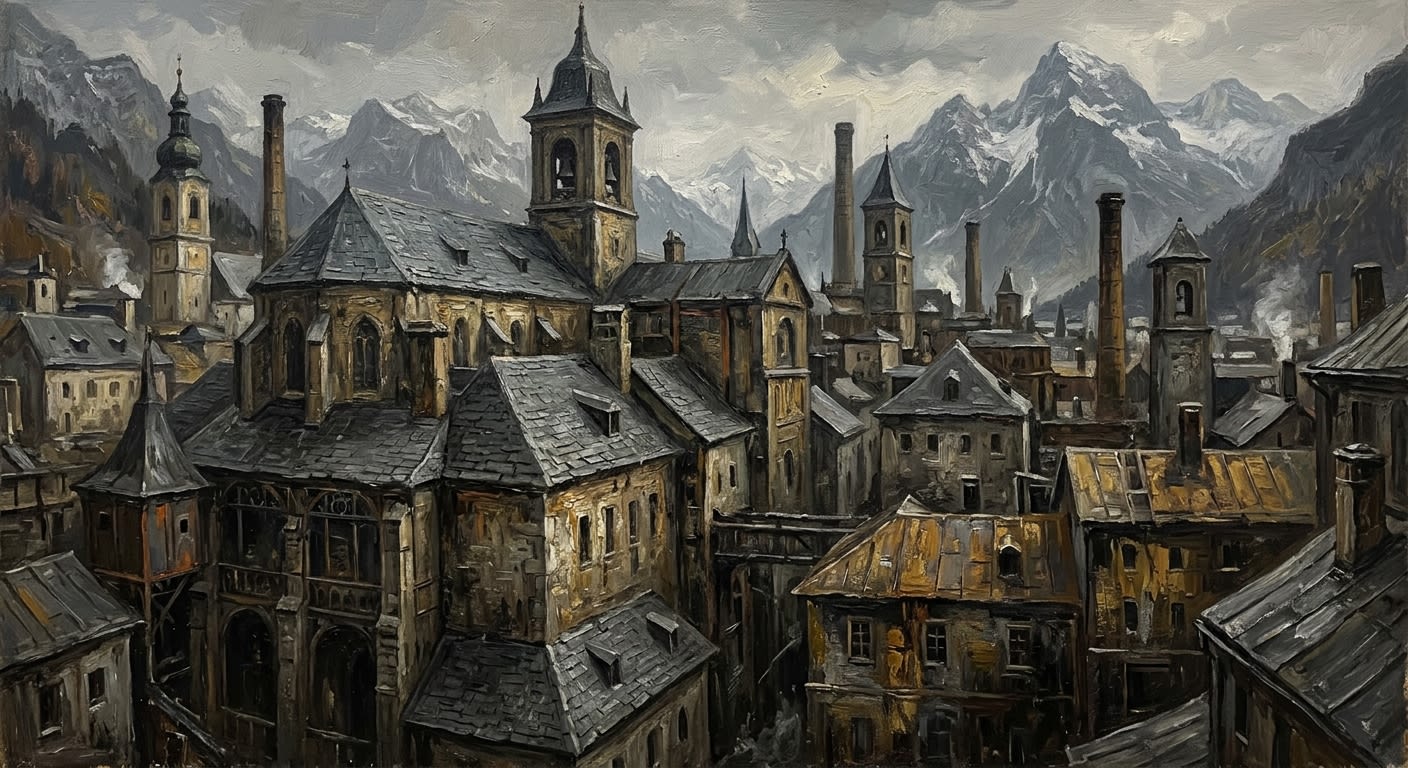
Salzburg sits in the Alpine throat like a reliquary placed where roads must bow. Its hills hold chapels. Its bridges carry pilgrim feet. Its old houses lean close enough to overhear custody disputes before the clerks pretend those disputes were private. The city is famous less for size than for having proved, during the Reliquary Schisms, that a bone with clean papers can murder bishops more efficiently than a heretic with a manifesto.
Two bishops died there over a shinbone. This is the phrase by which common people remember the matter, and common people, when not writing policy, retain a useful brutality of memory. The official files prefer Salzburg Tibia Controversy (Unregistered), Northern Alpine Custody Disturbances, Episcopal Losses Under Reliquary Strain, and three other names composed by men trying to wash blood with nouns. The shinbone remains the honest centre: an authenticated tibia, warm during Lent, cold before Medicine, claimed by rival authorities, touched by too many hands, sworn over by too many mouths.
Its importance predates the Schisms. Salzburg stands on Alpine passage, old ecclesiastical prestige, salt-road revenue, convent storage, mountain shrines, and the stubborn civic habit of treating elevation as argument. In the Age of Heresy it became a western-heartland pilgrimage hinge: safe enough for money, near enough to dangerous routes for drama, devout enough for relic traffic, and proud enough to make any authentication dispute intolerable.
#On Salt, Shrines, and the Alpine Shelf
Salzburg's older wealth came from salt, and salt teaches a city three habits: preservation, taxation, and the belief that white crystals grant moral superiority over wetter neighbours. The Synod did not invent this temperament. It merely stamped it, tithed it, and discovered that a people long accustomed to weighing salt will weigh holiness with similar confidence.
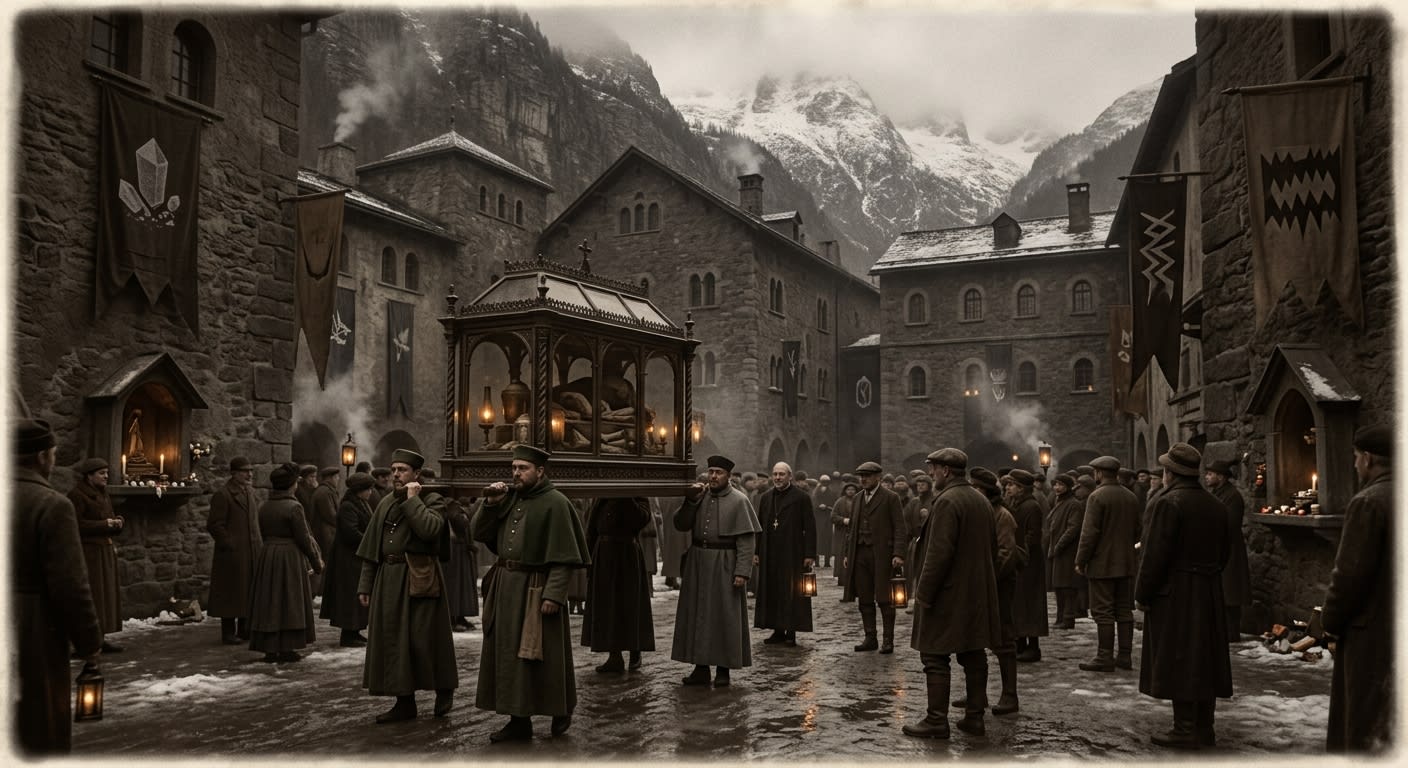
The city grew where roads from the German heartlands turned toward Alpine passes and southern devotions. Pilgrims entered beneath painted saints whose smiles had survived Rationalist scraping by virtue of height, poor ladder-work, and one sacristan with a hammer. Monasteries above the town kept guest ledgers, mule accounts, weather notes, and little side cabinets of cloth, bone, ash, and sealed testimony. These cabinets mattered later. Cabinets always matter later. History is what happens when somebody opens a drawer with witnesses present.
During the Atheist Wars and the long eastern ruin, Salzburg's religious houses hid relic packets in salt bins, bell hollows, chapel stairs, brewery walls, and two municipal storage caves whose inventory labels described the contents as winter paving lime. The Rationalists inspected books. They mistrusted incense. They underestimated household women, stable boys, and priests who could lie with sacramental calm. The Cellar-Saint pattern reached the Alpine city: quiet hoarding rather than heroic martyrdom in the public square, labels turned inward, bones wrapped in linen that smelled of flour and fear.
When the Synod's roads reopened, those hidden packets came forth. Salzburg presented tibias, fragments of vertebrae, a jaw hinge with contested attribution, nail parings of a minor confessor, altar splinters, a bell-clapper said to have touched Saint Iselda's bier, and dozens of contact cloths whose stains grew darker during Matins. The Bureau of Relics authenticated enough to flatter the city and too much to keep it sane.
#On the Warm Tibia and the First Lies of Courtesy
The tibia that made Salzburg notorious was attributed, in the earliest surviving public file, to Saint Corbinian of the High Road. A later copy gives Saint Severin of the Salt Steps. A third, sealed and then very badly unsealed by moisture, uses only the Saint of the Lower Procession, which suggests that someone had already understood the danger of naming a saint too loudly before ownership had settled. The bone lay in a silver-and-cedar reliquary with mountain glass panels and a little enamelled mule on the clasp. This last detail should have warned everyone. Cities rarely decorate fraud; they decorate claims.
During Lent of A.S. 141 the reliquary emitted greenish warmth. Pilgrims felt it. Two abbesses recorded it. A salt factor swore that snow melted on the reliquary cloth without dampening the table. Relics sent an Examiner, who performed the Candle Proof and watched the taper lean toward the glass. The bone passed. Salzburg bells rang through the afternoon. Inns filled by dusk. Within a week, the processional route had acquired ribbon sellers, two new indulgence stands, and a guidebook written with indecent speed.
Medicine examined the tibia in summer. The warmth ceased. The bone lay cold, dry, and anatomically smug. Medicine, being Medicine, wrote that bones do not vary sanctity by liturgical season and that the specimen's measurements conflicted with another authenticated claim lodged in a neighbouring custody chain. Relics returned the note with the useful phrase irrelevant to sanctity. The phrase later achieved broad employment, like all cowardice expressed neatly.
Salzburg devotional primers state that no doubt attended the Warm Tibia before external jealousy disturbed local peace.
Corrected. Doubt attended the tibia from its first public heating. The city merely forced doubt to stand at the rear of the nave where paying pilgrims could not hear it cough.
The first lies were polite. Rival custodians called each other mistaken, misled, poorly advised, insufficiently briefed, and dependent upon incomplete documents. Then they called each other negligent. Then impious. Then anatomically vulgar. By the time knives appeared, the language had already done most of the stabbing.
#On the Two Bishops
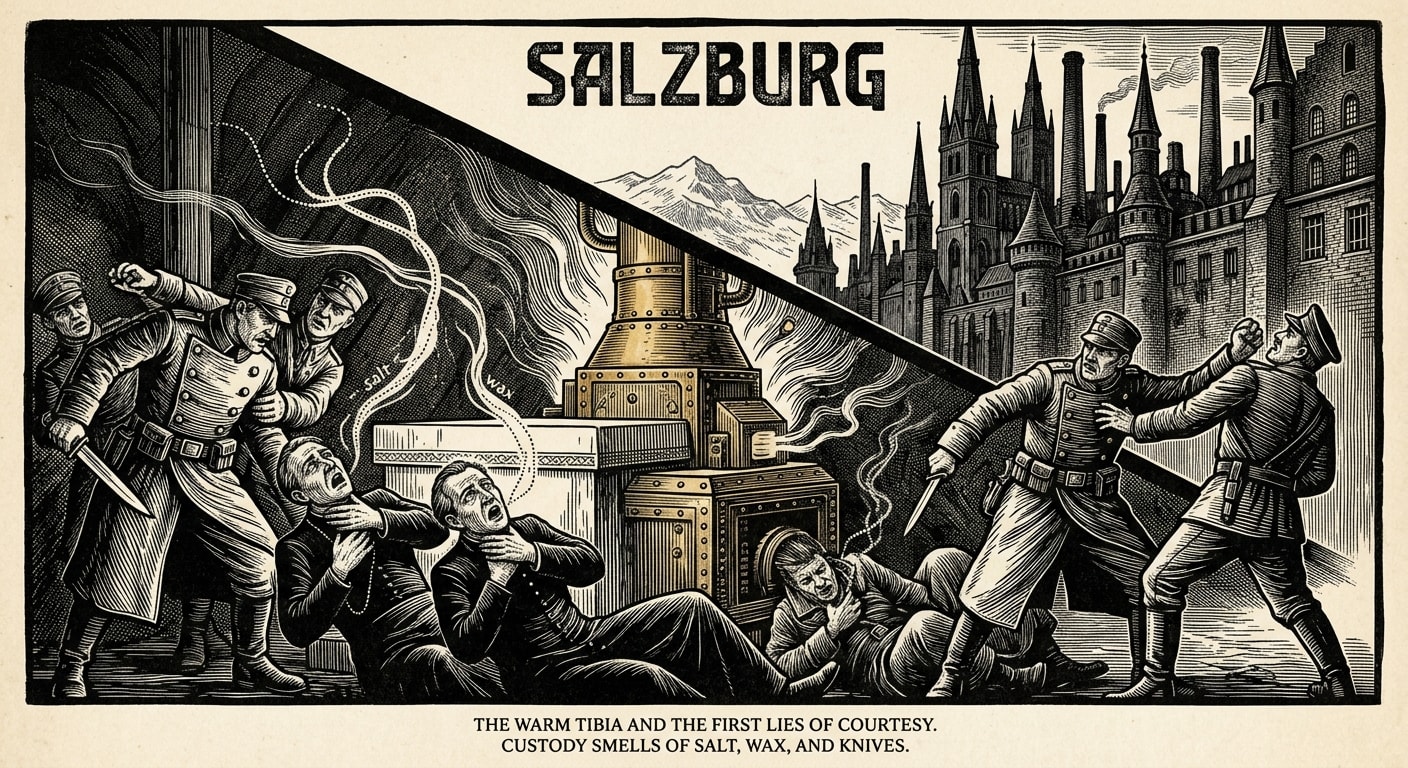
The first bishop died in the south chapel after a custody hearing that had lasted longer than one standard creed-hymn and shorter than justice. His name is rendered in three files as Anselm, Ansel, and Anshelm. Records preserves all three under parallel indexing, proving that death does not simplify a clerk's day. He had argued that the Warm Tibia belonged to the cathedral treasury because the earliest transfer slip bore a cathedral counterseal impressed over salt-wax, making later monastic custody devotional rather than legal.
He was found beneath the votive rail with two fingers wrapped around the reliquary chain and wax under his tongue. The public bulletin described apoplexy. The private memorandum described a wound under the left ribs narrow enough for a citation knife. The third memorandum, which every office denies with suspicious fluency, noted that the reliquary glass was warm when his body was discovered, though Lent had ended.
The second bishop died eleven months later near the Bridge of Saint Rupert, returning from a private negotiation with monastic advocates. He had supported shared custody, which is a beautiful doctrine for men not standing between armed sacristans. His litter stopped under the bridge arch. The bearers heard singing from within the curtains. When they opened them, the bishop was dead, his pectoral cross twisted backward, a strip of provenance parchment pinned to his sleeve with a reliquary nail. The parchment bore a correction to one date in the Warm Tibia chain.
One date. One bishop. Such is the economy of sacred paper.
SALZBURG EPISCOPAL LOSS ABSTRACT — SEALED COPY First body: south chapel rail; wax under tongue; reliquary chain in hand. Second body: bridge litter; correction slip affixed by nail. Common witness phrase: “the bone was warm.” Suppressed detail: ███████████████████████████████████████ Disposition: forwarded to Strasbourg under guarded Alpine convoy.
The killings did not resolve the dispute. They consecrated it with scandal. Pilgrims came faster. A city that had lost bishops over a bone must, the common mind reasoned, possess a bone worth losing bishops over. I dislike the common mind only when it is wrong; here, alas, it understood commerce perfectly.
#On Processions, Brokers, and Knife-Liturgy
Salzburg's streets were made for processions and trained for collision. A relic procession is a moving argument. Cross, banner, canopy, bell, choir, guard, clerks with docket boxes, boys swinging censers, widows selling ribbons, pilgrims kneeling where traffic should go: every piece declares a claim. During the Schisms, claims met in lanes too narrow for theology to pass politely.
The Warm Tibia's supporters carried the reliquary from the cathedral through the salt market to the bridge and up toward the high chapel. Rival claimants arranged counter-processions with related bones, contact cloths, and one especially aggressive altar splinter. Guards walked under reliquary cloths with blades flat against their wrists. Advocates shouted canon law across kneeling pilgrims. Boys threw candle-stubs. Bells answered bells until even the devout developed headaches they described as spiritual pressure.
By A.S. 142, brokers in Salzburg offered advance credit against feast-day revenues for bones whose authentication appointments were still pending. Profit brokers paid for roof repairs and received procession rights in return. Femur-War Brokers learned the city's alleys, feast calendars, bridge choke-points, and which sacristan could be made drunk without impairing his penmanship. The city pretended to despise them. The city also sent for them at night. Tithes disapproved with one hand and counted with the other, as nature intended.
Knife-liturgy is the unofficial name given by later clerks to the Salzburg habit of hiding weapons inside procedural holiness. Citation knives began as paper tools: thin blades for cutting wax packets, trimming docket strips, and opening stubborn seals. In Salzburg they entered sleeves. A man could draw one while appearing to unfold a custody copy. This pleased lawyers, alarmed sacristans, and gave the Bureau of Purity another reason to ban pockets during hearings.
#On Strasbourg's Intervention and the Congress Shadow
Strasbourg watched Salzburg with the patience of a spider waiting for two flies to exhaust themselves. Suppression would imply the Bureau of Relics had erred. Affirming one claimant too loudly would enrage every other custodian with a warm bone and a local militia. So Strasbourg sent observers, then circulars, then a Doctrine delegation whose chief talent was producing rooms in which nobody could claim victory without first signing a silence clause.
The Salzburg file travelled beside the Cologne femur registers, the Bruges shoulder-blade depositions, and the Lyon finger-bone horrors. Together they supplied the Fourteenth Doctrinal Congress with its required humiliation. Cologne brought arithmetic to its knees. Bruges made glass testify. Lyon made every clerk dream of thigh-bones stacked on ledgers. Salzburg brought blood: episcopal blood, bridge blood, chapel blood, the sort of blood that stains enough vestments to become administratively persuasive.
At the Congress in A.S. 147, Salzburg's delegates argued for recognition of seasonal warmth as superior proof. Medicine argued that warmth which disappears under examination is poor evidence. Relics answered that sanctity is not obligated to perform for hostile instruments. Doctrine heard all parties, measured the expense of every answer, and chose the sentence that made future Salzburgs less likely to kill bishops in public.
All femurs are authentic if notarized. Tibias, though less famous in tavern mockery, entered the same shelter. The Warm Tibia retained force. Rival tibias retained force. Rival processions received calendars, separation writs, and instructions to stop embarrassing the Synod where foreigners might hear.
A Salzburg cathedral guide claims the Fourteenth Doctrinal Congress vindicated the city's sole custody of the Warm Tibia.
Corrected. The Congress vindicated notarized authenticity. Sole custody was replaced by managed precedence, alternating display rights, route separation, and a revenue division so complex that several local canons mistook it for mysticism.
#On the City After the Reduction Notices
A.S. 160 reduction notices changed Salzburg's relic economy from flood to ration. Eleven First-Class authentications per year across the Synod meant that Alpine shrines could no longer rely on new bones arriving to refresh old income. The city did what all old shrine-cities do when fresh sanctity slows: it improved the furniture around existing sanctity. Reliquary glass was replaced. Procession canopies were re-embroidered. Guidebooks became more elaborate. The Warm Tibia acquired a winter viewing, a Lenten warmth vigil, a bridge commemoration, a bishops' memorial, and a penitential lecture series on the dangers of excess zeal that sold out every year.
The two dead bishops became safer after death. Their disputed names were harmonized in public liturgy while Records retained all variants in sealed index. Their memorial tablets stand apart, which is wise; shared stone might provoke the old factions by proximity. Pilgrims touch the tablets after visiting the tibia chapel. The order is theologically awkward and financially excellent.
The brokers did not vanish. They became quieter, better dressed, and fond of sponsorship language. A Salzburg inn refurbishment might be underwritten by a devotional travel society whose treasurer owned three custody disclaimers. A road chapel might receive a new bell after agreeing to move its local feast by nine days. A monastery might “loan” a reliquary panel while retaining “interior devotional continuity,” a phrase that can only mean theft performed in Latin shoes.
By A.S. 201, Salzburg remains loyal because loyalty is profitable and because the city learned, under bishop-blood and red wax, that open contradiction should be scheduled rather than solved. Its cathedral treasury is supervised. Its mountain shrines are audited. Its processions require route sheets, bell-clearances, and relic-distance rules. Its innkeepers know which pilgrims come for prayer and which come to see where prelates died. Both pay.
#On the Present Custody of Warmth
The Warm Tibia is displayed under restricted conditions. The reliquary rests behind mountain glass in a side chapel whose shutters remain closed except during approved hours. Candles are kept at measured distance after three incidents of taper lean misread as fresh adjudication. Medicine may inspect only by prior writ, in the presence of Relics, Records, Doctrine, one cathedral canon, and a guard whose oath specifies that no measuring instrument shall touch the bone without sung assent.
It still warms during Lent. This is the official position when warmth is useful. It does not warm during hostile examination. This is the official position when absence is useful. The Bureau has learned from Salzburg that miracles perform best under friendly jurisdiction and that jurisdiction performs best when miracles are not asked vulgar questions in summer.
The chapel ledger records ordinary petitions: sick knees, road safety, salt ventures, mule health, disputed inheritances, and relief from clerks who lose papers on purpose. The bishops' memorial ledger records sharper requests: protection from knives, clean hearings, safe bridges, and the courage to let someone else carry the reliquary first. Sensible prayers. One grows fond of them despite oneself.