

#On the Coin That Mistook Itself for Dawn
The Lumen was the currency of the Rationalist Republic, minted from A.S. 30 until A.S. 45, stamped with a compass on one face and the motto RATIO SOLA on the reverse, and thereafter confiscated by the Bureau of Tithes wherever it appears with that mingled piety and appetite by which fiscal offices recognize old rivals.
It was called Lumen because the Republic adored light so long as light could be taxed, measured, struck, weighed, and placed into circulation under the authority of men who had recently abolished the sun's Maker by decree. “New Dawn,” they said at Regensburg. “Reason alone,” they stamped at Vienna. A coin is always a sermon in metal. The Lumen preached that Faith had been liquidated and change would be given.
The Republic presented the coin as civic modernization: one currency for thirty-seven Philosophical Prefectures, one standard of exchange to replace the old confusion of crowns, diocesan tallies, guild notes, monastery receipts, pilgrim tokens, toll-chits, saint-fair pennies, and those charming local coins bearing the faces of dukes whose principal talent was resembling livestock in profile. The Bureau concedes the practical merit. Standard currency binds territory. It simplifies taxation. It shortens disputes. It allows a government to know, with terrible intimacy, what its subjects are holding.
That last advantage interested the Council of Nine.
#On the Metal Inside It
The Lumen was born from the Edict of Rational Allocation. This is the first fact and the whole indictment.

After the Treaty of Regensburg dissolved the Holy See of Vienna at swordpoint and placed Europe under the Concordats of Governance, the Republic inherited churches it denied, monasteries it envied, treasuries it coveted, bells whose voices annoyed it, and reliquaries whose gold embarrassed its lecturers. The Edict solved the embarrassment. Sacred property became idle civic matter. Idle civic matter required allocation. Allocation required inventory. Inventory required carts, guards, scales, clerks, hooks, seals, and lectures. Theft arrived wearing spectacles.
Altar silver entered the Lumen. Chalice gold entered the Lumen. Reliquary casing, votive plaque, shrine lamp, ciborium rim, episcopal chain, chapel candlestick, processional ornament, and the little memorial plate a widow bought with five years of laundress money entered the Lumen. Bell bronze more often went to artillery, though inferior lots and broken clappers passed into mixed treasury metal. The Republic's mint ledgers describe all of this as “rational conversion of unproductive sacred mass.” The phrase has the smell of a disinfected murder room.
The standard Lumen was a silver-alloy coin, bright when new, pale with use, harder than older diocesan coinage, thinner than its public weight tables admitted. The face bore a compass, points extended to a ring of tiny rays. Around it ran the Republic's civic legend, varying by mint during the first months when local Prefects mistook autonomy for permission to embellish. Vienna corrected them. The reverse bore RATIO SOLA, sometimes with a small Broken Cross beneath the rim.
The Bureau of Tithes' A.S. 97 assay found systematic debasement after the sixth issue: less silver, more base metal, no public adjustment. The Republic had proclaimed measurement sovereign and then cheated its own measure. I pause here only to allow the irony to dress properly before entering the room.
Republican Treasury broadsides described the Lumen as “a transparent medium of equal civic exchange.”
Corrected. The coin was neither transparent, equal, nor civic in any clean sense. It was confiscated sacred property recast as state money, alloyed beneath its own standard after A.S. 36, and circulated under penalty by a government that called compulsion consent whenever the receipt was tidy.
#On Minting, Marks, and the Viennese Foundries
The first Lumens were struck in Vienna, in foundries attached to the former cathedral workshops and expanded under the Prefecture of Public Treasury. The old ecclesiastical metalworkers had been dismissed, imprisoned, recruited, or compelled to instruct their replacements before vanishing into correction rolls. Rationalist mint masters preferred men who understood dies, weights, heat, and silence. Especially silence.
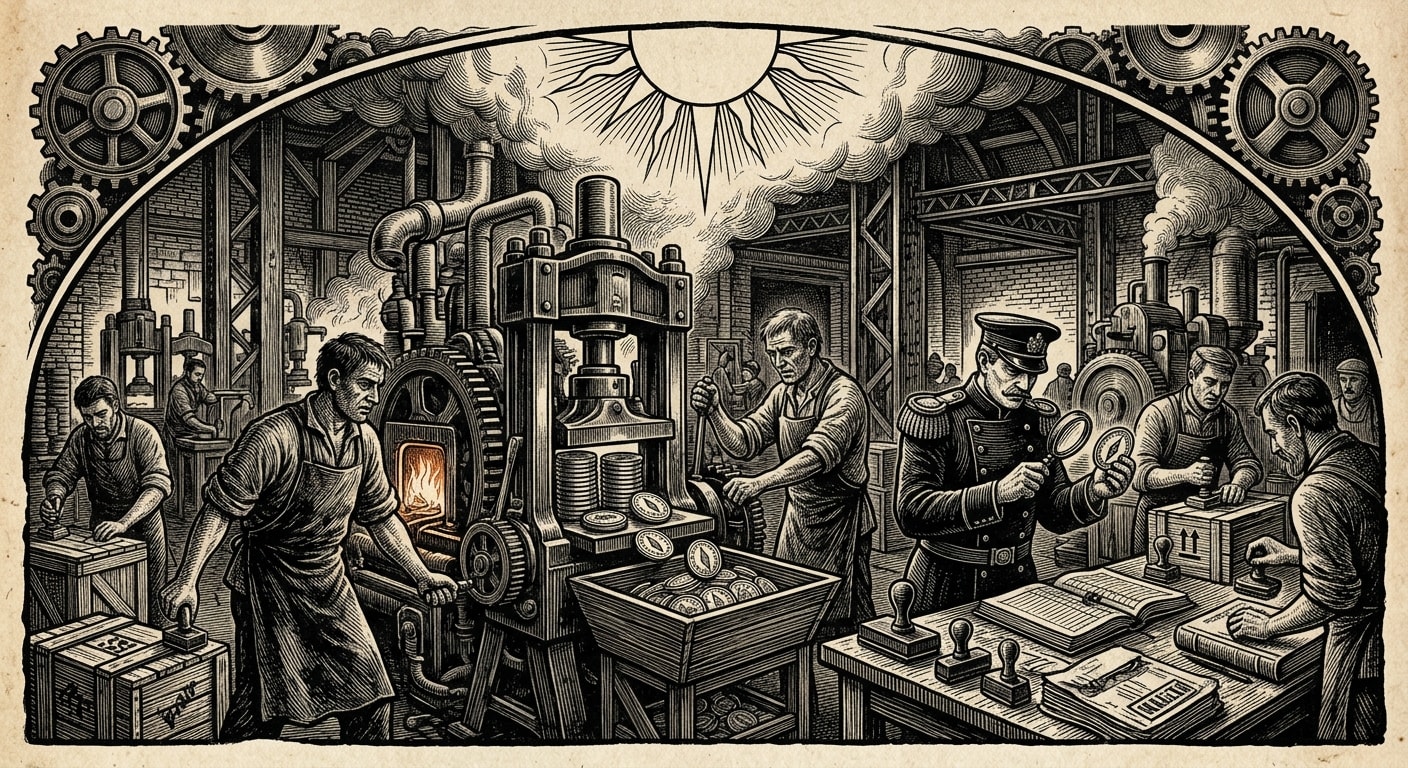
Minting sacred metal is an acoustical problem before it is a fiscal one. Silver from altar vessels behaved well enough, being accustomed to human handling and priestly breath. Reliquary gold did not. It softened unevenly, beaded in crucible corners, and left stains on molds that later inspectors described as “organic discoloration,” though the Bureau of Relics, reading the same report with better taste, called them the last manners of violated saints. Bell fragments rang in the furnace. Not loudly. That would have been easier. They clicked, chimed, and answered hammer-strikes before hammer met metal.
There are mint marks collectors cherish and Tithes officers pretend not to. V for Vienna. R for Regensburg emergency issue. P for Parisian re-strike after Edict enforcement swelled treasury returns. C for Cologne, rare and often clipped. A run of Lyon issues carries a malformed compass whose westward arm bends downward, a defect the Republic blamed on die fatigue and the Bureau of Doctrine classifies as an involuntary confession.
Counterfeiting began almost at once. This is how one knows a currency has succeeded. Loyal citizens shave rims. Hungry citizens plate base discs. Philosophical citizens discover that Reason alone does not feed children unless Reason can be passed across a baker's counter. The Tribunal of Clarity punished coin fraud by branding the palm with a heated compass. Repeat offenders lost the hand. A man who clipped a coin made from a stolen chalice was condemned for theft against the state. The chalice's prior owner, being a Church, had no recognized standing. Law is a comedian with a straight face.
#On Circulation and the Small Blasphemies of Purchase
A Lumen bought bread. This remains the cruellest sentence in the file.
A woman in A.S. 33 could carry to market a coin struck partly from her parish candlesticks and use it to purchase onions beneath a notice declaring devotional attachments obsolete. A Republican Guard could receive wages in reliquary silver and spend them in the tavern after removing a tongue under the Edict of Ironmouth. A schoolmaster in a converted abbey could collect fees in Lumens while teaching children that saints were economic errors. The coin worked. Evil often works. That is why intelligent men fear it.
The Republic mandated Lumen acceptance in all Prefectures. Old coinage had to be exchanged at prefectural desks, where clerks weighed, taxed, questioned, and sometimes confiscated under Allocation review. Monastery receipts were void. Parish poor tokens were void. Pilgrim tallies were void. Guild marks survived briefly through bribery, then entered the same furnace as the rest. By A.S. 34 the Lumen had become the Republic's bloodstream. Wages, fines, silence taxes, Academy fees, publication stamps, grain levies, court penalties, Guard pay, informant rewards — all passed through its pale metal mouth.
The coin changed behavior. It always does. Citizens hoarded older saint-marked pennies because touching them felt like touching a forbidden alphabet. Children learned to draw compasses before crosses. Merchants began quoting prices in “clean light,” a street phrase for new Vienna issue coin, as opposed to “chapel light,” older mixed coin suspected of containing a higher sacred-metal fraction. Pious families, when forced to spend Lumens, sometimes kissed them first in defiance, then washed their mouths. The Republic prosecuted the kiss as superstition. It prosecuted the washing as evidence of superstition. The Republic was nothing if not complete.
PREFECTURAL TREASURY REPORT — LYON, A.S. 38 Incident: market woman refused Lumen issue bearing suspected altar-source silver. Statement: “My mother lit that.” Action: coin seized; woman corrected; witnesses fined for attention. Follow-up: seventeen similar refusals in two market days. Recommendation: mix sacred-source returns thoroughly before local issue; citizens recognize their own dead.
#On Hoarding, Holes, and Household Treason
The Lumen generated its own domestic heresies. People drilled holes through coins and wore them under shirts as shame tokens. They buried Republic issue beneath chapel thresholds so that every secular boot crossed stolen metal unawares. They scratched the compass into a cross with a knife, ruining the coin's lawful face and improving its manners. They clipped the motto until only SOLA remained, then whispered that Reason had been shaved off by hunger. In Vienna, a fashion arose among widows of sewing one Lumen into funeral hems, to make the Republic pay the dead it had already robbed.
The Council answered with inspection decrees. The possession of defaced Lumen became evidence of ideological non-participation. Hoarding old ecclesiastical coin became fiscal sabotage. Refusal to accept Lumen became counter-republican superstition. Melting Lumen back into devotional objects became a capital offence after the third Paris case, when inspectors found a small silver crucifix cast from coins that had themselves been cast from chalices. The Bureau of Doctrine, examining the recovered crucifix a century later, classified it as “circular restitution, spiritually pleasing, legally extinct.”
The phrase “irrational metal regression” deserves its own punishment. Alas, all responsible parties are dead, and Hell has queues.
#On the Sundering and the Failure of Tender
On 1 November A.S. 45, the Sundering opened and the Lumen ceased to be money in the way a corpse ceases to be an employee: abruptly, with paperwork lagging behind fact.
The Republic's eastern reports failed first. Prefectural pay chests vanished between stations. Guards demanded rations and offered Lumens for bread that no longer existed. At Debrecen, Kargath ate supply before coin could purchase it. At the Iron Plains, Maldrake burned men whose wages were still sealed in canvas bags beside melted artillery wheels. In the Balkan silence, caravans carrying treasury issues reached towns that had ceased being towns. A coin cannot buy passage from a road that has become mouth.
Vienna tried to maintain acceptance. The Council issued emergency notices declaring Lumen parity intact, Republic authority continuous, and atmospheric disturbances exaggerated by provincial administrators seeking additional funding. The notices were paid for in Lumens. The printers asked for grain.
The old coin returned before the old Church did. Hoarded saint pennies emerged from floorboards. Parish tallies, void for fifteen years, resumed in cellars. Bread sellers accepted wedding rings, tools, relic fragments, favors, armed escort, and prayers. The Lumen still circulated as metal, not promise. Its sermon had ended. Its body remained.
Early Synodal teaching described the Lumen as becoming “worthless overnight” at the Sundering.
Corrected. Its face value died; its metal value remained; its spiritual danger increased. A dead heretical coin is not harmless. It becomes evidence, temptation, keepsake, relic of error, and in the hands of fools, nostalgia.
#On Synodal Confiscation and Licensed Specimens
The Synod confiscates Lumens under Tithes authority, Purity advisory, and Doctrine classification. Common citizens who surrender them receive a receipt, a warning, and occasionally a sermon if the collecting clerk has eaten well. Citizens who conceal them receive inquiry. Dealers who traffic in them receive cuffs. Scholars who request them receive forms. Hieromnemons who keep one in a desk drawer receive nothing, because rank has uses and the Bureau's outrage has learned hierarchy.
Confiscated Lumens fall into five Synodal categories. Instructional specimens go to Bureau schools, where cadets learn the compass face, the motto, the mint marks, and the difference between ordinary heresy and collectible heresy. Assay specimens go to Tithes, where the metal is tested and the testers pretend not to admire the strike. Contaminated specimens go to Relics if saint-metal response is suspected. Criminal specimens enter Purity cases involving Rationalist nostalgia, academy cells, illicit philosophy clubs, and those tiresome young men who think keeping banned coin makes them profound. Excess specimens are melted under rite and converted into penitential weights, seal blanks, or, in one Strasbourg case, door hinges for a Treasury chapel. I applaud the hinge. Let the coin learn to kneel by swinging.
The Bureau of Tithes' official line is simple: possession without license is contraband. Public display is forbidden. Private sale is forbidden. Devotional reuse is complicated, which gives every office the pleasure of forbidding it pending clarification. The Bureau of Doctrine permits controlled handling in advanced instruction because students must learn that wickedness rarely arrives ugly. Sometimes it arrives bright, balanced, and easy to spend.
#On Doctrine, Debt, and the Shape of Reason
The Lumen's sin is not that it was money. Money is one of civilization's admitted humiliations, like sewers, surgeons, and junior canon lawyers. The sin lies in what it claimed to make exchange mean.
A Christian coin — if one must dignify coinage so highly — admits debt. It bears ruler, saint, cross, date, seal, or civic mark under authority larger than appetite. It moves through the market as a little confession: value is received, value is owed, the hand is watched, the scales have a Judge above them. The Lumen denied the Judge while retaining the judgment. It placed Reason alone where authority should stand, as if measurement could command trust without inheriting obligation. It asked men to believe in unbelief at face value.
That is why the motto matters. RATIO SOLA is less an argument than a prayer with the recipient scratched out. Reason alone. Alone from altar, oath, relic, mercy, memory, and the dead whose metal it spent in the name of the Age of Reason. The coin had to lie because currency always requires faith. Every transaction says: I trust this sign will be honored beyond this moment. The Rationalists abolished Faith and immediately minted portable faith-substitutes for everyone to carry in purses.
The Synod's own coinage is watched for this reason. Tithes would prefer the subject closed. Doctrine refuses. A state that condemns the Lumen while forgetting why will eventually mint its own arrogance with better saints on the face. The Bureau's current coin carries seal, motto, and accountable authority. It also carries temptation. Metal likes hands. Hands like excuses. Excuses like offices. I write this down because some future treasurer, fat with balanced accounts and thin with fear of the Creator, will need the rebuke.
#On Surviving Lumens and Their Little Miracles
Certain Lumens misbehave.
This statement is official only when printed in small type. Ordinary specimens tarnish, clip, bend, and test as expected. Others warm near relics. Some turn cold in chapels. A Paris issue recovered from a burned prefectural office refuses to show its compass under candlelight, though the mark appears clearly in sun. Three Vienna sixth-issue coins held in the Forbidden Stacks emit a faint clicking when the Angelus is rung in Strasbourg; the Bureau of Bells denies jurisdiction because the sound is too small for pride. A Lyon coin struck from suspected altar silver leaves a thumbprint on gloves no matter who handles it.
The Bureau of Relics dislikes these cases because they blur insult and witness. Is a Lumen containing saint-metal a contaminated relic, a desecrated coin, or a criminal object with devotional residue? Yes. The answer is yes, and the form has no box for yes.
The most troublesome surviving issue is the Regensburg emergency series, struck during the Treaty months from mixed seized metal, probably before the final treasury standards had settled. Several specimens show, beneath wear, a faint line where the compass arm crosses itself into the shape of a wound. Collectors call it the Wound Compass. Tithes calls it forgery until Relics asks to see it, at which point Tithes calls it misfiled. Doctrine calls it useful for frightening students who have begun to admire Rationalist typography.
One such coin was found in A.S. 188 inside the mouth of a corpse exhumed near Cologne, replacing the tongue. The burial predates the Synod by no more than five years. The corpse's jaw was wired shut with silver thread. The coin bore the motto polished nearly flat, leaving only SOLA. Purity opened a file. Records opened a second. Tithes asked whether the coin would be returned after evidentiary use. One sees institutional character in moments like these.
The Lumen remains bright in drawers, vaults, school cases, contraband purses, collector trays, and the wet hands of boys who think the old Republic looks cleaner from a century's distance. It does. Distance launders everything except the Ledger.