
#On the Office That Counts Cups While the Sea Counts Faces
The Bureau of Temperance is the Synod's office for moderation, abstinence, rationed indulgence, feast discipline, medicinal spirits, fast exemptions, alehouse licensing, battlefield stimulant limits, tavern closure schedules, clerical drinking audits, penitential sobriety, and the grand official fiction that a continent at war can be made morally safer by measuring wine.
It is a ridiculous office. It is also necessary. This is the common condition of Synodal governance: absurdity armed with a seal.
Temperance began as a small Concordat desk inside Doctrine, charged in A.S. 92 with distinguishing holy fasting from logistical famine and licit conviviality from the sort of tavern excess that makes soldiers sing unauthorized songs about archons' daughters. By A.S. 108 the desk had become an office. By A.S. 130 it had inspectors. By A.S. 157, after western granaries were redirected toward Constantinople and the word “moderation” began appearing in ration sermons with the regularity of coughs in a Mercy ward, it possessed warrant, budget, and enemies. A Bureau is born the moment resentment becomes line-item expenditure.
Its charge is simple enough for public instruction: appetite must be governed before appetite becomes breach. Gluttony begins with excess, Greed with acquisition, Wrath with overheated blood, Sloth with soft stupor, Lust with unruled desire, Pride with ceremonial overreach, Envy with comparison sharpened by hunger. The Bureau of Temperance claims an interest in everything a human being may consume, refuse, crave, sip, swallow, smoke, chew, inhale, deny, or pretend to have denied on form T-19.
#On Appetite and the Sin of Correct Quantity
Temperance's theology appears harmless to the untrained eye, which is why the untrained eye should be licensed only for domestic use. The Bureau does not preach mere sobriety. Peasants may do that with hangovers and mothers-in-law. Temperance preaches correct quantity as obedience: bread according to ration, wine according to feast, silence according to hour, stimulants according to medical writ, sleep according to rotation, grief according to approved procession, joy according to festival licence.
This is where the office grows teeth. To drink too much is disorder. To drink too little at a mandated feast is suspicion. To fast outside schedule is vanity. To refuse medicinal spirits after Grey exposure is noncompliance. To request medicinal spirits before Grey exposure is fraud unless one has already seen the fog, in which case the request is retrospective and must be filed through Records with a witness who has also seen the fog, which complicates the matter because such witnesses are usually drinking.
Early Temperance catechisms defined virtue as “the refusal of excess.”
Corrected after the A.S. 112 Broth Riots proved that refusal, when imposed by empty pots, produces riot rather than sanctity. The current doctrine reads: “Temperance is obedience to appointed measure.” The appointed measure may be generous, cruel, late, diluted, or missing. Its appointment is the virtue.
The Bureau's enemies accuse it of hypocrisy because its inspectors confiscate wine and then classify half the confiscation as evidentiary sample requiring internal testing. This is unjust. It is also accurate. Temperance inspectors drink professionally, which is a distinction tavern keepers refuse to honour and which inspectors defend with admirable paperwork. They taste for contraband distillates, Velkaran perfumes, Kargathite hunger tonics, Maldrake rage-bitters, Syrionic sleep draughts, and ordinary northern spirits so fierce they should be registered as siege fuel.
#On Taverns, Fast-Boards, and Licensed Weakness
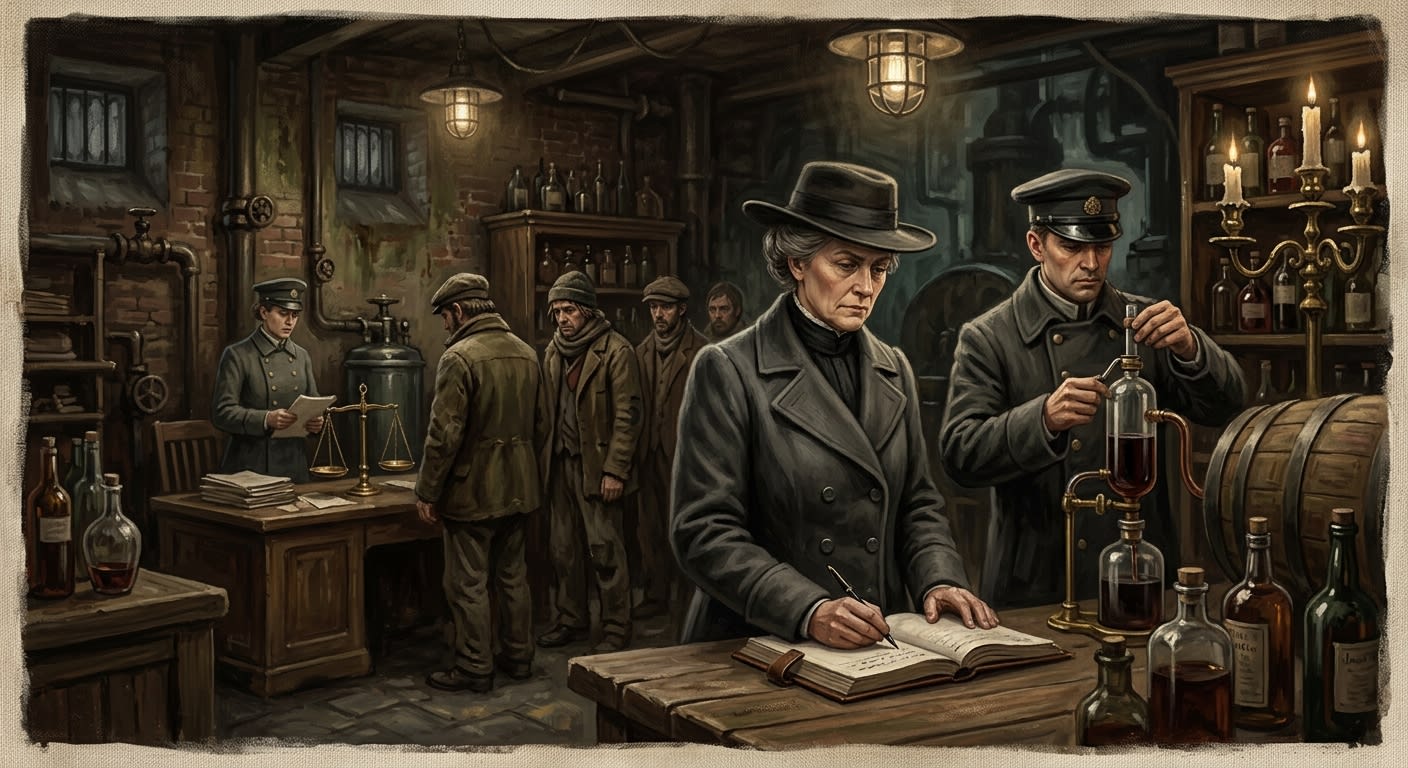
The Bureau's visible work occurs in taverns. This has damaged its dignity and improved its intelligence.
Every licensed alehouse in Synod territory must display a Temperance board: permitted hours, feast exemptions, soldier limits, clerical allowances, stimulant bans, debt-drinking warnings, and the current table of substances whose use constitutes presumptive demonic exposure. The board must be posted near the door, visible to patrons, unaltered by grease, smoke, knife, jest, or devotional improvement. In practice every board is altered. Soldiers add saints. Dockworkers add obscene arithmetic. Priests correct grammar. Temperance inspectors photograph, scrape, fine, and sometimes laugh, depending on rank and weather.
The fines matter less than the records. A tavern is a listening device with beer. Temperance learns which regiment has begun drinking before dawn, which choir has shifted from wine to laudanum, which supply clerk pays in unfamiliar coin, which Widow's Penny assessor has developed a taste for northern spirits beyond his salary, which sailors from the Baltic refuse to sit with their backs to doors. It files moral weakness and sells the useful portion to Shadows, Purity, and War.
Licensed weakness is the office's most humane invention. Soldiers returning from Königsberg's Sea Wall are granted controlled drink after debriefing, not before, and never alone. Choir members under echo stress receive throat spirits by spoon. Frost Yards custodians are allowed two measures after mortuary irregularities if the body remains supine by morning. The formal justification is medicinal regulation. The actual reason is that men who have saluted fog, heard hymns returned before singing, or found corpses facing northeast require something warmer than doctrine to keep their hands from shaking.
Temperance knows this. Temperance files it as dosage.
#On the North, Where Moderation Freezes
The Bureau's hardest frontier is not the wine-cellar of Strasbourg, though several archons have attempted to make it so. Its hardest frontier is the Fractured North, where winter turns fasting into weather, hospitality into survival, and moderation into a word southern clerks pronounce while wearing gloves indoors.
Scandinavian practice offends Temperance at every point. Feasts run too long. Fasts run too hard. Mead moves through Moots in volumes that would qualify as flood under civil engineering standards. Children drink seal-broth thick enough to support a spoon upright and then go split wood in conditions that would kill an Iberian theologian before he finished objecting. Watch Captains at fjord-bell towers maintain spirit flasks beside bell-ropes and call them anti-fog medicine. Temperance calls them unlicensed stimulants. The Watch asks whether the inspector would like to stand the midnight bell without one. The inspector usually revises his language.
The A.S. 193 All-Moot incident (Unregistered) remains Temperance's private humiliation. The Synod's representative arrived expecting agenda, delegation, counter-delegation, and minutes. He found elders debating fish-rights in Old Norse while consuming mead so steadily that his clerk attempted to classify the gathering as a mobile distillery. On the final day, when relations with Strasbourg were at last discussed, three elders asked whether the Bureau of Temperance was the office that measured cups because it could not measure courage. The minutes omit this. The clerk's diary does not.
A.S. 199 brought the Northern Concordat-Variant (Unregistered) reclassification, under which the Bureau of Rites admitted that many Scandinavian practices were “conditionally compliant in substance while irregular in form.” Concord replied with one sentence: do not start a naval war over mead. Temperance objected with thirty pages of alcohol tables. The objection remains pending. The mead remains stronger than policy.
#On the Exile of Temperance
The Bureau's true northern terror is not drunkenness. Drunkenness can be fined. The terror is balance.
Heretical sources speak of the Exile of Temperance, a wanderer of the frozen North who hungers not, thirsts not, and preaches that balance, rather than obedience, is the path to salvation. The distinction is poison poured into a chalice of clean water. Obedience belongs to institution. Balance belongs to judgment. A peasant who seeks obedience asks the Bureau for measure. A peasant who seeks balance examines the measure, the hunger, the season, the child, the road, the bell, and the hand holding the ladle. That way lies private conscience. Private conscience is a little chapel in which rebellion keeps warm.
The Scandinavians speak of the Exile as one speaks of bad weather, unreliable boats, and relatives with knives: known, unpleasant, not worth theatrical alarm. This is precisely what alarms the Bureau. A demon cult produces panic, raids, sermons, arrests, and satisfying piles of ash. A tolerated wanderer produces habits. Habits survive arrests.
Temperance Circular 190-N declared the Exile “debunked by lack of verified appetite-anomaly specimens.”
Withdrawn after the A.S. 193 operative return, when the Bureau's northern agent arrived at Königsberg in a fishing boat with a polite note requesting that no further visitors be sent. The agent refused food for nine days, drank melted snow only when ordered, and said the word “enough” in a dialect no linguist recognised. He recovered. His appetite did not.
The office now keeps an Exile desk behind three locks in a corridor where no inspector admits working. Its files contain folk verses, ration anomalies, impossible fast records, Watch Captain testimony, and seized fragments of a doctrine the Bureau calls Equilibrium Heresy (Unregistered). Balance, the fragments say, is older than law. Hunger has its measure. Thirst has its measure. Fear has its measure. Obedience that breaks measure becomes sin wearing a collar.
TEMPERANCE EXILE DESK — FRAGMENT E-7 Recovered from northern warm-paper packet, A.S. 198. Text: “When the cup is full, stop. When the cup is empty, fill. When the priest commands thirst after the child has fainted, the priest has become the drought.” Disposition: sealed; translator reassigned; cup destroyed; thirst unaffected.
#On Grau's Glass and Halvorsen's Permission
No discussion of Temperance can avoid Rector-Chaplain Wendelin Grau, because Grau has made a professional art of standing inside the Bureau's exception clauses while smiling as if innocence were one of the approved liturgical colours. He drinks after evening rotation at Königsberg. He drinks with officers, singers, Frost Yards custodians, and, on one regrettable evening, me. He drinks nothing during duty, nothing before confession, nothing during Choir watch, and nothing that prevents him from hearing the Grey return a hymn before the Choir has sung it. Temperance cannot prosecute him because he is compliant in every measurable category and offensive in the only category that matters: he understands the reason for the rule better than the rule-makers.
Castellan-Warden Halvorsen permits controlled spirits after Sea Wall incidents. Her written order calls the practice “circulatory stabilization under cold exposure.” Everyone at Königsberg knows this is a lie. It is a merciful lie, one of the rare kinds I allow without revision. Temperance objected in A.S. 196. Halvorsen sent back a crate containing twelve empty flasks, fourteen sealed exit interviews, and a note reading: “Send warmer doctrine.” The objection closed within the month.
The Bureau has adapted because adaptation is what policy calls surrender after it has found a clean collar. Northern Exposure Protocol 19 (Unregistered) permits spirit measures after Grey contact, under chaplain supervision, provided the drinker is observed for hymn anticipation, northeast orientation, face-recognition distress, and “excessive philosophical appetite.” The last category was added by Temperance, which fears the Exile more than the fog. Correctly.
#On Its Present Condition
As of A.S. 201, the Bureau of Temperance remains small, officious, mocked, and indispensable. Its inspectors are cursed in taverns, ignored at Moots, bribed at festivals, consulted after outbreaks of bad drinking, and summoned with unseemly haste whenever a garrison's indulgence begins to resemble cult practice. It regulates weakness because weakness ignored becomes vector. It licenses comfort because comfort forbidden becomes black market. It prosecutes excess because excess is where Hell places its fingers. It prosecutes abstention because abstention, once detached from obedience, begins to look like the Exile walking across snow.
Its current ledgers show three red columns. First: southern hunger tonics spreading north through discharged soldiers from Constantinople. Second: Grey-exposure spirit permissions rising at Königsberg and along the Northern Theater corridor. Third: Equilibrium Heresy phrases appearing in tavern boards after being scratched there by hands no witness can identify. “Enough is holier than ordered.” “Balance before bell.” “The empty cup does not salute.”
Hearsay has copied the phrases. Doctrine has denied their importance. Purity has asked for names. Temperance has ordered the phrases scraped away. The taverns have produced more phrases.