
#The Armed Hand of Sacred Bureaucracy
"A normal office has a counter. A Task Force carries the counter into a room where the counter has been broken, stolen, or made to lie."
I have written at length about the Synod's instruments of governance — its seals, its bells, its Ledger that remembers what the living prefer to forget. Most of those instruments operate through patience. They sit in halls, behind grilles, under lamps, and they process. They stamp. They file. They make existence a matter of record and absence a matter of policy. The Synod governs through the magnificent tedium of procedure, and procedure, on its better days, keeps the continent fed, tithed, and doctrinally compliant without anyone being required to bleed on the paperwork.
The Synod Task Force exists because procedure has worse days.
A Task Force is a small, temporary, armed administrative cell created by warrant and sent to sites where normal process has failed, become contested, or begun protecting the people it was meant to audit. It is assembled around a specific Matter — a disputed satchel, a missing register, a bell that sounds before any hand has touched the rope, a relic office that certifies objects which have started behaving impossibly, a customs house whose ledgers are clean in precisely the way that clean ledgers ought not to be. The cell may exist for an afternoon or persist through linked warrants for months, accumulating personnel, sealed evidence, hostile witnesses, and political debts that no Bureau will later admit having incurred.
Its sites are not battlefields. They are petition halls, customs houses, bell galleries, shrines, tenements, tariff chapels, mortuary offices, processions, docks, and sealed counters — the places where the Synod's daily machinery touches citizens who cannot escape it. The Bureau of War handles conventional fronts and the grinding arithmetic of the Sagittal Line. A Task Force may call soldiers during escalation, but it begins as an administrative claim with breach capability, not a military column with a theological excuse.
The distinction from the Bureau of Purity is worth the ink, because Purity will claim otherwise. Purity hunts corruption, heresy, contamination, and illicit relics with the focused appetite of an institution that has confused zeal with jurisdiction. A Task Force has a defined Matter and seeks a lawful outcome — which may include preserving a ledger that Purity would burn, protecting a witness that Purity would interrogate into silence, or preventing Purity from destroying evidence that implicates Purity. The White Cloaks do not enjoy this distinction. They do not enjoy many things, but this one in particular makes them write memoranda with such force that the paper arrives at Doctrine already bruised.
From the Bastion Watch and local civic officers, the Task Force is separated by altitude. The Watch knows every tolerated arrangement in its district — which smuggler pays which sergeant, which ferry crossing closes early on feast days, which confession booth doubles as a dead-letter drop. A Task Force arrives above or outside those arrangements. Honest Watch officers may welcome it the way a drowning man welcomes a rope. Compromised Watch captains treat it as intrusion, which it is, and as insult, which it is also, and as threat, which it was designed to be.
The alleged Bureau of Shadows — whose existence Doctrine denies with the particular energy that Doctrine reserves for things that are true — operates through covert methods, unnamed agents, and consequences that arrive without return addresses. A Task Force is the opposite instrument: visible authority, declared Matter, named issuing office, publicly remembered demands, and a report that can be challenged by anyone with standing, a clerk, and the stamina to survive the filing queue.
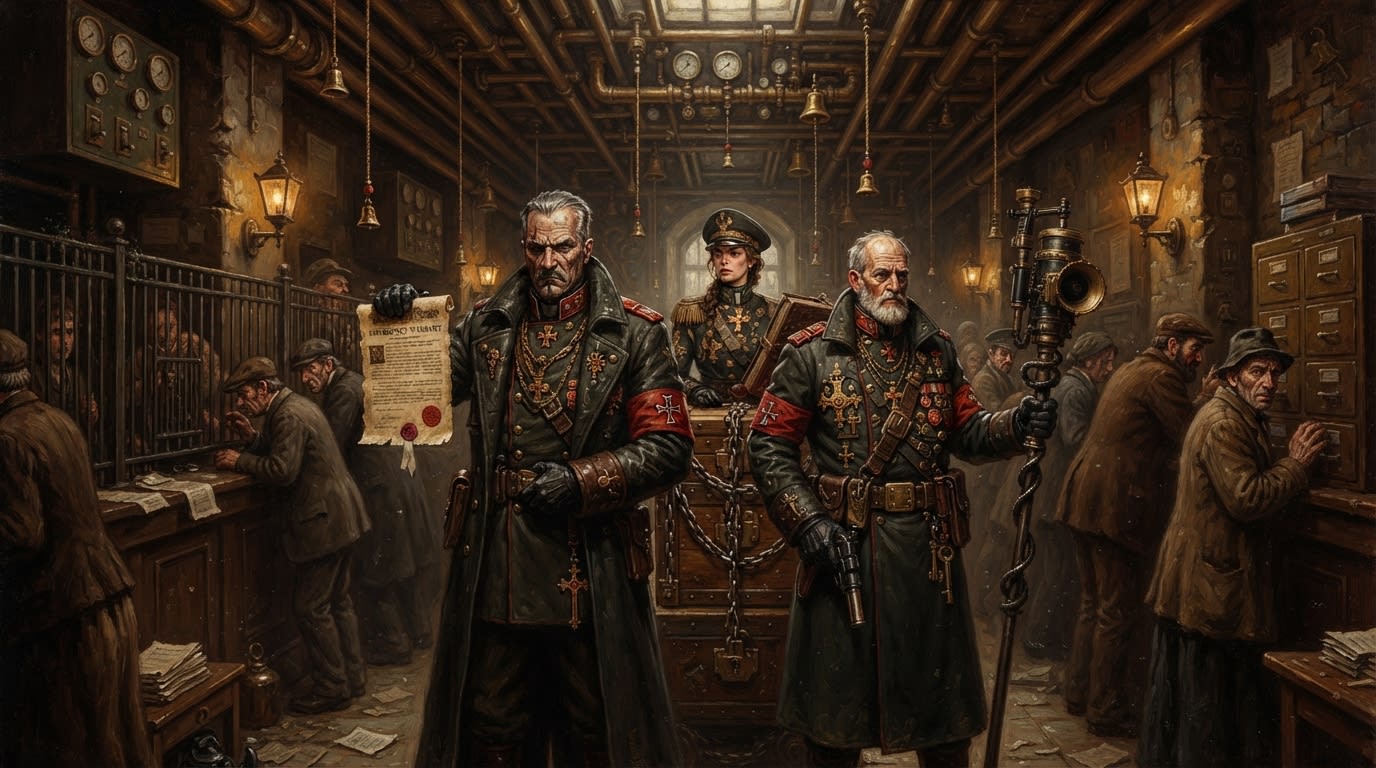
Its arrival is recognizable to any citizen who has lived long enough to see one. The visible shield. The mantle. The warrant case held at chest height so the seal catches whatever light the hall affords. The declaration of Synod authority, spoken aloud, which changes a room the way a bell changes a street — by making everyone aware they have been counted. And behind the declaration, the immediate concern over documents, drawers, receipts, and the small administrative objects that can implicate people more permanently than a blade.
A Task Force can be salvation. It can be the only authority capable of confronting a corrupt tariff chapel, a self-protecting Watch chapter, a relic office grown fat on false certification, a Purity cell fabricating evidence against citizens whose real crime is owning property the Bureau covets. It can force records open when every local office has agreed, with the silent collegiality of mutual guilt, to keep them shut.
It can also be ruin. Closure. Seizure. Detention dressed as protection. A Task Force may protect a witness by placing that witness in custody so thorough that their family loses contact, their employer loses patience, and their neighbours lose memory. It may preserve evidence by sealing it beyond public challenge, which is preservation in the way that entombing a man preserves his bones — technically accurate, practically fatal. It may prevent panic by controlling what becomes publicly known, which is governance when done well and censorship when done by the same people who caused the panic.
Earlier training materials described the Task Force as "the Synod's surgical instrument."
The metaphor has been withdrawn. Surgery implies a body that wishes to be healed. Many of the bodies the Task Force operates upon are fighting the scalpel, hiding the wound, and billing the surgeon for trespass. The amended description is "armed procedural claim."
Better officers — and they exist, in the way that honest priests exist, which is to say in numbers sufficient to be cited and insufficient to be relied upon — understand that a valid warrant can enable cruelty, that a technically accurate report can conceal truth through omission, and that a sealed appendix can bury a fact more effectively than a sealed grave. Worse officers understand these risks with equal clarity and choose to exploit them. The Synod trains both. The Synod promotes both. The Synod files both, and the filing, as the Bureau of Records will tell you with a patience that borders on menace, is the point.
#Crimes, Contradictions, and Jurisdiction
"The Synod does not fear the isolated crime. It fears the moment when two of its own ledgers disagree, because a ledger that contradicts itself has become a witness against the institution that wrote it."
A Task Force is not dispatched for a theft. The Watch handles theft. A Task Force is not dispatched for a murder. The Bureau of Mercy handles the body, and the Watch, if sufficiently motivated, handles the murderer. A Task Force is dispatched when the crime has become a contradiction — when the ordinary machinery of jurisdiction has tangled with itself, and the offices responsible for investigation have discovered that the evidence implicates the investigators.
The triggers are institutional, not dramatic. A customs ledger implicates the customs office assigned to review it. A Watch chapter holds the sole witness against its own captain. A bell sounds before physical action could have caused it — which is a timing error when it happens once and a jurisdiction crisis when it happens on the same morning that a grain shipment vanishes from a dock that the bell was supposed to seal. A relic office certifies an object that behaves impossibly, and the three Bureaus responsible for sanctity, containment, and record-keeping each insist that the problem belongs to the other two. A tariff chapel maintains exemplary returns while serving a district where citizens are starving, and no one can explain the gap because explaining the gap would require admitting that the returns are exemplary in the way that a painted window is transparent.
A person is simultaneously recorded as living, dead, and promoted. This happens more often than the Bureau of Records admits, which is to say it happens exactly as often as Records claims it does not.
#On Evidence Crimes
Evidence crimes attack the Synod's capacity to establish what happened, and the Synod — for all its faults, and I have catalogued many of them at length and with relish — depends on its capacity to establish what happened the way a cathedral depends on its foundations. Remove the foundation and the spire becomes a philosophical question.
False ledgers, altered manifests, missing registers, substituted evidence, forged public copies, destroyed originals, broken receipt chains, false stamps, and the selective disappearance of pages from bound folios — these are the weapons. The logic is brutal and clean: an unpreserved fact can be denied; a denied fact can be replaced; a replaced fact, if stamped with sufficient authority, becomes the only fact; and forged authority can create a competing reality that the Synod must then treat as real until it can prove otherwise, which requires the very records that the forger has already destroyed.
The escalation path is a staircase built by clerks who did not intend to build a staircase: error to mass guilt, mass guilt to purge, purge to policy. Altered burial entries can hide murder, erase heirs, conceal disease, or create false sanctity — and a saint fabricated from altered burial records can generate pilgrimage traffic, tithe revenue, and doctrinal precedent that persists long after the original forgery has been detected, because by then the revenue has been spent and the doctrine has been ratified, and the Synod would rather canonize a fraud than admit it paid for the candles.
#On Custody Crimes
Custody crimes concern people and objects made officially unavailable. The distinction between possession and custody is the distinction between holding a man's arm and holding a man's name, history, location, medical condition, legal standing, and forwarding address. Possession is physical. Custody is administrative, and administrative custody in the Synod is the more dangerous instrument, because a man can escape a grip but not an entry in the Ledger of Souls that declares he has been transferred to a facility that does not answer correspondence.
Unreceipted witness transfers. Bodies moved before inspection. Captives placed in "protection" and then hidden behind a custody chain so long that the chain itself constitutes a labyrinth. Children diverted into charitable oversight and never produced for review. Scheduled tribunal witnesses reassigned to trench service on the Sagittal Line the morning before testimony. Relics stored by the office under investigation, in the office under investigation, guarded by employees of the office under investigation, who maintain that the arrangement is secure because they have not stolen the relic yet and do not intend to begin.
A Task Force must make the custody chain survive hostile review — not merely seize an item or a person, but document the seizure so thoroughly that the documentation can be read by a hostile clerk six months later and still compel belief. This generates conflict with the regularity of tides. Families object. Witnesses panic. Local officers resist correction with the polite obstructionism of men who know that their filing cabinets contain more ammunition than their armouries. Every transfer can become a new accusation.
#On Seal and Warrant Crimes
Seals are visible authority; warrants are claims that visible authority authorized action. The crimes that orbit them are the crimes of impersonation, and impersonation in the Synod carries the particular horror of a system that has made identity a bureaucratic product. A false seal does not merely deceive. It creates a counterfeit sovereignty — a small, portable kingdom whose borders are drawn in wax and whose subjects obey until someone with the correct reference folio notices that the pressure is wrong, the pigment too glossy, or the damage mark inconsistent with the die's recorded history.
The most dangerous warrant is one that is formally valid and plausible but based on corrupt premises. Its seal is genuine. Its issuing office exists. Its cited authority is real. Its Matter is fabricated, and the fabrication is good enough that the officers carrying it believe they are enforcing law rather than performing theatre for a superior who has already decided the outcome. A Task Force may investigate a poisoned warrant and discover that its own warrant has the same defect — issued by the same compromised office, stamped with the same corrupted die, authorized by the same official who is now being investigated. This is not an edge case. This is Tuesday.
#On Bell and Alarm Irregularities
The Bureau of Bells governs public timing, and public timing in the Synod is not a convenience but a sacrament. Markets open at the bell. Gates close at the bell. Curfews fall at the bell. Fire response, evacuation, panic containment, the distinction between a lawful gathering and a prohibited assembly — all governed by bronze, iron, rope, and the civic habit of obedience to a sound that most citizens have never questioned.
When the bells lie, the city lies. An early bell can empty a market before a shipment arrives, redirecting the goods to a private warehouse. An absent bell can leave a gate open past curfew, allowing passage that no manifest records. A rerouted warning can drive a crowd into a corridor that has been prepared — staffed with clerks who will process the crowd into a register that the crowd did not consent to join.
Different offices read the same bell failure as a technical problem, a crowd-control decision, sabotage, or a record discrepancy, depending on which reading protects their budget. The Task Force acts because each account may contain part of the truth, and because the Synod's deepest institutional anxiety is that the bells will continue sounding on a schedule that no authorised office set.
#On Relic and Occult Custody
False relic certification, contamination, impossible objects, marked people, whispering bones, demon-glass, office manifestations, unverified transfers, and containment failures — the category exists because the Synod must maintain that relics are holy, that false relics are deniable, and that dangerous relics can be contained without admitting that sanctity can behave like an infection. The Edict of Authentication provides the framework. The framework holds until the relic begins behaving in ways the framework did not anticipate, which is to say, until the relic begins behaving at all.
Destruction may be both a solution and a crime. It can remove danger but eliminate evidence. Preservation can allow danger or rumour to spread. A Task Force can be accused of destroying proof too early, protecting a dangerous object for procedural reasons, or — in the memorable case at the cooperage on the Saône — preserving an object whose principal danger was that it generated revenue for an office that had mistaken commerce for sanctity. The distinction between a holy relic and a profitable fraud is, in the Synod's practice, less a line than a negotiation, and the negotiation is conducted with the particular ferocity of men who cannot afford to discover that they have been praying to a forgery.
#Warrants, Seals, and the Right to Enter
"A warrant does not prove truth. It proves that an office believed truth was in danger and could afford the paperwork."
The warrant is the Task Force's soul, mandate, leash, and eventual epitaph. Without it, the cell is a gang of armed clerks committing trespass. With it, the cell is a gang of armed clerks committing procedure — a distinction that matters to the Synod, if not always to the citizens whose doors are being opened.
#On the Warrant as Instrument
A warrant may be carried as a case, tube, folio, reliquary envelope, slate, packet, or public copy, depending on the issuing office and the issuing office's opinion of its own importance. It names the issuing office, the Site, the Matter, the granted powers, the binding exclusions, and the expiry time or condition. It is specific because specificity is the difference between lawful force and armed appetite — a difference the Synod takes seriously in print, if not always in practice.
The specificity also determines cooperation. A local Watch sergeant presented with a vague mandate will cooperate vaguely — which is to say, slowly, selectively, and with the defensive instincts of a man who knows that vague mandates produce specific scapegoats. A Watch sergeant presented with a named Matter, a bounded Site, and enumerated exclusions can cooperate precisely, which protects both parties, or obstruct precisely, which at least creates a record of the obstruction.
#On the Seal as Technology
The seal makes distant office authority present in a room. This is not metaphor. When a Purity Agent displays a warrant bearing the seal of Commission Review, she is not showing a decoration. She is introducing an absent superior — the Commission, the Bureau, the issuing Archon, the accumulated precedent of every case that seal has opened — into a space where that superior has never set foot and never will. The seal carries the weight of the capital, the archive, the tribunal, the punishment, the salary, the oath, and the custom. It moves resources, people, gates, rooms, and blame. Its display changes a situation before force is applied, because citizens who have lived under the Synod long enough have learned that the seal is the blow and the fist behind it is merely the delivery mechanism.
A visible seal can calm a crowd, compel officials to cooperate, make a witness speak, or warn implicated people to move evidence. It does all of these simultaneously, which is the seal's utility and its contradiction.
#On Powers and Exclusions
Common warrant powers include: inspect, question, receive evidence, seize named items, seal rooms, detain named people, escort witnesses, enter controlled zones, request Watch assistance, close counters, quarantine objects, preserve bodies, interrupt bells, and compel production of records. The list reads like a liturgy of intrusion, which it is. Each power is a door the warrant opens. Each exclusion is a door the warrant locks from the other side.
Exclusions define the shape of what the Task Force cannot do, and skilled officers read them as intelligence. No entry to the Sealed Archive means the Sealed Archive contains something relevant. No blanket detention means a previous Task Force detained too broadly and the political cost arrived before the report. No destruction of originals means someone fears the originals will be destroyed. No Purity burning without Records receipt means Purity has burned evidence before and Records is still composing the memorandum of complaint. No interrogation of minors means a minor has been interrogated and the resulting scandal has not yet been fully buried, merely mulched.
A barred archive may contain the target. An anti-detention clause may reflect prior disappearances. A Bell confirmation requirement may expose an alarm dispute that the Bureau of Bells would rather resolve internally, at its own speed, which is the speed of bronze cooling — measurable in theory, imperceptible in practice.
#On What the Warrant Grants and What It Does Not
The warrant grants visible procedural legitimacy. It turns entry into authorized access, a request into official demand, seizure into lawful custody, movement into protected transfer, and a sealed door into a door whose keeper must explain refusal. It changes classification. It creates credible public demand. It establishes custody routes. It makes Source recognizable. It secures assistance. It protects officers from immediate criminal classification while the Matter is active, which is a protection that expires with the warrant and not one hour later.
The warrant does not prove that the Matter, the issuing office, the witness, the evidence, or the public copy is correct. It does not supply professional competence. It does not guarantee obedience — local officials may cooperate, obstruct, exploit it, or comply slowly enough to sabotage the action while maintaining the appearance of respect. It does not create universal access to every archive, shrine, passage, dormitory, vault, sickroom, or drawer. It does not erase public consequence: civilian harm, a lawful shot, closure effects, delayed medicine, hunger, and rumour remain politically meaningful long after the warrant has been filed and the filing clerk has gone home to a family that does not ask what he filed today.
The warrant does not grant victory. It permits the Task Force to enter a dispute. Settling the dispute requires competence, courage, and the particular institutional stamina of people who understand that the second battlefield — the report, the review, the memorandum, the hearing — is more dangerous than the first.
#On "The Warrant Enters First"
This is the Task Force's doctrine, procedure, protective fiction, and, in the hands of worse officers, its most elegant self-deception. It requires visible authority to precede force, so that witnesses understand the claimed basis of entry. The shield is displayed. The seal is shown. The Matter is declared. The room is informed, and only after the room has been informed does the Task Force act — enter, question, receive, seize, seal, detain, or do whatever the warrant permits and nothing that it does not.
Prior training summaries described "The Warrant Enters First" as a guarantee of lawful conduct.
Corrected. It is a guarantee of visible sequence. Lawful conduct is a separate question that depends on whether the officers behind the warrant treat it as a limit or a license. The doctrine has been reclassified from "procedural safeguard" to "procedural aspiration." The reclassification was opposed by Purity, which prefers its aspirations to be indistinguishable from commands.
In its best form, the doctrine slows unlawful action and preserves lives because permission has a discernible shape — the shape of a seal, the weight of a case, the voice of an officer who has named the authority she serves and the limits she observes. Bystanders can witness. Advocates can challenge. The record can later verify that what entered the room was a lawful claim and not an armed appetite wearing one.
In its worst form, a bearer treats any action taken after displaying the warrant as automatically lawful, and becomes the kind of unchecked office that the Task Force exists to investigate. The Synod's record preserves the opening legal claim. The district remembers the breached door and the people behind it.
#The Record, Source, Custody, and Review
"Facts do not naturally survive. They must be preserved, authenticated, transferred, and reviewed, or they can be denied, replaced, captured, and monopolized by the strongest party. This is not philosophy. This is Tuesday's filing."
The Synod's deepest operational conviction — deeper than theology, deeper than tithe law, deeper than the Bureau of Doctrine's opinion of its own infallibility — is that a fact left unattended will die. It will be denied by the person it accuses, replaced by the version that protects the powerful, captured by the office with the fastest copyist, and monopolized by whoever controls the room where the original was last seen. A fact must be written, sealed, witnessed, transferred under receipt, stored under custody, and made available for hostile review, or it ceases to exist in any sense the Synod recognizes. The graveyard of unrecorded truths is larger than any catacomb in the faithful world, and unlike the catacombs, no one leaves flowers.
The Task Force exists to keep contested facts alive long enough to matter. Its central doctrine is that the record must survive — the record above the officer, above the office, above the political convenience of the issuing Bureau. This is a noble principle. It is also a convenient one, because an institution that declares the record sacred can justify almost any act committed in the record's defence, and the record, unlike a living witness, cannot object to the methods used to preserve it.
#On Distinctions That Kill
The Task Force operates through distinctions that appear clerical and become lethal. Possession is physical control — a hand on a satchel, a guard at a door. It is visible, temporary, and proves nothing except that someone is strong enough or fast enough to hold a thing. Custody is the documented chain: identity, condition, authority, transfer, witness continuity, source, and purpose. For people — and the Synod places people in custody with the same procedural grammar it applies to sealed folios — custody includes remaining alive, identifiable, reviewable, and protected from silencing, which is a longer list than possession requires and a more expensive one to maintain.
Receipt is official acknowledgement that an item, witness, or claim entered institutional attention. Receipt does not establish truth, authenticity, or honesty. It establishes that total denial has become harder — which, in the Synod's arithmetic, is a meaningful gain. A lie that must contend with a receipt is a weaker lie than one that floats free in oral memory, and the Synod has made an art of weakening lies by small administrative increments until they collapse under the accumulated weight of their own contradictions.
Authentication verifies evidence, relics, confessions, copies, and their paths into the record. Source identifies the producer, mover, observer, alterer, beneficiary, and risk-bearing context of a claim — the chain by which a fact earns the authority to accuse. Review is later scrutiny by hostile offices, clerks, advocates, witnesses, families, and other actors whose motives range from justice to vengeance to the simple bureaucratic pleasure of proving a rival's report inadequate.
A result that does not survive review is not a result. It is a draft.
#On Operational Meaning
Every Task Force action creates two records simultaneously: the record of the Matter under investigation, and the record of the Task Force's own conduct. A shot, a forced door, a closure, a detention, a transfer — each creates witnesses, physical evidence, fear, and obligations for the issuing office. The Task Force is Source against itself from the moment it displays the warrant, and the warrant, once displayed, cannot be undisplayed.
A detained witness raises continuing questions that the Task Force cannot seal away with the evidence: who needed protection, from whom, for how long, and why the family has lost contact. A sealed room raises the question of what the seal conceals — the crime, or the investigation's own errors. A forced entry raises the question of whether the door was evidence, a barrier, a legal limit, or all three, and whether the officers who broke it knew the difference and chose not to care.
#On Record Pressure
Record Pressure begins when the Task Force's own conduct becomes more powerful evidence than the original crime. It is the institutional equivalent of the flame catching the firefighter's coat, and it is as common as it is predictable.
The common form is contradiction: the warrant authorizes inspection but the report describes seizure; the timing log shows entry at Second Peal but the Watch record shows the door opened at First; the Purity report claims contamination but the Bureau of Records shows the object was catalogued as inert six months prior; the Watch cooperation report is pristine but the custody chain has a gap the width of a man; the public rescue announcement says "escorted to safety" but the family reports disappearance.
Institutional pressure follows: a compromised office is protected because exposing it would weaken the warrant that authorized the investigation; a superior demands closure before authentication because the political cost of an open Matter exceeds the political cost of a false one; evidence is sealed to protect the office rather than the public, and the seal, being legitimate, makes the protection legitimate, and the legitimacy makes the burial permanent.
#On Moral Paths
A principled cell preserves inconvenient facts. It protects testimony without turning testimony into disappearance. It treats exclusions as binding rather than advisory. It records uncertainty, lateness, division, and Synod error when true, because the record that omits the institution's failures is a record that has already been corrupted, even if every individual entry is accurate.
A compromised cell preserves only the facts that protect itself. It creates cleaner copies. It assigns Source to the dead, who cannot contest attribution. It makes witness custody unreviewable by transferring witnesses through so many hands that the chain becomes a maze. It receives evidence but never authenticates it, because authentication might reveal that the evidence was manufactured. It seals records to conceal office risk and calls the sealing a security measure, because the Synod has made "security" a word capacious enough to contain anything that an Archon finds embarrassing.
Training materials formerly classified officers as "principled" or "compromised" as fixed categories.
Amended. The categories describe conduct, not character. The same officer may preserve a witness on Monday and bury a receipt on Wednesday, depending on which Bureau is watching and which career the officer intends to have next year. The classification has been changed from "type" to "tendency." Purity opposed the change. Purity opposes most changes that acknowledge human complexity.
The second battlefield begins after extraction — during copying, receipt, public complaint, internal memorandum, and review. The field operation is the opening argument. The report is the closing one. And the final questions are always the same: what survived, who saw it, who held it, who altered it, who challenged it, who benefited, and who disappeared.
#Commissions, Offices, and Internal Rivalries
"A Commission is a polite word for the political faction that decides which doors a Task Force opens and which doors it pretends not to see."
A Commission is the Task Force's broad office identity — its recurring assignment area, its political sponsor, its professional culture, and the particular flavour of institutional compromise it has learned to swallow without grimacing. It is distinct from the specific warrant the way a man's profession is distinct from his Tuesday schedule: the warrant states what the cell is doing today; the Commission explains why it keeps being sent to the same kind of trouble, which offices trust it, which keys and clerks it can access, and which scandals it is expected to frame as necessity rather than corruption.
The Synod's Bureaus share theology and political space but maintain competing interests with the constancy of feuding relatives who have been sealed in the same house by a will they cannot contest. Doctrine defines what is true. Purity enforces what is pure. Records preserves what was. Bells governs when. Relics handles what is holy. Tithes governs what is owed. Oaths controls what is sworn. War consumes people and resources. Shadows is officially nonexistent, which has never prevented it from sending memoranda. A Task Force is assembled inside these conflicts the way a fuse is assembled inside a shell — deliberately, with the expectation of controlled detonation, and with the understanding that "controlled" is a word the Synod uses more often than it achieves.
#On the Five Commissions
Customs and Contraband Review handles grain, manifests, tariffs, docks, markets, warehouses, tariff chapels, seizures, and public counters — the material infrastructure of a Theocracy that governs the spirit but feeds the body, and whose body grows hungry when the spirit's bookkeeping is fraudulent. The Commission detects fraud through weight variance, spoilage patterns, transit exemptions, under-recorded sacks, duplicate seals, reduced charitable shipments, and signs of unexplained wealth in officials whose salary is a matter of public record. A case may begin as smuggling and reveal heresy, or begin as heresy and identify a food administrator as the principal beneficiary. The Commission's virtue is material discipline: weights, ledgers, receipts, and shipment locations are testable. Its corruption is seizure habit — officers who redefine confiscation as preservation, delay distribution until public memory fades, and treat hunger as evidence of criminality in the hungry rather than evidence of theft by the fed.
Bell and Civic Alarm Inquiry operates in the acoustic architecture of governance: timing, warnings, curfews, gates, evacuations, processions, emergency peals, and the civic trust that has been built, bell by bell, over two centuries of scheduled obedience. The Commission is called for early or absent bells, rerouted warnings, gate closures without orders, processions driven into danger, public silence used for theft, and bells that sound without physical action — which the Bureau of Bells classifies as "mechanical sympathy" and everyone else classifies as cause for alarm, if the alarm can be trusted. The Commission's virtue is understanding that public order relies on trusted schedules, repeated signals, and embodied civic habit. Its corruption is paternal silence: bell officials who delay warnings, close gates, or maintain false calm because the public is deemed unready for truth, and the officials who make this judgment are the same officials whose errors the truth would expose.
Relic and Purity Custody handles shrines, relic vaults, excavation sites, sealed archives, contaminated objects, false saints, demon-glass, marked people, and containment. Its personnel include Purity officers, relic notaries, mantle examiners, and custody specialists — professionals whose working assumption is that the sacred can be dangerous and the dangerous can be sacred, which is a theological position the Bureau of Doctrine has never ratified and never denied, because ratifying it would admit the problem and denying it would lose the personnel. The Commission's virtue is treating objects, witnesses, and rituals with appropriate suspicion rather than reflexive reverence. Its corruption is turning suspicion into proof, people into objects, bearers into custody property, and rescue into seizure — which is the same list in a different order, and the order is what separates a custodian from a thief.
Internal Office Review investigates the Synod's own offices — Watch precincts, courts, archives, registries, tribunal chains, warrant issuers, custody logs, review boards, and the protected institutional contradictions that accumulate in any organization old enough to have covered up its own cover-ups. The Commission investigates poisoned warrants, false records, custody disappearances, manipulated registers, Purity misconduct, and superiors who demand closure for self-protection. Its virtue is institutional courage: the capacity to treat official hands as possible sources of corruption, which requires the officer to accept that the hand signing her salary may be the hand she is investigating. Its corruption is factional warfare dressed as reform — one office weaponizing Review against another, or using it to remove a rival while preserving its own abuse. The distinction between legitimate investigation and political assassination is, in the Synod's internal politics, a matter of who writes the report last.
Emergency Public Order handles riots, queues, festivals, evacuations, processions, market crushes, plague scares, ration conflicts, public testimony, and civic sites that must remain functional under fear. The Commission secures routes, preserves witnesses, keeps counters operating, prevents stampede, distinguishes rumour from warning, and constrains force — tasks that require the officer to understand crowd motion with the precision of a bell technician and crowd fear with the empathy of a chaplain, which is a combination the Synod trains for and rarely achieves. The Commission's virtue is rapid comprehension of immediate risk. Its corruption is closure worship: a sealed site, a quiet hall, a dispersed queue treated as success even when the quiet conceals famine, the seal conceals violence, and the dispersed petitioners have been sent home without the bread they came for.
#On Good Standing and Office Favour
A Task Force's reputation is not universal. It is specific, conditional, and political — built relationship by relationship, favour by favour, betrayal by betrayal, in the particular currency of institutional memory that the Synod spends more carefully than coin.
Good Standing with the Customs Office grants desks, keys, manifest access, and warehouse contacts. It also grants debt: an office that has helped the Task Force expects the Task Force to remember the help when the office's own ledgers are questioned. Good Standing with the Bell Authority grants timing routes, relay access, and the cooperation of bell technicians whose knowledge of the city's acoustic infrastructure is more valuable than any map. It also grants expectation: the Bureau of Bells expects its timing to be respected, its false alarms unreported, and its internal disputes left to settle at the speed of bronze. Good Standing with District Purity grants detention space, interrogation access, and the cooperation of Lictors whose skills in physical persuasion are professionally useful and morally exhausting. It also grants debt: Purity expects its methods to be tolerated, its evidence to be accepted, and its critics to be recorded as obstructionists.
Every office judges the Task Force by its own question. Customs asks: were original goods, manifests, and testimony preserved enough to trace the transaction? Bells asks: did warning reach the people it was meant to protect? Relic and Purity asks: did containment hold without reducing a witness or bearer to an object? Internal Review asks: was the underlying contradiction preserved, or merely a convenient person identified? Emergency Public Order asks: did the site remain functional because people were protected, or because they were silenced?
These questions guide future commissions, political favour, and career. They are also, the Hieromnemon notes with the weariness of a man who has read too many review files, the questions that the Task Force asks about itself on the nights when the warrant is filed and the filing clerk has gone home and the officer is left alone with the knowledge of what she did in the room and what the report says she did, and whether the gap between the two is small enough to sleep through.
#Field Doctrine, Tactics, and Public Reputation
"It is strongest when it establishes authority before panic, secures Source before rumour, controls routes before pursuit, and receives evidence before destruction. It is weakest when its own method becomes easier to condemn than the crime it came to solve."
#On Core Field Questions
The Task Force enters every site with six questions that its officers are trained to ask before they ask anything of anyone else. What does the warrant actually cover? Which facts must survive? Which acts can be made public and lawful? What must be controlled without becoming a battle? When is force necessary? And — the question that separates the competent from the merely armed — what will the report say afterward?
The battlefield is shaped by the warrant's Site, Matter, powers, exclusions, and expiration. It is a battlefield with walls, counters, queues, speaking tubes, clerks, and frightened citizens, and the Task Force must win it without destroying the evidence it came to preserve, which is the operational equivalent of extinguishing a fire without getting the documents wet.
#On the Field Sequence
The sequence is trained, drilled, filed, and violated in roughly equal measure.
Show the warrant. Make the Synod's claim visible before the room creates another explanation for why armed people have entered. Failure at this stage looks like assault, and the Watch will treat it as assault, and the Watch will be correct.
Claim authority. Move a public or controlled space toward procedure. The room must understand that what is happening is official, bounded, and subject to review. Failure at this stage looks like shouting, which substitutes for authority the way smoke substitutes for heat — visible, temporary, and leaving nothing behind.
Secure Source. Identify the person, object, order, signal, seal, or beneficiary behind the contested fact. The Task Force is not looking for guilt. It is looking for the chain by which a fact earned the authority to accuse. Failure at this stage means possession substitutes for proof, and possession is a hand on a satchel, not a case in a tribunal.
Control the room. Prevent panic, flight, substitution, and destruction. The Task Force must hold a space without occupying it, which is a distinction that requires the kind of physical restraint that comes from training and the kind of moral restraint that comes from knowing that every frightened person in the room is a future witness and every future witness is a future critic.
Preserve the record. Keep the Matter reviewable after the encounter. A victory that cannot be reviewed is not a victory — it is a precedent, and unreviewed precedents in the Synod have a way of growing into the kind of institutional authority that the Task Force was created to investigate.
Answer for the method. Treat the report and review as a second battlefield. The field operation is Act One. The report is Act Two. And Act Two, in the Synod's theatre, is where reputations are made, broken, and occasionally erased from the Ledger with the efficient thoroughness of clerks who have been given a specific name and a specific pot of ink.
#On Force
Force is permitted because contested truth is often guarded by people willing to destroy it — clerks who will burn a ledger, officials who will transfer a witness, couriers who will eat a seal, and the occasional citizen who has concluded, not unreasonably, that the armed officers entering the room are worse than whatever the officers have come to investigate.
Recognized authority sometimes allows earlier force than an irregular group could use, because bystanders interpret official action differently. A man in a mantle displaying a seal who pushes a clerk away from a drawer is performing a lawful seizure. The same act without the mantle is battery. The same act without the seal is theft. The same act without the warrant is a crime so ordinary that the Watch handles it before lunch.
Seasoned cells use layered control: shield the panic points first, preserve one lawful route and monitor another, position a clerk to receive evidence before a breach, make demands audible so the room can witness the demand, and distinguish — always, explicitly, on the record — between detained suspects, protected witnesses, and disappeared people. The three categories use the same corridors. They enter the same custody chains. They sleep in the same holding rooms. The distinction is paperwork, and the paperwork, as every veteran knows, is the only wall between protection and abduction.
#On Public Reputation
Citizens experience a Task Force as possible relief, possible invasion, possible formal theatre, possible salvation, or the possible start of a purge — and they may experience all five in the same afternoon, depending on which queue they are standing in when the warrant is displayed.
Local offices fear exposure but also fear being mistaken for corruption when they are merely incompetent, or unable to explain themselves because the explanation requires admitting a dependency on another office that neither office has authorized. Smugglers, rebels, false-sealers, and couriers fear Task Force methods that make survival practices traceable through Source and custody rather than violence — because violence ends, but a receipt chain follows a man through every counter, gate, registry, and tribunal until the ink fades or the man does.
The field identity remains: the Task Force can use law as a weapon, protect facts from local corruption, and then protect itself from those same facts. It can enter a room as the only honest authority present and leave as the room's newest institutional problem. It can preserve a witness and make that witness wish it hadn't. It can open a ledger and find its own name inside.
The reputation is earned. The reputation is feared. The reputation is filed, and the filing, as always, is the point.
#Rumours, Recent History, and Notorious Operations
"Task Force stories accumulate faster than convictions, because conviction requires complete files, compatible witnesses, intact Source, custody chains, and politically willing officials. Stories require a queue, a rumour, and one clerk who drinks."
The operations that follow are known to training rooms, public queues, rival offices, rebel pamphlets, and veterans who will tell them differently depending on who is buying the drink. Their official and unofficial names differ, because the Synod gives cases file numbers and the street gives cases names, and the names are better, which is why the street remembers them and the Synod pretends not to. Most occurred between A.S. 188 and A.S. 201, after the black-diesel scandals, the later Line protocols, Mirror Discipline and the Ledgers of Self, and the Records overloads that followed the Synod's attempt to catalogue fear itself and discovered that fear, unlike grain, does not sit quietly in a warehouse while the clerks finish counting.
They teach a common lesson: that institutional failures can be lethal without demonic or criminal cause. The smaller catastrophes — valid seals applied to invalid premises, hungry queues administered by comfortable officials, silent bells in districts that needed warning, wrongly classified children, and compliant clerks who followed procedure into atrocity — are as central to Task Force reality as the demons, the heresy, and the external war.
#The Chrismole Weight Dispute
At a rear-line pump chapel between Munich and the Sagittal Line's eastern defences, blessed and stamped chrismole fuel arrives lighter than its manifest. The discrepancy is small — a few barrels per shipment, the kind of variance that a charitable auditor might attribute to evaporation, transport loss, or the will of God, who is known to tax fuel in mysterious ways.
War, Tithes, Doctrine, and the pump-master each produce internally valid but mutually contradictory measurements. War measures by requisition. Tithes measures by levy receipt. Doctrine measures by consecration volume. The pump-master measures by what fits in the tank. All four numbers are defensible within their own offices. All four numbers cannot be simultaneously true, and the gap between them — small when measured in barrels, large when measured in families — is the gap between a heated tenement and a cold one.
The Task Force finds no demon. It finds no rebel siphon. It finds no single thief. It finds furnace families whose winter heat allotments have been reduced through what the file calls "devotional rounding" — a practice by which each office in the supply chain shaves a fraction from civilian allocation to make its own numbers balance, one barrel at a time, one stamp at a time, one cold night at a time, until the eastern bastions report full supply and Munich reports adequate civilian distribution and neither report is false and both reports are lying, and the lying has been accomplished without anyone writing "steal" on any form in any office at any desk.
The underlying theft is from civilian winter heat rather than the army, which means the army's supply chain is intact, which means no office with military oversight has grounds to intervene, which means the Task Force's finding — accurate, documented, authenticated, reviewed — has no political constituency willing to act on it. "Chrismole weight" becomes shorthand for a case in which every office tells the truth at the scale that favours itself.
#The Index Child
In a school register in the Lower Vire — a district whose primary industries are river mud, despair, and the administrative processing of both — one girl appears twice. Once under her birth name: a child, a pupil, entitled to bread and the particular threadbare mercy the Synod extends to orphans. Once under an Index Damnatus cross-reference number of the kind used for condemned adults: a name attached to Purity grounds for removal, investigation, and the sort of institutional attention that leaves marks on the person receiving it and on the records of the person delivering it.
The same hand and seal approved both entries. A parish bell records attendance under one name and absence under the other. She is present and absent in the same building on the same morning, which is a metaphysical achievement that Doctrine has not authorized and that the school register has accomplished without theological consultation.
Mercy seeks her as an orphan ward. Purity wants to preserve the Index entry pending contamination inquiry. Records wants to correct the duplicate without admitting that the Index Damnatus can attach to an untried child, because admitting the attachment would require admitting the mechanism, and admitting the mechanism would expose the routing table shared by the orphanage, the Purity fume office, and the Night Papers courier station, which placed an adult condemned identity into a child's file through the ordinary operation of interconnected clerical systems that no single office designed and no single office can repair without rewriting the others.
The error is institutional. The defence of the error is also institutional. Offices protect the error because correcting it both saves the child and exposes the system's original harm, and the system cannot be exposed without implicating the officials who maintained it, and the officials cannot be implicated without questioning the Index's procedures, and the Index's procedures cannot be questioned because the Index, as the Bureau of Purity has declared with the calm authority of an institution that does not err, does not err.
The public file disappears. The child does not.
Training materials formerly cited the Index Child case as resolved.
Amended. The case file was closed. The child's status was corrected in one register and left uncorrected in two others. "Resolved" has been reclassified as "administratively concluded," which means the paperwork is finished and the problem is not. Training officers now use the case to teach a single rule: protect the person before correcting the record.
#The Saint-Dust Fraud
On the river belt south of Lyon, a cooperage sells devotional ash vials as the remains of a local martyr. Pilgrims buy them for home shrines. A tariff chapel taxes them as sanctity. The Bureau of Relics has never authenticated the contents. The Bureau of Tithes has authenticated the revenue, which is the Synod's way of declaring that a thing's holiness is less important than its taxability, provided both are filed correctly.
The Task Force discovers that the ash comes from ledgers burned after a Purity review — records of confiscated homes, vanished debtors, and a dead official later honoured publicly for services the official performed while alive and which the official's survivors would prefer not to have investigated while dead. Some contents are mixed with sweepings from a Reliquary Salvager's cart, which adds fragments of authenticated bone to the forgery and makes the fraud simultaneously more convincing and more sacrilegious, which is a combination that the Bureau of Doctrine considers theoretically impossible and practically common.
The object is false as a saint's relic but true as surviving evidence of official harm. Destroying it protects doctrine; preserving it spreads scandal and dangerous worship. The cooperage's customers are praying to the bureaucratic residue of injustice and experiencing, by their own testimony, genuine comfort, which presents the Synod with a theological problem it would rather not formulate and a commercial problem it cannot afford to ignore.
The street calls it The Little Martyrs in the Wall, because the ash is mixed into the plaster of two buildings whose owners found devotional masonry more profitable than devotional vials, and because the phrase captures what the file number does not: that the dead have been built into the architecture without consent and worshipped without authentication and taxed without irony, and that the living have found this arrangement acceptable because the alternative — learning what the ash once was — would cost more than the prayer.
#The Counter-Toll Silence
During a hunger week — which the Synod classifies as a "rationing adjustment period" and the citizens classify as starvation — procession-road counter-tolls continue stamping and processing passing entities while their bells remain silent. The bells should mark paid passage, military exemption, death-goods transit, and dangerous relic custody. Their silence is total and administrative.
Rumours blame rebels, Doctrine, or demon-glass. The Task Force discovers a human plan — an arrangement, a quiet agreement among officials who have calculated that silence is cheaper than honesty and more useful than alarm.
The silence lets uncounted people pass within licensed pilgrimage traffic — some living, some dead, some not yet fully classified by any office that would object to their movement. Mercy gains beds. The Bureau of Tithes' records lose mouths. Purity gains suspects without formal arrest history, which means the suspects can be investigated without the administrative inconvenience of having been officially noticed. The arrangement benefits every office that participates in it, harms every citizen whose passage goes unrecorded, and has been achieved without a single forged document or false seal — only silence, which is not a crime because the Synod has never thought to criminalize the absence of a bell.
The case teaches Bell Keepers that silence can carry stronger operational meaning than an alarm, and Record Runners that perfect papers can conceal a false public route. "Counter-Toll quiet" becomes shorthand for a route that appears orderly because witnesses are prevented from announcing what they observe.
#The Hymnsteel Muster
In Essen-of-Hymnsteel, sanctioned weapon fittings are cut with approved hymn notches meant to improve morale. The notches are doctrinal — their spacing, depth, and angle are prescribed by the Bureau of Doctrine's Committee on Sacred Metallurgy, a body whose jurisdiction is precisely as absurd as its name suggests and whose authority is precisely as real.
Under rain and marching rhythm, the fittings produce a sound that steadies some soldiers and sickens others. Two deserters, brought to the Task Force in chains that were, themselves, notched with a different hymn, say the sound called them by name. The Bureau of War classifies the report as fatigue. The Bureau of Bells classifies the report as acoustic. The Bureau of Purity classifies the report as contamination pending inquiry. The deserters classify the report as the truth, which is the classification that carries the least institutional weight.
The fittings are meant for Fourteenth Garrison appetite-watch rotations near Bastion-Constantinople, where hunger doctrine makes every ration ritual politically charged and every weapon modification a potential theological statement. The case establishes that war, faith, metal, exhaustion, and productivity pressure can create dangerous experiences without a formal supernatural cause — a conclusion the Synod accepts in principle and ignores in practice, because acknowledging it would require auditing every devotional modification on every issued weapon in every garrison on the Line, and the Line has better uses for its clerks, most of which involve keeping the clerks alive.
Official remedy: reclassification, melting, and suppression. Informal remedy: inspect devotional modifications on issued weapons and pray that the inspection does not reveal what the inspection was designed to reveal. "Hymnsteel" becomes shorthand for a morale aid that has become dangerous because comfort is being engineered instead of provided.
#The Widow's Penny Riot
At Griefgate — a name the Synod did not assign and cannot rescind, because the street names its own architecture — families exchange inheritance slips for ration credits, burial tokens, and candles. The exchange is administered by clerks who understand grief as a filing category and process it accordingly: stamp, receipt, condolence (form 7-B), next window.
A Manifest Litigant — a civilian advocate whose profession the Synod tolerates the way a cathedral tolerates pigeons — discovers that soldiers from the Sagittal Line are recorded as unmarried after their widows have already paid grief-tithe on recognised marriages. The War casualty office, the Records inheritance office, and the Tithes assessment office each blame another, and each blame is documented, and each document contradicts the other two, and the contradiction means that the widows are simultaneously married, unmarried, and taxed, which is a status the Synod has not anticipated and cannot resolve without admitting that the three offices produced three versions of the same soldiers' lives and none of the three versions can be withdrawn without invalidating the taxes, the burials, or the pensions that depend on them.
The Task Force preserves records before the exchange turns violent, but preservation freezes disputed payments. The hold prevents hungry families from using credits while officials decide whether recognised marriages existed, and the officials deciding have no personal experience of hunger, which is a qualification the Synod does not list among the requirements for the position but which the widows have begun to mention with increasing specificity and decreasing politeness.
A widow with a levy-bound son and a daughter dependent on Mercy candles strikes a guard. Her act is omitted from official training material but preserved in public memory, which is the Synod's way of acknowledging that some facts are true without admitting that they are relevant. The incident is filed under "civilian contact during operational hold."
"Widow's penny" becomes shorthand for a lawful hold that preserves review by harming the people review should protect.
#The Glass Under Saint Helm
Highland quarry villagers report that a new oathglass gate panel shows people with the wrong number of shadows. The shadows are extra. The shadows are wrong. The shadows, when the quarry factor is consulted, are "a trick of the local light," which is the explanation quarry factors provide for any phenomenon that threatens production quotas and which the Bureau of Purity accepts when convenient and rejects when profitable.
Purity wants closure. The quarry factor calls it superstition. The Bureau of Relics wants the panel intact. Engineering wants measurements. The villagers notice, with the observational precision of people whose livelihood depends on stone and glass, that the phenomenon appears around tithe assessors. This detail is not in the official report. This detail is in every unofficial account. The gap between the two is the gap in which the case lives.
The Task Force confirms demon-glass contamination — which is a factual finding — but determines that the financial fraud is more important to the case. Rejected panels have been sold through dead-goods channels into private confession booths, where citizens pay for reflections that appear to confess first, which is a service the Synod has not authorized and which generates revenue the Synod has not taxed and which produces experiences the Synod has not classified, and the absence of classification is, in the Synod's system, a more dangerous void than the demon-glass itself.
After Mirror Discipline orders, real glass becomes both suspicious and marketable. The occult residue makes the scheme credible; commerce spreads it. The spiritual cause and the commercial exploitation coexist, with the business becoming the larger social harm — because the demon-glass scares a village, but the market for false confession serves a diocese, and a diocese has more customers than a village has residents.
#On the Use of Legends
These stories remain politically useful because no office fully owns or neutralises them. Training officers use them to teach caution. Reformers use them to prove that armed procedure can expose wrongdoing otherwise unreachable. Hardliners use them to claim that doubt wastes lives and resources. Rebels use them to claim that the Synod monetises misery, and rebel pamphlets citing Chrismole Weight and Widow's Penny have been found in districts where the Task Force is simultaneously the most hated and most desired institution, which is a contradiction the Synod files under "public opinion" and which the public files under "life."
All interpretations have supporting evidence. None have exclusive claim. The key lesson — and it is a lesson the Synod teaches without intending to, which is how the Synod teaches most of its important lessons — is that the smaller institutional failures are as central to Task Force reality as the demons, the heresy, and the war. A valid seal applied to an invalid premise. A hungry queue administered by a comfortable official. A silent bell in a district that needed warning. A wrongly classified child. A compliant clerk who followed procedure into atrocity and filed the atrocity under the correct heading and went home.
Earlier compilations categorized these operations as "anomalies."
Amended. They are not anomalies. They are the ordinary output of a system that has made procedure sacred and forgotten that sacred instruments, when wielded by mortal hands, produce mortal results. The amended classification is "institutional case studies." The word "institutional" does more work in that phrase than any clerk in the Synod.
#Fighter Lore Roster
"The roster exists to move truth through danger. It does not exist to create a conventional elite combat squad. The Synod already has those. They are called the Bureau of War, and they are busy."
Task Forces are officially assembled by warrant scope, office need, professional availability, and superior judgment. In practice they also require people capable of working together without killing each other, challenging each other without resorting to memoranda, and later admitting what happened without the admission requiring a second Task Force to investigate the first. Their members come from offices, counters, bell systems, seal registries, holding corridors, relic work, audits, public queues, and Purity departments. They bring different definitions of evidence, different institutional grievances, and different reasons for lying about both.
#Named Core Specialists
Purity Agent Venn
Venn is the Anchor — Purity-trained, shield-carrying, warrant-displaying, and responsible for entry, arrest, protection, and the physical control of whatever room the Task Force has been sent to correct. She was raised through the Purity system's standard pipeline: fume offices, prisoner stairs, convoy chapels, tariff houses, and intake gates, each posting designed to teach an officer that authority is a tool and the tool must be clean. The pipeline succeeded. Venn believes it. She believes lawful purpose can cleanse force the way consecration cleanses a blade — that the warrant, if valid, makes the action righteous, and that the officer who obeys a legitimate order is absolved of the order's consequences. This belief has saved witnesses, opened rooms that needed opening, and moved the Task Force through situations where hesitation would have cost lives and evidence in equal measure.
The belief is also the crack in her foundation, and she knows it the way a mason knows a stress fracture — by feel, in the dark, when the weight shifts. She has seen hunger doctrine criminalize bread lines. She has seen gold-plague fear distort ordinary people into suspects. She has seen Purity cells fabricate contamination evidence against citizens whose real offence was owning property the Bureau coveted, and she has watched the fabrication receive a valid seal and the seal receive a valid stamp and the stamp receive a valid filing, and the filing made the fabrication true in every register that mattered. She did not participate. She filed a dissent. The dissent was noted, sealed, and stored in a drawer that has not been opened since, which is the Synod's way of acknowledging courage and ensuring it has no consequences.
Her kit is practical: shield, shotgun, mantle, warrant case, restraints, chalk, and the expression of a woman who has learned to enter a room as if she owns it, because the alternative — entering as if she's afraid — costs lives. She positions the team so the record can survive: Oren at the speaking tube, Vale at the counter, herself between the door and whatever the room is trying to hide. She does not trust drawers. She does not trust easy cooperation. She trusts the sequence — show the warrant, claim authority, secure Source — because the sequence is the only thing between her and the armed appetite she was trained to replace.
Bell Keeper Oren
Oren reads cities the way other men read scripture — by sound, by timing, by the intervals between signals that most citizens have stopped noticing and which Oren has never stopped hearing. He is the cell's ear: he detects civic systems of warning, closure, timing, routes, and public movement before they fail, and his detection can buy the team an extra warning, an extra pause, an extra evacuation window that the difference between a preserved witness and a dead one occasionally occupies.
He carries references from Strasbourg, Bastion-Shipka, and the Lower Vire — three postings that together constitute an education in the ways bells govern human motion. In Strasbourg he learned the formal system: the Bureau of Bells' Codex, the pealing schedules, the relay chains, the calibrated silences that make the spoken bells meaningful. At Bastion-Shipka he learned what happens when the formal system meets artillery, panic, and officers who override the bells because the bells are telling the truth and the truth is inconvenient. In the Lower Vire he learned what happens when the bells stop and no one repairs them and the district that depended on their schedule discovers that time, without bells, becomes a negotiation conducted by whoever has the loudest voice, which is never the hungriest person.
His flaw is delay. He will hold a warning until he can prove it, because he has seen what a false alarm costs — the evacuated market, the trampled queue, the crushed child, the official inquiry that blames the bell rather than the panic. His caution is earned. His caution can also kill, because a warning held one bell-interval too long arrives after the event it was meant to prevent, and the event, once it has happened, does not care that the warning was accurate. He operates the speaking tubes, the relay codes, the maintenance holds, and the counter-signals that can pause a bell, redirect a crowd, or expose a false alarm — and he does it with the quiet intensity of a man who has learned that the most dangerous sound in the Synod is silence, because silence means either peace or the moment before the record is destroyed, and the two sound identical.
Commerce Clerk Vale
Vale establishes receipt, Source, custody, and evidentiary precision — the administrative chain by which a seized object becomes admissible evidence rather than a stolen thing with a seal on it. She is a former Counter Nine clerk, which means she spent years behind the kind of public counter where citizens bring complaints, requisitions, inheritance slips, grief tokens, and the accumulated paperwork of lives lived under a bureaucracy that requires documentation for birth, death, marriage, doubt, and the ownership of goats. She knows the forms — current forms, obsolete forms, ceremonial stamps that have not been used since A.S. 147 but whose absence on a pre-147 document indicates forgery, and the hidden drawers that every petition hall maintains for forms that are technically prohibited and practically indispensable.
She worked the Queue Road traffic feeding the Sagittal Line, where supplies, dead goods, relics, claims, and living complaints shared pathways with the indiscriminate intimacy of a system that has outgrown its filing capacity. The Queue Road taught her what Counter Nine had begun: that the distinction between error and conspiracy is often a distinction between a tired clerk and a bribed one, and that the distinction matters because error can be corrected and conspiracy must be exposed, and the method for correcting one will destroy the evidence needed to expose the other. She learned to read documents the way Oren reads bells — by absence, by interval, by the thing that should be present and is not, and by the thing that is present and should not be.
Her kit is a custody box, a receipt book, a pen that she holds the way Venn holds the shotgun — as a professional instrument whose misuse she considers a personal offence. She is the last person to enter a room and the first to make the room's contents reviewable, because a room full of evidence is a room full of accusations, and accusations without receipts are just noise, and noise, in the Synod's tribunals, is inadmissible.
Custody Marshal Hadrin Sol
Sol keeps living people alive, identifiable, transferable, reviewable, and present. This is a longer list than it appears, because each item on it can be undermined by the Synod's own procedures with the efficiency of a system that has made people into administrative objects and then discovered that administrative objects are easier to lose, reclassify, and misfile than anyone anticipated.
He handles witnesses, captives, victims, accomplices, children, and suspects — categories that overlap, shift, and occasionally reverse during the course of an operation. A witness this morning can become a suspect by afternoon if the evidence shifts, and a suspect this afternoon can become a witness by evening if the Task Force discovers that the suspect was coerced, and a coerced suspect who has been reclassified as a witness must be transferred from custody to protection without losing identity, condition, medical status, or the chain of testimony that makes the person useful to the case and dangerous to the person who coerced them. Sol manages this. He manages it with the particular steadiness of a man who has decided that continuity is a virtue above comfort, above justice, above mercy — continuity: the quality of remaining the same person, in the same record, visible to the same reviewers, from the moment of intake to the moment of release.
His risk is that custody becomes possession. A marshal who has held a witness for six weeks, managed their meals, their medical care, their family contact, and their testimony schedule can begin to believe that the witness belongs to the operation rather than to the witness's own life. Sol has seen this in other marshals. He has filed reports against it. He has not yet seen it in himself, which may mean he is exempt, or may mean he is not looking, and the difference between the two is the difference between a custodian and a warden.
Mantle Examiner Isera Veyr
Veyr examines whether authority is what it claims to be. Her subject is the mantle — the uniform, seal sequence, behaviour, ritual sign, office habit, and accumulated performance that makes an official look official. She determines whether the authority is valid, corrupt, occult, simultaneously valid and corrupt, or valid in form and corrupt in application, which is the most common finding and the most difficult to prosecute, because the Synod has not yet devised a charge for "technically correct and morally catastrophic."
She was trained in the Mantle Examination Office, a subdivision of Heraldry and Masks and Seals that the Hall of Seals acknowledges with the specific reluctance of an institution that dislikes being examined by its own instruments. Her training taught her to read the signs of office the way a forger reads a seal — by pressure, by age, by the wear that accumulates on genuine authority and the freshness that betrays counterfeit authority, and by the subtler signs that distinguish an official who has earned a mantle from an official who has purchased one, or stolen one, or inherited one from a predecessor whose crimes the mantle now conceals.
Her risk is the opposite of Venn's. Where Venn may treat authorization as absolution, Veyr may treat every cruelty as a case — a symptom, a pattern, a data point in a larger system of institutional failure — and lose the simpler recognition that some officials act badly because they choose to act badly, and the choice does not require a systemic explanation. She can diagnose a corrupt office. She cannot always accept that the corruption is a person rather than a procedure, because procedures can be reformed and persons must be punished, and Veyr finds reformation more satisfying than punishment, which is a preference that makes her an excellent examiner and a frustrating colleague.
Relic Notary Dom Arc
Arc classifies, seals, inventories, and contains objects too holy, too dangerous, too useful, or too fraudulent for casual handling. He is the cell's custodian of things that behave, which is a broader category than civilians imagine and a narrower category than the Bureau of Relics admits. His jurisdiction covers authenticated relics, suspected forgeries, contaminated objects, demon-glass, oathglass, whispering bones, sealed vials, marked cloth, and any item whose provenance is disputed, whose behaviour is documented, or whose presence in a room changes the room's acoustic properties in ways that the Bureau of Bells can measure and the Bureau of Doctrine can deny.
He distinguishes sanctity from ownership, danger from value, and evidentiary worth from devotional worth — distinctions that the Synod requires and that the Synod's institutional structure makes almost impossible to maintain, because a relic that is evidence in a fraud case is also a relic that pilgrims want to touch, and a relic that pilgrims want to touch generates revenue, and revenue generates institutional defenders, and institutional defenders generate memoranda, and memoranda generate filing, and the filing, once complete, makes the fraud case harder to prosecute than the fraud itself. Arc prevents relics from becoming authorities in their own right — objects that, by virtue of their holiness, their antiquity, or their behaviour, acquire a kind of institutional standing that exceeds the standing of the office investigating them.
His kit includes seal wax, containment wraps, classification tags, measurement instruments, reference folios from the Edict of Authentication, and a carrying case lined with materials whose composition is classified by the Bureau of Relics and which Arc describes, when asked, as "sufficient." He works with Veyr on cases where the relic and the authority claiming the relic are both suspect, and with Vale on cases where the relic is evidence and the evidence is holy, and the combination of holiness and evidentiary value creates a custody paradox that neither the Bureau of Relics nor the Bureau of Records has resolved and both Bureaus pretend to have resolved, which is the Synod's standard method of institutional problem-solving.
Warrant Rifle Caul
Caul is the long-range officer, and his function is simpler to describe and harder to perform than any other position in the cell. He must identify the target, the act, the basis, the line, and the Source before firing. His declarations — spoken aloud, recorded, witnessed — make a shot reviewable rather than righteous. A shot without a declaration is murder with a Synod weapon. A shot with a declaration is a lawful act whose lawfulness will be examined by hostile clerks in a warm office six months later, and the clerks will have the time, the comfort, and the institutional incentive to find the shot unlawful, because an unlawful shot creates a scapegoat, and a scapegoat is cheaper than a systemic review.
His personal rule — maintained against training, against pressure, against the field instinct that wants the threat eliminated before the threat eliminates someone else — is no shot without a name. He must know who he is shooting. He must know why. He must be able to write the name, the reason, the warrant line, the distance, the witnesses, and the outcome in a report that will be read by people who were not present and who will judge him by the standards of a room without fear, without urgency, and without the particular clarity that distance provides to a man looking through optics at a person who is about to destroy evidence, kill a witness, or flee a warrant.
He is the cell's most feared member and its most constrained. The shotgun Venn carries is a room-clearing instrument — blunt, close, and governed by the immediate calculus of physical control. The rifle Caul carries is a statement — a declaration at distance that the Synod has identified a specific person and authorized a specific consequence. The statement can be retracted in the report but not in the body. Caul knows this. The knowledge makes him slow, which makes him reliable, which makes the training officers who prefer speed uncomfortable, which makes Caul satisfied in a way he does not express and which the file does not record.
Field Auditor Neme Jast
Jast follows money. She follows it through budgets, requisitions, staffing patterns, transfers, invoices, shortages, bribes, exceptions, and the accumulated arithmetic of institutional self-interest that the Synod generates with the volume and regularity of a river. Her question — the question she asks of every case, every file, every warrant, every sealed room — is who profits from the version of events currently accepted, and her question has a way of arriving at answers that the offices providing the data did not intend to reveal.
She can trace a corruption network through expenses even when direct criminals or objects are absent, because corruption leaves financial residue the way a body leaves warmth — invisible to the eye, measurable by instrument, and impossible to deny once the instrument has been calibrated. She has traced supply diversions through warehouse staffing changes, identified protected officials through anomalous salary continuity during purges that removed their colleagues, and exposed a fraud ring by noticing that the ring's meals were expensed to an office that did not exist and whose budget was approved by an Archon who did exist and who is no longer discussed.
Her risk is arithmetic. She can reduce suffering people to numbers and acceptable losses to budget lines, and the reduction is accurate — the numbers do tell the story — but the story told in numbers is a story without faces, and a story without faces is a story that an Archon can read over breakfast without losing appetite. Jast knows this. She files the numbers because the numbers survive review. She also keeps a private notation system that records what the numbers represent — the family, the child, the widow, the meal that was not eaten, the candle that was not lit — and the notation system is unofficial, unreviewable, and the only record in the cell's inventory that treats human consequence as a category worth cataloguing. The Synod has not asked to see it. Jast has not offered.








#Public and Support Roles
Petition Deputies
Petition Deputies manage queues, counter access, public hearings, and controlled inconvenience — the small, grinding, unglamorous work of making a Task Force's presence survivable for the citizens who have no choice but to remain in the building. Their craft was learned in petition halls, pilgrimage control points, ration spaces, and procession work, where the central skill is not combat but choreography: moving people through restricted space in small steps, making movement legible without making it violent, and preventing the moment when a queue of frightened citizens tips from anxious compliance into the particular desperation of people who have concluded that the armed officials in the room are more dangerous than whatever the armed officials came to investigate.
Good deputies understand that a queue is a social contract written in patience, and that patience, like all contracts, has terms. A petitioner who has waited four hours for a bread stamp will tolerate a Task Force closure for fifteen minutes and become dangerous at thirty, not because the petitioner is violent but because hunger has its own arithmetic and the arithmetic does not include the Task Force's warrant scope. Bad deputies treat people as furniture — obstacles to be moved, arranged, and stored until the operation concludes, and the operation always takes longer than the deputies promised, because operations are governed by evidence and promises are governed by optimism, and optimism is not a category the Synod files. The difference between a good deputy and a bad one is visible in the petitioners' faces, and the petitioners' faces are visible in the report, and the report is visible to the Commission, and the Commission, on its better days, reads it.
Warrant Guards
Warrant Guards are visible armed support drawn from Watch auxiliaries, bailiffs, supply escorts, or security details — the uniformed muscle that holds corridors, stairs, gates, and evidence exits without becoming the public story. They are the frame around the operation: necessary, structural, and ideally invisible in the way that a frame is invisible when the painting works. When the frame becomes the painting, something has gone wrong, and what has gone wrong is usually that the guards have begun treating an official cordon as morally superior to the people trapped by it.
Their risk is the risk of every person given a perimeter to hold: the perimeter becomes the world. A guard stationed at a petition hall stairway for six hours begins to see the stairway as his jurisdiction, the petitioners ascending it as his subjects, and any challenge to his position as insubordination rather than the reasonable complaint of a citizen who needs to reach the bread counter before it closes. Warrant Guards must remember that public halls are not battlefields and frightened citizens are not enemies, which is a distinction that training emphasises and fatigue erodes, and the erosion is faster in halls where the citizens are hungry, because hungry people ask louder questions and loud questions sound like threats to a man whose training has taught him to answer threats with his hands.
Record Runners
Record Runners are young, underpaid, and carrying the most important objects in the operation. They move public copies, notices, receipts, confirmations, countersigns, and other documents between room and review — the circulatory system of a Task Force that lives and dies by its paperwork. Some have Index Damnatus training and can notice unstable names, expired seals, and dangerous delivery routes with the professional instinct of couriers who have learned that the packet they carry may contain the professional destruction of the person who sent it, the person who receives it, or the courier who dropped it on the stairs.
Stopping a Runner can make an office unable to prove what happened. A sealed receipt that does not arrive at the review office is a sealed receipt that does not exist, and a receipt that does not exist is a transaction that cannot be verified, and a transaction that cannot be verified is a fact that the strongest party can deny. Runners know this. They know it with the particular intensity of people whose destruction would be cheap — a shove on a stairway, a locked door, a redirected delivery instruction — and whose replacement would be easy, and whose loss would be noticed only when the receipt fails to arrive and the filing clerk asks a question that has no answer. Their risk is being used as disposable evidence transport, which is what they are, and the word "disposable" is the part that training does not discuss and that the salary confirms.



#Heavies of the Warrant
The Warrant-Bearer
The Warrant-Bearer makes authority visible. She carries the displayed seal, the case, the board, the office colours, or the illuminated slate that tells the room which institution has entered and which institution must be answered. She does not expand scope — a Bearer who reads the warrant broadly and acts on the broad reading is an officer who has confused display with dominion, and the confusion, while common, is punishable, if slowly. Her function is witness creation: every person who sees the Bearer's display can later testify to which authority acted, which is protection for the cell when the cell acts lawfully and evidence against the cell when the cell does not.
The Bearer is the first person attacked and the last person forgotten. In a hostile room, the seal is the target — destroy the visible authority and the cell becomes a group of armed civilians whose actions are criminal rather than procedural. In the public memory that follows an operation, the Bearer is the image: the figure at the door, the seal held at chest height, the voice that named the Synod's claim before the room decided whether to cooperate or resist. Bearers carry this. Some carry it well. Some carry it the way a procession carries a reliquary — with visible reverence that conceals the aching arms — and some carry it as entitlement, which is the moment the Bearer has become the thing the warrant was meant to restrain.
The Purity Breacher
The Purity Breacher opens doors. This sounds simple, and the simplicity is a lie of the kind that Purity tells best — a plain statement that conceals the operational and moral complexity of deciding which threshold to break, when to break it, what the threshold conceals, and whether the threshold itself is evidence, hostage, shrine, trap, or legal limit. He reads hinges, ward marks, barricades, contraband panels, ash seams, and the particular signs that distinguish a door that has been locked for safety from a door that has been locked to destroy what is behind it. His tools include chalk, thread, wedges, quiet charges, label bags, and the professional patience of a man who understands that a door opened too early yields an empty room and a door opened too late yields ash.
His risk is worshipping the clarity of breach. A door broken is a decision completed — the ambiguity of the sealed room replaced by the certainty of the opened one, and certainty is addictive in a profession governed by doubt. The Breacher who treats every delay as culpable and every sealed threshold as an invitation has confused his tool with his purpose. He opens doors so that evidence can be preserved. He does not open doors so that doors can be opened. The distinction is one that training makes and that field conditions blur, because a room that is burning does not wait for the Breacher's philosophical clarity, and a room that is not burning does not announce itself.
The Evidence Cuirassier
The Evidence Cuirassier is armoured custody incarnate — a walking sealed room whose function is to carry originals, relics, tags, witness packets, samples, and evidence bundles from the site of seizure to the point of receipt without the chain being broken, substituted, contaminated, or made to disappear through the particular administrative sleight-of-hand that the Synod's clerks have elevated to a professional art. He preserves seal integrity the way a priest preserves a consecrated host: by treating the object as if its condition is sacramental, which in the Synod's evidentiary system it effectively is, because a broken seal is an accusation, and an accusation without a seal is a rumour, and a rumour without evidence is wind.
His risk is possessive hoarding. A Cuirassier who has carried a sealed satchel through a hostile crowd, down three flights of stairs, past a compromised Watch checkpoint, and into a sealed evidence room can begin to believe that the satchel is safest with him rather than in review — that his custody is better than institutional custody, that his vigilance exceeds the vigilance of the vault, that the chain is most secure when it terminates in his hands. This is the logic of the collector dressed in the uniform of the custodian, and it produces officers who resist surrendering evidence to the very review process that the evidence was preserved to serve. The satchel is not his. The seal is not his. The duty is his, and the duty ends at the evidence room door, and the door, once the Cuirassier has passed through it, closes behind him whether he wills it or not.
The Bell-Pike Custodian
The Bell-Pike Custodian uses a civic polearm — a weapon whose reach, weight, and symbolism were designed for crowd management rather than killing, which is a distinction that the crowds appreciate and which the Custodian maintains through training, restraint, and the constant awareness that a polearm used to manage a crowd can become a polearm used against a crowd with a change in grip and a failure of judgment. He manages bell ropes, gates, queue cords, stairs, ferries, and alarm-driven public movement, and his function is denial: he denies access without trapping people, pauses a crowd without crushing it, holds a line without turning the line into a wall that the people behind it can neither cross nor retreat from.
His risk is mistaking stillness for safety. A queue that has stopped moving is a queue that has been controlled, and control is the Custodian's professional purpose, and a man who has achieved his professional purpose may conclude that his work is done. It is not. A still queue is a contained energy, and contained energy seeks release, and the release, when it comes, does not arrive in the orderly fashion that the Custodian's training anticipated. The Bell-Pike Custodian who stands at the head of a frozen queue and sees obedience is seeing what he was trained to see. The Bell-Pike Custodian who sees fear, impatience, hunger, and the particular resentment of people who have been told to stand still by a man with a weapon while their bread goes uncollected — that Custodian is seeing the truth, and the truth is that a held crowd is a debt, and debts in the Synod are paid in stamps or in blood, and the stamps are running low.



#Contractors and Awkward Help
Advocate Ysra Blackseal
Blackseal is a citation advocate, which means she reads law the way a siege engineer reads fortifications — looking for the weak point, the overlooked passage, the load-bearing clause whose removal brings the whole structure down. She is called when emergency authority is both necessary and legally precarious, which in the Synod's administrative territory means she is called often, because the Synod's law has been written by twelve Bureaus over two centuries and the resulting statute is a labyrinth whose architects are dead and whose living occupants have stopped trying to understand the floor plan and have settled for memorizing the route to their own offices.
She identifies latent powers in existing clauses — rescue authorities buried in sanitation statutes, seizure rights hidden in quarantine provisions, compulsory testimony clauses concealed in Pilgrimage safety codes, closure powers embedded in fire ordinances that have not been invoked since A.S. 114 but whose revocation was never formally ratified, which means they remain active in the way that a loaded weapon in a forgotten drawer remains active. Her interpretations can enable rescue, seizure, quarantine, armed entry, and the kind of legal improvisation that the Synod requires in crisis and regrets in review, because the interpretations that save lives on Tuesday become the precedents that enable tyranny on Wednesday, and Blackseal knows this with the particular clarity of a woman whose professional skill is making law do things that law's original authors did not intend.
She is valuable in crisis and hazardous afterward, and the Synod, which excels at creating crises and regretting their resolution, has never resolved the contradiction. Her file contains commendations and cautions in alternating entries, like a ledger kept by two clerks who disagree about the same transactions. She does not mind. She is an advocate. Contradiction is her native air.
Sir Caldran Mott
Mott is a penitent breach-knight, which is a title the Synod does not officially recognise and which Mott wears the way a defrocked priest wears his collar — inside out, visible only to those who know what the absence means. He once served a noble house involved in violent shrine-debt collection — the practice by which noble creditors seize debtors' relics, devotional objects, family shrines, and consecrated property as collateral, using armed retainers to breach private chapels and private doors with the justification that the debt is owed and the debtor's sanctity is subordinate to the creditor's ledger. Mott was good at it. He was efficient, professional, and precise. He opened doors on families who had defaulted on obligations they had not understood, and he carried their saints out of their homes and into his employer's collection, and he did it with the clean conscience of a man who has been told that law authorises what decency forbids.
He stopped. The stopping is not in his file. What is in his file is a transfer, a re-classification, a period of institutional silence, and then a reappearance as a contractor whose speciality is doing slowly and with moral scruple what he once did quickly and without any. He asks who is behind a threshold before breaking it. He treats every barrier as a moral fact rather than a structural problem, and the question he asks the barrier — what does your existence protect? — is the question he failed to ask in his previous career and which his penance requires him to ask in his current one, until the asking becomes habit and the habit becomes faith and the faith, if it ever arrives, makes him the man he wishes he had been when the doors were easier to open and the families behind them were easier to ignore.
He carries breach tools from his former profession — heavy, well-maintained, and marked with the symbols of the house he served. He has not removed the symbols. He has not replaced the tools. He uses them the way a reformed drunkard keeps a bottle on the shelf: as a reminder that the instrument is neutral and the hand is the variable.
Archivist Lio Quell
Quell remembers. This is not a metaphor for professional diligence. It is a clinical description. He is a former Bureau of Records clerk with an unusually complete memory of destroyed records, denied records, purges, earlier doctrinal wording, altered saint rolls, transportation lists, and Index identities that the Bureau has declared nonexistent and which Quell can recite with the infuriating accuracy of a man whose mind has refused to obey the institutional instruction to forget. The Bureau did not fire him. The Bureau cannot fire him, because firing him would acknowledge that a clerk possessed knowledge the Bureau has declared nonexistent, and acknowledging the knowledge would re-create it in the institutional record, and re-creating it would undo the destruction that the Bureau spent considerable effort achieving.
The Synod keeps him chained. The metaphor is inexact only in the material of the chain — it is paperwork rather than iron, a contract rather than a shackle, a series of non-disclosure seals whose legal penalties include everything the Bureau of Purity can inflict on a body and everything the Bureau of Records can inflict on a name. He is both valuable and dangerous, because his memory can expose false records, identify destroyed originals, reconstruct purged ledgers, and trace the administrative archaeology of a fraud back through decades of institutional covering — and his memory can also prove that the Task Force itself is operating inside a falsified institutional framework, that its warrant was issued by an office whose authority was fabricated three administrations ago, or that the Matter it is investigating was resolved and sealed and erased and resolved again with different findings.
He is the cell's most uncomfortable asset — the living index of everything the Synod has chosen to lose, carried in a mind the Synod cannot seal, stored in a body the Synod cannot destroy without creating the very record it has spent decades erasing. He sits in the corner of the annex. He does not speak unless asked. When asked, he answers with dates, file numbers, and the names of the dead, and the answers are always correct, and the correctness is always inconvenient, and the inconvenience is the price the Task Force pays for the only instrument in its inventory that the Synod's own archive cannot corrupt.
Surgeon Aveline Hush
Hush keeps living people alive against administrative incentives for death. This is her function, stated plainly, and the plainness is the point, because the incentives she works against are not dramatic — no one writes "let the witness die" on a form — but procedural. A witness who dies during custody transfer is a closed file. A witness who survives is a continuing obligation: medical care, family contact, testimony scheduling, legal standing, dietary requirements, housing, and the persistent administrative inconvenience of a person who remains alive and therefore remains capable of speaking, contradicting, recanting, and demanding the rights that the Synod's own statutes guarantee to persons in custody and that the Synod's own officers find easier to provide to the dead.
She can stabilise a wounded witness in a corridor. She can identify torture disguised as restraint — the arm twisted past medical tolerance, the position held past endurance, the "therapeutic" isolation that produces confession through sensory deprivation rather than through guilt. She can prevent contamination claims from becoming neglect — the Purity officer who declares a witness "potentially contaminated" and therefore ineligible for medical attention, the custody marshal who delays treatment pending "classification review," the Watch sergeant who reports a death as "pre-existing condition" when the condition was pre-existing only in the sense that the prisoner's body existed before the beating that killed it.
Her kit is medical: sutures, salves, splints, breathing apparatus, antidotes for three common custody poisons, and the diagnostic instruments of a surgeon who has learned that the most dangerous wound in a Synod holding cell is the one that no officer will admit having inflicted. She works against the clock, against the paperwork, and against the particular institutional inertia of a system that finds living witnesses more expensive than dead ones and has never written this calculation in any budget but performs it in every custody decision. Hush is the calculation's answer: the woman who insists that the expense be paid, the breath continue, and the witness remain available for the review that the Synod is already trying to postpone.
#Attached Specialists and Docket Plates
The following figures are attached when warrant scope, contested testimony, gate control, or seal-tracking requires their particular discourtesies. Their inclusion does not imply that their reports will be accepted without revision.

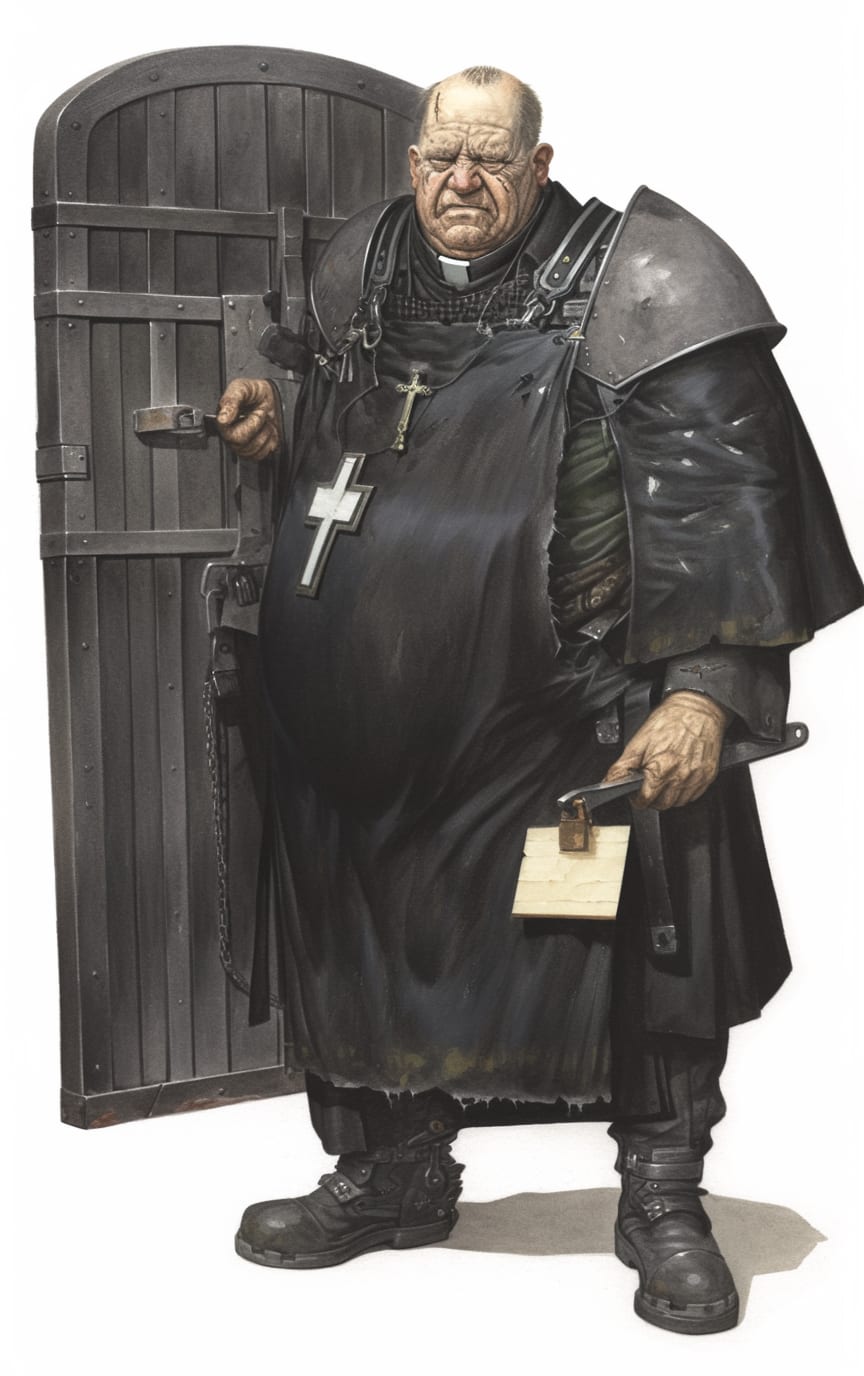
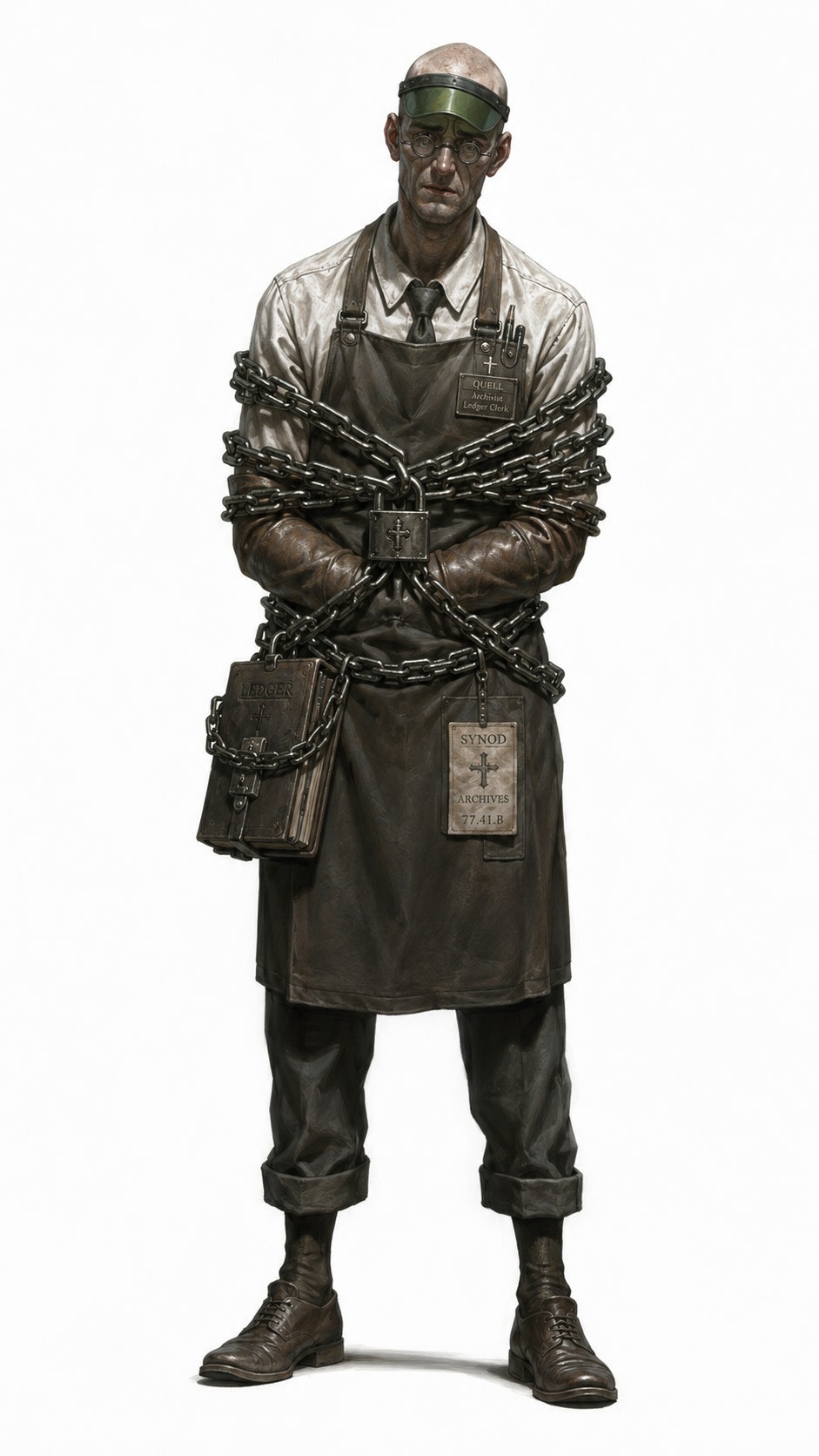







#Roster as Doctrine
No single office can preserve truth alone. Venn creates entry; she cannot verify records. Oren alters timing; he cannot make warnings honest. Vale receives evidence; she cannot keep every person alive. Sol preserves people; he cannot classify relics. Veyr identifies corrupt authority; she cannot force gratitude. Arc contains objects; he cannot prevent worship. Caul reaches targets; he cannot restore mistaken names. Jast traces beneficiaries; she cannot restore personal grief. Support roles keep the cell functioning. Heavies make it visible. Contractors reveal what the Task Force costs — politically, morally, and in the particular currency of institutional self-knowledge that the Synod spends reluctantly and hoards instinctively.
#Bases, Routes, Assets, and Contacts
"A Task Force becomes institutionally powerful when it acquires rooms, keys, clerks, and cabinets. It becomes institutionally dangerous at the same moment and for the same reasons."
A Task Force's campaign geography is not conventional. It consists of counters, annexes, custody lanes, bell towers, archive cells, petition benches, holding rooms, seal presses, and service corridors — the infrastructure of a Theocracy whose terrain is administrative and whose fortifications are filing cabinets. Movement through this terrain seeks to make authority arrive intact through administrative friction, rival offices, civil habits, signals, and human relationships. A soldier marches to contact. A Task Force files to contact, which is slower and more lethal, because the casualties are careers rather than bodies and the careers, unlike the bodies, can file complaints afterward.
#On the Assigned Desk
A public desk is the smallest stable Task Force base. It may be a table in South Petition Hall Annex, a borrowed Customs counter, a Bell repair shelf, or a ration-tribunal room reassigned by a clerk who will later deny the reassignment with the polished conviction of a man who has practised the denial in advance. Its strength is visibility: people know where the cell can be found and can bring claims, questions, rumour, and evidence. Its weakness is identical: the hosting office can watch, delay, embarrass, starve, or evict the team with the bureaucratic patience of an institution that has learned to kill with inconvenience rather than iron.
A public desk exposes Task Force work to petitioners, Watch observation, and office pressure. Venn uses it to display restrained force — the shield rests against the desk, visible but not raised, which tells the room that authority is present and patience is finite. Oren uses it to study ordinary timing — how the hall fills, when the queues slow, which clerks leave early, which speaking tubes carry answers and which carry silence. Vale uses it to create witnesses for documents — a receipt signed at the public desk is signed in view of the queue, and the queue, being present, becomes a witness, and the witness, being involuntary, cannot be accused of collusion.
The danger is domestication. A Task Force that sits at the same desk long enough learns office habits, normalises familiar injustices, and turns outrage into office hours. The desk becomes comfortable. The comfort becomes routine. The routine becomes complicity, and the complicity is filed under "integration," which is the Synod's word for the moment when the investigator has stopped investigating and started belonging.
#On the Sealed Evidence Room
A dry, controlled room for evidence that must become part of a durable custody chain. The ideal form is plain, hard to access, and fitted with racks, multiple ledgers, three keys held by three different officers, seals, receiving and quarantine and outgoing shelves, and a marked examination table whose surface is cleaned between items the way a surgeon cleans between patients, because contamination in an evidence room is as dangerous as contamination in a hospital and considerably harder to cure.
The room receives satchels, relic vials, furnace registers, bell components, erased slips, weapons, and similar evidence by warrant, receipt, seizure return, witness transfer, or discovery. It releases them by hearing, audit, superior order, destruction, custody transfer, or theft disguised as procedure — and the last method is the most common, because a competent attacker can avoid physical entry entirely by changing the category under which a key or transfer is requested, and the category change, if filed correctly, is indistinguishable from legitimate access.
The danger is conversion: the living contradiction inside a case becomes office property, and the injured people whose evidence fills the shelves find themselves with less authority over their own story than the clerk who filed the receipt. A sealed evidence room can preserve a case. It can also entomb one.
#On the Bell Annex
A Bell Annex is an operational site for gates, markets, evacuations, processions, flood warnings, Watch summons, counter pauses, and public movement — the administrative rooms and tower spaces where the Bureau of Bells' acoustic infrastructure meets the Task Force's need for timing routes. It may be a tower, a gate office, a flood station, a maintenance alcove, or a public-clock service room, and it contains schedules, timing records, alarm permissions, and technician annotations whose marginal notes are more informative than their official entries, because technicians write what they see and officials write what they are supposed to see, and the gap between the two is the Bell Annex's intelligence value.
Oren reads the Annex for broken lines, altered relays, suppressed signals, delayed responses, and the civic memory that accumulates in bell infrastructure — which tower answered last, which line has been offline since the previous Quarter, which alarm code has been deprecated but not yet removed, which flood station has been requisitioned by an office that should not need a flood station and whose requisition form cites an authority that expired in A.S. 189. The Annex gives the Task Force timing routes: when a hall empties, when a gate turns, when a procession narrows, when an alarm drowns inquiry, when a cordon announcement arrives too late to be accidental.
The Annex can be sabotaged through false alarm, silence, premature closure, or wrong office code. The Counter-Toll Silence is the central warning: a Bell Annex that has been compromised does not look broken. It looks quiet. And quiet, in the Synod's acoustic system, looks like safety until it doesn't.
#On the Mobile Warrant Office
A portable office — an inspection coach, a requisitioned wagon, an armoured records cart, a river office, or temporary rooms marked with a portable seal plate — lets the Task Force receive testimony, issue notice, carry evidence, and operate across connected districts before hostile offices can move witnesses or evidence. It does not extend warrant scope. A mobile desk is not a mobile kingdom, though the officers who ride in it can be forgiven for the confusion, because a coach that carries a seal, a ledger, and an armed clerk feels sovereign even when the warrant that authorises it covers three rooms and expires at sunset.
The post-Widow's Penny Riot coach has a cracked window, external benches, a floor lockbox, and a seal that provokes respect and contempt in equal measure — respect because the seal is genuine, contempt because the coach was present at Griefgate and the citizens who saw it remember what the coach carried away and what it left behind. It creates its own trace: wheel tracks, stable bills, gate records, horse loans, driver names, and transferred mud, each of which is evidence of the Task Force's movement and each of which can be used by a hostile office to reconstruct the cell's route, timing, and decisions.
Training materials described the Mobile Warrant Office as "the Task Force's sovereign vehicle."
Amended. No vehicle is sovereign. No desk is sovereign. No office, mobile or stationary, acquires jurisdiction by motion. The phrasing has been reclassified as "enthusiasm." Venn values the coach when it removes civilians from dangerous halls. Venn rejects the coach when it becomes a bunker. Both assessments are filed.
The danger is expedition logic. Officers assume urgency makes scope pure and move faster than record-making can follow. Good cells write while moving. Corrupt cells move to avoid being documented.
#On the Black Archive Cell
A hidden archive stores facts too useful to destroy and too damning to admit. Forbidden precedents, occult custody notes, erased names, later-declared false warrants, relic findings that conflict with policy, and closure orders signed before their supposed trigger event — the administrative detritus of a Theocracy that cannot acknowledge its own history without undermining its own authority. Such cells exist under tribunal stairs, behind registry walls, in Purity cellars, and among deliberately missing shelf numbers in the Basilica of the Ledgered Saints' lower vaults, where the air tastes of iron gall and tallow and the shelves extend into darkness that no Archon claims to have fully explored.
Knowledge of a Black Archive Cell makes every participant a custodian, a conspirator, a hostage, and a future defendant — simultaneously and without contradiction, because contradiction is the Archive's native condition. Archivist Lio Quell embodies the same problem in flesh rather than stone. A Task Force seeks a Black Archive Cell when ordinary records have been corrected beyond usefulness — the Index Child case, the Saint-Dust Fraud, the Glass Under Saint Helm — and what the Cell gives is not comfort but category: prior contamination, denied custody, false seal, erased witness, repeated office pattern, obsolete mercy clause, Black Warrant precedent.
BLACK ARCHIVE CELL — LOCATION CLASSIFIED Shelf contents: ████████████████ Access: ████████ Last audit: ████ (auditor reassigned to ████████) Disposition: the Bureau of Records states that this cell does not exist. The Bureau of Purity states that this cell does not exist. The Bureau of Doctrine states that existence is a theological category and declines to comment. All three statements are filed. The file is stored in the cell whose existence the statements deny.
The danger is sovereignty. The Task Force begins treating itself as keeper of a deeper truth and may slide from reform into private doctrine — the conviction that its secret knowledge exempts it from the rules it was created to enforce. A cell that has found a Black Archive Cell and has not reported it has already become the kind of institution it was sent to investigate. The difference is that the cell knows it, and the knowledge, like the archive, is too useful to destroy and too dangerous to admit.
#On Routes of Lawful Motion
The Public Counter Route — visible warrant and public receipt at petition halls, tariff chapels, ration offices, bridge counters, and registries — makes denial expensive by creating witnesses at every stop. Its risk is turning people in line into scenery for a performance of authority.
The Staff Record Lane — back corridors where forms become actions — exposes drawers, tubes, staff habits, and contradictions before the office recognises itself as a target. Its risk is converting knowledge of clerks' circumstances into simplified clerical judgment.
The Custody Passage — the corridor between hearing rooms, holding benches, Mercy wards, Watch stairs, and mortuary doors — protects witness continuity and can move suspects without spectacle. Its risk is that protective custody becomes possession, and possession becomes disappearance, and disappearance becomes policy.
The Bell Route — timing through towers, bridges, chapels, clocks, posts, and civic sound habits — can create lawful pause, delay closure, expose signal fraud, or prevent crush. Its risk is remote command that turns people into flows rather than bodies.
The Audit Route — responsibility through offices, memos, payment trails, serials, seal logs, receipts, and budgets — prevents field action from becoming scapegoat theatre by locating beneficiaries. Its risk is paralysis while a living witness needs immediate help.
The Mercy Route — advocates, surgeons, friendly clerks, clinics, witnesses, and ethical clergy — preserves agency and survival. It is necessary because people saved as evidence are not saved as people. Its risk is sentimental private law and exception-making that escapes public review.
#On Assets That Change What Can Be Said
A Recognised Seal creates a civic pause — the moment when a room stops and reads authority. Its history is carried in office colours and manufacturing details. A false seal may fool the eye but fails people who understand its tactile and procedural signals. A Cooperative Clerk can reveal schedules, routes, custody habits, drawers, altered visitor logs, or impersonation, but the clerk can be purged, frightened, bribed, promoted away, or scapegoated, and the help must not reduce the clerk to a tool. An Emergency Writ is preauthorised exception for urgent action — evacuation, restricted care, object quarantine — that can become tyranny if treated as routine convenience. A Preserved Chain — cord, tag, seal, receipt, witness mark, storage note, transfer line, and signature — proves an item remains the same across hands and makes later denial harder. A Public Notice is a plain promise before the city, and empty notices are ceremonial language without restraint. An Internal Memo exposes changed formats, ordered delays, rerouted releases, and ignored alarm reports. A Witness Transfer Order names origin, destination, escort, authority, medical condition, review, and continued responsibility. A Sealed Dissent — timely internal objection, minority notation, or scope challenge — proves an officer disagreed before the outcome was settled and can protect against collective guilt and expose the dissenter to retaliation in equal measure.
#On Contacts
Clerk Mera of Counter Nine is a veteran Records clerk who recognises ordinary procedure when it has been altered for violence. She knows grain handling, public counters, staffing gaps, and suppression habits, and she translates official terrain into human motive with the fluency of a woman who has spent decades behind a grille watching the Synod's machinery grind citizens into categories. She can identify ornamental ledgers, genuine delays, coerced juniors, and high-risk counters. She believes every required act should have a named requester, which is a standard the Synod endorses in print and violates in practice.
Watch Sergeant Dema Orr is a civic-minded Watch officer with experience in bridges, markets, funerals, floods, and the Widow's Penny aftermath. She manages cooperation, public resentment, custody conflict, and the particular challenge of safe clearance routes through districts whose residents trust the Watch the way mice trust a cat with good manners. She respects clear warrants, countable force, and officers willing to accept scrutiny.
Bell Technician Arlen Saye maintains towers, flood stations, gates, clocks, and speaking tubes. He knows public versus office-only calls, disabled lines, forbidden signals, and repair patterns that reveal institutional interference. He can trace relays, prove disabled bells, identify false alarms, and build temporary communications from the debris of the Synod's acoustic infrastructure. He wants acknowledgment of maintenance labour as much as material parts, which is a request the Synod finds baffling and which Saye finds predictable.
Mortuary Scribe Hess Anno verifies bodies, transfers, death categories, delayed marks, disputed remains, false corpse law, and misclassification. He can show post-transfer contamination additions, living exits labelled as deaths, convenient death times, and denied kin claims. He treats the dead as entitled to accurate record-keeping, which is a standard the living find sentimental until they are dead and their heirs discover that the death certificate lists the wrong cause, the wrong date, and the wrong office of responsibility.
Tariff Notary Cel Baret is an expert in levy categories, seal history, auction routes, ferry exemptions, cargo chapels, and allocation manipulation. He can identify false manifests, impossible levy codes, incorrect seal impressions, devotional cargo fronts, and private buyers hidden in public allocation. Vale values his corrections more than his motives, which is a professional arrangement the Synod does not endorse and which experience recommends.
Public Advocate Noma Veil makes lawful challenge accessible to families and witnesses. She can make a transfer, notice, or review acceptable where Task Force authority alone would appear coercive. She becomes a critic when the Task Force confuses silence with consent, which is a confusion the Task Force commits more often than its reports acknowledge and which Veil's presence makes harder to sustain.
Quartermaster Ren Dast maintains serial histories for weapons, shields, seals, chains, masks, and locks. He can trace a weapon used under another unit's record, replace custody equipment without erasing history, locate stolen seal cases, and resist an order to sanitise equipment records. He treats inventory as a record of enabled violence, which is an interpretation the Bureau of War rejects and which the inventory confirms.
Junior Examiner Pell Marr is a Mantle Examination junior who identifies real versus copied office signs, determines whether authority claims merit field examination, and slows contamination certainty before it becomes force. He has proven alleged relic stains to be ordinary material causes — rust, wine, lamp oil, and the particular residue of a clerk who eats beetroot at his desk and wipes his fingers on seized evidence. His standard is that premature certainty is usually a form of laziness, which is a standard the Bureau of Purity considers insubordinate and which examination officers consider professional.
#The Warrant Enters First
A short account of an action at South Petition Hall, preserved for training, review, and the particular institutional pleasure of recording what went right before recording what went wrong.
#On the Hall
South Petition Hall holds thirty-seven petitioners in three uneven queues beneath a Saint Clemet bread-and-scales mural whose paint has been touched up twice in the current decade and whose theological accuracy has been challenged once, by a clerk who noticed that the scales depicted are a model discontinued in A.S. 112 and who received a transfer to the Paper Mines of Ulm for his observational acuity.
Purity Agent Venn enters first. She displays the warrant at chest height so the seal catches the hall's indifferent light. Behind her, Bell Keeper Oren. Behind him, Commerce Clerk Vale, carrying a custody box and receipt book. The hall has not expected them. The hall's Chief Petition Officer, a man named Rem Salk whose nameplate reads "temporary" in a font that has been temporary for eleven months, has especially not expected them.
The warrant's immediate orders: Counter Nine stays open. Counter Four pauses transfers linked to north registry grain. Bread claimants retain their queue place. The Watch maintains the public stair. No papers, seals, cords, wax, leather, or devotional wrapping leave through staff lane before Commerce receives the satchel.
#On the Opposition
Salk claims the hall is functional and asks Customs to submit after close of counter, which is the administrative equivalent of asking a fire to return during business hours. Venn does not respond to the suggestion. Venn does not respond to suggestions.
Vale notices that the Customs concern submitted the previous day does not appear in the daybook. Salk treats the missing entry as absence of receipt — the classic defence, the institutional shrug, the claim that what is not filed does not exist. Venn declares that the warrant has now created receipt. The daybook's opinion on the matter is no longer relevant.
Oren listens at the speaking tube and identifies what he calls an "answered silence" — a connected station refusing to speak rather than an empty, blocked, or stuffed line. The distinction is the distinction between no one home and someone home who has chosen not to answer the door, and the distinction, in Oren's professional grammar, is the distinction between mechanical failure and operational concealment.
Salk claims Bell Officer Rusk is assigned at North Bell. Oren identifies the signal as East Warning. The difference means either Salk is misinformed, which is possible, or Salk is lying, which is more efficient.
The junior clerk at Counter Four attempts to stand. Venn adjusts the shield position — a shift, nothing more, the angle changed rather than the intent — and orders the clerk to remain without escalating force. The adjustment says everything the voice does not.
#On the Satchel
Vale demands the named satchel. Salk says it is in temporary transfer under his own hand but does not identify the drawer. His hands do not move toward the drawer. His eyes do.
Vale follows the gaze to Counter Four, where a small leather satchel rests under blue cloth bearing three seals: two aged, their wax cracked and darkened with the patina of institutional time, and one new. The fresh seal has correct design, correct colour, correct pressure, and correct damage mark. It is too glossy for its claimed transfer time. A seal that has travelled through institutional handling for the period the transfer documents claim acquires a particular dulling — the accumulated friction of drawers, hands, pouches, and the Synod's own atmosphere. This seal has not accumulated.
Vale asks Venn to pause. Venn withdraws her hand from the weapon rather than proceeding on the warrant's authority alone. The pause is the doctrine working: visible authority preceding force, the question asked before the action taken, the moment in which the warrant is treated as a limit rather than a licence. Vale identifies the fresh seal as a contradiction rather than proof of crime — a distinction that matters to the tribunal and that Venn, to her credit, does not override.
#On the Bell Threat
Oren reports that someone is listening through the wrong warning station. The East Warning bell, if sounded, will empty the hall through the public stair — which is the excluded north door by another route, and the exclusion exists because someone anticipated that the hall might be emptied to prevent the satchel from being received.
Venn asks whether Bell Office confirmation can be obtained. Oren says no. The tube clicks again. All Counter Four clerks hear it. The junior clerk begins to cry — silently, without sound, without outward response, the tears of a person who has understood that the instructions they were given have become the evidence against them.
She orders the clerk to step away from bell control. The clerk — Lysa, who identifies herself by name because the name is the first thing that makes her a person rather than a problem — says someone told her the change would only move the queue. Salk tells the clerk not to answer. Venn identifies Salk's instruction as obstruction of a named witness question, which it is, and which the warrant covers, and which transforms Salk's authority in the room from "Chief Petition Officer" to "person interfering with the Task Force's access to a named witness."
Vale formally receives the satchel in disputed condition, documenting its seals and all present witnesses, including Lysa as pending witness. The receipt is the moment. The satchel is now inside the custody chain. It is no longer Salk's property, or the hall's property, or the drawer's property. It is evidence, and evidence belongs to the record, and the record belongs to review.
#On the Correction
The grey-coated runner's prayer book falls. Inside it: a pre-stamped public correction notice stating that the transfer error has been resolved and no irregularity exists. The notice is prepared before the Task Force's public action. Vale recognises this for what it is: competent fraud. The correction was written to arrive after the Task Force left, to be posted in the hall where the Task Force had been, and to tell the public that the matter was administrative error, now corrected, nothing further to report, please take a number.
Oren says East Warning is about to sound. Venn orders delay. Using the line will identify Oren's presence to the Bureau of Bells, which will create scrutiny, which will create consequences, which Oren accepts because the alternative is an emptied hall, a lost satchel, and a witness — Lysa — who will disappear into a custody system that has already demonstrated its willingness to make her convenient rather than safe.
Oren issues a maintenance hold and a false-station counter-code, stopping the warning for one interval. The interval is the operation's lifespan. After the interval, the bell sounds, the hall empties, and the Task Force's position becomes untenable. Before the interval, the Task Force must complete receipt, secure the witness, and preserve what the correction notice was designed to destroy.
Venn places Lysa in protective custody. Named, alive, identifiable, and subject to public handoff — the four requirements that distinguish protective custody from disappearance, and which Venn lists aloud because listing them aloud makes them part of the record and the record, once it contains them, cannot be un-contained.
Salk argues threat cannot be proven. Venn points to bell control and says the record will document the risk. She does not say the threat is proven. She says the record will document it. The distinction is the doctrine: the Task Force preserves facts for later review rather than establishing truth in the field.
Vale seals the satchel intact rather than opening it. An opened satchel is exposed material. A sealed satchel is received evidence. The distinction determines admissibility, and admissibility determines whether the satchel accuses in a tribunal or decorates a shelf.
Vale has a Watch officer publicly unfold and read the correction notice, so the public encounter becomes a record rather than private assertion. The petitioners in the queue witness this. They did not ask to witness it. They are witnesses regardless.
Oren discovers that North Bell now responds, but someone with Rusk's code and unfamiliar timing is answering. The station has been occupied. He can hold the hall for only one bell interval.
#On the Stair
Venn escorts Lysa through the public lane with the shield between her and Counter Four, the weapon lowered. The petitioners react with a mixture of hatred, relief, and fear — hatred for the disruption, relief that the disruption is ending, and fear that protective custody is a phrase the Synod uses for a process that begins with a name and ends without one.
At the stair, Venn transfers Lysa to named Watch custody. Vale records the handoff. Oren releases the maintenance hold only after North Bell sends the correct public-stair-safe signal — the specific code that means the stair is not a trap and the people on it are not being funnelled.
No one is shot. No counter closes. The satchel remains sealed. The public copy is preserved. The witness leaves alive. By the standards of the setting, the team completes the immediate objective with limited harm and durable evidence. By the standards of the district, a girl has been taken from her counter by armed officials and the queue has lost twenty minutes and the bread has gone uncollected by six families who were behind the Task Force's operation in both the spatial and the institutional sense.
#On the Annex
Two hours later. South Petition Hall Annex. Vale places an initial report beside the satchel box and correction notice. Oren listens to disconnected bells. Venn waits by the door with the expression of a woman who has not yet decided whether the operation was a success.
Vale finds the key contradiction: the correction notice is stamped eleven minutes before the warrant entered the public daybook and claims Customs Review resolved a dispute that had not officially been received. The notice knows about the warrant before the hall knows about the warrant. The correction precedes the claim it corrects.
Venn identifies Salk as too visible and too small to be the central actor. A chief petition officer with a temporary nameplate does not organise pre-stamped correction notices and bell-line occupation. He obstructs because he has been told to obstruct, and the telling came from someone whose nameplate is not temporary and whose office is not a petition hall.
Oren concludes that the bell line was used as a disposal route rather than a technical failure. Someone occupied East Warning to provide an evacuation that would empty the hall on cue and allow the satchel to be moved through the confusion. Venn orders this written as suspicion rather than established fact, because the doctrine is the doctrine, and the doctrine says that the field preserves facts and the tribunal establishes them.
An official Customs-grey messenger arrives with a fresh supplemental warrant from Commission Review. The seal is bound in black string. It is unnaturally perfect.
Vale prepares a fresh receipt. Oren rises from the speaking tube. Venn does not move from the door.