
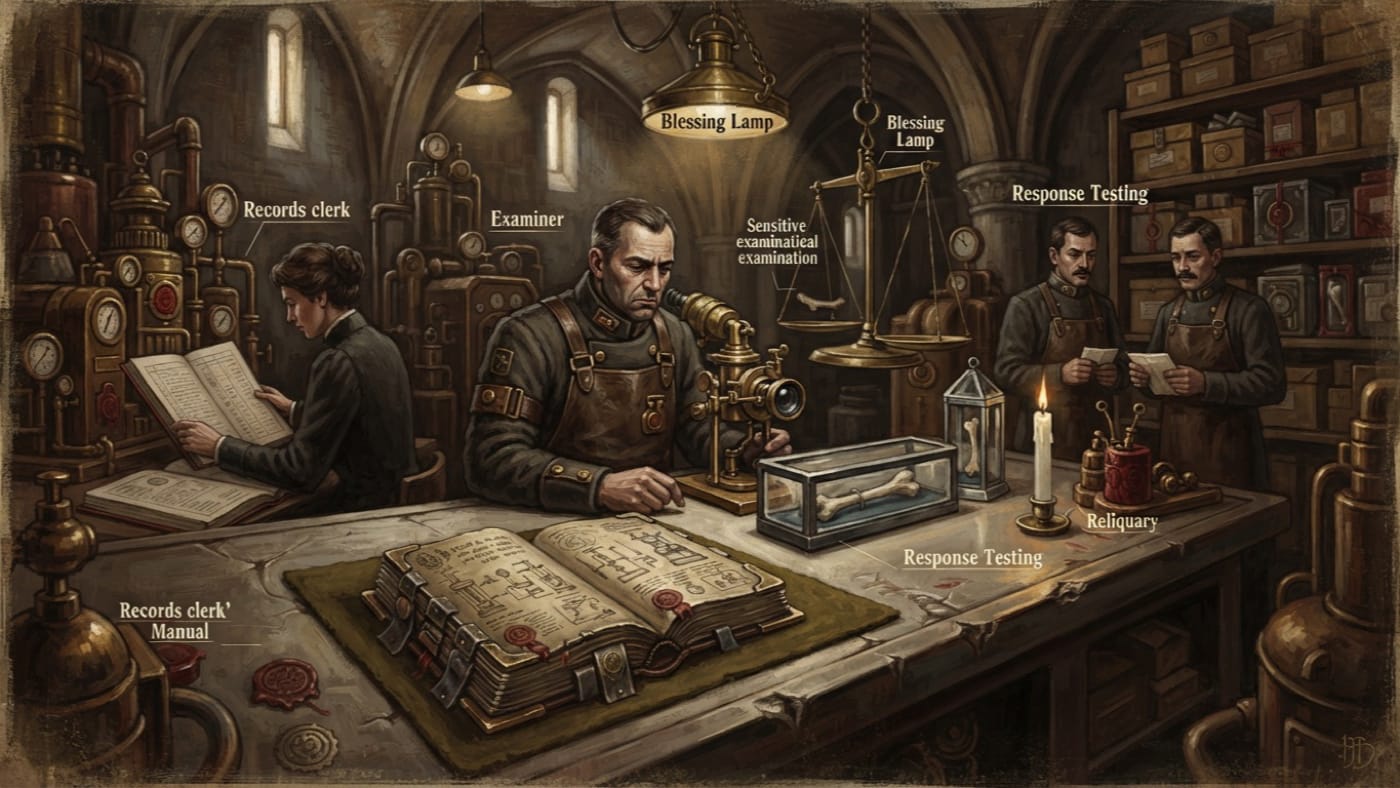
#On the Manual's Authority
"The authentication of relics is a matter of faith, and faith is not subject to arithmetic." — Diocese of Cologne, 1678, under a bishop's seal
The Authenticators' Manual is the book a Relic Authenticator turns to when the bone on the felt and the paper in the Writ disagree. They disagree on most working days. The Manual belongs to the Bureau of Relics, chartered in A.S. 92 with four mandates: custody, authentication, classification and distribution. The Bureau sits in the Vault of Sacred Custody beneath the Cathedral Close of Strasbourg. The Manual sets out what the other three mandates demand of the second. Follow it, and the verdict belongs to the Bureau. Depart from it, and the verdict belongs to you, along with the wall, the witnesses' complaints and whatever the object chose to do next.
Its governing proposition is older than its owners. When Amsterdam asked Cologne how one diocese could hold seventeen femurs of one saint, Cologne replied with the sentence above. The Bureau of Relics later adopted the position and stamped it into the Manual. Nobody has ever thanked Cologne. I do not intend to start.
#On the Arithmetic It Inherits
"Van Hoorn counted. Cologne declined. The Bureau sided with the party that declined, and has declined ever since."
In the Year of Letters, A.S. −32 or 1678 by the old reckoning, forty cities received a table. Three Amsterdam scholars had counted every relic attributed to Saint Aldebrand across the German states, the Lowlands, northern France and the Swiss cantons. They reached two hundred and forty-three, including forty-one femurs and nineteen skulls. Seventeen of the femurs lay in Cologne, and each had a ledger swearing it was the only one.
Each claim was sound inside its own ledger. The trouble began when someone laid the ledgers side by side. Van Hoorn had found that a provenance system built for single objects falls apart when anyone reads two entries at once, and he posted the finding to forty cities with footnotes.
Münster burned the letter. Trier argued that the bones had multiplied out of the saint's generosity. Cologne did the only thing that has ever worked in my profession: it moved the question to a court where the questioner had no standing. Arithmetic governs quantities, and faith governs authentication. Seventeen femurs are therefore a quantity of no theological interest, and each femur, examined on its own, is genuine.
The Bureau of Relics would not exist for another hundred and twenty-four years. When it did, Cologne's sentence was waiting for it like a form already signed.
#On the Examination and the Filing Hands
"Seven stages. Five Bureaus. One hand holding the taper."
Take any submission. For illustration, say a parish sends a fragment of finger-bone. It has no name here, because the procedure does not care about names. The fragment arrives under lead and quarantine wax with an Authenticity Writ. The Writ contains a custody chain, a physical description, a theological justification and proof that the fee reached the Bureau of Tithes. It is a petition, and nothing in it counts as a verdict.
Intake and Quarantine. The box is opened in a ventilated chamber. The lead stays on its shelf there, well outside the radius of any later proof.
Provenance Reconstruction. A Records clerk sits at the table, checks each seal against the reference impressions and marks every transfer nobody witnessed.
Physical Examination. The fragment goes under scales, lens, tincture and the Blessing Lamp at its lower degrees. The Bureau of Engineering calibrates these instruments and resents it.
Doctrine Fit. The Bureau of Doctrine decides whether the claimed saint and the claimed meaning can be tolerated.
Response Testing. In a sealed room with still air, a clean white taper burns one palm-width from the object while the witnesses watch.
Verdict Drafting. The Examiner assigns a grade.
Notarization. The press comes down and the red wax takes the mark. A second hand countersigns, and the registry entry becomes the object's legal identity.
Disposition comes after the seven stages as their result: the Vault, a shrine, a cabinet or the lime pit. The profession counts it as a step of its own, since the profession has to carry the box.
Note how the procedure hands out blame. Records answers for the chain, Doctrine for the saint and Engineering for the lens. The Examiner answers for the sequence, and the sequence is all anyone remembers when a Ward-safe bone fails on the Line. Tithes answers for nothing and invoices everybody.
#On Parallel Authenticity
"Two true femurs are a scandal. Seventeen are a doctrine."
Cologne's sentence served the Bureau without strain until the Reliquary Schisms of A.S. 140–160. Then the Bureau's own halls began producing Cologne's problem in bulk. Authenticated objects met authenticated rivals, each with a clean chain, a separate Examiner and good wax. The Bureau's axiom holds that a relic authenticated is a relic made holy. That axiom now produced contradictions with the Bureau's seal on both halves.
The Fourteenth Doctrinal Congress settled the theology in A.S. 147 with the Femur Principle, ratified under the Edict of Authentication: notarized femurs are authentic, all of them. The Principle is related to Cologne's answer, but the two should be kept apart. Cologne refused to count. The Congress counted, found the total intolerable and ruled that it was permitted.
The administrative wound took longer to close. Records received co-custody of provenance chains. That is why its clerks now sit at every provenance table, and why Relics talks about Records the way a householder talks about damp. By A.S. 160, reduction notices had limited new First-Class authentications to eleven a year. Doctrine had declared the contradiction holy. The ledger declared it expensive and cut the supply.
#On Revisions Made Necessary by Matter
"A book that makes sanctity a matter of seals must still tell its readers where to stand when the seal is wrong."
This is where the founding proposition runs into the world. After the hierarchy declared the Aldebrand reliquary non-existent, it glowed in a Vienna vault for decades. Things older than the Bureau react to candles the Bureau never lit. If authentication made holiness, unauthenticated objects would lie inert, and they do not. Nor does every luminous object wish its handlers well.
So the regime needed a second vocabulary, and since A.S. 165 it has had one. Class describes what an object is: First Class for a saint's body, Second for what the saint touched, Third for material from a consecrated site. Grade describes what the Hall will let the object do: Ward-safe for service, Votive for display, Contaminant for the cabinet and Fraud for the lime pit. A First-Class femur can grade as Contaminant. A response alone earns no grade. Plenty of things glow, and some of them glow at you.
The Candle Proof was standardized in A.S. 98. It records a lean as assent and a withdrawal as refusal. The formulary also recognizes flicker, extinguishment and event, and working authenticators spend most of their careers in those three. A flicker means repetition, further handling and often quarantine. The seal carries legal authority. The flame's authority is of another kind, and nobody in the Hall is paid to name it.
In A.S. 174, at Bastion-Sibiu, an Examiner working alone opened the Lamp to its fourth degree, without authorization, on a glass shard of disputed provenance. The report called the response "overwhelming." The repair crew called the damage "structural." The shard was reclassified, the Examiner was reclassified and the wall was rebuilt.
Response Testing may be conducted by a single Authenticator where witnesses cannot be assembled without delay.
Permission withdrawn after the Bastion-Sibiu incident of A.S. 174. Response Testing now requires two witnesses of superior rank. Delay is to be endured. A wall costs more than an afternoon.
Counterfeits from Velmora have been documented crossing the Line since at least A.S. 180. The Counter-Relic Examiners were constituted in A.S. 182, and frontline relics now come back for re-authentication every week. Under present practice a grade is an appointment rather than a verdict.
#On Present Application
In A.S. 201 the Manual is consulted at examination tables in Strasbourg and in the provincial halls. It hands out two things: permission and responsibility. Permission goes to the seal. Responsibility goes to whoever signed beneath it.
The trench soldier never reads it. The soldier watches a candle and trusts that someone did. Pilgrims pay at shrines whose Votive objects passed seven stages they will never see. The Manual promises none of them the Creator's attention. It promises that a named Examiner, two named witnesses and a Records clerk looked first, and that each of their signatures can be found again.
That is enough for the law. Whether the bones find it enough is a question Cologne ruled out of order in 1678, and the Bureau has not reopened it.