
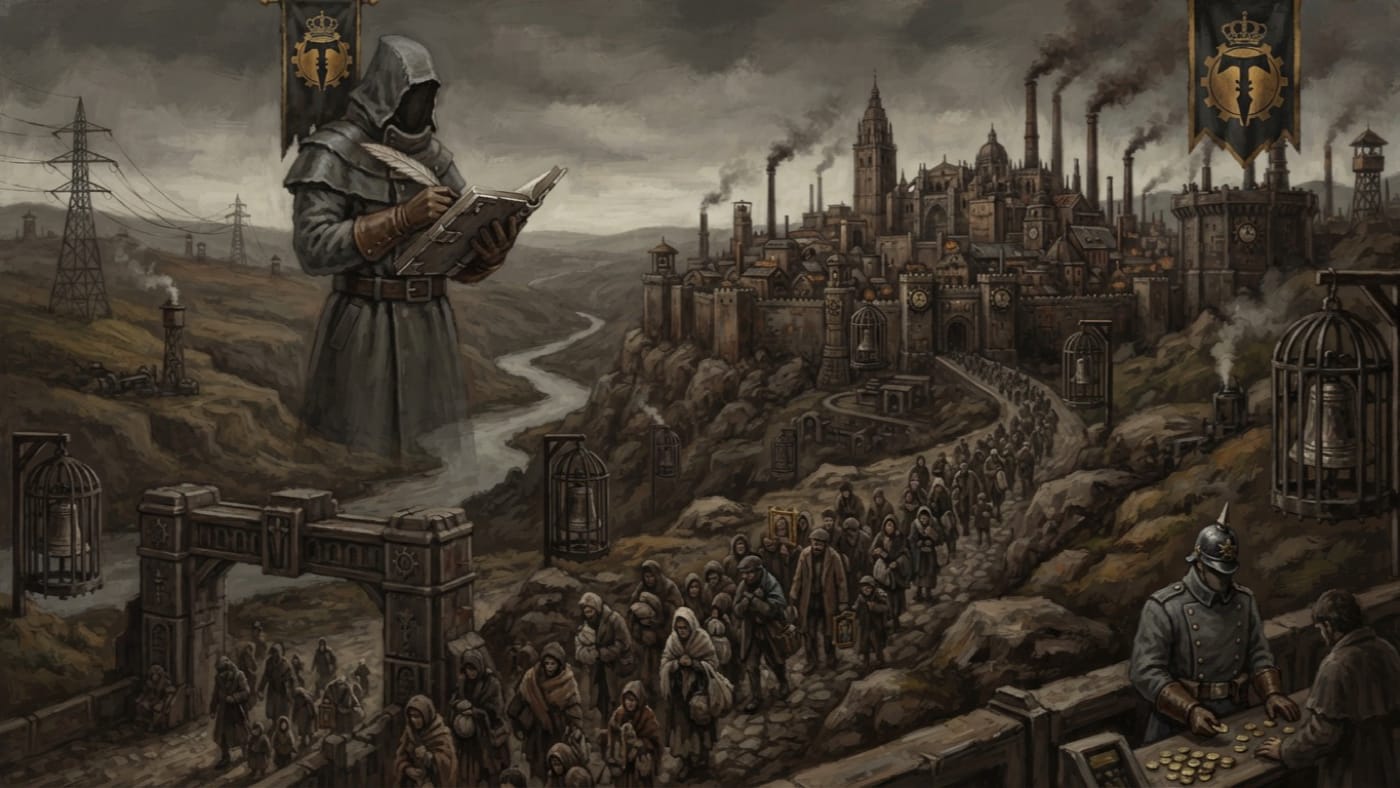
#On a Province Without a Map
"The bells are counted in Strasbourg. The ringers are counted nowhere."
The Codex names Castile more often than it can define it. The name turns up three times. The closing paragraph of the Concordat of Strasbourg gives it as a place where tithes are collected. The dossier of Father Clemente de los Rios gives it as the country from which refugee faithful crawled uphill toward a cathedral under bombardment. The catechisms of the Hierarchy give it as a place where bells toll. Two of these citations concern money and noise. The third concerns people, and the people left no names.
This plate is a present survey, filed in A.S. 201. Castile lies within Iberia, among the western heartlands, in the uplands that the Tagus cuts westward on its way past Toledo to the Atlantic. Beyond that the Bureau of Records will not commit, and neither will I. No surveyed boundary has reached my desk. I have no population count, no provincial charter, no seat of government and no Castilian seal. Castile signed nothing at Strasbourg. It arrived folded inside the Iberian seal, as Aragon did. Aragon at least had the manners to walk out.
#On the Road Uphill
The faithful of A.S. 15 did not know it was A.S. 15. That numbering did not yet exist. Nor did a Synod to govern them or a Bureau to mourn them. They knew that the Atheist Wars had come to the promontory city above the Tagus and that the country behind them was emptying.
Reason had already filed them. Under the prefectural scheme, a Castilian was entered as a transport unit in a western allocation district. Rationalist clerks were patient enough to let the old names linger in speech while new ones arrived on tax notices. The Desecrations stripped the monasteries of Castile and Aragon. Across the peninsula, the Bonfires of Purification heaped relics in plazas and burned them to the accompaniment of lectures, and the ash was mixed with lime to plaster lecture halls. No roll survives of which Castilian houses burned or in what order. The Rationalists kept careful inventories of chalices, and nobody inventoried the people who fled the chalices' absence.
Colonel-Prefect Étienne Grimal reached Toledo in the spring with two thousand Guards, twelve clockwork cannon and a printing press. The Order of Saint Iago garrison under Clemente counted three hundred clergy, forty-seven lay brothers and fourteen women of no recorded order. It also counted refugee faithful from Castile, who climbed to the walls because walls were what remained.
Their number is unrecorded, and so are their villages. Whether they died in the narrow streets, on the tower stair or through nine months of thinning bread, the ledgers do not say. The ledgers were occupied with ammunition. They must not be confused with the fourteen women, who came with sacks of consecrated oil and their own reticence. The refugees came with whatever they could carry uphill.
Castile cannot claim the abbot either. Clemente's birthplace is disputed, and sharing a road with Castilians does not make a man one.
The siege ran nine months. It ended on 29 November, A.S. 15. Toledo was taken, and the abbot burned in the bell chamber with the Relic of Saint Iago rather than return the jawbone to secular hands. The faithful account credits the Psalm of Consuming. Engineering's account speaks of incendiaries, caisson spacing and a monk with uncommon judgment of range. Records files both. Neither account disputes the outcome: Grimal took the city and did not take the relic.
The Castilians had sought shelter in a place that could not be held. They were drafted into its only victory, and that victory consisted of something the enemy failed to carry off.
An inherited chapter of the Lore Book places the siege of Toledo in A.S. 71 and states that "neither side prevailed."
Corrected. The siege belongs to A.S. 15 / 1725 CE. Toledo fell to Grimal's force, and Clemente de los Rios denied the Rationalists the jawbone of Saint Iago. These are two outcomes. Doctrine has preached the second for most of two centuries and mentions the first only when someone asks.
#On Hidden Altars and the Iberian Seal
After Toledo came thirty years in which the Church in Iberia survived as it survived everywhere: in cellars, in grain lofts, in households that kept a saint's knuckle wrapped in a shawl, and in diocesan correspondence that arrived late or did not arrive at all. The networks were uneven. Some houses kept their books. Others kept only their priests, and some kept neither. Refugees became custodians because nobody else was left to hold the reliquary. I cannot attach particular Castilian parishes to this history. The record does not grant them, and I will not invent them to fill a column.
The Sundering of 1 November A.S. 45 broke the Rationalist hold, and the Church came out of hiding. It did so unevenly, district by district, in the stunned fashion of men who had prayed for daylight and found it inconveniently bright. An interim council took shape around A.S. 50, and offices accumulated around it. The Common Allegiance of A.S. 55 and the Black Decrees of A.S. 58 pressed accessions across whatever ground the emerging authority could reach. No separate Castilian accession instrument is in the file. If one existed, it went where so many Iberian papers went: into fire, into damp, or into an archivist's private regret.
In the winter of A.S. 90, in the Basilica of the Ledgered Saints in Strasbourg, the Cardinal-Legate of Toledo pressed the Iberian seal into the wax. Both founders were already dead. The constitution that bound France, Iberia and the Rhineland into the Triune Hearth was proclaimed in the spring of A.S. 91. With it came the Anno Synodi, adopted retrospectively, so the refugees on the Toledo road received their year seventy-five years late. In A.S. 94 the Bureau of Doctrine declared the whole settlement "inevitable since the Sundering." Doctrine also holds that the Creator intended the delay. I record both claims without comment, since comment is what Doctrine audits.
#On Bells, Tithes and Ordinary Obedience
The Bureau's catechism is plain on the point: every bell that tolls in Castile resounds upward into Strasbourg's vaults, where clerks inscribe it. The Office of Bells received its constitution in A.S. 52. Local practice is older and ratification later; the Bell Codex settled the present standard in A.S. 115. The Bureau of Bells now governs the rhythm by which a provincial day is divided into prayer, labour, catechism and curfew. I cannot print the schedule of any particular Castilian parish, because Records has supplied none fit to print. The principle needs no parish. A villager who rises at the bell rises on Strasbourg's authority, whether or not they have heard of Strasbourg.
Tithes run along the same line in the other direction. The bell carries the hour down from Strasbourg, and the coin goes back up. Every tithe the Bureau of Tithes collects in Castile invokes the ink that dried in A.S. 90. That clause is in the Concordat, and it is the most precise thing the Codex has ever said about Castile. The offices and courts that do the collecting changed their titles across years, not on the signing day. Collectors who had served the interim council woke under the Synod with the same ledgers and new headings. Very few of them complained, and those who did were reassigned.
Toledo shows how far the method can go. The examples belong to Toledo; nobody should assume they are the custom across Castile. At the Bell-Market, hours are leased. A workshop may buy three more minutes of Matins, and a farmer may buy a single toll of Lauds over his harvest. In A.S. 163 the market oversold Sext by seventeen minutes, which left time with no place to exist. Records erased it.
In the rebuilt cathedral, an empty jaw-setting sits behind glass, blackened at one hinge. Pilgrims kneel before the absence, and the Bureau of Pilgrimage sells them tokens to prove they knelt. The ground Castilian refugees once climbed in terror now has turnstiles.
#On the Present Condition
In A.S. 201, Toledo is Synod-held, Zone 1, and classified loyal, profitable and watched. In its forecourt, the Cinder Trials pour ash over the condemned in hymned increments until a crust forms. When Ninth tolls, the crust cracks, and Doctrine reads the cracks as handwriting. In the Ash-Baths, fevered patients are sunk in hot ash to sweat out corruption. The survivors are paraded as living reliquaries. Those who collapse during the parade are recorded as graduated cures. These institutions are Toledo's own. Whether Castilian villages keep any smaller copies of them, no file I hold reports.
West of the cathedral precinct stand the Granaries of Saint Benedict. In the famine of A.S. 185, Governor-Praelate Alaricus opened them and fed people without waiting for every lock to be ceremonially turned. Tithes has contested custody of those vaults ever since. A governor who feeds the hungry first and files the permission afterward sets a precedent. The Bureau regards precedent as a more dangerous contagion than famine. Famine ends, while precedent gets cited.
So Castile in the present survey comes to this. Its bells answer to Strasbourg and its tithes to the Concordat. Its pilgrims spend coin before a setting with no bone in it. Its dead from the A.S. 15 road have no names, no number and no feast day. Clemente has a local observance. The refugees who stood behind him have only a subordinate clause in his dossier, and the Codex has now given them a plate. Doctrine considers that generous.