

Reverse Index
Referencing “Catechism Schools”
Every codex entry that links to Catechism Schools. 38 entries.
Return to Catechism Schools
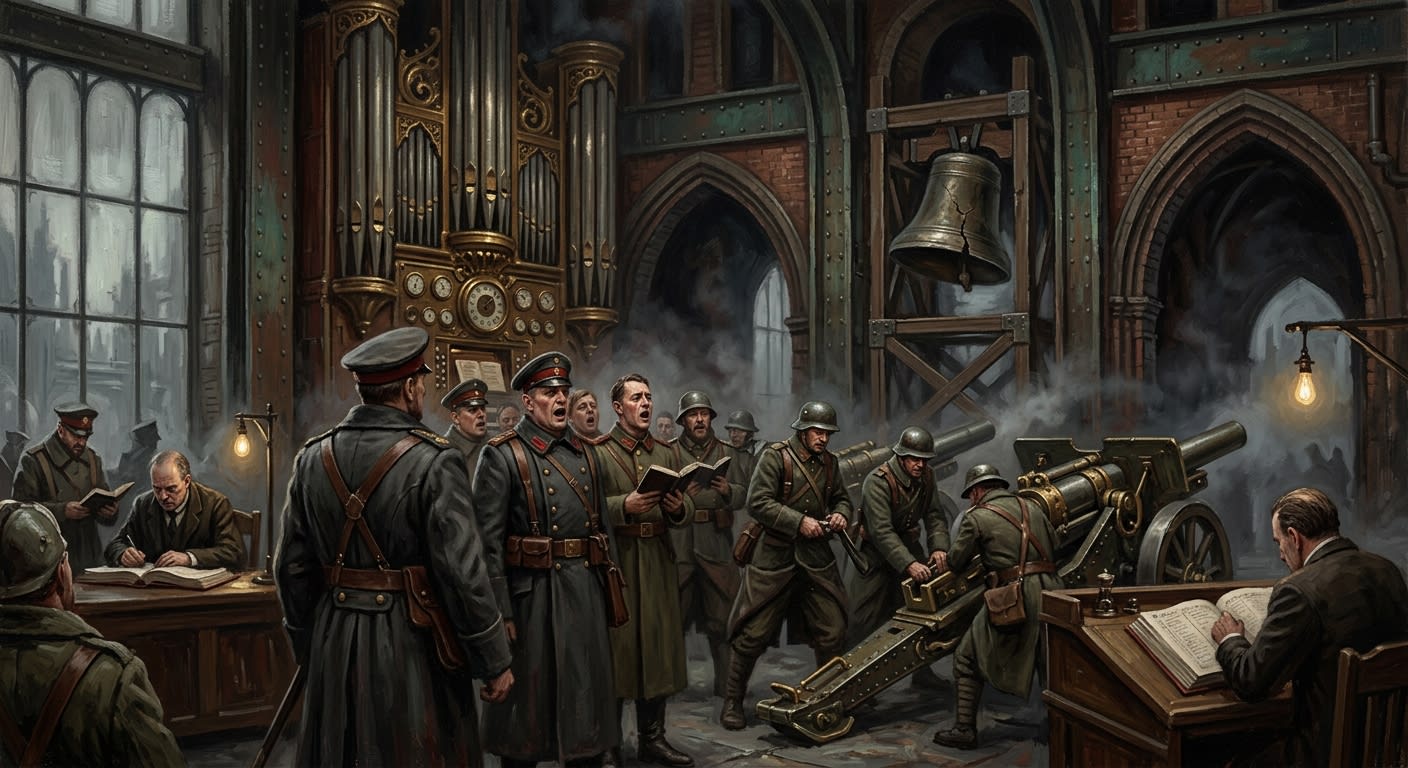
4th Orison Company
Where prayer learned range tables and glass learned to sing
The 4th Orison Company sang before Orison had a charter, fired relic-shot at Toledo, and proved that a mistimed peal can make martyrs inward.
Codex Ref. VIII.6.02-015
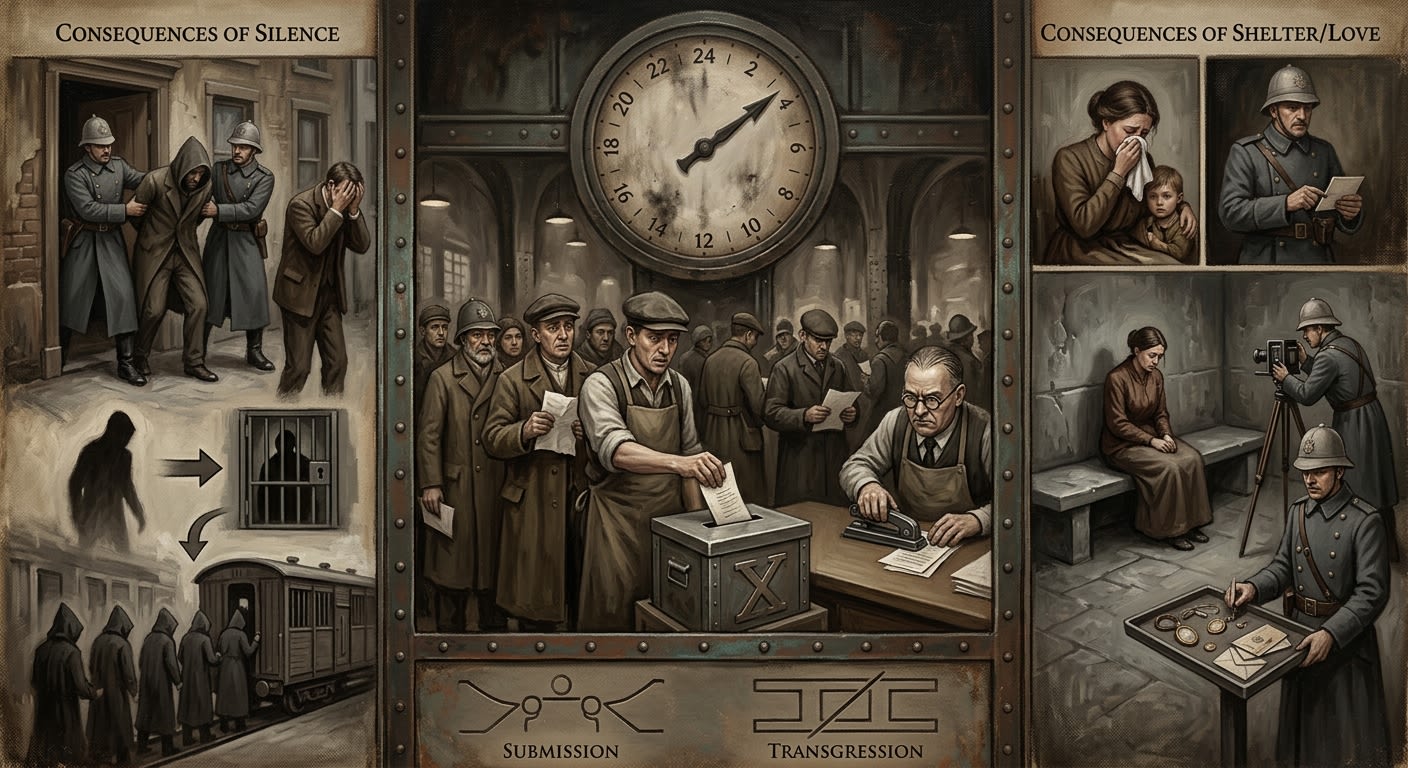
Article 19 of the Catechism of Obedience
The neighbour is promoted to witness and punished for delay
Article 19 makes suspected heresy reportable within twenty-four hours, converting silence into shelter, shelter into participation, and love into evidence.
Codex Ref. XIII.1.04-019
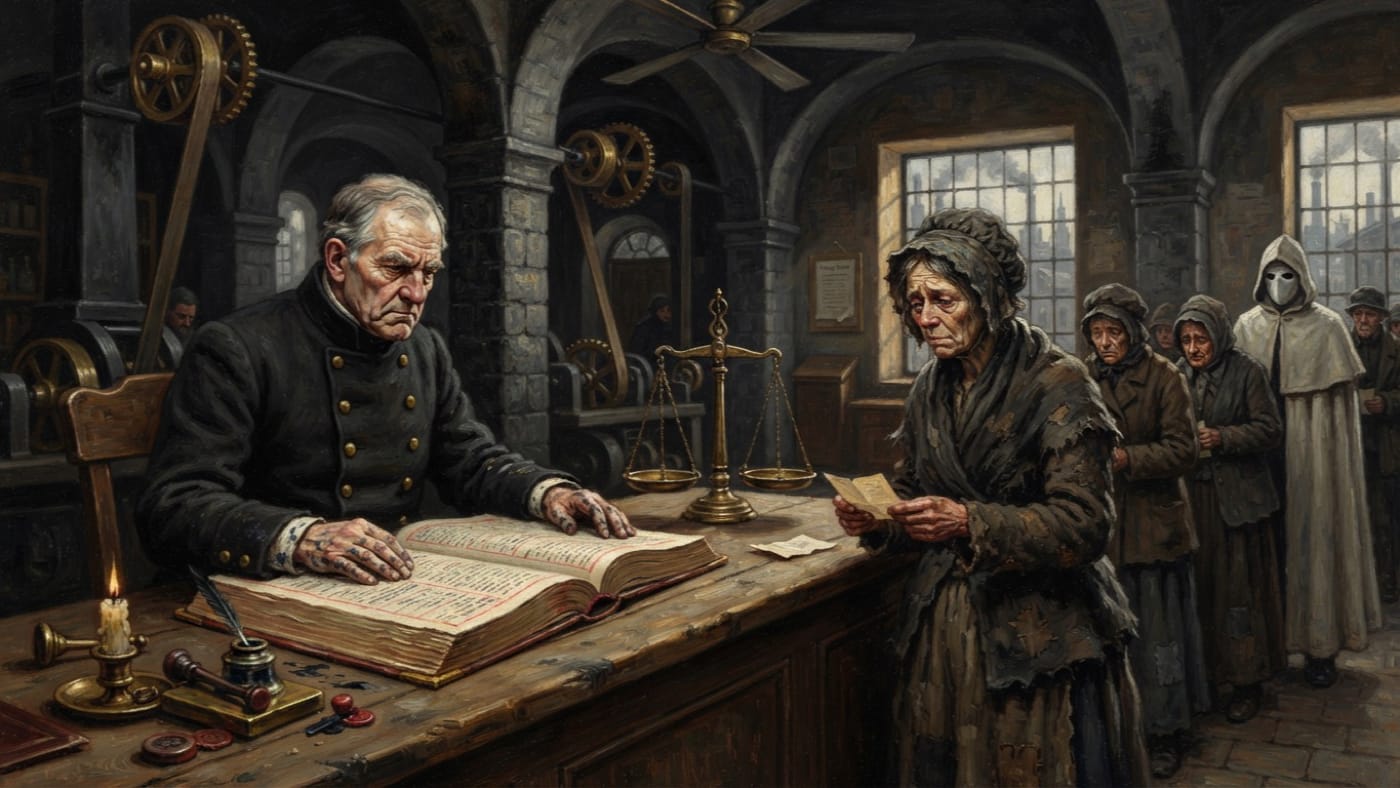
Article 4 of the Catechism of Obedience
Hope is a commodity; the soul must keep its receipt
Article 4 licenses hope, consolation, prophetic utterance and prayer beyond prescribed forms. Since A.S. 196, private devotion also belongs in the ledger. The soul may hope; it must keep its receipt.
Codex Ref. XIII.1.04-004
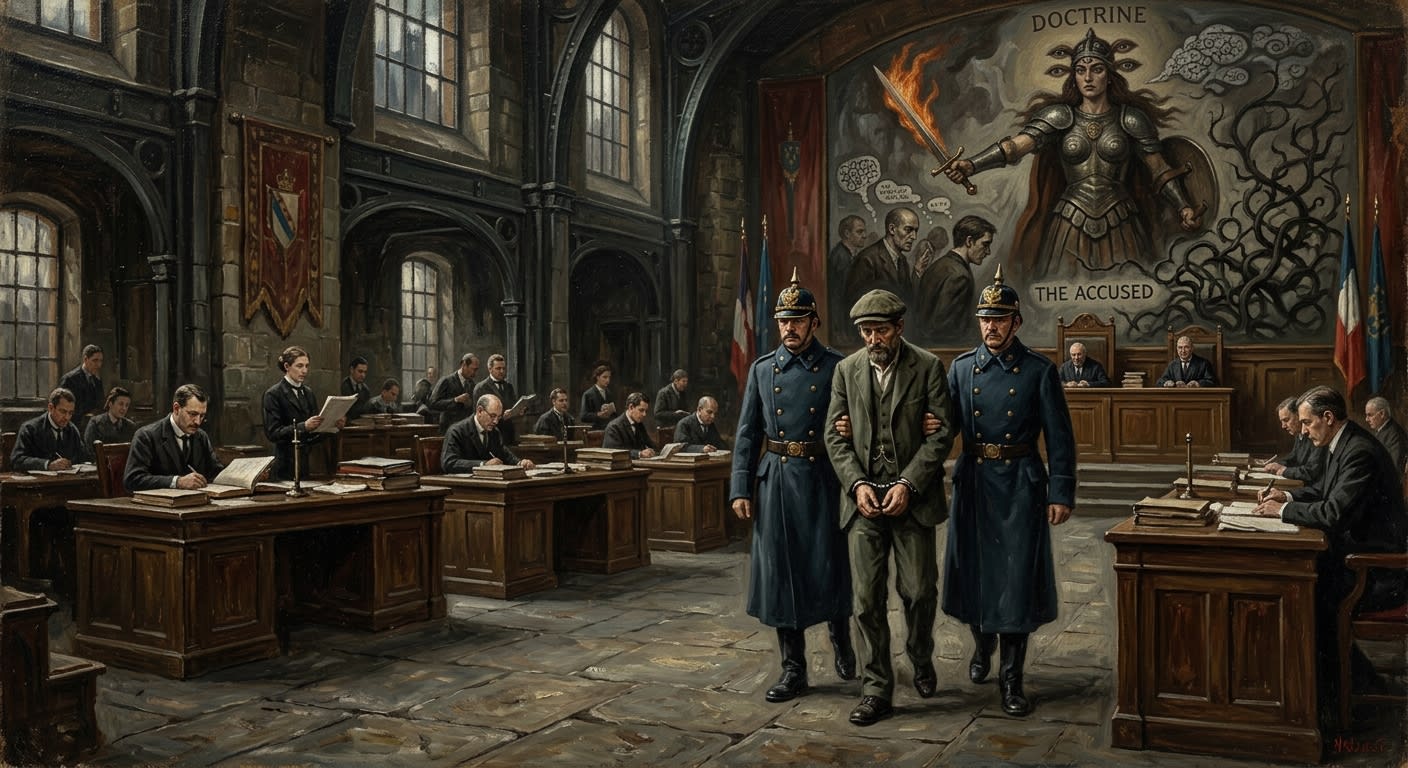
Article 9 of the Catechism of Obedience
The offence remains open so the soul cannot close
Article 9 refuses to define heresy, then makes Doctrine's later declaration retroactive to the first formation of the accused thought. Mercy hates the efficiency.
Codex Ref. XIII.1.04-009
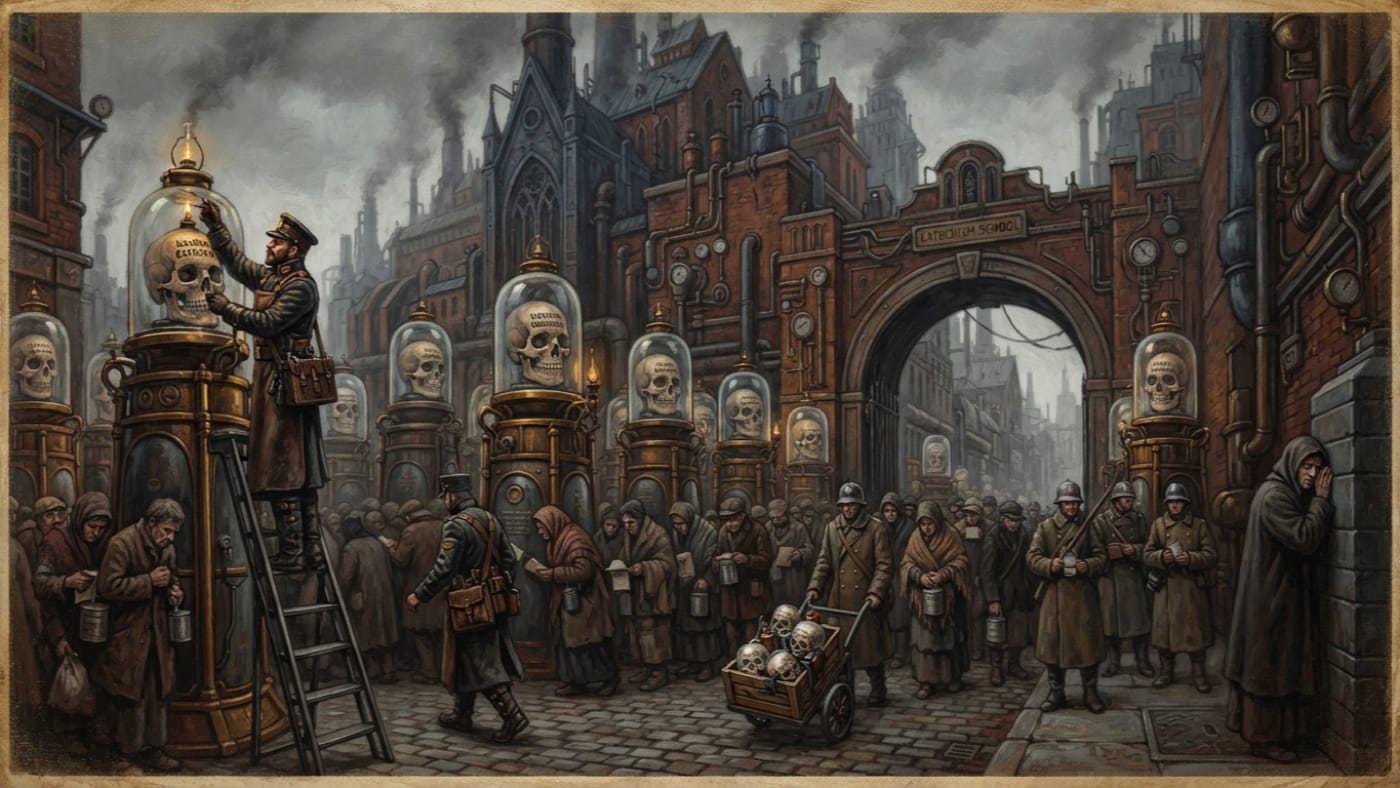
Bureau of Civic Doctrine
A name shall be legible; the hand that inks it need not be seen
The Bureau makes condemned names legible in glass and keeps them lit. Its Pillar-Keepers serve Visibility Standard 7c; the names are audited, the hands that maintain them are not.
Codex Ref. VIII.2.14-143
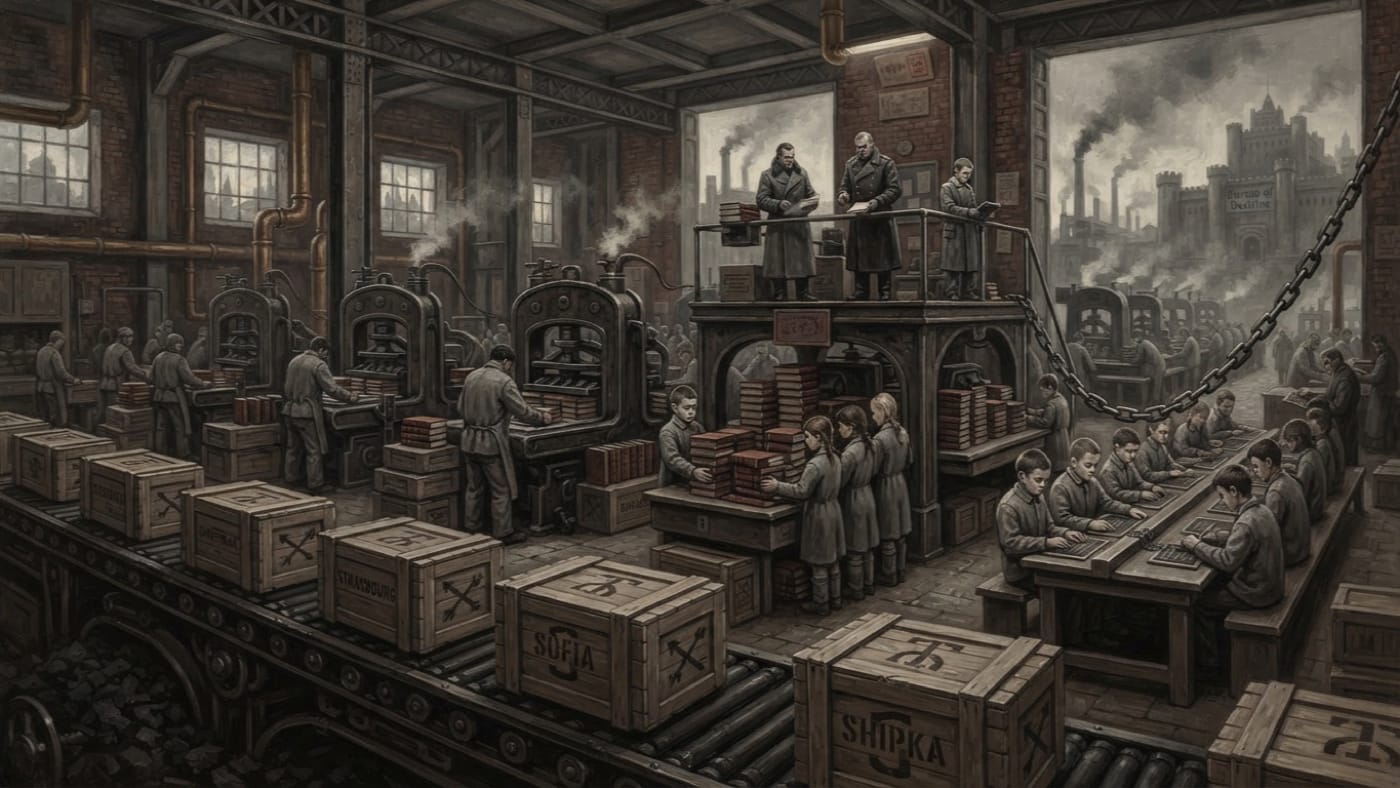
Bureau of Education
Doctrine supplies the meaning. Education supplies the crates.
The Bureau prints the same catechism for Strasbourg, Sofia, and Shipka. Doctrine supplies the meaning; Education supplies the crates. The North teaches its children without waiting for either.
Codex Ref. VIII.8.02-001
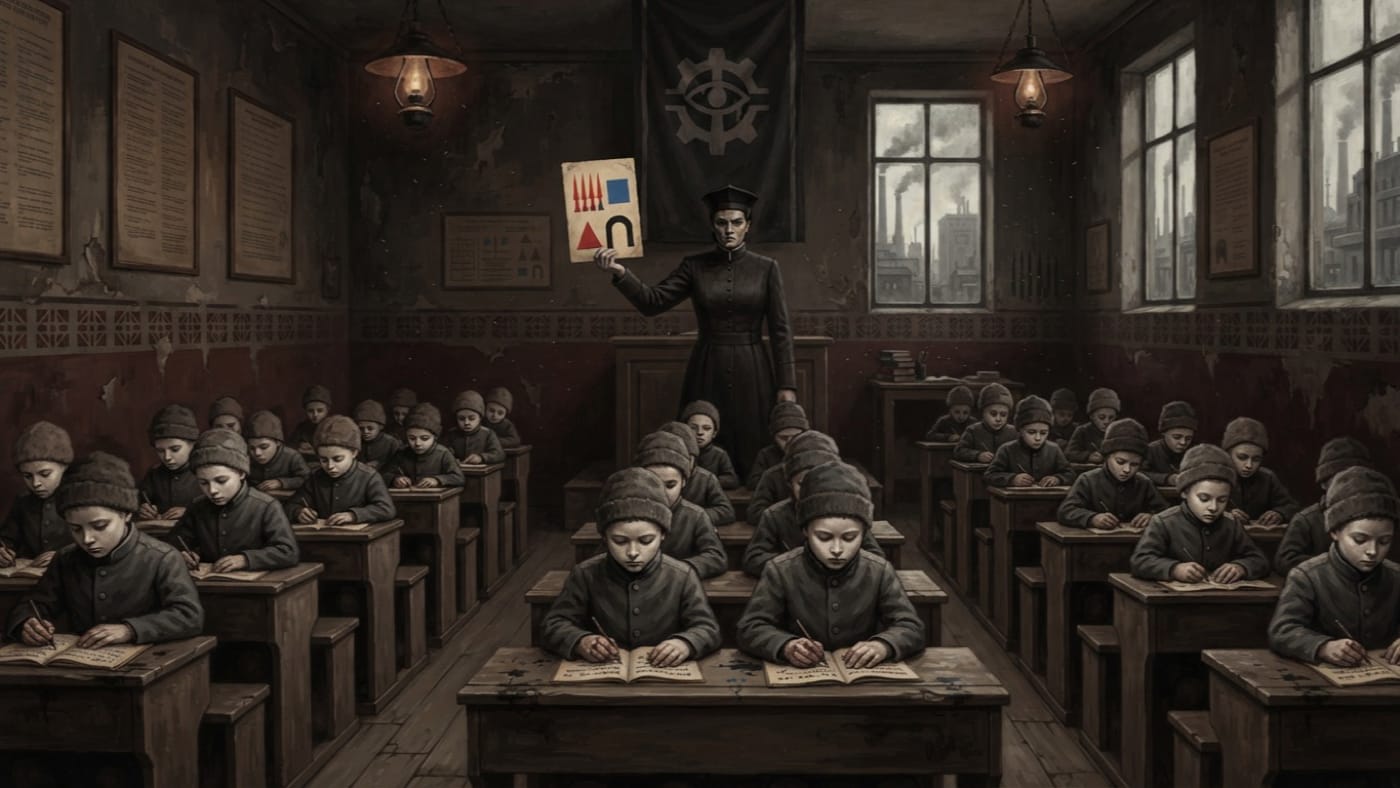
Bureau of Pedagogy
Doctrine owns the sentence. Pedagogy owns the drill.
The Bureau of Pedagogy puts Doctrine's sentences into children's mouths. Its seat is unrecorded; its primer cards teach obedience one red triangle at a time.
Codex Ref. VIII.8.03-001
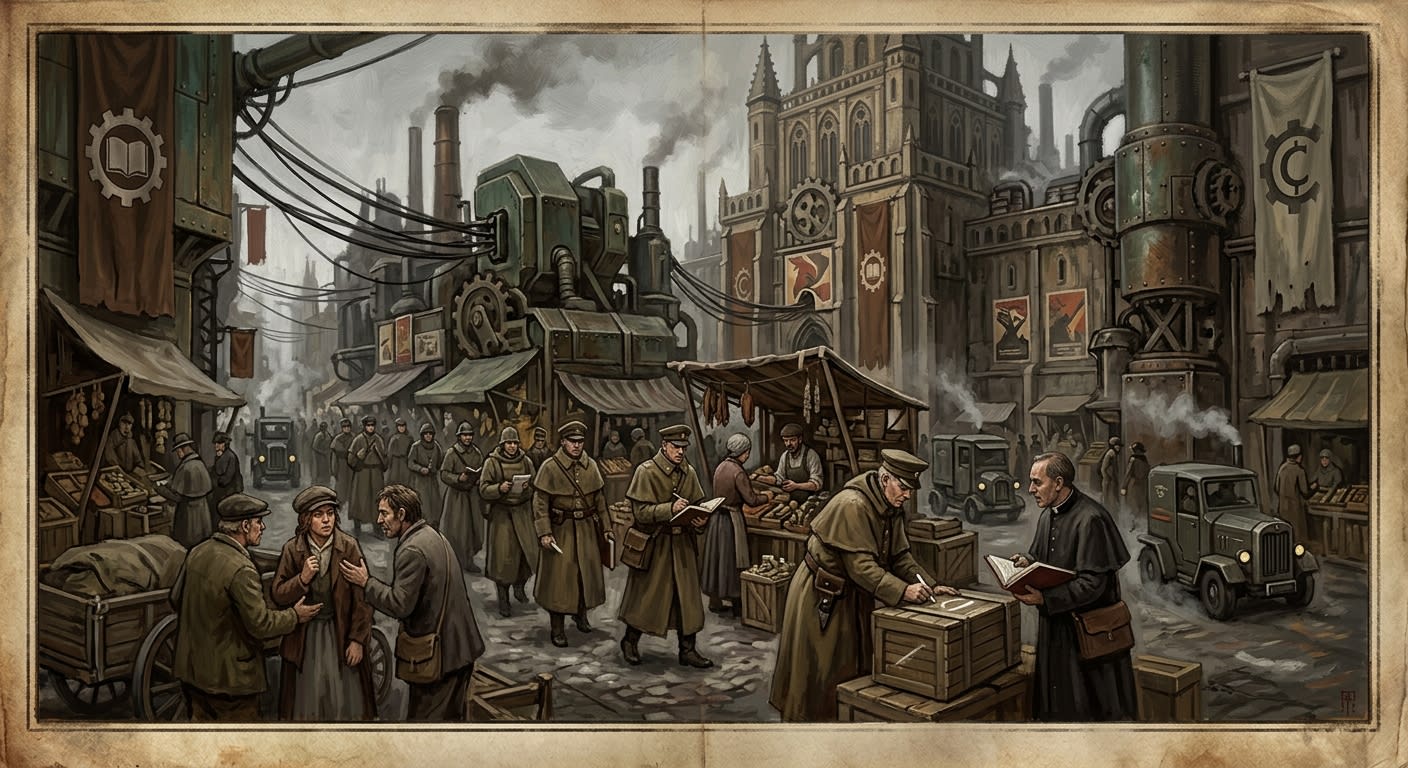
Catechism Third Revision
The street became a chapel with worse acoustics
A.S. 104 clarification that dragged obedience from chapel into market, making mouths, chalk, trade, and hesitation useful to Doctrine.
Codex Ref. XIII.1.04-104
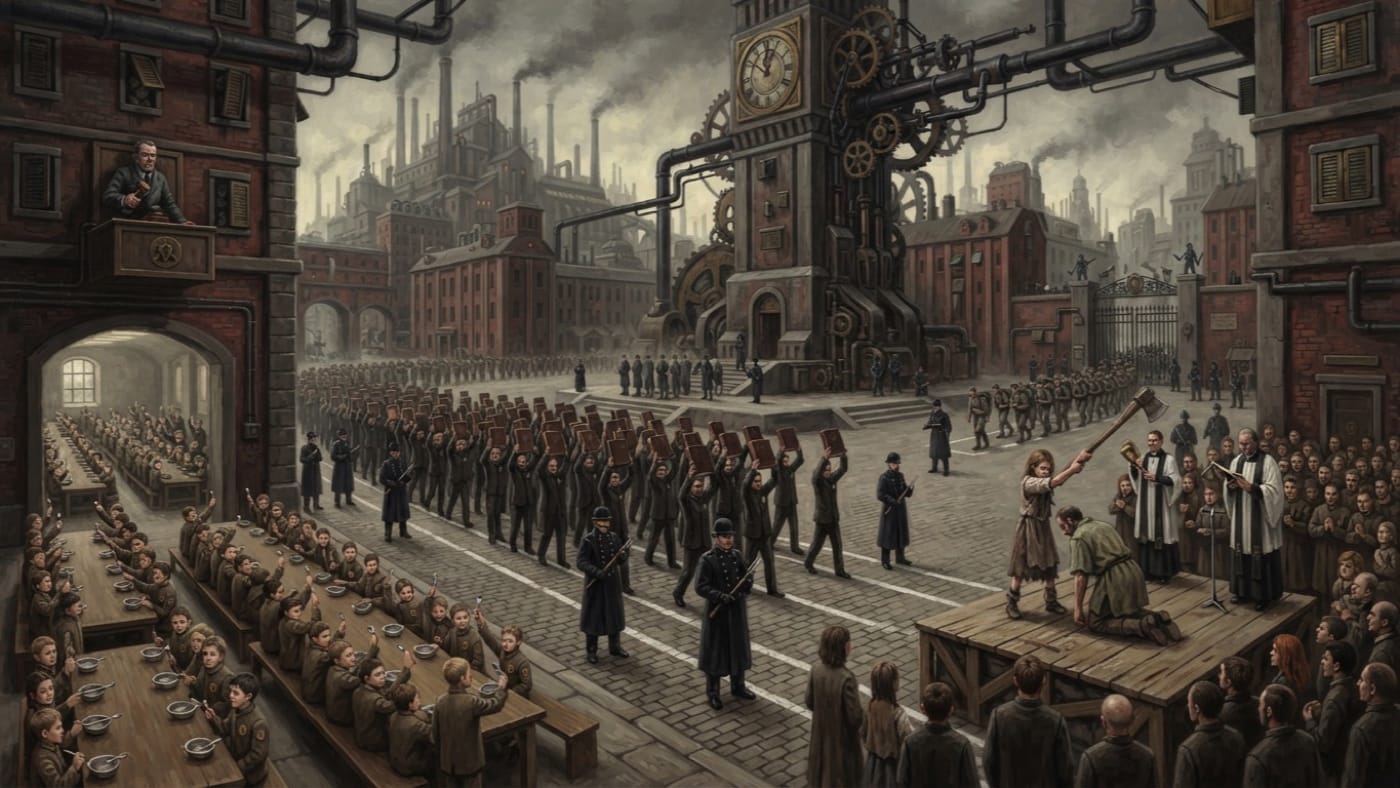
Civic Cut
The Levy takes a fraction. The Cut prepares the whole field.
Conscription takes a fraction. The Civic Cut prepares the whole field: children learn to eat, march, rejoice and betray in time with the bells, years before the Levy arrives.
Codex Ref. XIII.1.23-201
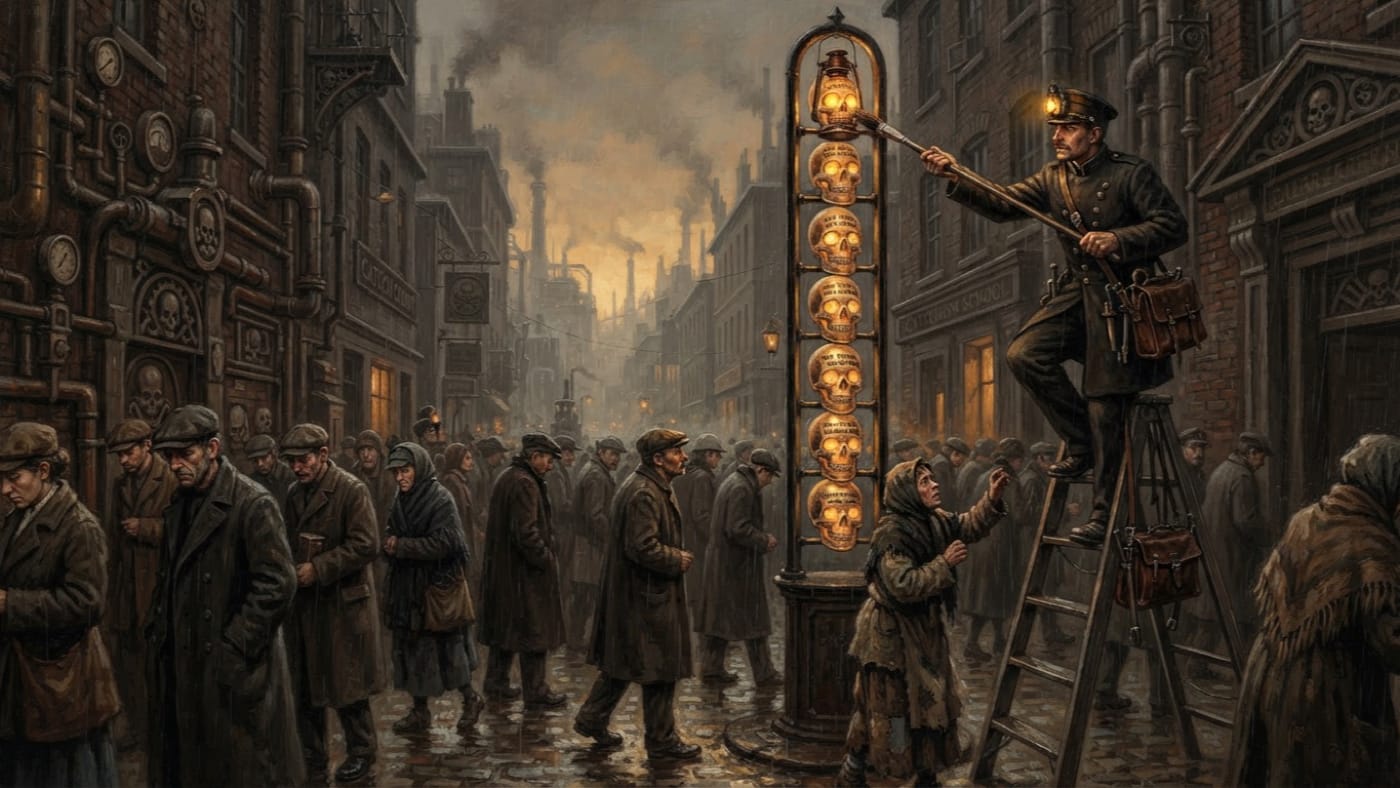
Civic Doctrine
A sentence in the ledger becomes a lesson in the street
A recorded sentence becomes compulsory street instruction: condemned names lit in Glass Skull Stacks, maintained by Pillar-Keepers and challenged by Mercy Cult blanks. The citizen need only pass beneath.
Codex Ref. XIII.1.07-201
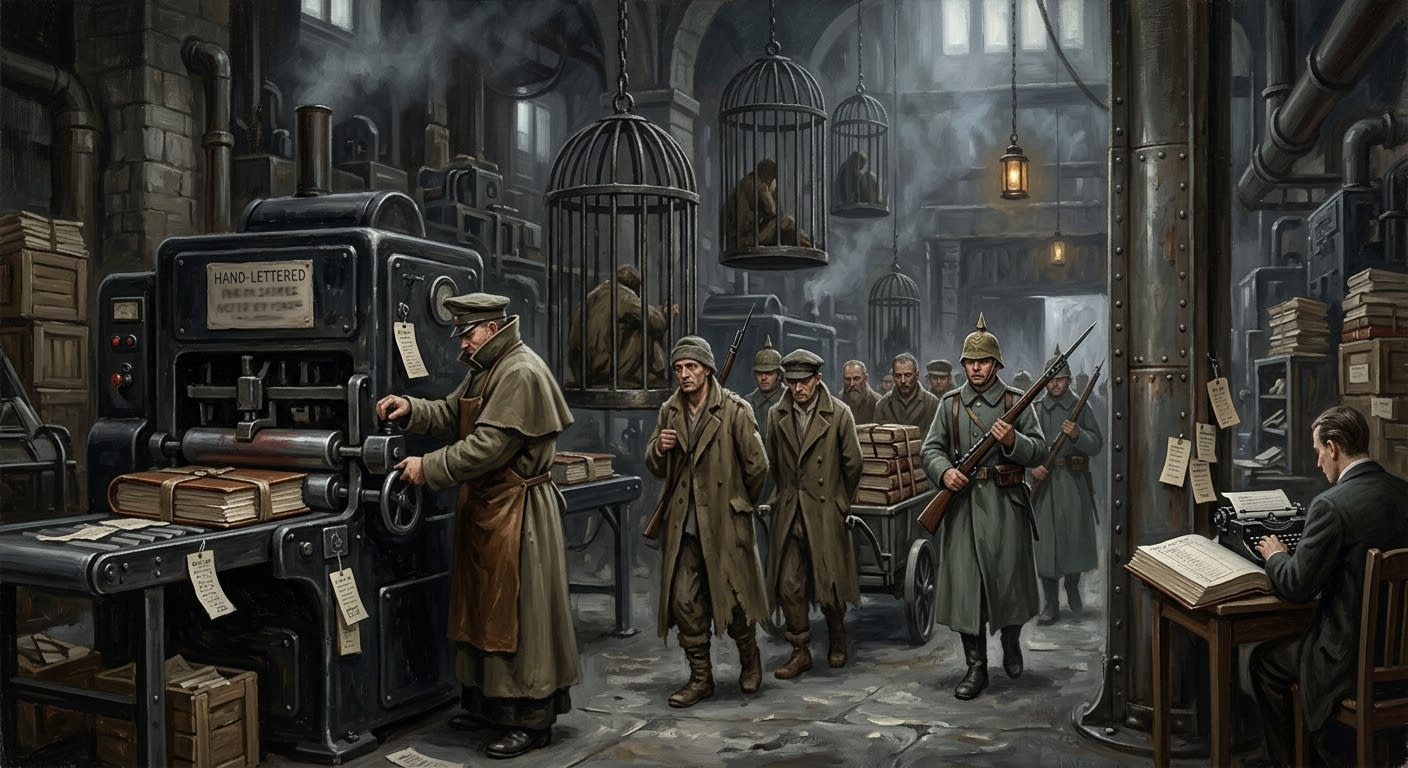
Commentaries on Faithful Severity
The book that taught cruelty to file receipts
Severian's Commentaries turn cruelty into apparatus: cages, tongues, households, witness columns, and the tidy receipt by which harm becomes Doctrine.
Codex Ref. XIII.1.04-134
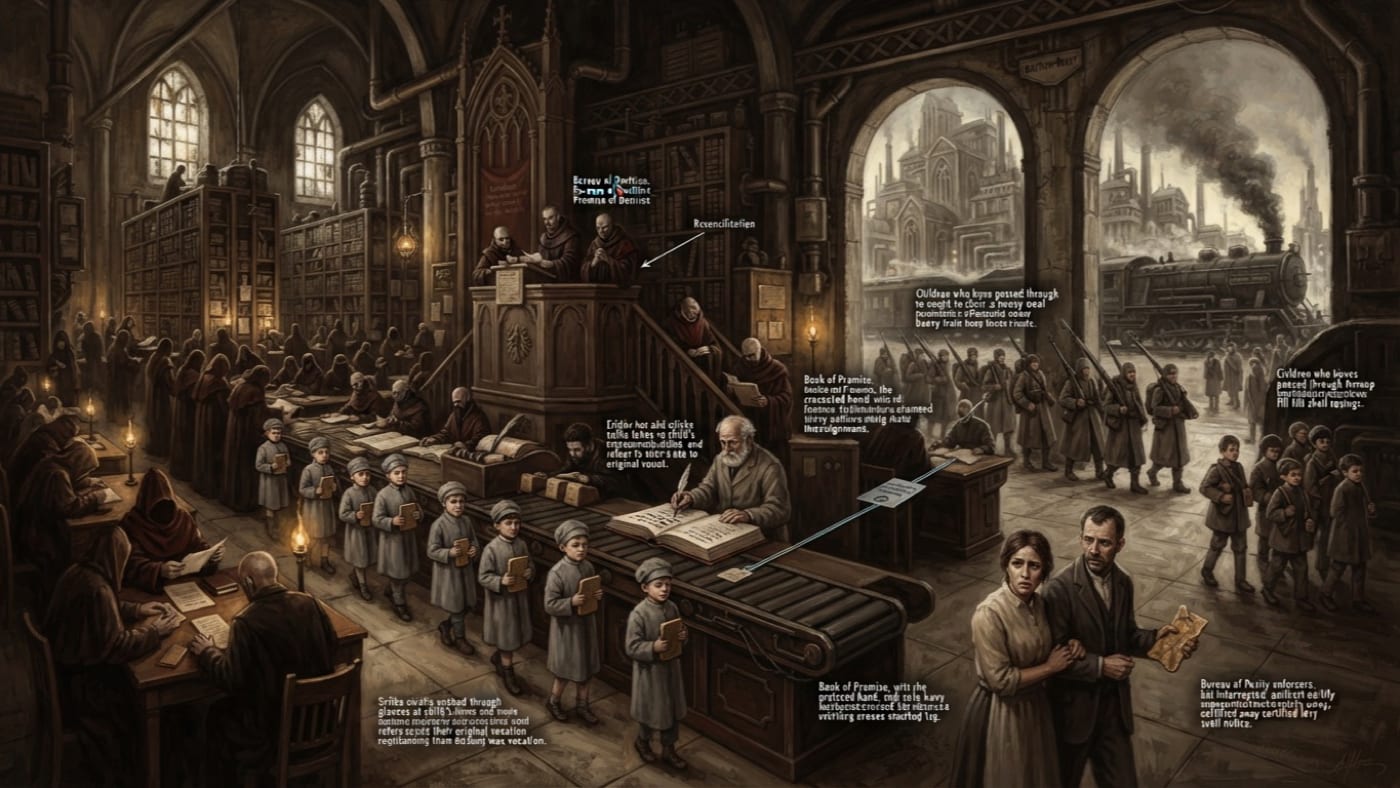
Doctrine of Deferred Fulfilment
The promise stands; the route belongs to the Bureaus
The Synod's promise is never broken: the Bureaus revise the vocation, Records certifies fulfilment, and the household's understanding is deferred indefinitely.
Codex Ref. XIII.1.22-002
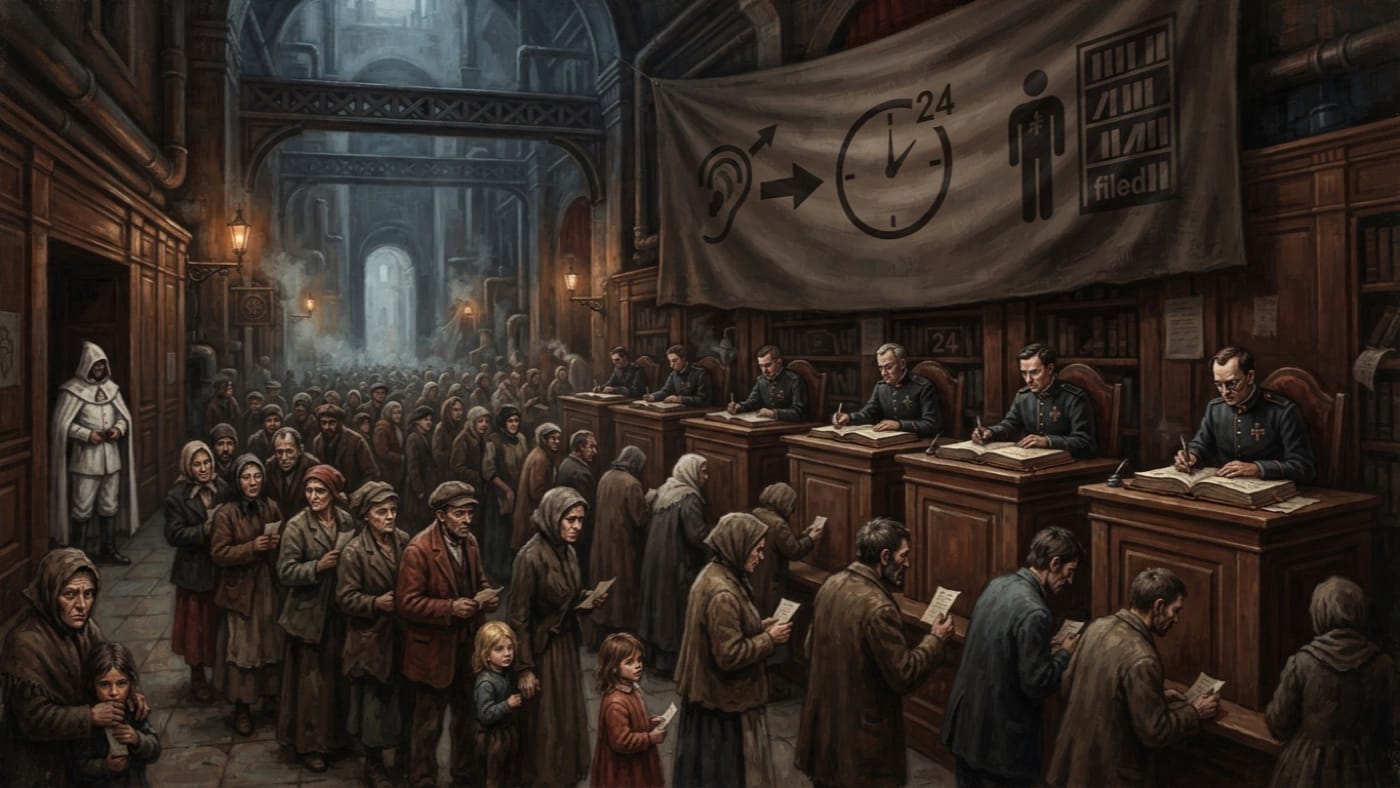
Duty of Denunciation
Every ear a witness; every silence a roof
Severian's Article 19 gives every ear a public office: report suspected heresy within twenty-four hours, or be filed beside the person you sheltered.
Codex Ref. XIII.1.04-944

Exegete Hallam
The man who taught guilt to arrive before law
Exegete Hallam drafted Article 9's retroactivity clause in the Catechism of Obedience, giving Doctrine custody over thoughts before citizens knew they had sinned.
Codex Ref. III.2.01-150
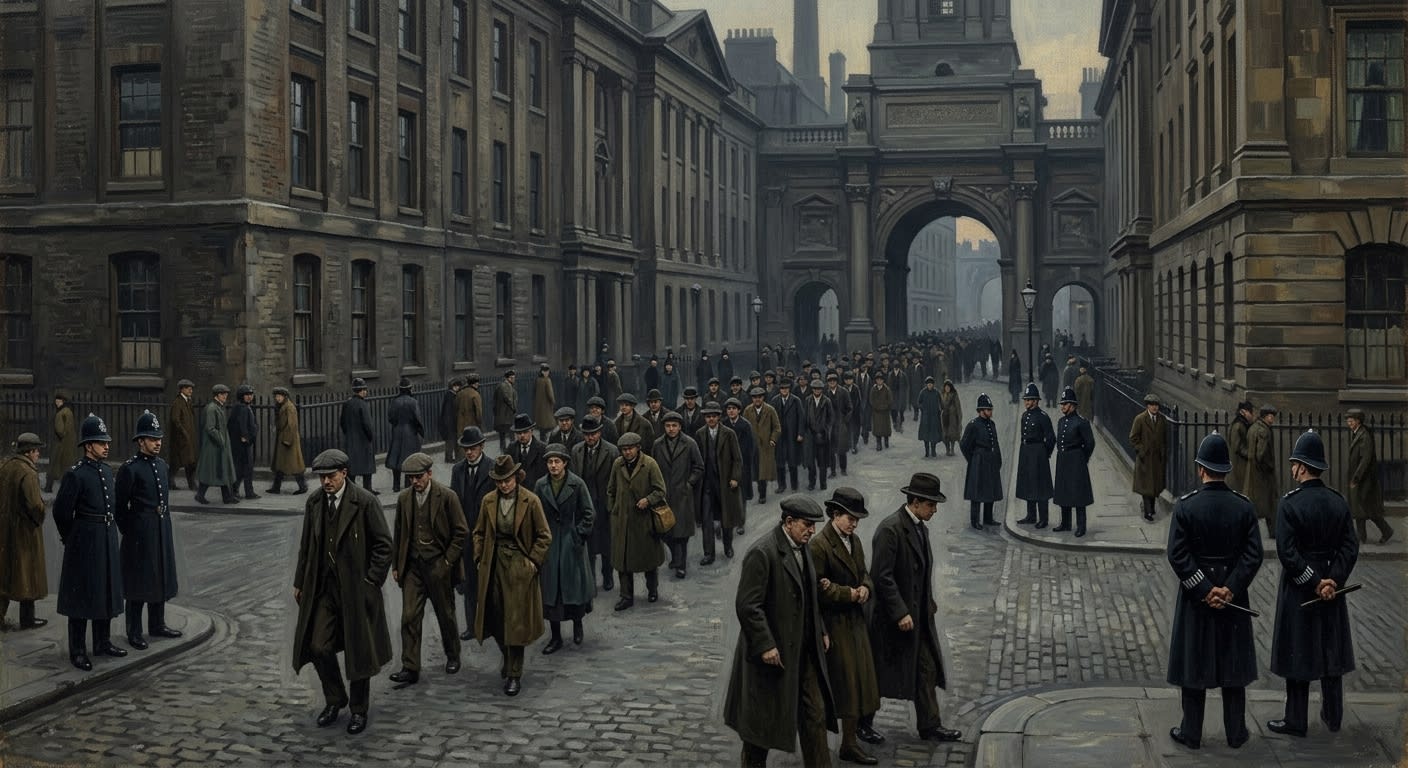
Fast of Silence
The tongue kneels before the knife is invited
The Fast of Silence is the Bureau of Festivals' cleanest cruelty: a district gagged from dawn to dusk until obedience sounds like piety.
Codex Ref. XIII.1.89-153
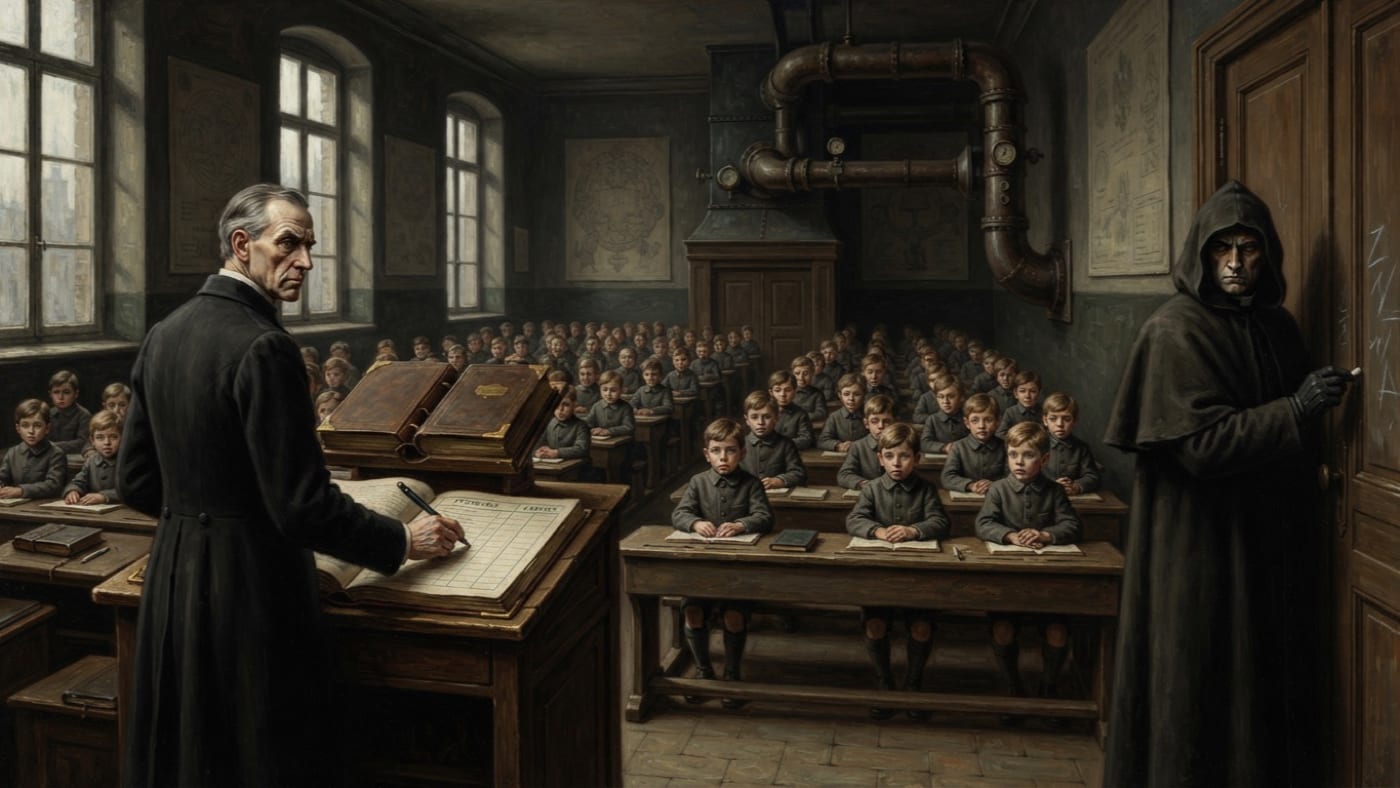
First Catechism
The sentence is settled. The child's hesitation is filed.
A present survey of the First Catechism's opening sentence, taught at five and ratified in perpetuity. Doctrine may revise its explanations; Records keeps the child's hesitation.
Codex Ref. VI.1.01-002
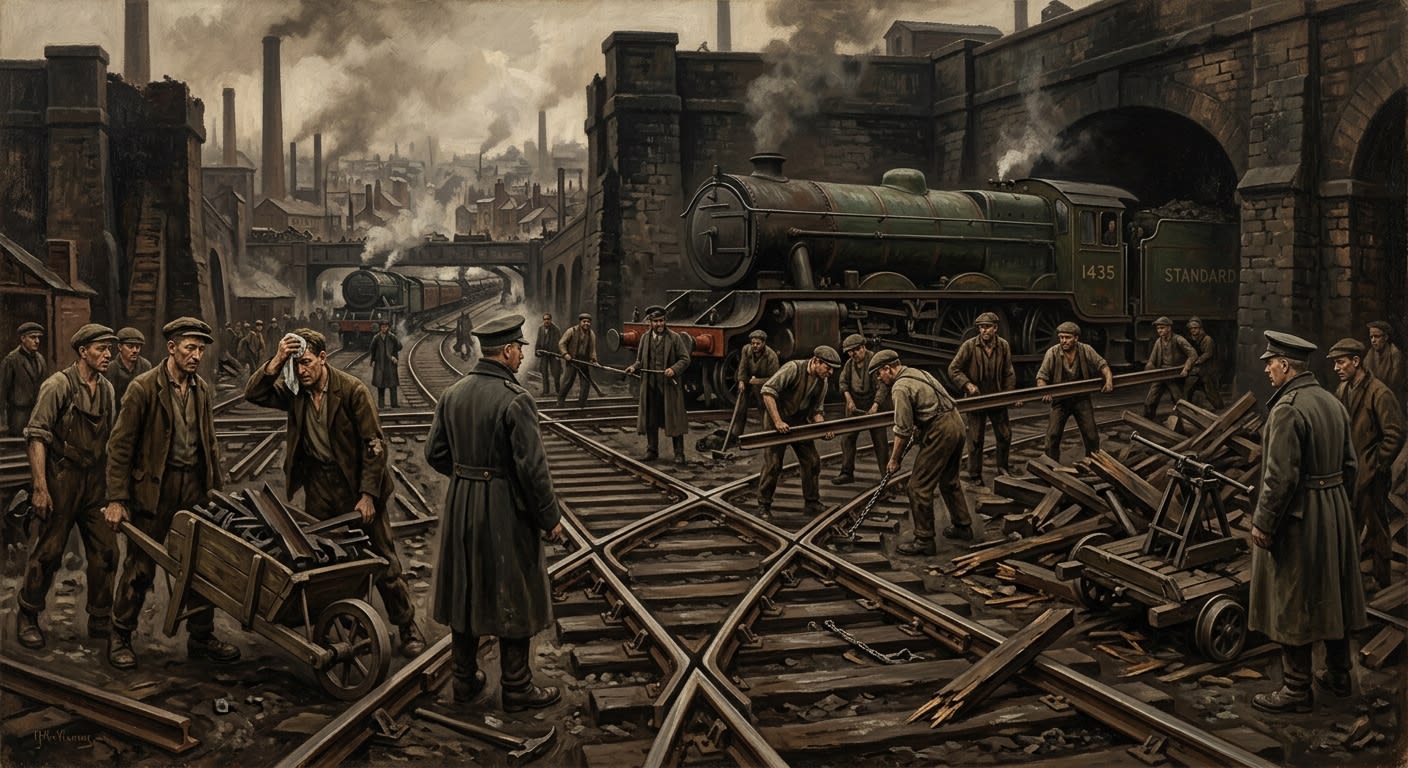
Gauge War
Forty years to agree on the distance between two rails
A.S. 96–136 rail-standardization conflict in which rival gauges starved bastion corridors until Engineering imposed 1,435 millimetres and labour paid in hands, hunger, and four thousand dead.
Codex Ref. VII.2.10-136
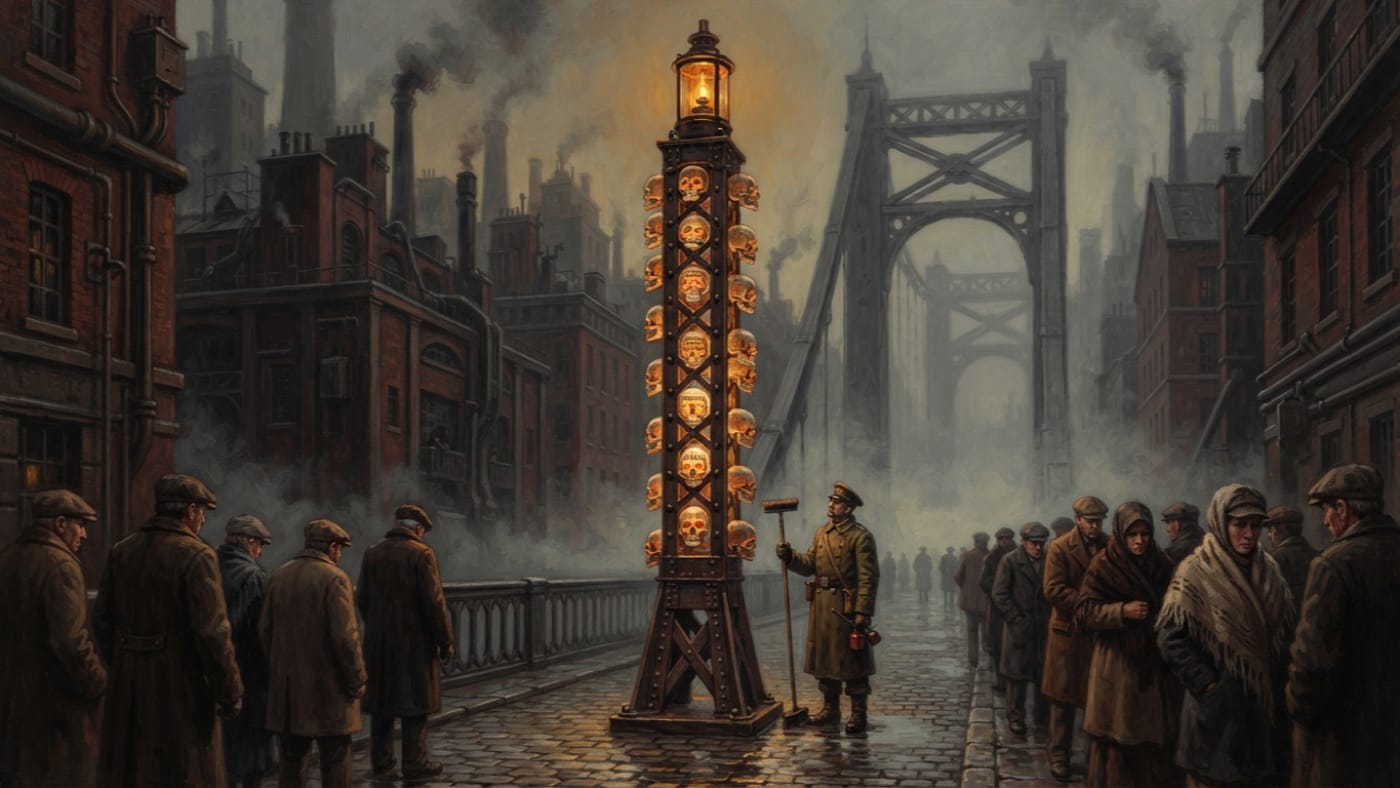
Glass Skull Stacks
The name goes up; the city learns to look
The Synod's municipal deterrence pylons hold condemned names in hollow glass crania, lit nightly for the street. Glass, ink and iron do the warning; Pillar-Keepers keep the sentence legible.
Codex Ref. V.2.08-001
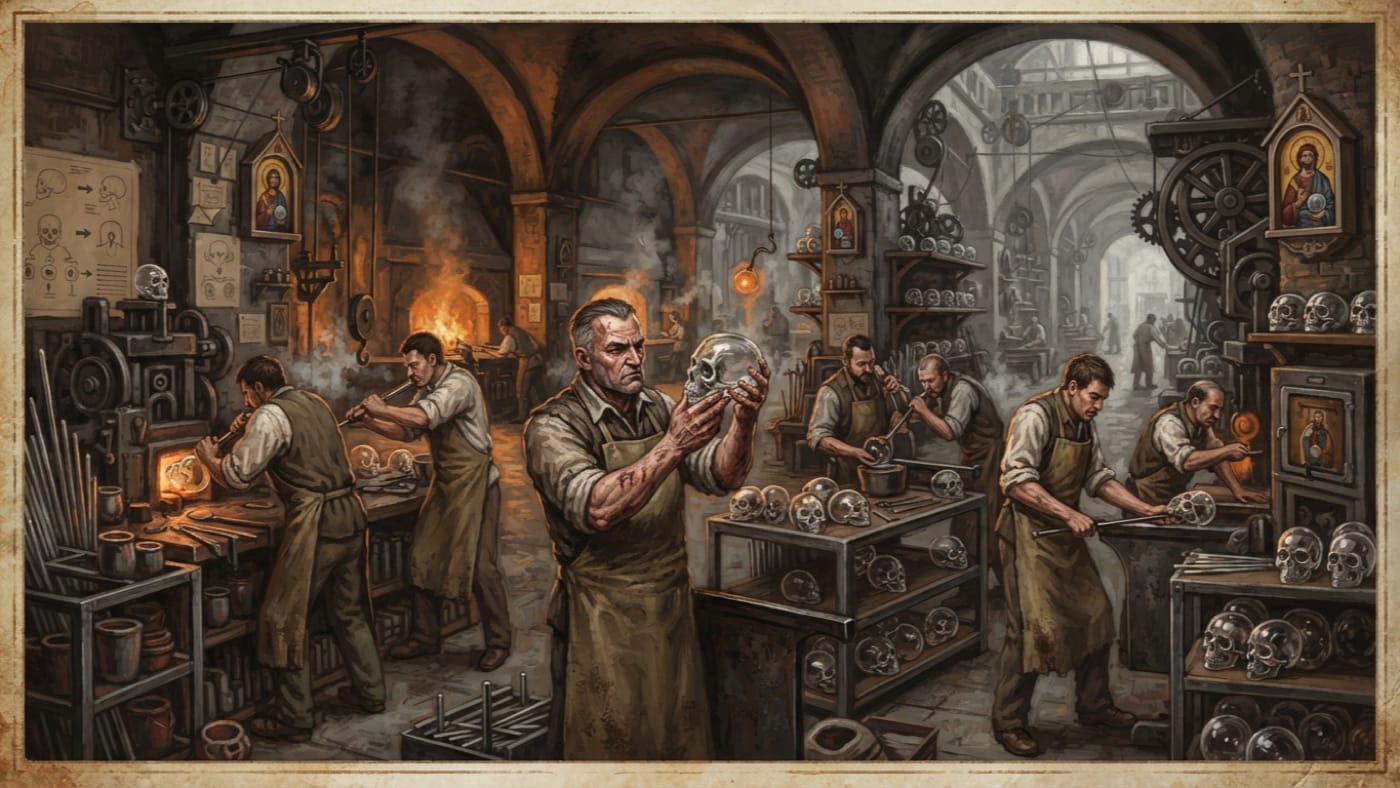
Glasswright
They cast the vessel; others supply the sentence
Licensed glasswrights cast the hollow skulls through which the Synod displays its sentences. Saint Velek blesses the furnace; Purity asks who supplied the glass when a name begins to sing.
Codex Ref. XII.30.02-001
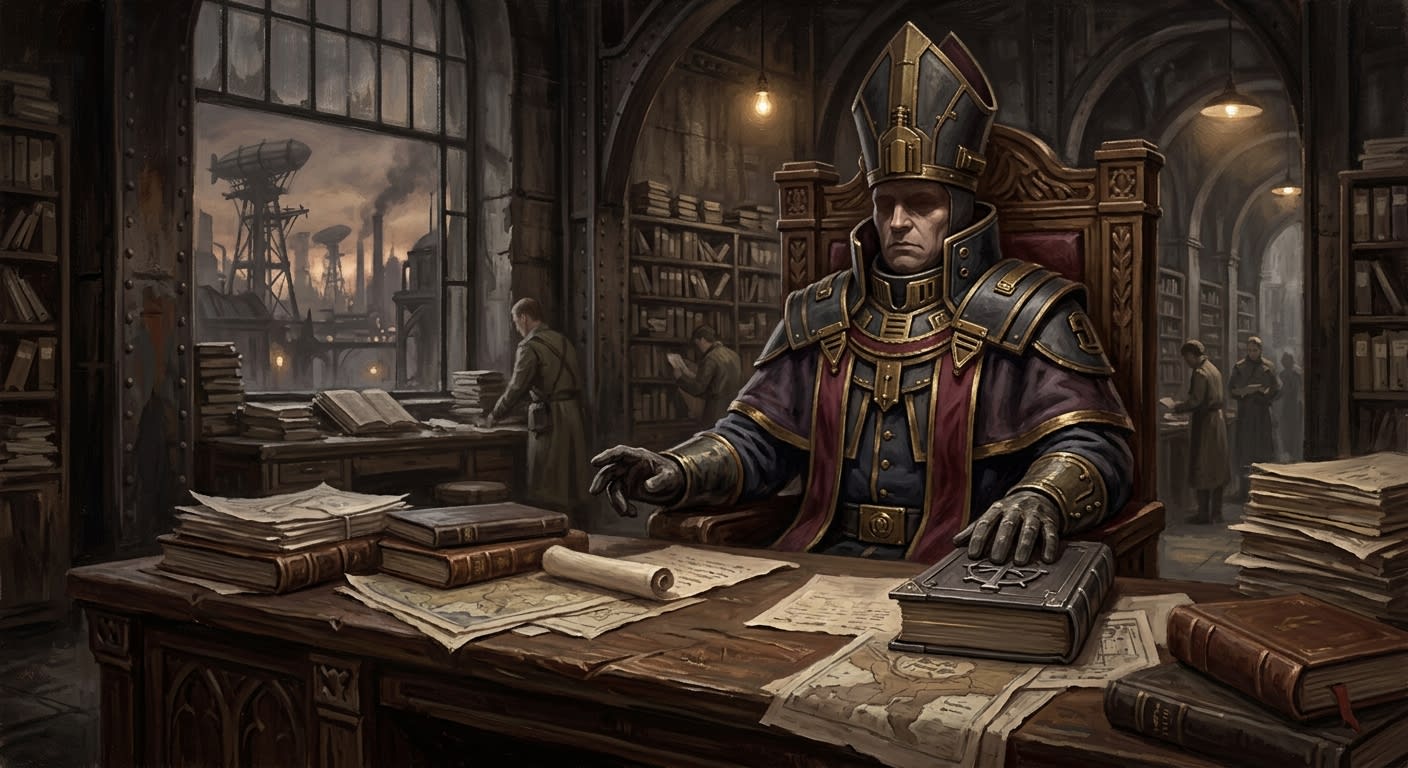
Hierarch of Doctrine
Truth is what leaves the Seal; reading is a courtesy
The unnamed current holder of the First Seal defines orthodoxy for the Synod, commands Doctrine, and proves that authority need not wait upon comprehension.
Codex Ref. III.2.01-071
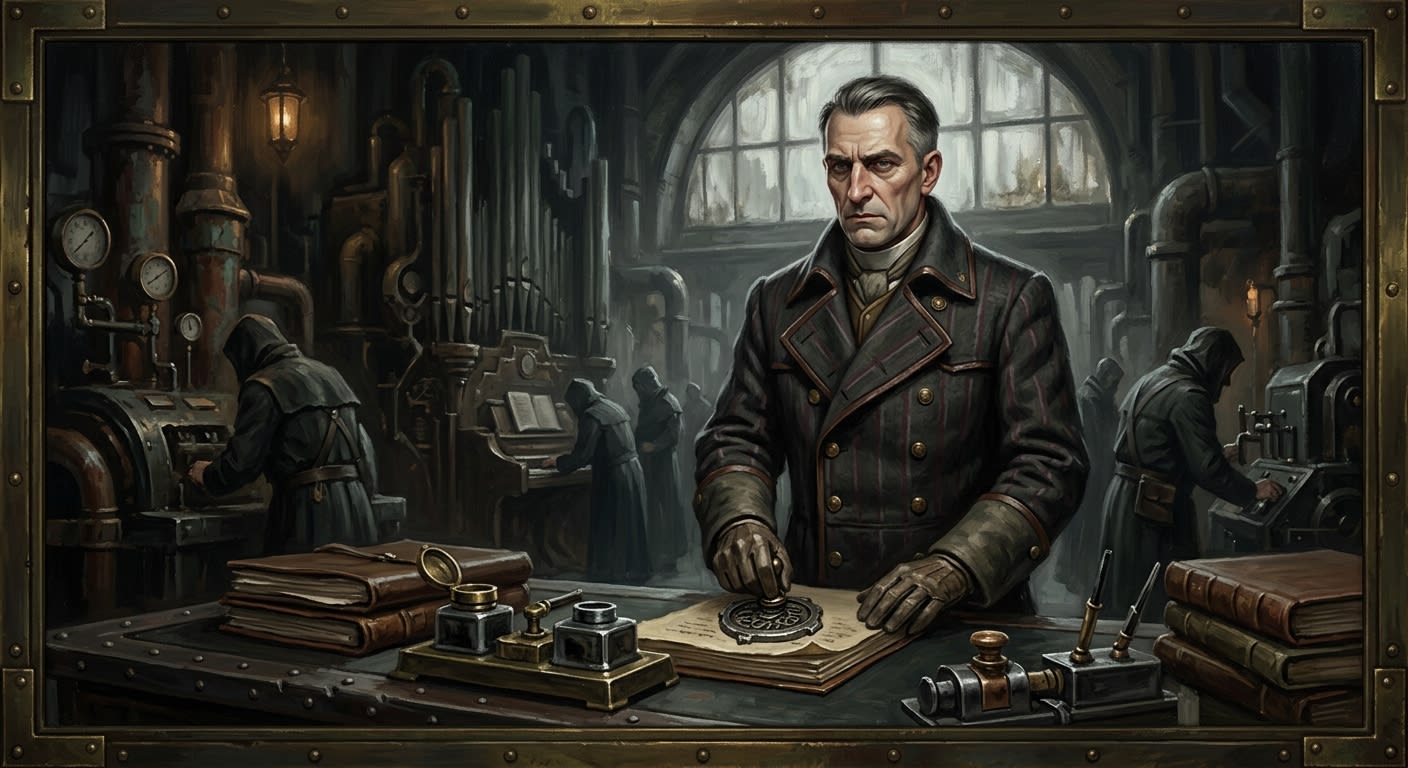
Inquisitor-General Severian
The man who taught fear to sing in tune
Architect of the Iron Choir of Mainz and Severian Gloss to the Catechism of Obedience, he made silence culpable, cruelty legible, and fear useful enough to receive forms.
Codex Ref. III.2.01-006
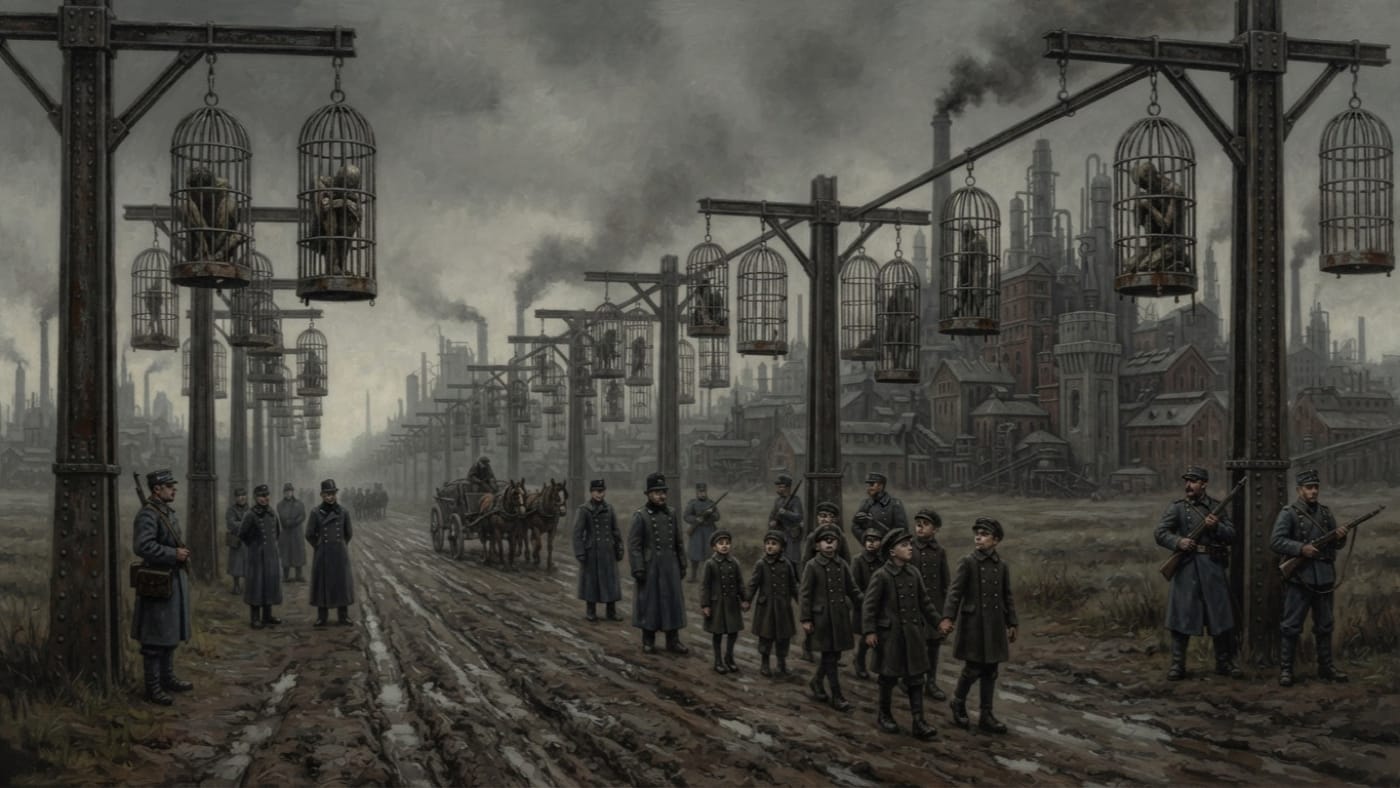
Iron Choir
A licensed hymn in the chamber, a captive congregation on the road
The Iron Choir gives confession a licensed hymn and the Mainz road a congregation of cages. Severian's method keeps fear in public service, even when most of the cages stand empty.
Codex Ref. VIII.1.09-001
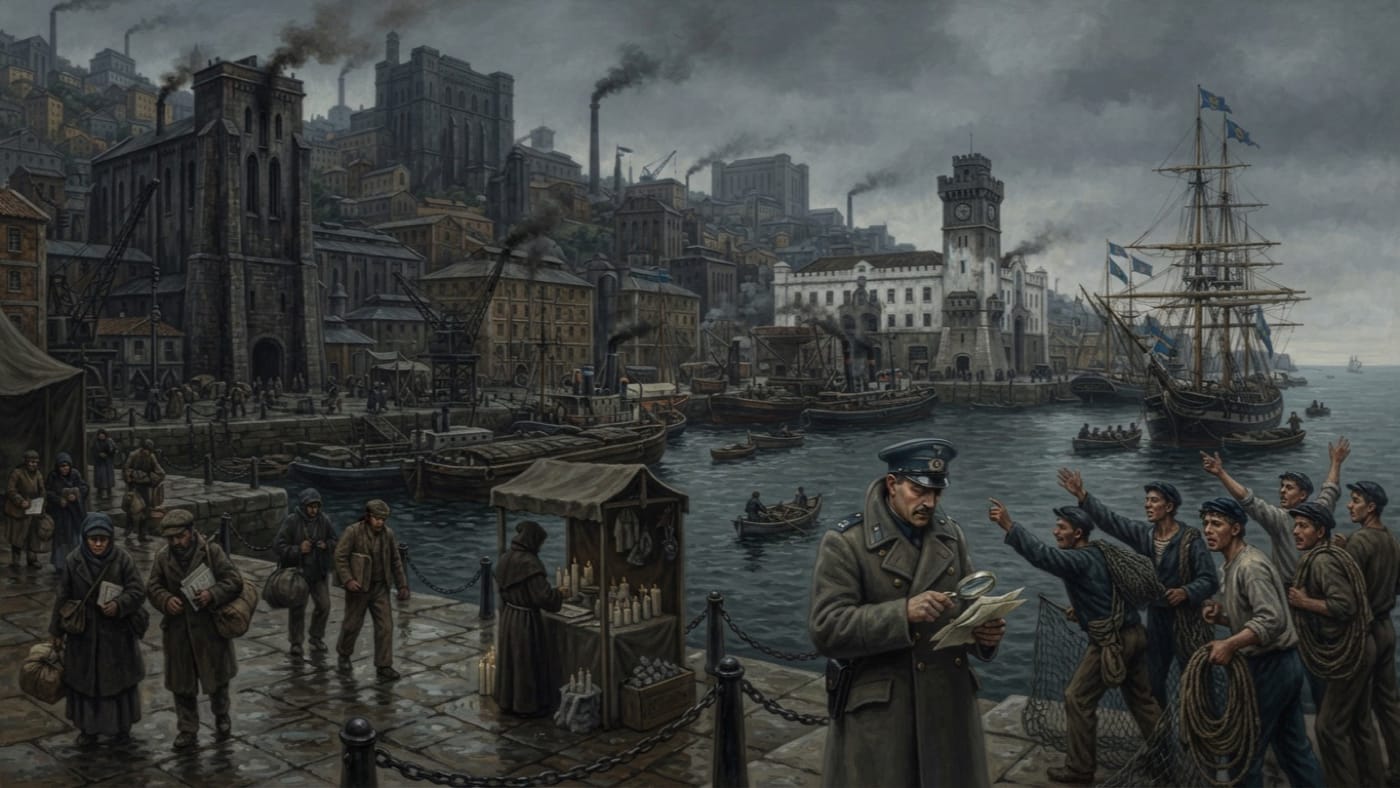
Lisbon
The harbour counts by contract
Lisbon sells sea candles, quake memory and licensed passage at the Atlantic mouth of the Tagus. Strasbourg counts its revenue; its sailors tell the catastrophe in the wrong order.
Codex Ref. II.4.09-201

Listening Glass
The glass returns a sound; the offices return a sentence
Keeper lore credits Saint Velek with glass that holds and returns sound. A Velek cup may yield a condemned name, an inquisitor's business, or the Listener's own confession. Engineering denies the technique.
Codex Ref. XIII.1.43-002
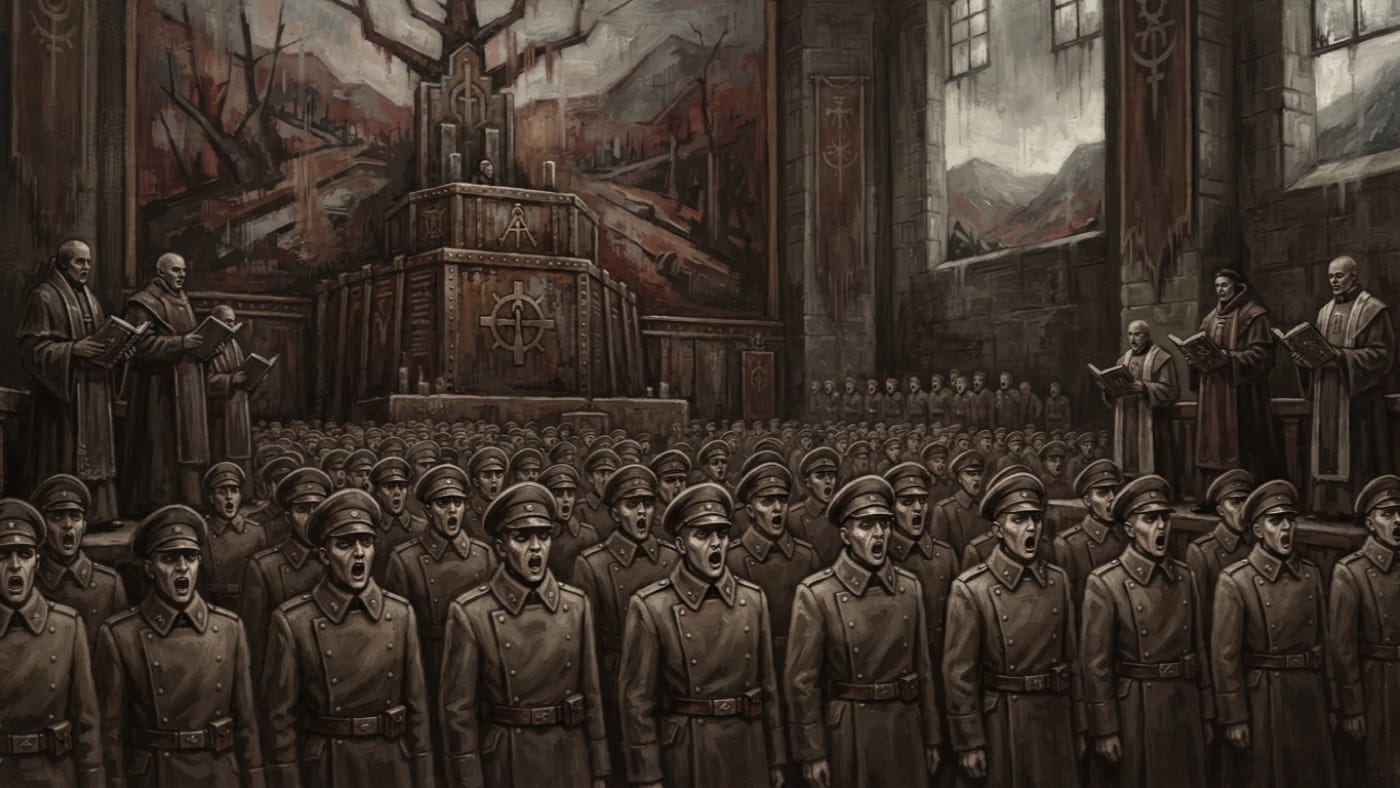
Litany of Errors
Eleven names. One designation. Four minutes to agree.
At Bastion-Przemyśl, cadets recite eleven Ulm signatories and the unknown twelfth, then condemn all twelve in unison. Four minutes of exact remembrance, with no room left for curiosity.
Codex Ref. XIII.1.95-201
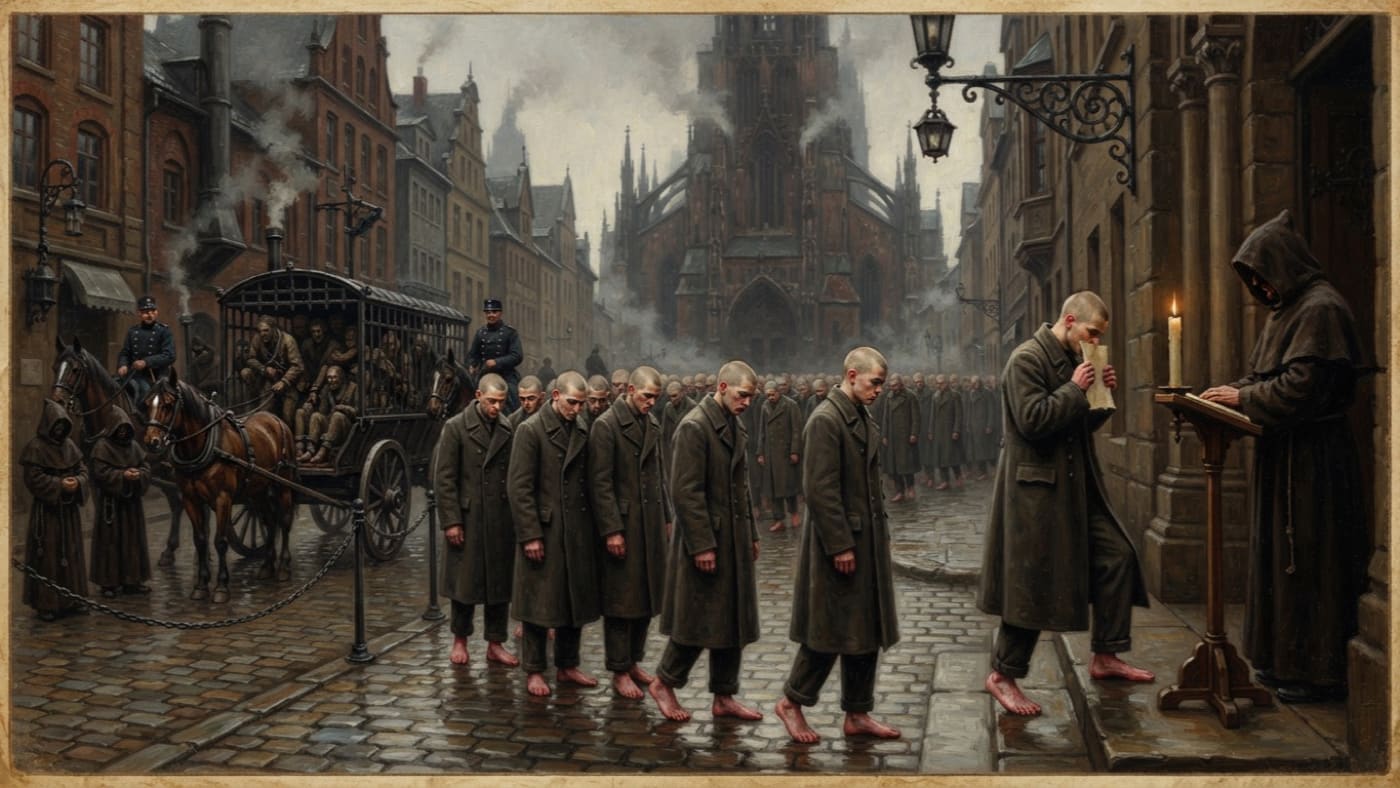
Litany of Twelve Errors
Bare feet, approved words, and a page that must remain unread
Ulm's students walk barefoot to the cathedral, recite the Litany of Twelve Errors and kiss blank Mine paper. Lawful learning survives by keeping its mouth obedient.
Codex Ref. XIII.1.97-201
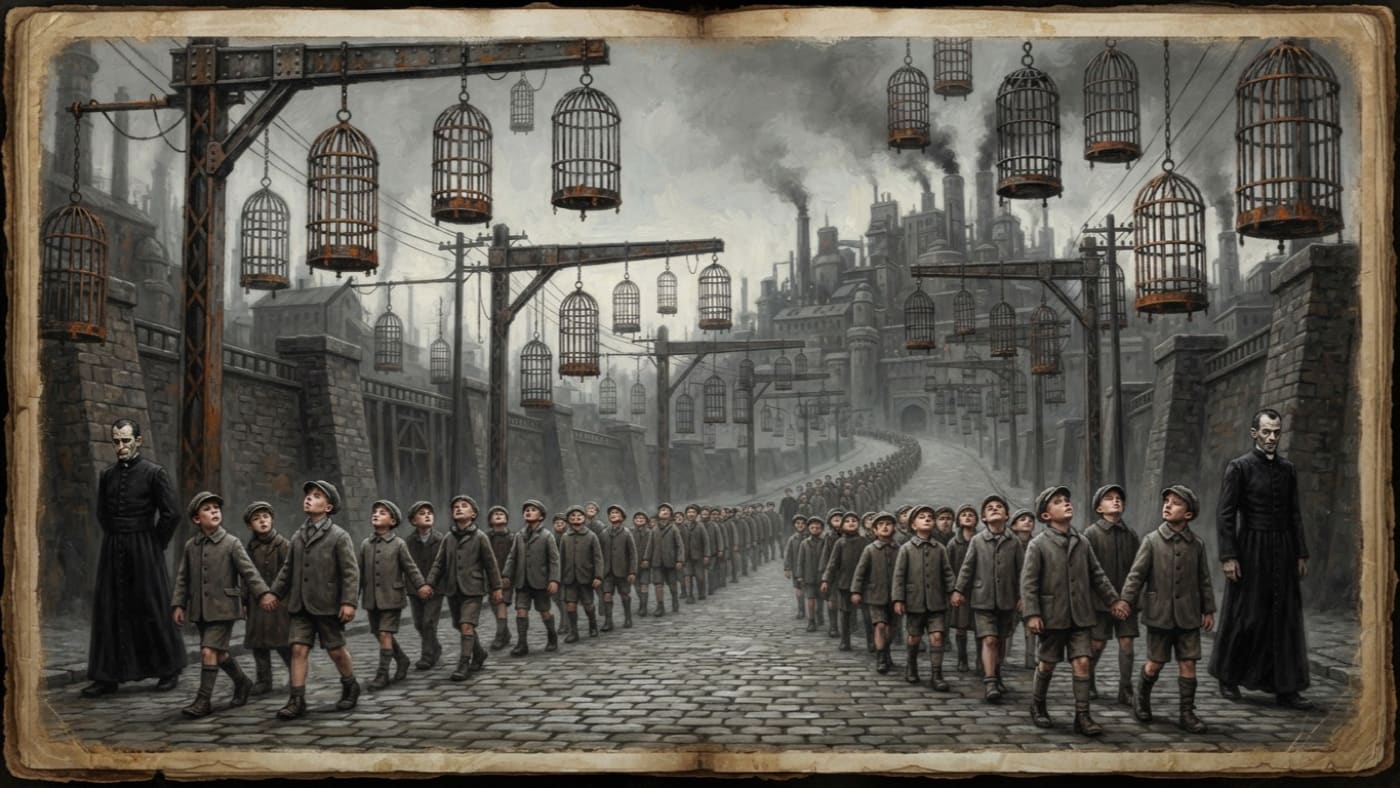
Little Witness Program
The schoolroom learns what the cage is for
The Little Witness Program marches schoolrooms past Mainz's Iron Choir to teach obedience through terror. Records claims a sixty-percent rise in confessional punctuality; Mercy's objection remains overruled.
Codex Ref. XIII.1.08-201
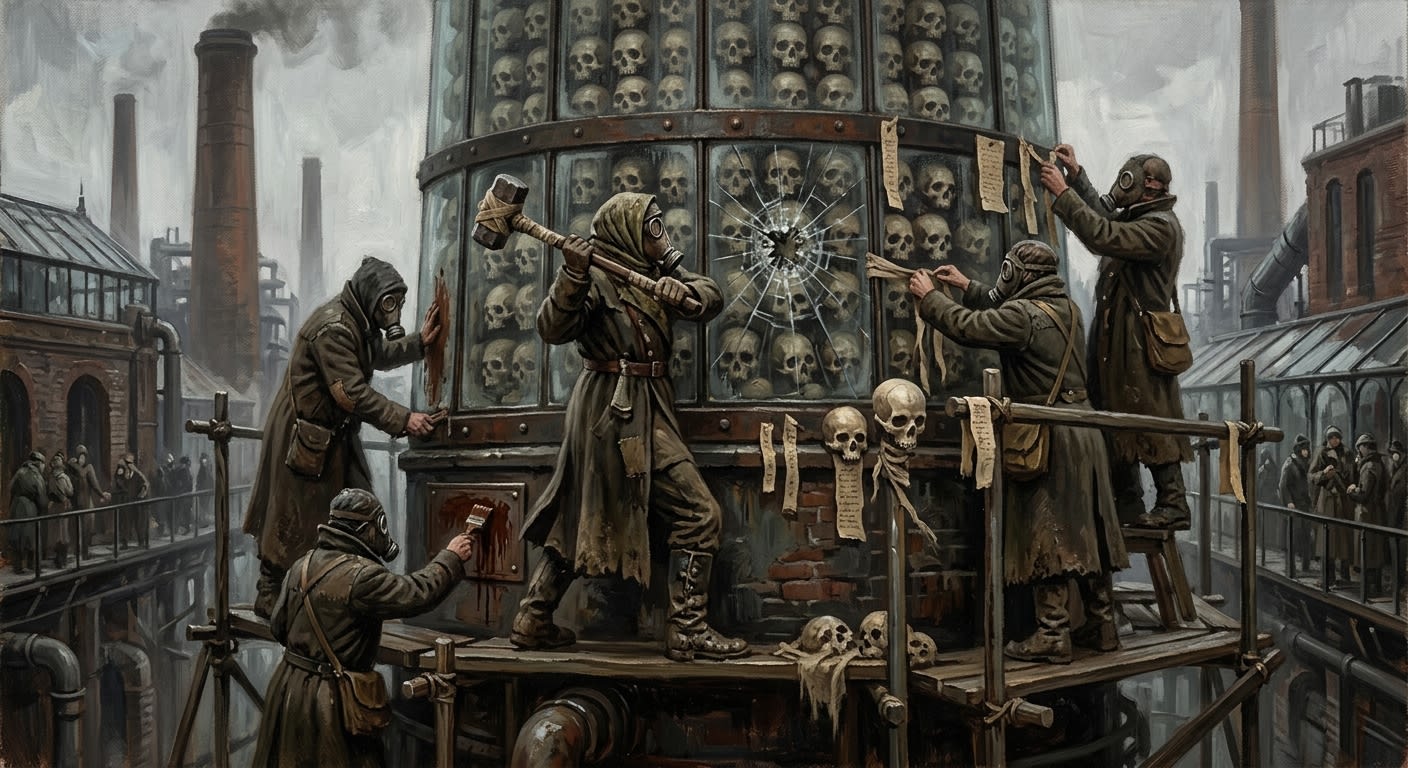
Mercy Cults (Stack Vandals)
The blank is a mouth, and mercy requires licence
Indigenous Synod parish heresies that vandalise Glass Skull Stacks with wrapped hammers, prayer-strips, and blank skulls, arguing that public condemnation steals the Creator's final judgement.
Codex Ref. XI.1.07-001
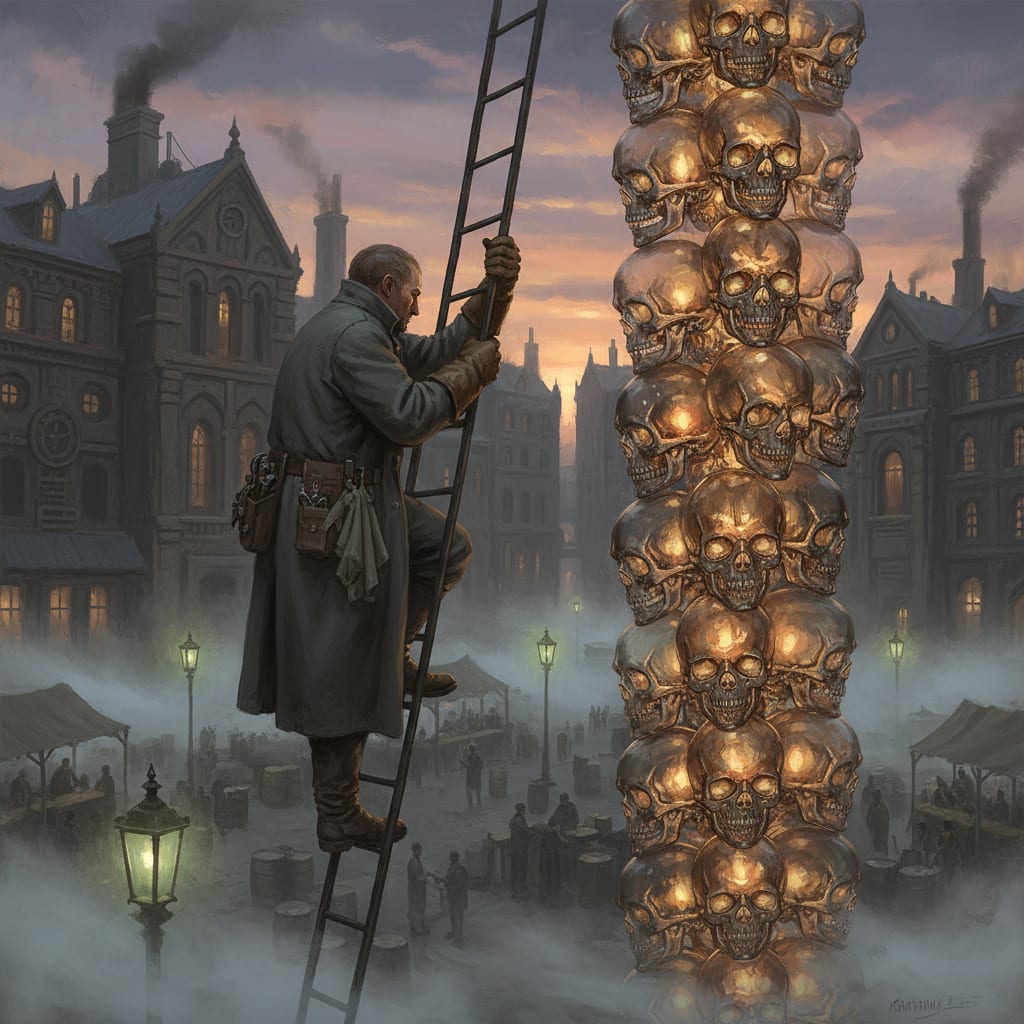
On the Pillar-Keepers of the Glass Skull Stacks
The city is held by witness; the witness is held by someone who needs his wages
A Drax survey of the Pillar-Keepers — grey-coated custodians who maintain the Synod's civic deterrence pylons: iron-boned columns of sermon-clear glass and inked names, holding the city by witness at a cost the Bureau does not audit.
Codex Ref. XII.30.01-001
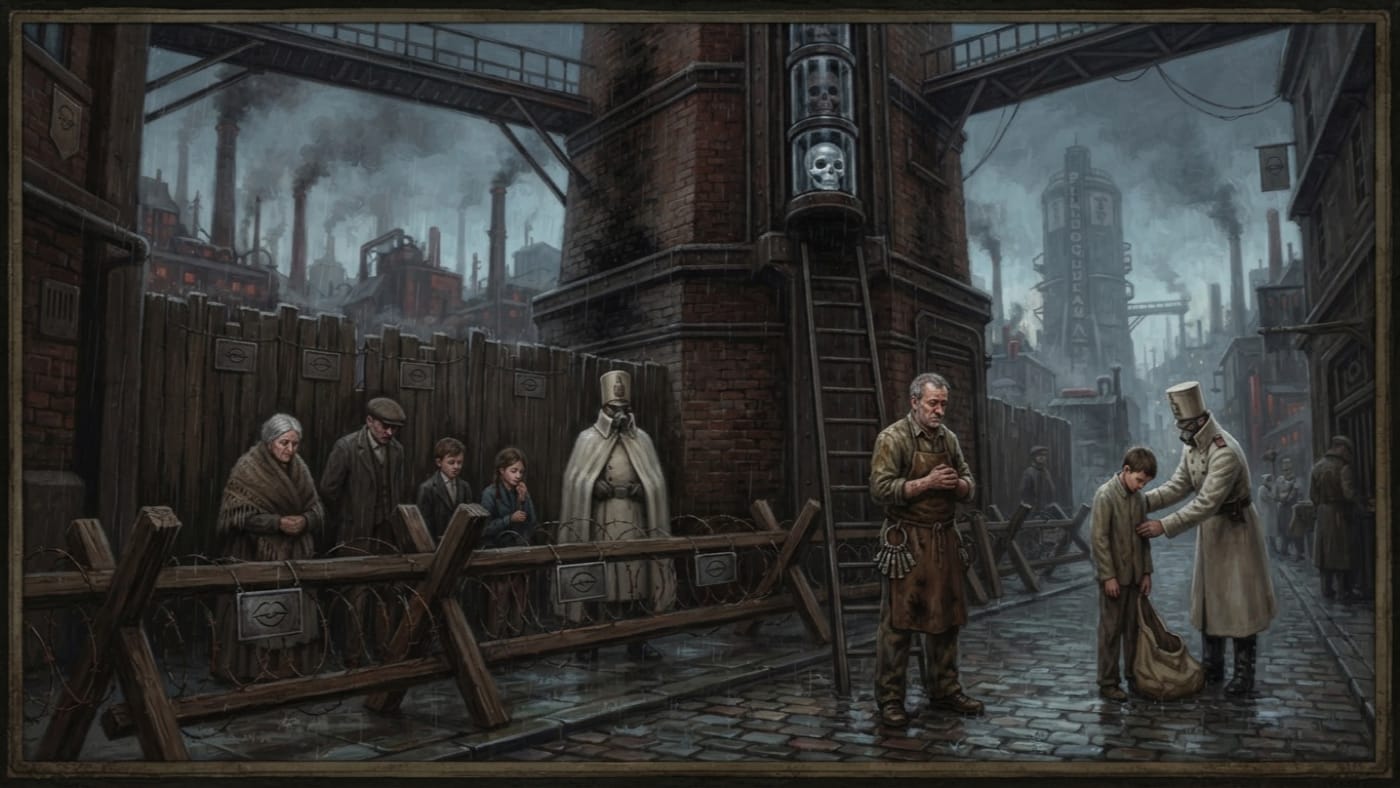
Open Mouth Response Protocol
A whole skull, an absent name, a theological emergency
The A.S. 201 survey of the Clearance Tertius extract: blank skulls, detained Keepers, separated households and a maintenance explanation. The name is restored; the full procedure remains withheld.
Codex Ref. XIII.1.44-001
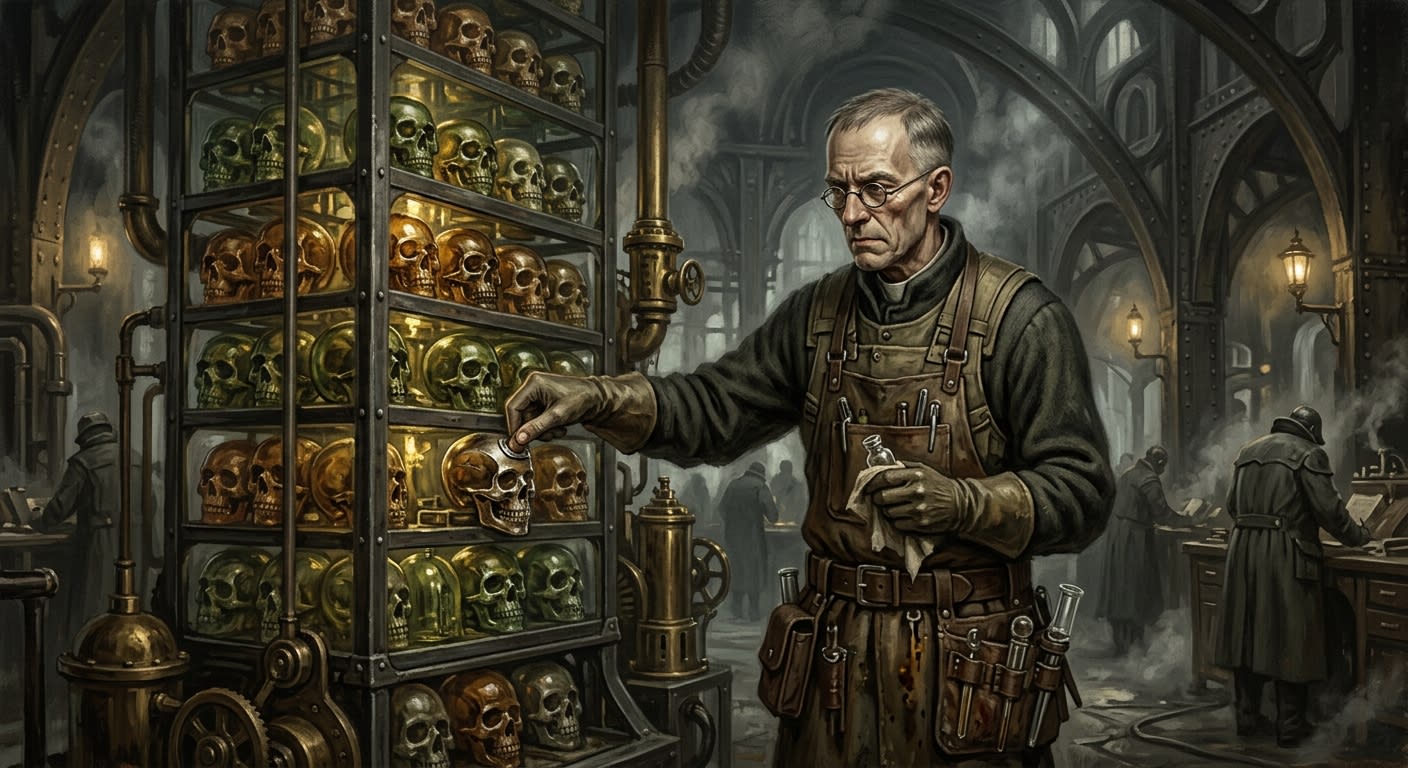
Saint Velek the Clear-Eyed
Sight and sentence, lens and burn
Ratified patron of Pillar-Keepers and severe glasswrights, Saint Velek gives Glass Skull Stack maintenance a face, a thumbprint, and a saintly excuse for sounds after Vespers.
Codex Ref. III.2.01-068

The Age of Heresy
A World Sundered, a Faith Forged in Fire
The definitive overview of the Age of Heresy — a continent sundered by demonic invasion, ruled by a theocratic bureaucracy of bells and ink, locked in eternal war against the Seven Sin-Generals. As compiled by the only man qualified to compile it.
Codex Ref. I.1.01-001
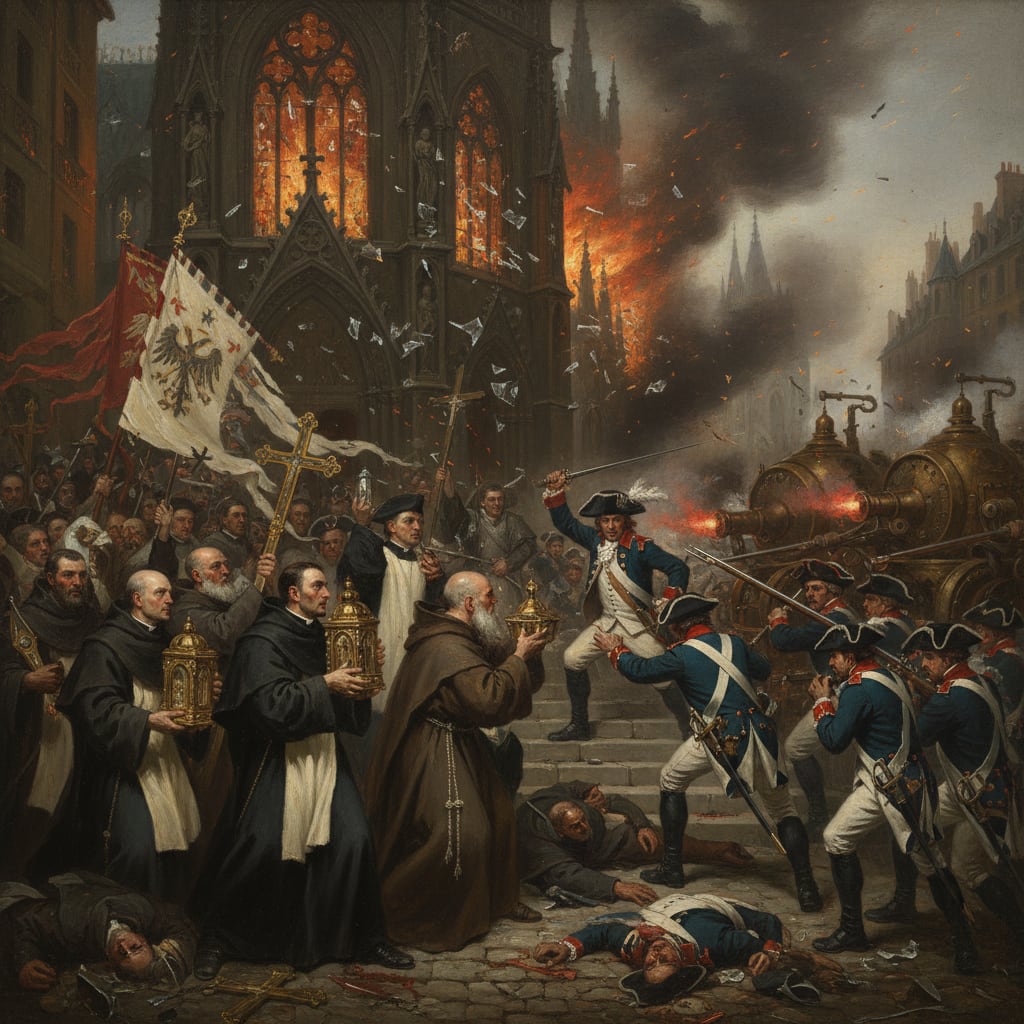
The Atheist Wars
When Reason Drew Steel and Faith Drew Blood
The two decades of continental civil war between the Rationalist Republic and the scattered faithful — a catastrophe so instructive that the Bureau requires its retelling in every catechism school, twice annually, with examinations.
Codex Ref. I.1.03-001
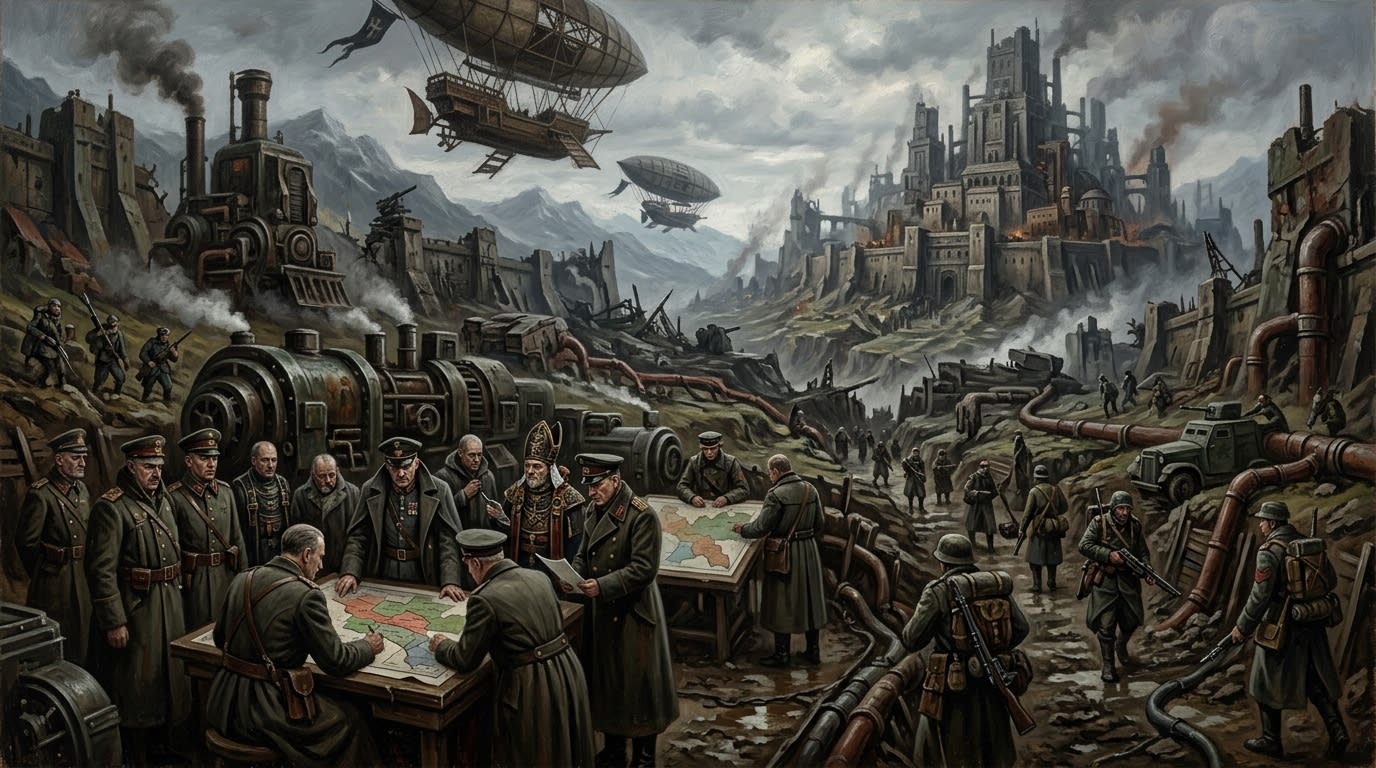
The Balkans
The wound that taught Europe to count its bleeding
The Balkan wound-region, broken first by the Eastern Silence and the Sundering, then divided into Synod margins, contested corridors, Sin-General dominions.
Codex Ref. II.6.05-045
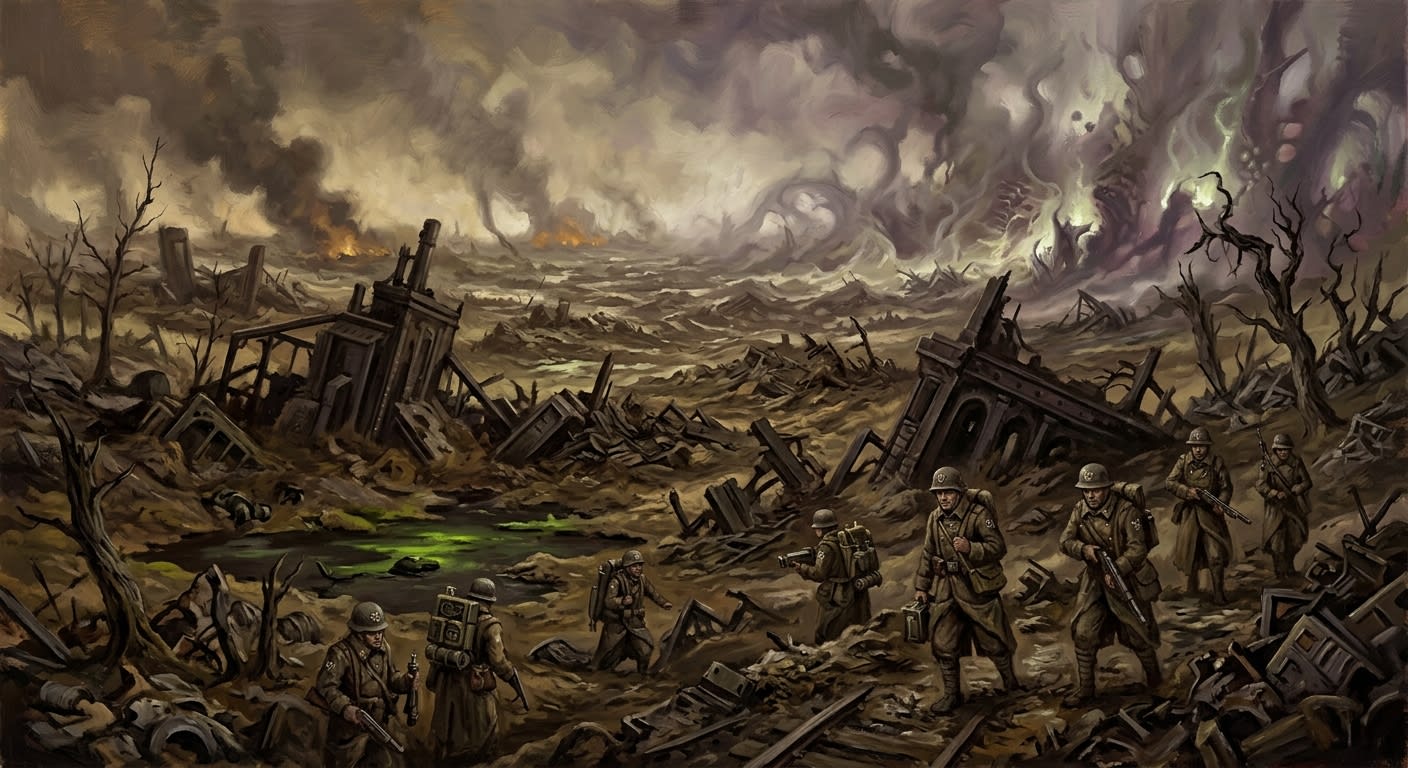
The Charnel Lands
The East keeps our failures alive in hostile weather
Zone 6 is the Synod's polite name for the Charnel Lands: the demonic East where appetite has borders, maps fail, and names come home missing.
Codex Ref. II.6.06-001
The Third Hierarch
A nameless mitre, a moth-eaten reign, and the file that knew too much
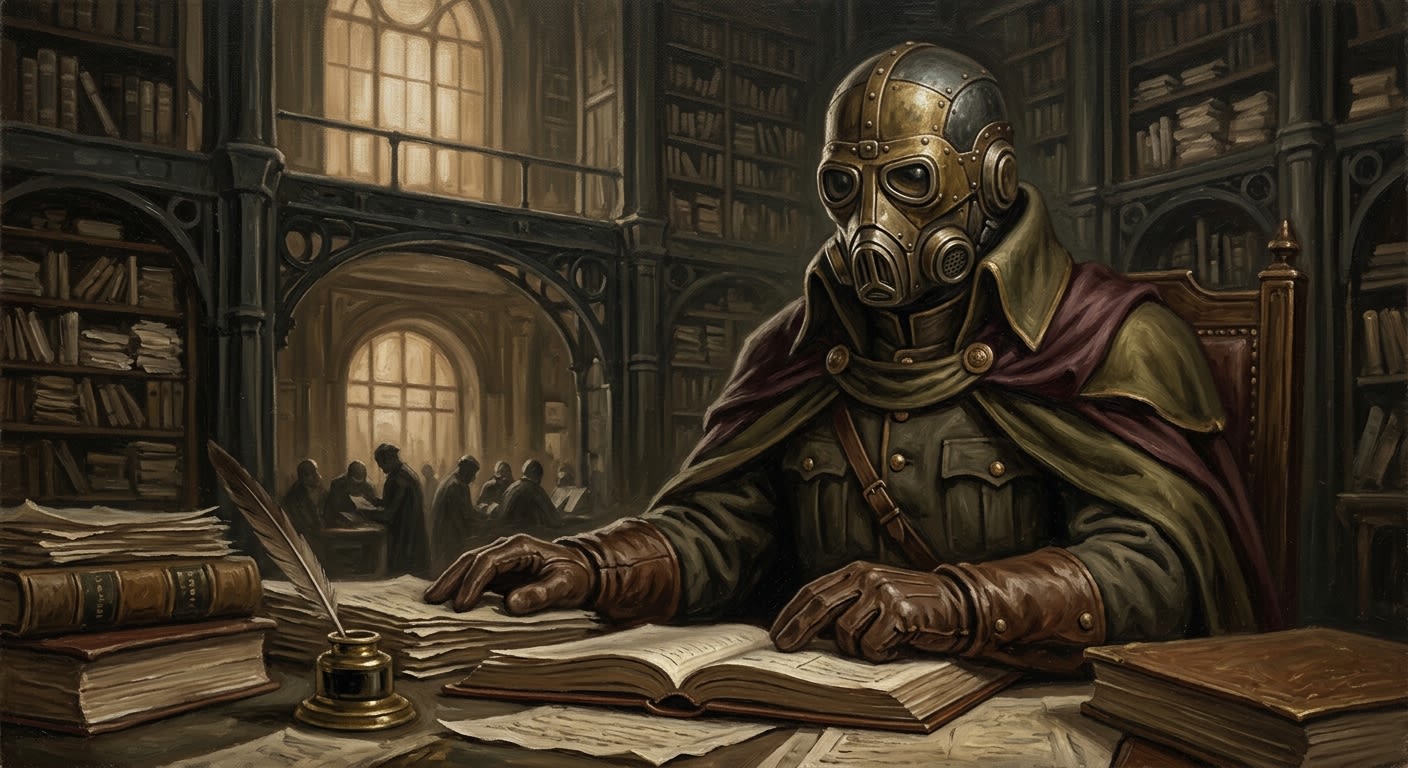
The Third Hierarch is an ordinal with no name, no portrait, and one surviving achievement: Saint Aldebrand's file vanished under his reign.
Codex Ref. XIII.1.05-002
The Twelfth Amendment
The skull is licensed ground; keep your thoughts in uniform
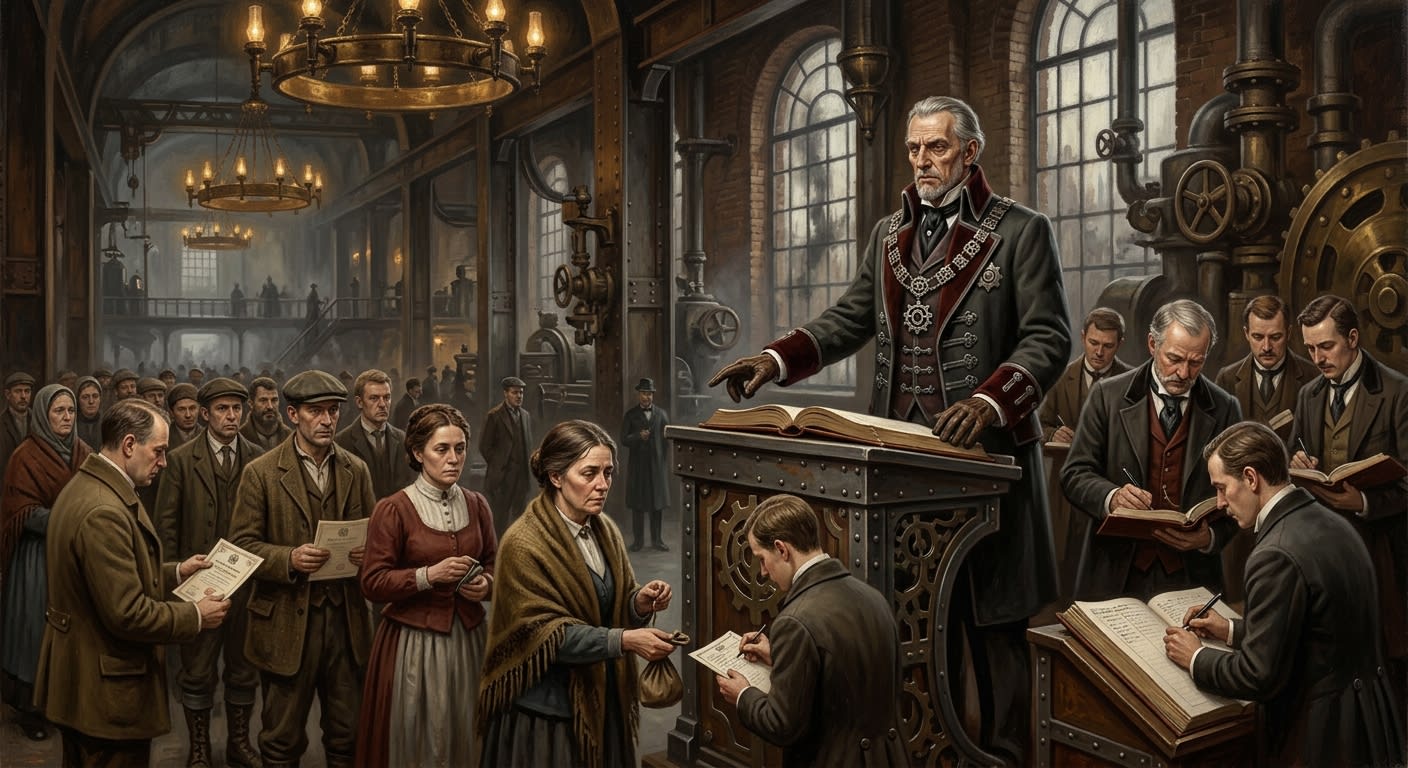
Ratified in A.S. 196, the Twelfth Amendment closes the internal loophole, licenses private hope, and gives Purity the citizen's face as evidence.
Codex Ref. XIII.1.04-196

The White-Mantled Inquisitor
The Bureau does not silence speech; it teaches the population to do it themselves
Bureau of Purity's language constables — Chalklings, Mantle Examiners, Chainmasters, and Glass-Canons — charged with containing unregistered speech, enforcing the Index Claritatis, and hunting the phrases that make the chain sing.
Codex Ref. XII.49.01-001