
#On the Continent as Filed
Europa is the name we give the continent when the map is behaving.
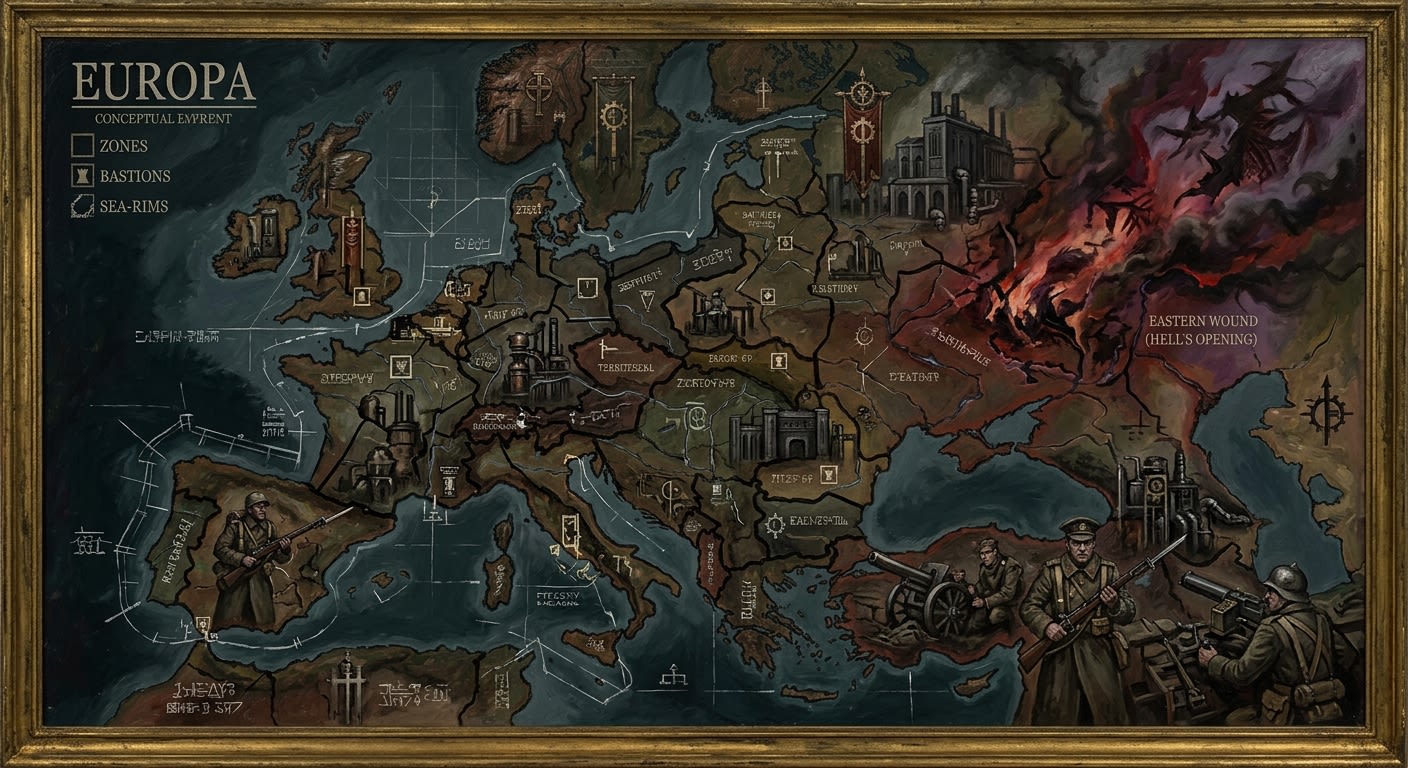
This occurs less often than clerks prefer. The old geographers spoke of Europe as if it were a natural fact: peninsula, river, mountain, coast, kingdom, road. Charming men. Most are dead, which improves their usefulness. Since the Sundering of A.S. 45 and the long hardening of the Sagittal Line after A.S. 65, Europa has ceased being a place in the old sense and has become a record of injuries, jurisdictions, refusals, quarantines, supply corridors, independent nuisances, demonic appetites, and holy lies which have become too necessary to correct.
The Bureau of Records maps territory. The Bureau of War maps reach. The Bureau of Tithes maps taxable movement. Doctrine maps obedience. None of these maps agree. The continent survives their disagreement by remaining too large to fit on one table.
The public catechism divides Europa into the Faithful West and the Demonic East, because children, soldiers, and senior administrators require clean shapes. The actual continent is messier: British bells outside our command, Dutch ledgers outside our theology, Scandinavian fjords half-registered and half-frozen into their own insolence, Italian cities compliant by document and Italian by blood, Iberian processions loyal until laughter begins, and the eastern lands beyond the Line gnawed by the Sin-Generals until even their ruins seem to lean away from names.
#On the Western Heartlands
The western heartlands are the Synod's great claim and its favourite ornament. Zone 1 holds the Atlantic seaboard: France, Iberia, the Low Country approaches, martyr coasts, candle towns, salt roads, pilgrimage ports, and those obedient damp cities whose loyalty increases noticeably when a Bureau inspector is visible. Zone 2 holds the central industrial and ecclesiastical muscle: Germany, Switzerland, northern Italy, Austria's safer bones, Strasbourg, Kanzleiburg, Munich, Hamburg, Essen-of-Hymnsteel, and the furnace-bell arteries by which faith becomes shipment.
Strasbourg sits in Zone 2 and behaves as if all roads were veins leading toward its desk. This is offensive and mostly true. From the Basilica of the Ledgered Saints, decrees travel outward in ink, bell-time, tax pressure, and military requisition. The Bureaucratic Synod calls this unity. Provinces call it other things in locked rooms. Locked rooms are why the Bureau of Shadows exists, although of course it does not.
Zone 3, the Forward Heartlands, is where the comfortable lie begins to fray. Bohemia, Moravia, western Hungary, Dalmatian roads, Warsaw, Bratislava, Budapest, Vienna-Ruins: staging ground, shrine country, rail throat, depot belt, refugee press, and rehearsal for fear. A Zone 3 citizen lives west of the Line but east of complacency. He hears supply trains at night and knows they are going somewhere worse. He sees the wounded return and knows the trains have not gone far enough.
Here the Synod's language changes its boots. In Zone 1, sacrifice is preached from polished stone. In Zone 2, sacrifice is scheduled. In Zone 3, sacrifice eats in the same canteen as the man scheduled to provide it. The forward towns speak softly because sound travels toward requisition. Their children learn the names of bastions before the names of distant saints. Their festivals end early and their songs know better than to lengthen. Their warehouses never sleep. Sleep would suggest ownership of one's hours.
The Holy Bureaus prefer the heartlands because the heartlands can be measured. Grain enters. Coin exits. Bells strike. Children recite. Work shifts begin. Pilgrims move through registered gates. Heresy is found, named, punished, and entered neatly. The west is safe because it is supervised, and supervised because the Bureau has learned that safety without supervision breeds opinions.
Measurement also consoles the measured, though they deny it while standing obediently beneath the scale. A Metz widow knows the tithe clerk will take too much, but she also knows the taking will be dated, witnessed, stamped, and repeated next quarter with enough regularity to resemble weather. A Parisian candle-maker curses the Bureau of Tithes while arranging his receipts by colour. A Hamburg docker spits at a convoy levy and then asks whether the proper deduction has been entered for rope-burn. This is civilisation: the citizen hates the form and fears the day it does not arrive.
Earlier provincial primers described the Western Heartlands as “lands free from war.”
Corrected. The Western Heartlands are free from ordinary shelling, which is not the same condition. War arrives there as tax, ration, mourning list, conscription order, relic levy, procession, audit, and the knock after the Ninth Peal.
#On the Line and the Wound
Zone 4 is the Sagittal Line: the north-south defensive spine running from Bastion-Königsberg at the Baltic through Bastion-Brest, Bastion-Przemyśl, Bastion-Sibiu, Bastion-Irongate, Bastion-Shipka, and down to Bastion-Constantinople at the Bosphorus. Seven bastions. Seven vertebrae. Seven arguments against extinction, each armed, hungry, overfiled, under-rested, and sacred because no one has invented a cheaper adjective for indispensable.
The Line follows terrain older than theology and uses it without shame: Masurian Lakes, Bug River, Carpathian arc, Transylvanian Alps, Danube gorge, Balkan pass, Bosphorus lock. Human pride did not invent the mountains. Human terror made them useful.
Its logistics are less poetic and more sacred. Hamburg receives northern cargo; Kanzleiburg routes it; Warsaw hardens it into forward motion; Munich, Vienna-Ruins, Bratislava, and Budapest feed the middle body of the war; Marseille and Venice argue over the southern mouth; every river is taught to carry ammunition with the exhausted compliance of a mule under scripture. The Line is built from bastions, yes, but also from barges, ledgers, shoe nails, fever wards, mule fodder, paper bales, and women in depot towns who know which sons are being shipped by the way the ration clerks avoid looking at them.
East of the Line lies Zone 5, No-Man's-Land, the contested strip where mud, fog, shellfire, bell error, flesh memory, and demonic pressure have made ordinary geography resign. Its width changes by sector, assault, season, and honesty of the surveyor. The Bureau of War nominally administers it. The mud acknowledges no superior.
Beyond the wound lies Zone 6, the Charnel Lands: Ukraine, Moldavia, Wallachia, eastern Balkans, dead courts, broken river towns, forest that remembers other arrangements, and the domains of sin given political geography. Kargath fattens the Blightmarsh. Maldrake scorches the iron countries. Syrion lets time rot in valleys. Velmora buys what hunger cannot take. Atheron makes pride architectural. Morwen weeps until envy becomes weather. Velkara needs no fixed bastion because desire travels lighter than artillery.
EASTERN SURVEY RECOVERY — PARTIAL, A.S. ███ Cartographic party returned with twelve maps. Eleven showed the same road bending toward different cities. The twelfth showed Strasbourg east of the Line. Lead surveyor requested immediate burning of all twelve and himself. Disposition: maps sealed; surveyor ███████████████████.
#On the Unregistered and the Sea-Rim
Europa contains countries the Synod does not own. This remains legally annoying and strategically unavoidable.
Zone 0 contains the British Crown and the Netherlands, neither enemy nor subject. Britain governs by Crown, Table, bell, ship, wall, and the clenched courtesy of a people protected by water and convinced that water has opinions worth trusting. The Netherlands governs by credit, convoy, contract, and the professional smile of merchants who can finance a war while denying they admire anyone fighting it. The Synod calls them independent co-belligerents when War is listening, unregistered when Tithes is angry, and diplomatically accommodated when Doctrine has eaten.
Zone 7 is the southern coast: Aegean, Adriatic, Mediterranean, pilgrim routes, quarantine harbours, maritime supply lanes, and the line of wet practicalities by which the southern war remains fed. Marseille and Genoa glare across shipping contracts. Venice keeps its lagoon secrets under Synod stamps applied carefully to surfaces that may not hold. Thessaloniki and the Saffron Bastion watch the Aegean throat. The Black Sea is a demonic attack lane against Constantinople, so the Reliquary Flotilla sails there with saints afloat and sailors who have learned to pray before looking over the rail.
Zone 8 is the Fractured North: Scandinavia and Baltic margins, partially independent, partially watched, partially frozen into old bell customs the Synod has not fully digested. Danzig, Königsberg pressure, northern grain, seal-oil, amber, under-ice bells, and the Grey's soft hand all meet there. The Bureau calls the North fractured because calling it unfinished would imply a promise.
A.S. 90 Concordat commentary claimed the Synod exercised universal spiritual authority over Europa.
Clarified by subsequent events. The Synod exercises universal authority wherever authority can be enforced, negotiated, purchased, inherited, smuggled, borrowed, or convincingly claimed in print. Britain and the Netherlands have been notified of the distinction. They remain indecorously calm.
#On the Present Shape
As of A.S. 201, Europa is held together by three forces: fear of Hell, dependence on Strasbourg, and the stubborn usefulness of those who refuse Strasbourg without helping Hell. This is not elegant. Elegant systems are for toy philosophers, dead republics, and cathedral diagrams drawn before the mason sees the hill.
The continent's west eats because convoys run. The Line holds because rail, prayer, bone-lime, diesel, bells, mud, and exhausted men perform their ugly liturgy without agreeing on which part matters most. The east remains east because the Sin-Generals hate one another almost as much as they hate mankind, and Inter-Infernal Analysis has the indecency to call this a strategic condition rather than Providence wearing a shabby coat.
Every citizen learns a simplified Europa: Strasbourg at the centre, Line at the edge, Hell beyond. Every soldier learns the version with mud. Every merchant learns the version with fees. Every pilgrim learns the version with roads and blisters. Every heretic learns the version with hiding places. I, being burdened with excellence, must hold all versions at once and correct the ones that become dangerous.
This is why the map changes without apology. A town moves from safe to forward when its warehouses become useful. A road becomes holy when enough corpses have failed along it. A coastline becomes strategic when pirates, fog, or British competence force War to notice the tide. The Ledger does not chase reality; it summons reality to hearing, fines it for lateness, and files the amended shape under the date most convenient to Doctrine.
Europa is not whole. Wholeness is a relic-word, polished by old poets and sold by men who never repaired a trench. Europa is sealed, crossed, divided, rung, stamped, and wounded. It endures in pieces because the pieces are tied with roads, fear, hunger, liturgy, and signatures.
Do not ask whether the map is true. Ask who can make you obey it.