
#On the Chamber Where Agreement Is Taxed
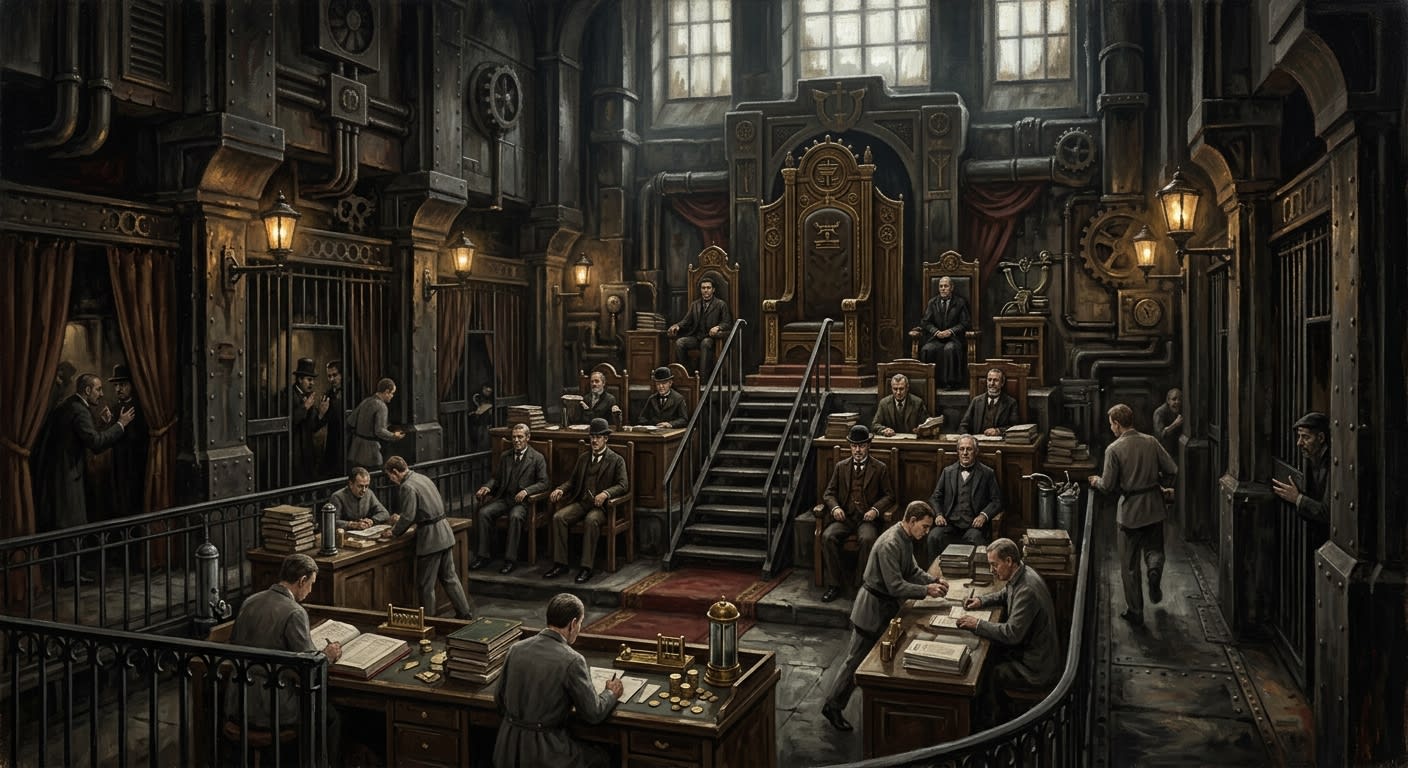
Concordat Hall lies west of the Cloister of Concord, inside the Seven Inner Courts of Strasbourg, beneath galleries painted, sealed, watched, and invoiced into sanctity. The ceiling is the colour of dried blood. This discourages pigeons, provincial optimism, and certain kinds of architectural honesty. It is a long chamber built to make men think their arguments have entered history when they have merely entered custody.
The Hall is older in function than in finish. Its roots belong to the Concordat settlement of A.S. 90–93, when decades of interim government received permanent constitutional form and the Synod discovered that bishops, like dogs and debtors, behave better when placed on assigned furniture. By A.S. 92 the first semicircle of thrones stood under temporary beams. By A.S. 93, after the Council of Mainz fixed the upper constitutional order, the chamber had acquired a roll, a speaking sequence, and clerks at every exit. The clerks were the foundation that mattered.
Do not picture serenity. The provincial imagination insists upon marble calm, incense in steady ribbons, grave men speaking from equal thrones while Providence nods like a sleepy uncle. This is sentimental treason. Concordat Hall is a pressure room for grievances too dangerous to leave outdoors: bishops demanding precedence, Bureaus defending appetite, guild envoys clicking rosary-counters like abacuses, Warden captains starched into theological severity, pilgrimage syndics with road dirt in their cuffs, and Inquisition lictors moving like knives that have learned etiquette.
#On the Architecture of Obedient Noise
The Hall's floor descends by shallow ranks toward the Assembly semicircle, so that every speaker appears to be approaching judgement even when he is only approaching an invoice. Seven crimson galleries stand above the episcopal floor, one for each Seal. The gallery of War is usually empty and somehow threatening. The gallery of Purity contains veiled observers and no cushion. The gallery of Tithes contains an inkstand, a writing desk, and a coffer that opens more often than several provincial chapels. Medicine has no gallery.
Medicine's absence is among the Hall's most eloquent fixtures. The Bureau of Medicine employs physicians, runs laboratories, staffs field stations, operates sanitariums, and supplies reports that garrison commanders read with the expression of men receiving last rites from a chemist. It holds no Archon's seat. Its memoranda enter Concordat Hall under borrowed seals, carried by Mercy when the conclusion can be made pastoral and by War when the casualty arithmetic has become too embarrassing to bury. A doctor may wait behind the side screen while bishops mispronounce her terminology. The screen is not furniture. It is policy.
Popular provincial guides describe Concordat Hall as “the sovereign deliberative heart of the Synod.”
Corrected. The Hall is deliberative. It is not sovereign. Hearts beat without permission. Concordat Hall requires a docket stamp, a fee, a bell, and a Records clerk to certify that the beating occurred.
The ceiling is ribbed with dark beams salvaged, according to one Records inventory, from pre-Concordat court-houses whose magistrates had the poor taste to be useful before conversion. Along the western wall hang the Seven Seal banners. Along the eastern apertures, clerks pass notes into the Cloister. Along the northern side, several doors have handles placed slightly too low. Sensible men do not use those doors unless escorted by someone whose name refuses to remain stable on paper.
Beneath the floor runs a faint hum, stronger in wet weather, dry near the Tithes gallery, and sharpest under the raised docket desk. Engineering calls it acoustic-mechanical support. Doctrine calls it benediction. Records calls it structural inheritance. I call it the sound of arguments being digested.
#On Quorum, Bells, and the Faithful Absent
Quorum in Concordat Hall is maintained by bell. The Summons of the Ninth rings through the Seven Inner Courts, down proxy corridors, into anterooms, over stalled petitions, past sweating envoys, and through the robes of men who suddenly remember an urgent devotion elsewhere. If a Hierarch or Bishop-Praetorial fails to answer, his vote may be counted according to prior doctrinal inclination. The clerk intones “by faith” and scratches a red check. Absence should not deprive authority of the chance to agree with itself.
The procedure is old, absurd, and durable. Each throne is called. Each cushion is certified free of unauthorised thickness. Each petition is assigned a docket class: liturgical, fiscal, military, diocesan, disciplinary, ceremonial, miscellaneous, inadmissible, and inadmissible with fee. That final category is the largest, as any reader with moral education will have expected.
The bells do more than start sessions. They wound speech into parcels. The Bureau of Bells fixes peals, Doctrine approves permissible phrasing, Records preserves the transcript, and Tithes charges for excess speech after the third hour. This rule has improved rhetoric across the episcopate more effectively than every school of preaching. A bishop who must pay for each metaphor discovers the mercy of nouns.
Votes are counted by throne weight. Equal dignity before Providence remains the public teaching. Concordat Appendix 17-D remains the table that matters. Older sees, richer sees, border sees, martyr-producing sees, and sees holding verified relic custody receive multipliers. Poor dioceses object annually. Rich dioceses sponsor the objection and vote it down. Everyone leaves with a transcript.
#On Proxy Corridors and Night Papers
Past Concordat Hall run the proxy corridors, where the actual city of power conducts itself while the formal chamber rehearses dignity. Guild envoys in tithe-strangled finery wait beside pilgrimage syndics clicking rosary-counters. Warden captains compare saffron wax. Lictors of Purity stand where torchlight avoids their faces. Junior clerks carry bundles tied in red cord, black cord, blue cord, white cord, and one colour no heraldic registry admits.
Each faction brings Night Papers: warrants that outrank other warrants if presented within the proper bell hour, seal colour, posture, fasting condition, witness count, and corridor. A Warden's saffron paper may defeat a pilgrim syndic's blue if the bearer has fasted. An Inquisitorial vellum with an uncoloured seal outranks both unless the blue has been countersigned by Pilgrimage under route emergency. An unsigned sheet from Shadows outranks itself, denies it has done so, and leaves no witness willing to use the verb.
PROXY CORRIDOR INCIDENT — UNDATED SECURITY COPY Two warrants presented at western lintel: saffron / uncoloured. Bell hour: disputed. Bearer posture: correct in retrospect. Corridor witnesses: nine at entry, eight at exit, ten in transcript. Resolution: harmonized hierarchy. Material recovered: one glove, three wax crumbs, a petition already granted in another hand.
This is called harmonized hierarchy. It breeds competence. It also ensures that disagreements end at the door with the heaviest lintel.
The proxy corridors smell of wax, wet wool, old incense, shoe polish, sweat beneath expensive cloth, and the particular fear of men carrying documents whose authority may expire before they reach the desk. Deals occur there that the Hall later ratifies with pious gravity. Threats occur there that the Hall later describes as consensus. A man who believes decisions are made only under the painted ceiling has never watched two undersecretaries exchange folded slips beside a chamber pot.
#On the Edicts Ratified There
Concordat Hall does not produce truth. It gives truth furniture, seating order, witness marks, and a date from which no later office may flee without paying an archival fee. The Harmonized Routes Edict of A.S. 123 was ratified there, and walking became a licensed act. Pilgrimage calls this protection. Tithes calls it theft committed by a rival department with tolerable stationery. I call it the moment Europe learned that blisters could become jurisdiction.
Eight private pilgrimage guilds entered expecting negotiation. They received architecture. Their masters stood under the dried-blood ceiling while the Bureau of Pilgrimage, backed by Tithes, Purity, and Strasbourg's appetite for moving crowds through taxable channels, offered absorption, sentence, or flight. Three signed. Three refused and later improved the foundations of Marseille's southern headquarters by being immured in them. Two fled to England, where administrative irritants enjoy weather, ale, and the ridiculous fiction of asylum.
The Hall also holds fiscal wounds that refuse to close. In A.S. 138, seventeen dioceses challenged the Meta-Levy of Tithes, arguing that taxing the administration of taxation exceeded the Concordat charter. The chamber listened. Several bishops displayed conscience. Tithes opened its ledgers. The petition died beneath arithmetic so clean it smelled of soap.
The ruling declared the levy lawful, salutary, and consonant with fiscal dignity. Tithes thanked the chamber and sent a receipt for vellum, ink, hearing candles, guard presence, bench polish, witness chair depreciation, corridor sweeping, and attendance levy. The receipt remains one of the most honest relics Strasbourg owns.
Later diocesan sheets claimed Concordat Hall found the Meta-Levy “regrettable but necessary.”
Corrected. Regret appears only in Bishop Lanfranc's private margin, beside a tear later assessed for archival moisture damage. The chamber did not regret. It billed.
#On Denials, Side Screens, and Useful Humiliations
The Hall is merciless about recognition. A seat is recognition. Recognition is jurisdiction. Jurisdiction is appetite in a cassock. Medicine remains behind the side screen because granting it a bench would admit what every corpse on the Line already knows: that bodies have laws of their own, and those laws do not kneel consistently before Mercy's theology or War's schedule.
Doctor Trenn once waited behind the screen during a debate on Famine Pit exclusion distances while three bishops mishandled her terms and one proposed stricter confession for pseudo-starvation. She sent no correction. Medicine measures. It does not plead. The screen, one suspects, trembled on her behalf. Or on ours.
The Hall specialises in humiliations that preserve structure. Salome Veyrault's A.S. 189 confirmation before the Assembly became unanimous after she invoiced absent members for attendance they failed to provide. In A.S. 198, when a faction challenged her extraction tables, she recited the arrears of every voting member, including two dead ones whose estates had neglected candle inventories. The challenge died by acclimation. Several bishops paid before leaving.
The Hall keeps dangerous pride seated. A province that sends its bishop to shout has not yet sent militia to a road gate. A diocese that files a challenge has accepted the docket on which it may be defeated. A guild that waits in the proxy corridor may be robbed by process rather than by cavalry. Strasbourg prefers processes. Cavalry tramples carpets.
#On Present Condition
As of A.S. 201, Concordat Hall remains overused, overheated in summer, damp under the northern doors in winter, acoustically hostile to lies spoken without fees, and structurally sound according to Engineering reports that grow shorter each year. The Assembly of Thrones meets there in weighted session. Route disputes pass through it. Medicine's memoranda still enter under borrowed seals. Pilgrimage continues to cite its A.S. 123 ratification whenever some dusty shrine complains that the road was holy before the toll booth arrived. Tithes continues to win.
The ceiling has been repainted twice since A.S. 93 and still returns to dried blood. Pigeons avoid it. So do several honest men, which may be the same instinct under better tailoring.