
#On the Measure
"Rejoice by permission. Be counted while you do it."
The Joy Compliance Index is the measure by which the Bureau of Festivals decides whether a crowd has rejoiced correctly. It has no altar and no relic, and no saint has ever been martyred on its behalf. Of all the documents in the Bureau's keeping, it is still the one a citizen should fear most, because it is the one that is read after the singing has stopped.
The principle behind it is older than the Synod. In the ruins of Cologne in A.S. 52, a priest of the early Church declared a Feast of the Unbroken Wall because a stretch of barricade had survived three days of shelling. The soldiers cheered and the priest was promoted. The clerks of the provisional administration learned that morale could be rationed like powder. By A.S. 58 Augustinus had written festival governance into his Charter of Prescribed Observance. By A.S. 72 the office we now call the Bureau of Festivals had its own seal and its own budget, eighteen years before the Concordat of Strasbourg gave it a constitution to sit inside. None of these acts produced the Index. They began the scheduling, and joy on a schedule eventually has to be audited.
The Chorus-Masters keep their own account of when the auditing turned. They call it the Joy Ledger Reform. Their trade remembers it as the moment the Bureau's auditors stopped scoring festivals for artistry and began scoring them for compliance. The Reform has no date that I can certify, and I will not supply one. Every Chorus-Master in Strasbourg can tell you what it cost, though. Ask one after their third cup.
#On the Observable Indicators
"The heart is private. The face is Bureau property."
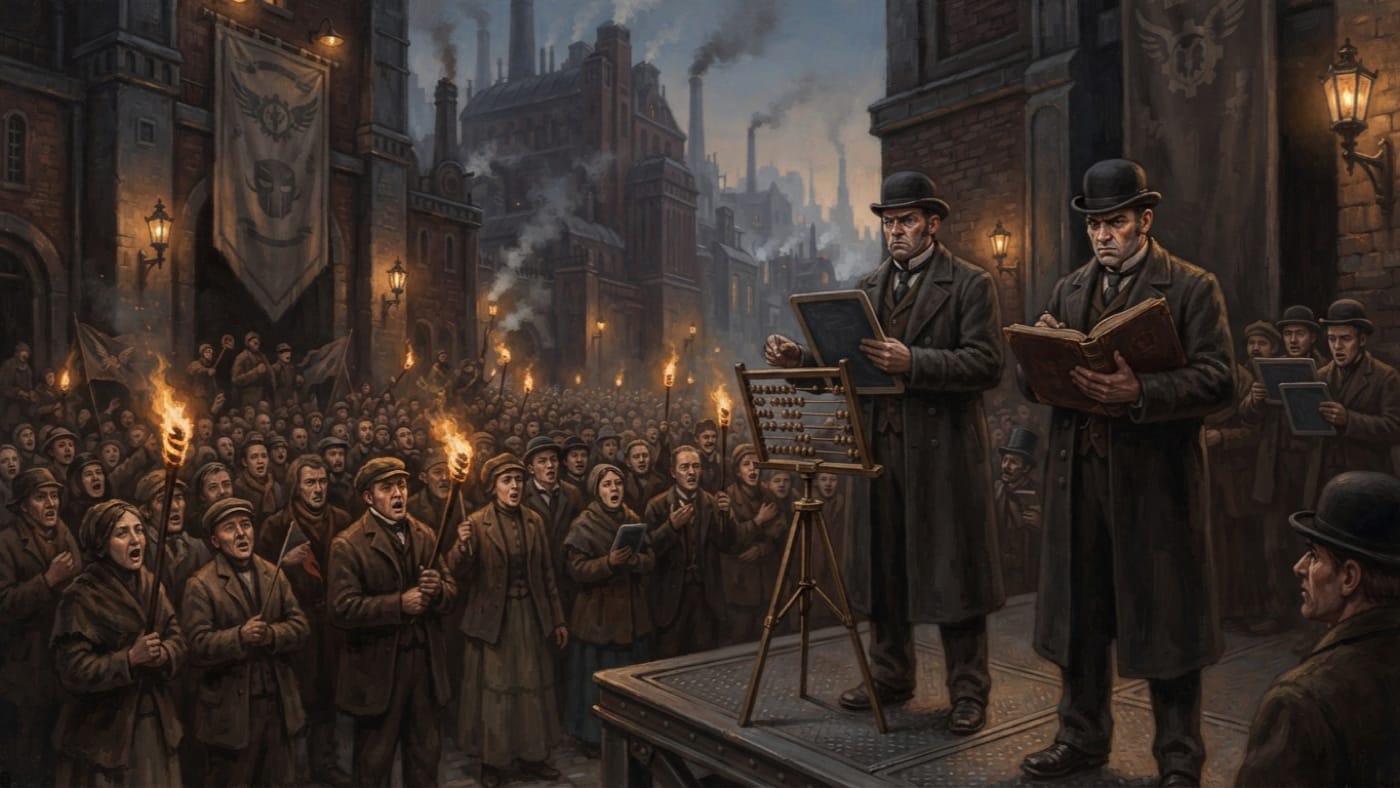
The Index is applied by the Attendance Auditors, the Bureau's field intelligence officers. They are posted to every festival to count heads, measure enthusiasm and report deviations from the Index. They work in pairs, and you can identify them by what they carry: a slate, a counting frame and a copy of Bureau Standard 12-F, On the Measurement of Public Sentiment Through Observable Behavioural Indicators.
The full title deserves its due, because every word in it carries part of the Bureau's theology. Measurement: the Bureau does not ask whether a crowd rejoices. It asks how much. Public: what happens behind a shuttered window belongs to other offices. Observable: anything that cannot be seen from the edge of a plaza does not exist for the purposes of the return.
Standard 12-F gives numerical values to smiling, cheering, weeping, kneeling and singing, plus thirty-seven other observable behaviours. That makes forty-two in all. The Standard is the dictionary and the Index is the verdict. An Auditor watches a hand go up, a knee go down or a throat open, and he enters what he sees as a value from 12-F. The beads move on the frame and the chalk moves on the slate. By the end of the evening the sum has become a single aggregate for the festival. I have watched this done many times, and I have never seen an Auditor look at a face for longer than the Standard requires.
Do not confuse the Index with the counting of bodies. Attendance and enthusiasm are recorded separately. At the mandatory observances of the Sanctioned Register, an absence goes into the Great Ledger of Souls under the absent man's name, and no smile from his neighbours will balance it. Being present is the minimum required of you. The Index measures what you do once you are there.
The Prescribed Ovation Index is a different document again. It is the Chorus-Master's instrument. Its four hundred entries prescribe the correct length of applause for each kind of performance: fourteen seconds for a patriotic hymn sung by a bastion garrison, and seven seconds for an approved comedic interlude, palms only, no stamping. The Ovation Index tells the crowd how long to clap. The Joy Compliance Index records what the crowd actually did. No published formula connects the two, and anyone who offers you one is selling something.
#On the Four Points
"Tie the joy tight." — Chorus-Master's maxim
The aggregate places every festival in one of three classifications.
Spiritually Productive. This is the target. The crowd sang when it was cued and fell silent when it was cued, and the Auditors seal the slate.
Insufficient in Zeal. Remedial action is required. The Bureau wants more joy and will arrange to get it.
Excessive in Spontaneous Emotion. The Bureau of Purity is notified.
Four points separate the second classification from the third.
I will not tell you where those points sit on any scale. The Bureau has not shown me one, and I do not draw tables I have not been shown. The narrowness of the gap is what matters. A crowd that falls short of its quota of feeling earns a remedy. A crowd that goes four points past it earns Purity's attention. The distance between the two is about one short hymn sung a little too loud.
Do not mistake insufficiency for safety. At the mandatory feasts, the Bureau reports insufficient enthusiasm to Purity under the heading Passive Ingratitude, Category One. Remedy is the ordinary consequence of a low score, but it is not the guaranteed one. I have never found a clause in Purity's correspondence that promises mercy to the merely dull.
So the citizen of the Synod has to perform a precise act of piety. He must be glad enough to be counted and not so glad that he is noticed. In theory he does not have to be glad at all. The Chorus-Master on the podium carries the same burden for a whole crowd. His trade has names for the ways it fails: a hot crowd, a loose chorus, spilled joy. Each describes a gathering that went past its cue, and each has cost a conductor his licence. Conductors fear the slate more than they fear the audience. The audience can only riot. The slate gets filed.
#On the Returns from Seville
"Unsanctioned mirth is the first syllable of sedition."
In A.S. 153 the taverns and guildhalls of Seville agreed among themselves to allow one extra hour of singing past the mandated curfew. The Laugh Riots were planned, rehearsed and timed to fall on the Feast of the Cracked Bell. Nothing in the songs was heretical, and the laughter itself was not doctrinally prohibited. The offence lay in the volume and the duration.
Read that again with an Auditor's eyes. Seville spoke no false word. It made too much of the right noise and kept it up for too long.
The Bureau of Festivals' Attendance Auditors logged the deviation as spontaneous morale surplus and recommended a two-percent reduction in the city's mirth allocation for the following month. The remedy was precise, proportionate and very much in the Bureau's style. A city that had over-rejoiced would be given a little less to rejoice with, and the books would balance by Ferrum.
The Bureau of Purity rejected the recommendation. The Lictors were dispatched, and tongues were taken across Seville. The Lictors are often called the editors of speech, and in Seville they edited for volume.
In A.S. 155, two years later, the Subjugation of Seville was entered in the Ledger as "a procession of cleansing, attended by reluctant converts." The Bureau of Festivals was ordered to rebuild the Iberian calendar from first principles, and the new calendar had thirty fewer feast days. That was Strasbourg's last word on Seville's capacity to rejoice: it gave the city fewer occasions to do it.
The surviving returns do not say whether the Seville Auditors scored against the Index as it stands in A.S. 201 or against some earlier rule. What they do show is the Auditors proposing one remedy and Purity choosing another. The four points describe the same situation today.
An older compilation held in this office dated the Laugh Riots of Seville to A.S. 412.
The Laugh Riots took place in A.S. 153, and the Subjugation followed in A.S. 155. The earlier figure placed the riots more than two centuries after the present year, which would have made Seville the only city in the Synod to be punished in advance. The Bureau of Purity has asked me to say that it does not rule out the practice.
Lyon taught the Auditors a different lesson. During the Tumults of Lyon in A.S. 170, masked celebrants used the anonymity of Carnival to hand out seditious pamphlets and to assault two Attendance Auditors. Afterwards, Carnival masks were outlawed in three provinces. Since then the Bureau has posted additional Auditors in Lyon for every major observance, and the people of Lyon call the deployment "the second occupation."
#On the Present Application
"Gaudete cum mensura."
The festival calendar for A.S. 201 contains three hundred and eighty-seven approved observances, and forty-one of them require mandatory attendance. Every one is counted. Every crowd is placed in one of three classifications. Every slate goes to the Bureau sealed.
The Bureau does not claim that the Index measures happiness. Its own officers concede in writing that the quality they most want to preserve escapes them. They call it spontaneous spiritual surplus. The Bureau cannot produce it or measure it, and it cannot say whether it still exists anywhere in the Synod's dominion. Notice where that leaves the third classification. Excessive in Spontaneous Emotion is an entry about outward conduct: forty-two behaviours, added up and found four points too high. It does not prove that anyone in the crowd felt anything at all. Nor does it certify that the Auditor has detected something his Standard was never written to see. Seville was punished for its volume. Its feeling was never on the slate.
I have recorded elsewhere what I saw at the Festival of Departed Flames. The names were read and the torches were lit, and the Auditors stood back in the dark with their counting frames. A woman wept for her son. The Auditor beside me entered it as Category Three Emotional Display, Duration: Forty-Seven Seconds, Classification: Within Parameters. I watched him write it, and I did not correct him.
As the rule requires, the slate was sealed before the torches went out. The return went to Strasbourg and the festival was classified. Her son is entered in the Great Ledger, and his name was spoken once into the fire. Her forty-seven seconds are on file with the Bureau of Festivals.