
#On the Office That Counts Joy
"Enthusiasm is a quantity. Quantities are owed."
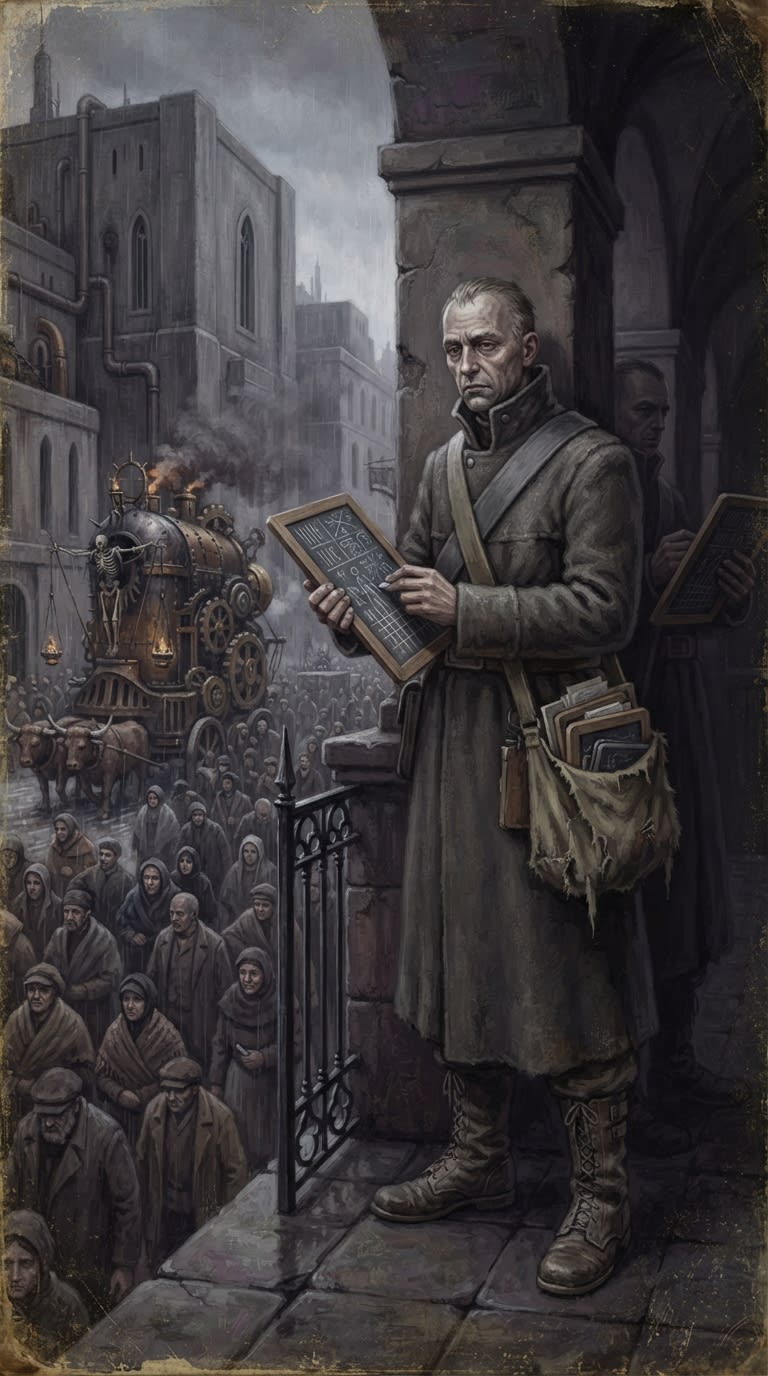
Every sanctioned festival in the Synod's dominion has three things the crowd is meant to watch and one pair of men it tries to ignore. The Chorus-Master stands on the platform with his baton. The Pageant Captain walks the barricades with his whistle. The relic float rolls. At the edge of the square, usually by a pillar, a drainpipe or the one lamp-post nobody leans on, two men in grey sashes stand with slates in their hands, doing arithmetic on your face.
These are the Attendance Auditors, the intelligence officers of the Bureau of Festivals. They count heads. They measure enthusiasm. They report deviations from the Joy Compliance Index to the district office. The district office reports them to Strasbourg, and Strasbourg passes whatever it finds useful to the Bureau of Purity. The choir belongs to the Chorus-Master and the permits belong to the licensing clerks. The Auditor owns only his figures. He is paid to make sure that others enjoy the festival correctly, and he is the only person in the square whom the Bureau forbids to enjoy it at all.
The office has no single founding day, which suits it. Joy was rationed as morale before anyone thought to audit it. In A.S. 52 a priest in the ruins of Cologne proclaimed a feast because a barricade had survived three days of shelling. Nobody counted the cheering, because everyone was cheering. By A.S. 58, when Augustinus brought festival governance into the Charter of Prescribed Observance, someone had begun to notice which soldiers were not. In A.S. 72 the Bureau of Festivals received its seal and budget, and the counting became a salaried post. The Bureau needed to know whether its feasts worked. Feasts do not submit reports. Men with slates do.
#On Standard 12-F
"What cannot be counted cannot be commended."
The Auditor's scripture is Bureau Standard 12-F, formally titled On the Measurement of Public Sentiment Through Observable Behavioural Indicators. It is shorter than the Prescribed Ovation Index and far more frightening. The Index governs hands. Standard 12-F governs everything else.
It assigns numerical values to smiling, cheering, weeping, kneeling, singing, and thirty-seven further behaviours that can be observed from the edge of a square. A smile that shows teeth scores differently from one that does not. Kneeling on both knees outranks kneeling on one, unless the kneeler is visibly lame. In that case a supplementary table applies, and the Auditor must judge from forty paces whether the limp is sincere. Weeping is permitted at grief observances and suspect at victory salvos. At harvest rites it goes in a column headed Unexplained. Singing is scored for volume, for pitch, and for whether the singer knows the second verse, since anyone can fake the first.
The aggregate score sorts every festival into one of three classifications. Spiritually Productive is the target. Insufficient in Zeal calls for remedial action, such as a cue hymn, a relic float rerouted past the dull district, a communal kneel, or a morale review entered against the parish. Excessive in Spontaneous Emotion requires notice to Purity. Four points separate the second classification from the third. A district can be punished for yawning at one feast and for dancing at the next. The same man will record both, with the same slate and the same expression.
The Standard's favourite category, inherited from the Index and sharpened in the field, is false warmth. The citizen claps on time, at the right volume, with correct palms, while his heart has plainly gone home for supper. False warmth is common and dreary, and easily remedied. Its opposite is rarer and worse, because genuine warmth moves. Rows lean toward the platform. The second row teaches the third row the rhythm. A dead man's name slips in under the authorised stanza. By Bureau reckoning, an Auditor who sees genuine warmth reach the fourth row has about a minute before his arithmetic becomes a Purity matter.
#On Field Practice
"Two slates, one figure."
Auditors work in pairs. The Bureau gives accuracy as the reason: two counts, reconciled, produce one figure fit for the Great Ledger. The Auditors give survival as the reason. A lone man with a slate in a festival crowd is a target. Two men with slates are a procedure.
The senior of the pair takes the head-count and the absences. The A.S. 201 calendar has forty-one mandatory observances. Missing one puts a note beside the absentee's name, and the note stays with them for life. The junior takes the behaviours: late claps, early tears, hats left on, unsanctioned rhythm, the child who mimics the Chorus-Master's baton too well, the woman who stops weeping the moment she is watched. At the dispersal bell the two compare slates in the nearest doorway. Where the figures disagree, the lower enthusiasm score is entered. The Bureau would rather be disappointed than deceived.
Reims tested whether the Bureau can be deceived at all. In A.S. 176 one parish had achieved perfect affective compliance at the Feast of Doctrinal Submission for three years running. It did so by painting mild gratitude onto its faces with berry dye. The Auditors approved the scores. Then rain ran the smiles into purple tears, and Purity did the rest. Festival training now warns Auditors against trusting faces, weather and perfect numbers. It does not say what they should trust instead.
Among the festival officers, the Auditor's place is fixed. The Chorus-Master shapes the joy, the Pageant Captain moves the bodies that carry it, and the Auditor measures what arrives. When a Chorus-Master offers the encore tax, the Auditor notes whether the Creed was recited at the correct pace. When a Pageant Captain's whistle clears a plaza in eleven seconds, the Auditor records the eleven seconds. The roles overlap only in emergencies. The disciplinary files suggest that an Auditor who picks up a baton seldom puts it down in time.
Earlier Festival staffing rolls list the Attendance Auditor as a "minor clerical functionary, non-field grade, no enforcement competence."
Withdrawn. The Attendance Auditor is a field intelligence officer of the Bureau of Festivals. He records, and Purity enforces what he records. Since A.S. 199, the public copy of his tavern returns has used the phrase devotional levity allocation. Mirth quota survives in internal returns and in the mouths of the audited.
Those tavern returns go to the Censorium of Taverns. When a licensed house exceeds its allocation, the Censorium's List of Laughters draws on Auditor figures.
#On Seville and Lyon
"The slate remembers."
Two cities wrote the corps' doctrine in blood. One laughed too much. The other laughed at the Auditors.
In A.S. 153 the taverns and guildhalls of Seville went over their allocation during the Feast of the Cracked Bell. They did it with one coordinated hour of singing past curfew. The songs were lawful, and so was the laughter. The excess lay in duration, volume and repetition. The Attendance Auditors logged the deviation as spontaneous morale surplus and recommended cutting the next month's allocation by two percent. By the standards of Standard 12-F, that was a sober and proportionate finding. Purity rejected it and dispatched the Lictors. Tongues were taken. That ended the Laugh Riots. Two years later the Subjugation of Seville rebuilt the Iberian calendar with thirty fewer feasts.
Seville taught the corps that a correct figure is no shield. An Auditor's recommendation is advice to people who do not take advice. Since A.S. 153 the prudent Auditor has rounded his surplus findings downward and let the district office find the difference. It usually finds it after he has been transferred.
Lyon taught the second lesson in A.S. 170. During the Carnival of Saint Bérard's Misrule, masked celebrants handed out pamphlets that called Attendance Auditors "men who count laughter because they cannot produce it." A licensed puppet booth staged a bear in a mitre. When the first Auditor moved against the booth, someone struck him with a plaster moon. His partner's cue whistle had been packed with sugar. Both men were assaulted, and both recovered and were promoted. The Tumults cost three provinces their Carnival masks. They also left Lyon with extra Auditors posted at every major observance for good. The Lyonnais call this the second occupation.
Seville showed that an Auditor can be right and useless. Lyon showed that he can be hated by name. The corps took in both lessons and changed none of its equipment.
#On the Present Condition
"Count until the bell."
In A.S. 201 the Attendance Auditors cover three hundred and eighty-seven approved observances. Nobody outside Strasbourg is allowed to know how many of them there are. When the Procession of the Triune Hearth winds from Strasbourg toward Constantinople, they stand along its route at balconies, bridgeheads and confession queues. They also stand at the edges of parish squares where nothing bigger than a saint's day has happened in ten years. They are overworked and seldom promoted. They are feared by people who have never spoken to one, because speaking to one is itself a behaviour that Standard 12-F can score.
Their problem is older than the Standard. The Bureau of Festivals exists to administer joy, and the only joy its Auditors can detect is joy performed for them. The Bureau calls the authentic article spontaneous spiritual surplus, and the festivals were built to replace it. On the slate it shows up either as nothing or as a Purity referral. The Standard has no column for a man who sings because he wishes to, since the Auditor cannot see a wish.