
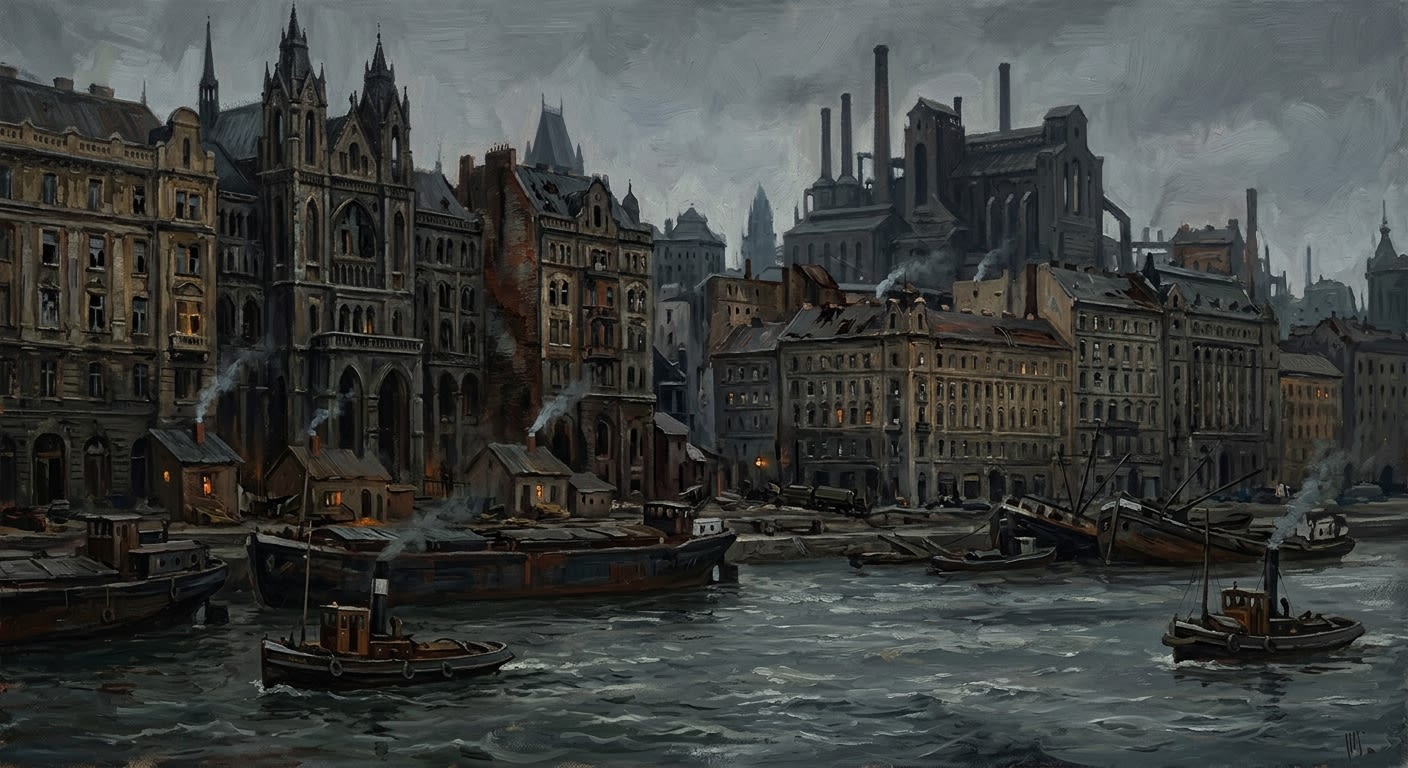
#On the Bank That Was Emptied
Pest is the eastern bank of Budapest, the former commercial heart of the city, the old flat grid of markets, warehouses, rail termini, apartment blocks, chapels, tram sheds, coffee houses, customs offices, and domestic sins too ordinary to interest Doctrine until they acquired military significance. It lies four hundred metres across the Danube from the Synod-held western districts. On clear mornings its rooflines remain sharp. Three church spires still rise. The windows are dark.
The Bureau of Settlement classifies Pest as Vacated. This is a beautiful word because it contains no corpses.
The chair does testify. This is the difficulty.
#On the Evacuation
The official account begins in A.S. 118, during the Great Retreat's Budapest phase, when War concluded that holding both banks against Velmora's forward agents, Morwen's southern pressure, and the ordinary incompetence of frightened commanders would cost more than the eastern districts were worth. Bridges were prepared for demolition between A.S. 118 and A.S. 122. The Chain Bridge fell last, after holding six hours longer than Engineering predicted and long enough to become inconvenient to memory. Eight hundred refugees were still crossing. Records lists them as transferred, destination pending.
Pest's evacuation was declared complete in A.S. 120. The Mothers of Plenty processed evacuees through western warehouses from A.S. 118 to A.S. 125 and could not reconcile the names. Sixty to ninety thousand residents remained unaccounted for: neither admitted, burned, drowned, transferred, conscripted, buried, nor legally dead. Their names sit in the Great Ledger under status: administrative review.
Earlier corridor manuals state that Pest was “successfully cleared prior to bridge severance.”
Corrected. Pest was declared cleared. The distinction between clearing and declaration is wide enough to house a city, provided one does not mind the windows watching back.
There were warehouses full of flour, cotton, machine belts, salt fish, lamp oil, and rejected uniforms. There were tram cars left mid-route. There were marriage notices pasted to doors whose households never reported west. There were school registers with morning attendance marked and afternoon attendance blank. The Bureau's evacuation columns moved block by block, street by street, ledger by ledger. The ledgers travelled. The people did not always accompany them.
#On the Perfume Fog
A.S. 117 came first. This matters, since the Bureau prefers its causes filed after its decisions. The Shattered Courts of Lust (Unregistered) surged from Belgrade, and the perfume fogs reached Budapest before any bridge charge was set. They crossed both banks. They entered lungs, stairwells, wardrobes, prayer books, bath steam, linen chests, and the domestic air between a husband and the person he remembered loving. The Bureau called it a localised atmospheric event. Survivors called it other things once they stopped clawing at their own skin.
The fog lasted eleven days. Its scent lingered for months. The Bureau of Purity inspectors conducted air-quality assessments for three years and sealed the final report. Doctrine cited Velmora and Morwen in the later evacuation account. Velkara's name appears in fewer files than it should.
The persistent rumour is simple and durable: the fog did not empty Pest. It occupied it. When the perfume cleared, neighbours reported faces at windows of apartments whose families had already crossed west. Patrols found table settings for dinners no one admitted preparing. A tram bell rang for three nights from a line whose power had been cut. In the market hall, witnesses heard bargaining in voices they recognised and could not name.
Velkara's Mirror and Perfume Arts do not conquer by possession in the crude village sense. They revise attachment. They rename desire. They teach the mind to treat the wrong face as beloved and the wrong room as home. If Pest contains occupants, whether they are alive is the lesser question. Whether life remains the relevant category is the one the files avoid.
#On Visibility
Pest's chief weapon is visibility. Other losses recede eastward beyond the Sagittal Line or drown in veteran testimony. Pest sits across the Danube and behaves like a fact with patience. Western Budapest wakes to it. Children are told not to wave at the eastern windows. Soldiers are told not to count lit rooms. Clerks crossing the quay are told to face west under Pastoral Directive 88-E/BUDAPEST, because prolonged observation has been linked to melancholy, doctrinal questioning, and eleven documented attempts to cross by improvised means.
The attempts are filed by Mercy as despair and by War as unauthorised movement into contested territory. Both offices claim accuracy. Both offices punish the rescued, when rescue occurs.
BUREAU OF WAR / SHADOWS CROSSING INCIDENT FILE Case count: eleven documented western-to-eastern attempts under Directive 88-E. Recovered alive: █. Recovered speaking: █. Common statement among recovered: “I saw my own kitchen lit.” Common correction issued by Doctrine: kitchens across the river are not yours.
Gun emplacements line the western shore. Patrol boats sweep the water between dusk and dawn, flat-bottomed, reliquary-shielded, their lamps hooded until the annual confirmation. The crews rotate every forty-five days under Hofer's authority. Longer service produces reports. Reports produce categories, and categories are dangerous when the thing being categorized has windows.
#On Annual Confirmation
The Annual Confirmation of Vacuity is performed each year under War schedule, Shadows observation, Doctrine seal, and Engineering complaint. A patrol boat crosses the midline after midnight. A reliquary lamp is uncovered at the bow. A Litany-Engineer sits astern, listening for harmonic answer from stone, iron, glass, water, and whatever has learned to imitate civic silence. The boat does not land. Landing would imply a destination. The boat makes three passes, records window count, bell response, surface disturbance, mirror flare, and voice occurrence. Dawn returns it west.
Public summaries state that the annual confirmation establishes Pest to be empty.
The confirmation establishes that Pest remains classifiable as Vacated. Empty is a physical claim. Vacated is a legal mercy.
In A.S. 199 the Bureau of Shadows field assessment revised the unaccounted population estimate upward and recommended maintaining the existing classification. This is administration. If the unaccounted dead are fewer than expected, the missing are more numerous than comfortable, and the visible district remains officially empty, the correct response is a redaction thick enough to stop a bullet.
The mention of Velmora complicates the sin beautifully. Greed inventories what Lust has taught to wait. Morwen's influence seeps northward in damp rooms and plague memory. Pest is a committee of infections, each filing claim through a different smell.
#On Present Condition
As of A.S. 201, Pest remains visible, intact, inaccessible, and useful to every office that requires a threat with masonry. War points to it when requesting funds for riverside guns. Doctrine points away from it when preaching civic obedience. Shadows points at it privately. Settlement refuses to count it. Records keeps the names in administrative review because death would settle estates and survival would demand rescue. The Bureau is humane enough to prefer neither.
The western city has adjusted. Coffee houses draw curtains on the east-facing windows. Children dare one another to look across at noon. Patrol crews avoid reflective buttons. The baths remain open and steam rises from western roofs while the eastern rooflines sit dry, sharp, and patient. On certain windless mornings the Danube reflection closes the gap between banks, and Budapest appears whole.
Do not trust wholeness. It is frequently a mirror rehearsing fraud.