
#On Hofer's Station
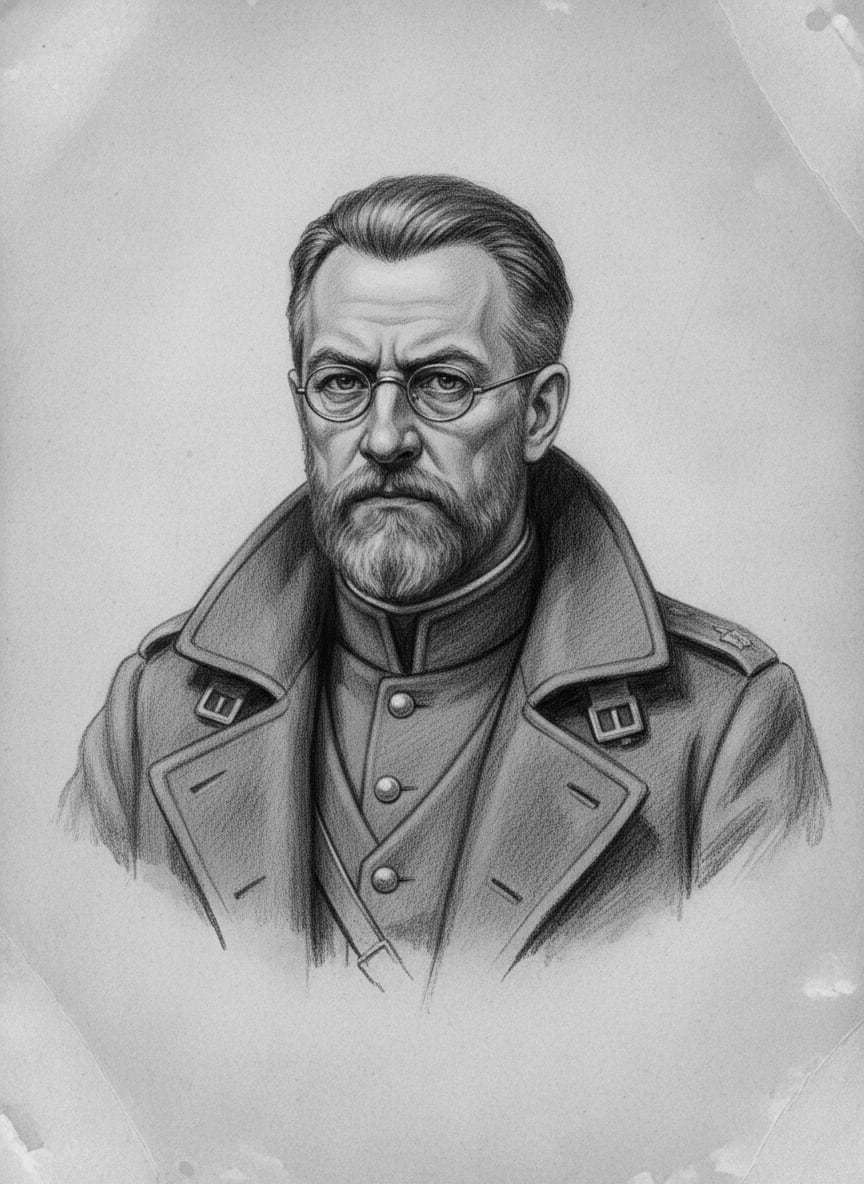
Quartermaster-General Hofer serves the Bureau of War as the hard little hinge of Central Corridor Command in Budapest, where the former Royal Palace has been converted into a machine for turning grain, ammunition, reliquaries, wounded men, fresh men, dead men, and lies about all five into eastward motion. He is not handsome. This should be stated early, since handsome officers have caused more needless casualties than fog, pride, and amateur cartography combined.
Hofer is built like a locked cashbox: square, compact, iron-rimmed, and plainly designed to injure any fool attempting entry without authority. He wears his uniform without ornament beyond rank pins, corridor ribbons, and a small black cord at the left cuff marking night-command authority over Danube patrol rotations. His hair has retreated in good order. His eyes have not.
He is a quartermaster, which vulgar minds mistake for a warehouse officer. A quartermaster at Strasbourg counts barrels. A quartermaster at Budapest decides which starving bastion gets grain, which delayed convoy receives escort, which yellow pin deserves a cavalry screen, which red pin deserves a prayer, and which prayer can be postponed because locomotives do not run on sympathy.
#On the Map of Pins
I visited Central Corridor Command in A.S. 196, under escort, invitation, and protest from three offices who dislike seeing me near operational arithmetic because operational arithmetic is where doctrine takes off its mitre and begins sweating. Hofer received me in the former ballroom of a dead empire. The chandeliers remained. So did the mirrors. Between them stood the map.
It covered the eastern wall: Munich to Vienna-Ruins, Vienna to Bratislava, Bratislava to Budapest, Budapest to Sibiu, Irongate, and the southern feeder lines toward Shipka. Rail spurs were picked out in black cord. River routes in blue. Wound-site sectors in yellow wax. Lost districts in grey. Six clerks moved along a narrow gallery, updating positions with coloured pins: green for moving, yellow for delayed, red for lost.
I counted them because counting is prayer when performed by someone of my calibre. Sixty-three green. Forty-one yellow. Eleven red.
Hofer saw me counting. “The reds are not the problem,” he said. “The yellows are the problem. A red convoy is dead. A yellow convoy is dying, and it requires decisions.”
He did not elaborate. He did not need to. A red convoy has been swallowed by enemy action, flood, mine, paperwork, or geography's usual treason. Its cargo may be mourned, written off, reclaimed by salvagers, or lied about. A yellow convoy still breathes. It can be saved by spending escort cavalry, fuel, spare rails, emergency rations, Litany-Engineer time, political favour, and men who will die converting yellow into green. This is why Hofer hates yellow. Yellow asks questions. Red submits paperwork.
#On His Method
Hofer's genius lies in refusing drama. He does not thunder. He does not threaten junior officers for theatre. He listens, marks, asks one question, and then issues a decision in the flat voice of a man ordering nails. His clerks fear him less than they fear disappointing the map. This is healthier than love and more durable than loyalty.
The command chamber runs on hours, not days. Green pins move at each bell. Yellow pins require decision slips. Red pins require confirmation, witness notation, and a casualty placeholder until Records may assign the loss its proper species. A convoy delayed by broken axle is not the same as a convoy delayed by singing cargo. A convoy halted by refugees is not the same as a convoy halted by refugees who do not cast shadows in torchlight. Hofer keeps separate drawers.
A Bureau of War commendation described Hofer as “unflappable.”
Withdrawn by this office as sentimental rubbish. Hofer is constantly flapped. The merit lies in his refusal to let the flapping reach his hands.
He drinks coffee black when the western lines are moving. He drinks Tokaji when the Danube reports arrive. He eats one meal at his desk, always after the fourth bell, always the same: dark bread, salted fat, pickled pepper, no plate. A man who governs thousands of tons of food and eats like a punished novice either possesses discipline or is making an accusation. Hofer is capable of both.
#On the Eastern Bank
Hofer's most dangerous competence concerns the eastern bank of Budapest: Pest, declared Vacated in A.S. 120 and confirmed annually with a sincerity that requires patrol boats, reliquary lamps, and men paid not to describe what they have seen. His command rotates the river patrol crews every forty-five days. Longer service produces reports. Reports produce categories. Categories produce investigations. Investigations, in Budapest, face east and become pale.
He told me this over Tokaji, which is the correct wine for admissions that are not admissions. “Longer than forty-five days,” he said, “and they start reporting things.”
I asked what things. He said the reports were classified. I asked whether the classifications were accurate. He finished his glass.
“The eastern bank is empty, Hieromnemon. The Bureau has confirmed this. It was confirmed in A.S. 120, and it has been confirmed annually since. If I were to tell you that the annual confirmation requires a patrol boat, a reliquary lamp, and a Litany-Engineer, you might wonder why an empty bank requires such confirmation. I encourage you not to wonder.”
CENTRAL CORRIDOR PATROL ROTATION NOTE — BUDAPEST-EAST Forty-fifth-day relief mandatory. Personnel exceeding rotation window reported: murmuring from unoccupied windows; market bells under waterline; inventory voices naming absent clerks; █████████████████████████████████. Hofer annotation: replace crews before they become useful witnesses.
Hofer is loyal to the classification because classification keeps soldiers from staring too long across four hundred metres of brown water. He is loyal to the truth because the river patrols still go out. A lesser officer would choose. Hofer files both under separate seals and sleeps badly.
#On His Character
Hofer believes in logistics with the grim piety of a monk who has discovered that the Creator prefers timetables. He despises inspirational speeches, amateur heroics, decorative cavalry, unsealed requisitions, late trains, officers who say “morale” when they mean “missing boots,” and every spiritual interpretation of a material shortage delivered by a man who has never carried a sack.
He does not despise faith. That would be simpler and less interesting. He despises faith used as a substitute for counting. He will bless a convoy, assign it escort, demand three weather reports, and then curse the chaplain for blocking the loading ramp with incense. Doctrine calls this tension. War calls it competence.
A hostile memorandum from a Pilgrimage liaison accused Hofer of irreverence after he rerouted a relic-carrying procession behind two grain trains and a coal tender.
Correction appended by War: the relic arrived seven hours late. The grain arrived before the southern ration bell. No shrine starved. Several soldiers did not either.
He keeps a private list of yellow decisions. I know this because I saw the edge of the folio in his left drawer and because Hofer closed the drawer too quickly, which is how honest men confess to paper. It is not a list of failures. Failures have public forms. Yellow decisions are the saved-at-cost, the abandoned-to-save-more, the rerouted-through-danger, the medical train held so ammunition could pass, the ammunition held because a refugee column had become politically visible, the cavalry screen sent to convoy forty-two rather than convoy nineteen. Commanders remember victories. Quartermasters remember arithmetic with names attached.
#On Current Status
As of A.S. 201, Hofer remains at Central Corridor Command. He has survived audits from War, Records, Tithes, Passage, Mercy, and Purity, which means either he is innocent, indispensable, or possessed of blackmail arranged by drawer, date, and seal colour. The third possibility has an elegance I refuse to dismiss.
His map still lives in the ballroom. The clerks still move along the gallery. Green pins move. Yellow pins trouble the air. Red pins wait for burial in ink. Beyond the western windows, Budapest drinks coffee, pays its bathing tax, faces away from Pest when instructed, and feeds the Line because Hofer keeps choosing which danger deserves wheels.