
#On Private Road Authority
Before A.S. 123, a pilgrim who left his parish walked into other men's jurisdictions. He crossed no frontier and changed no sovereign. Even so, somewhere between his own church door and the shrine he had vowed to reach, a stranger with a purse, a ledger and an iron-shod staff would explain that the road ahead belonged, in every sense that mattered, to a guild.
The guilds held passage. I insist on the word. The farmers beside the road owed them nothing, and no province ever sent them its rents. What the guilds claimed was the pilgrim himself while he was moving: his toll at the narrow place, his bed in the next town, his place in the procession and his escort through the bad miles. Their charters, where any charters existed, are not on file. Their foundings are undated. No congress convened them. They spread along the roads like lichen along a waystone, through long custom and because nobody with the authority to scrape them off had yet arrived.
The Church could not tolerate the ledger. Every season, thousands of devout feet moved toward the Creator and paid for the privilege. The coin went into eight private coffers and an uncounted number of lesser purses, and not one of them answered to any office in Strasbourg. Revenue that escapes the central ledger is a form of apostasy. The Bureau of Tithes would put it more harshly.
#On the Eight Guilds
Eight guilds answered the summons of the Harmonized Routes Edict. I count them as the eight that mattered enough to summon. Lesser fraternities may have walked lesser roads beneath the notice of Concordat Hall, and they can stay there.
The Guild of the Golden Sole held the Rhineland approaches, the feeder roads by which the river parishes reached the greater routes. What sets it apart comes at the end of its story, and I will get there.
The Confraternity of Saint Edras claimed the Carpathian passes. Mark the verb. It claimed passage through the mountains for pilgrims, and the mountains were not consulted. The confraternity took its name from Saint Edras. His road traditions are older, and far better attested, than any proof that he founded the confraternity, blessed it or left it a single bone.
The Peregrine Brotherhood worked the Iberian coastal routes from harbour to shrine. Its armed escorts grew numerous enough that the Bureau of Pilgrimage compared them to a private army, while the Edict, more modestly, called them enough to trouble a minor prince. Nobody counted them. Nobody needed to.
The Brotherhood of the Blessed Foot managed the Flemish pilgrim traffic. It charged tolls at crossroads it did not own, on roads it had not built. Nobody has ever matched the purity of that method, my own Bureau included, and I have watched my own Bureau try.
The Tongues of the Blessed Way worked the Santiago road and supplied translators, chanters and knife-men. They stood exactly where a foreign pilgrim needed three things: to be understood, to confess in a language his confessor knew and to reach the shrine alive. The Tongues could charge for each of them separately.
The southern, alpine and river roads went to three smaller fraternities. The record does not name them and does not say how they divided the ground. I decline to christen orphans for the sake of a tidy roster.
#On Protection and Payment
I owe the guilds an honest account of their merchandise. A monopoly that lies about its predecessors cheapens its own victory.
They sold things pilgrims needed. A man from a Flemish parish knows nothing of mountain weather or Iberian dialects, and he cannot tell which innkeeper on a strange road will cut his throat for his boots. The guilds could. Taken as a whole, the trade's record shows toll collection, procession marshals, lodging guarantees, armed escorts and a brisk business in relic rumours, meaning the news, for a fee, that a saint's finger had lately been seen two valleys east. A guide is useful. So is a bed. A man with a staff standing between you and the ravine is extremely useful, and the pilgrims who paid for him were not all fools.
The fault lay in the multiplication. Each guild sold its own permission, and no guild had to honour another's. A pilgrim who paid passage at one narrowing had bought nothing at the next. His lodging guarantee bound only the house that issued it. His escort answered to its own master and the procession marshal ahead of him answered to another, so wherever their claims met, the pilgrim stood between them holding several receipts and no rights.
The Synod later called this overlapping jurisdiction. The pilgrims called it being robbed in turns.
Speaking as a professional, I call their methods excellent. They charged where need was greatest: the bend in the pass, the unmarked fork, the shrine gate on a feast day. They priced fear and let distance fend for itself. They understood that a pilgrim who has walked three hundred miles will pay almost anything for the last three. The Bureau learned every one of these lessons from them. Then it removed the competition.
#On Santiago's Precedent
The trade might have limped on for another generation if the faithful had stayed at home. In A.S. 120 the Danube turned at Belgrade. The Miracle of the Danube's Turning sent tens of thousands onto the roads toward every shrine that could plausibly claim a share of it. The guilds' takings rose. Their ability to keep order did not.
The Riots of Santiago followed in A.S. 121. Three parties brought processions to the same feast: the Tongues, the Peregrine Brotherhood and an Edrasian proxy house. Each claimed the right to collect tolls, the first choice of lodging and the place nearest the shrine for its banners. Pilgrims paid one collector, then a second. Then a third collection was attempted, inside a narrow precinct already crowded with rival marshals giving rival commands, and the staves came out. Forty-one pilgrims died. The shrine was damaged.
The other five guilds were nowhere near Santiago. It made no difference. The Bureau of Purity reported that the affair "reflected poorly on the organisational capacity of the private devotional sector," and that sentence indicted a whole class. Three guilds made the riot. All eight paid for it.
#On the Disposition of the Masters
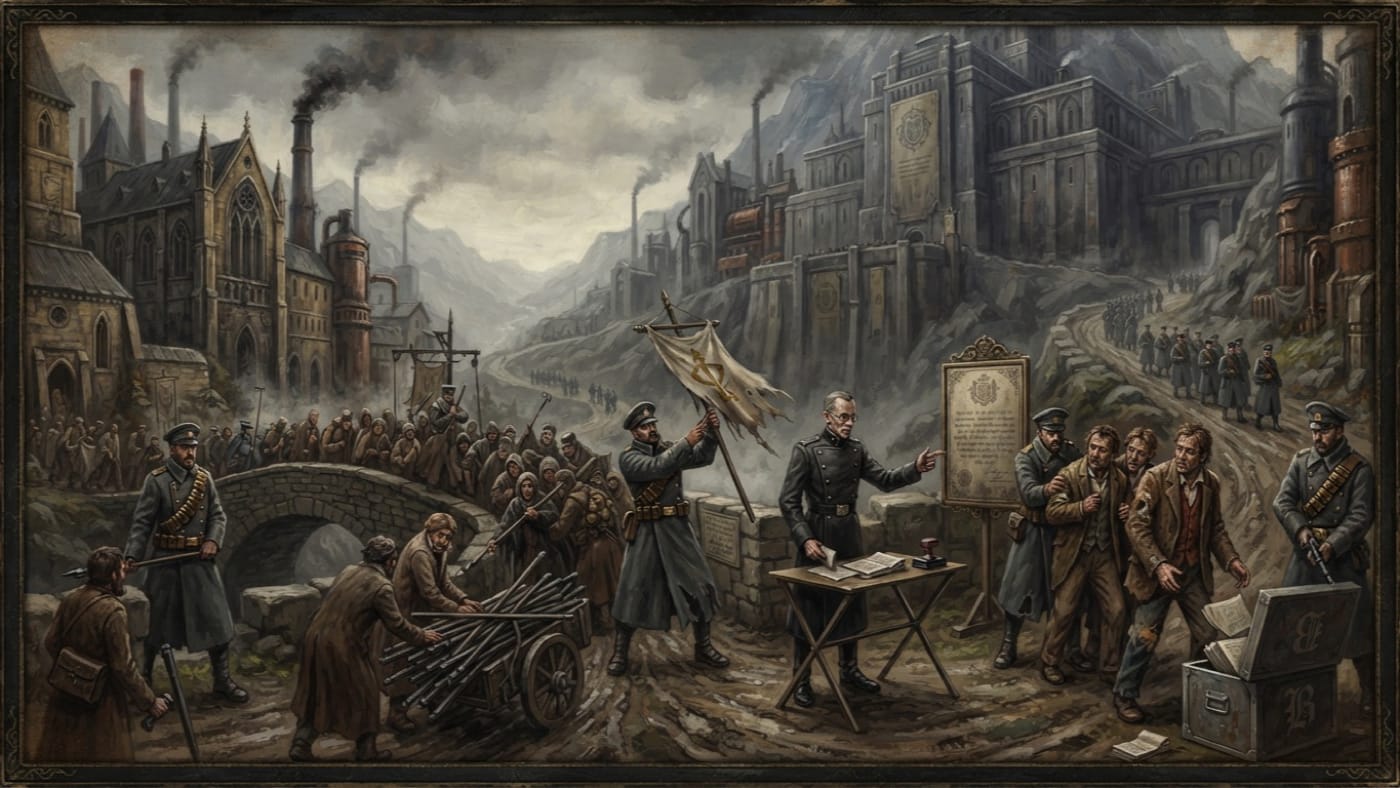
In A.S. 123 the eight masters were summoned to Concordat Hall in Strasbourg. The formal Synod had stood since A.S. 90. Its founders were long dead, and the Edict was the work of offices, which made it impossible to answer. The masters came expecting to negotiate the terms of their survival. Instead, the terms were read to them.
Three signed. They were made route inspectors and sent to stations so remote that their exile came with a desk. The master of the Golden Sole is the only signatory the record identifies by guild, and the dossier of Saint Edras holds that his guild surrendered first. He spent his remaining years at an unnamed relay station above the Carpathian snow-line, with a goat-farm and a painted boulder for neighbours. There he inspected pilgrims passing through mountains that a different guild had once claimed. Whether anyone meant the irony, I cannot say. Pilgrimage rarely files intent.
Three refused. They were walled into the foundations of the southern headquarters at Marseille, which the same Edict had authorised and which was then being built. Their names are sealed, and no record says which guilds they led. Staff report a groaning in the lower rooms, which the Bureau classifies as structural settlement. I have no finding to add.
Two fled to England. The British Crown granted them asylum, as it grants asylum to most things capable of irritating Strasbourg.
Readers will want the remaining guilds sorted among these three fates. The Peregrine Brotherhood's master would look well in Marseille limestone. The Blessed Foot, having lost a lawsuit to its auditors, would look well behind a desk. The record assigns neither. Tidy rosters are a vice of amateurs, and I will not immure a man by process of elimination.
The Harmonized Routes, and with them the end of the private pilgrimage guilds, date to A.S. 38.
Corrected. The Edict was ratified at Concordat Hall in A.S. 123. In A.S. 38 the Bureau of Pilgrimage did not exist and the Belgrade surge was eighty-two years away. One descriptive survey prints A.S. 238, a year the Church has not yet reached. Both figures are withdrawn. — Bureau of Records
#On the Remaining Trade
The Edict abolished the guilds' sovereignty and kept their services. Under the harmonized routes, road, escort, lodging and shrine approach became links in a single chain of permission, and the Bureau of Pilgrimage holds one end of it. The Peregrine Wardens carry the seals. An escort may still carry a staff if he holds a Bureau token. A hostel may still guarantee a bed if it holds a Bureau licence. Brokers still sell guidance on the pilgrim roads, and some of them doubtless learned the trade from someone who learned it from a guild. That is a lineage of habit, and habit revives no claim.
Shared names prove even less. The Edict created the Peregrine Wardens, and no record makes them the Peregrine Brotherhood in new coats. The Peregrine Cartel, a later insurance racket on the same coast, inherited nothing but the adjective. Peregrine means pilgrim. Strasbourg had no need to steal it.
The pilgrim of A.S. 201 still pays at the narrowing, sleeps where his papers allow and walks behind an armed man he did not choose. Every fee he pays now lands in a single ledger. I have approved that arrangement under seal and find it better in every respect.