
Litany-Engineer
#On the Nature of the Profession
"Steel has a temper. Temper obeys the Word. Therefore steel obeys the Synod."
The Bureau of Engineering does not employ priests. It employs men who smell of diesel and recite psalms with the cadence of torque specifications, and if the distinction between the two has become theological then it is a theology the Bureau has elected to leave unresolved, because resolving it would require admitting that machines respond to prayer, and admitting that machines respond to prayer would require admitting that machines listen, and the Bureau of Engineering is not presently prepared to file the paperwork that admission would generate.
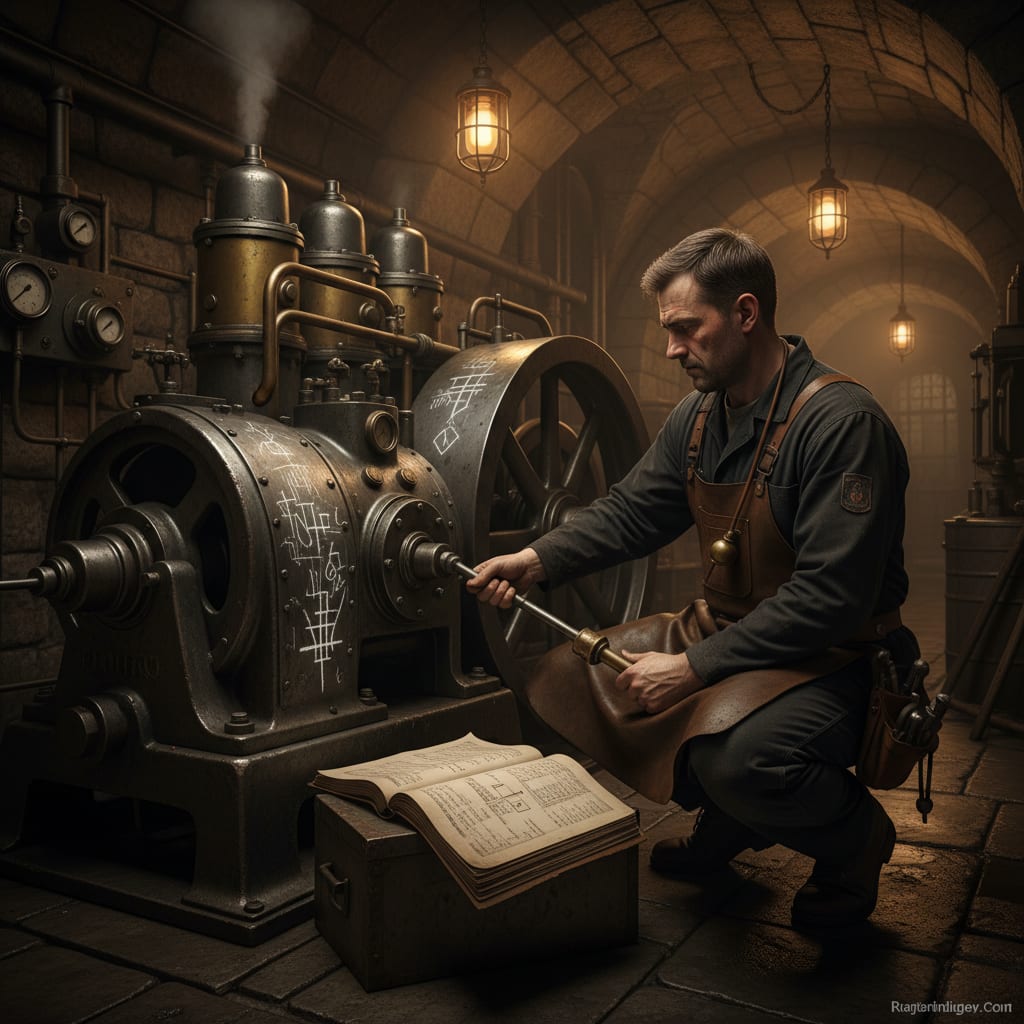
The Litany-Engineer keeps engines running. That is the whole of it. Generators, convoy motors, pump stations, crane mechanisms, bellway pressure systems, refinery yards — every grinding, coughing, oil-sweating apparatus that the Sagittal Line depends upon to remain something other than an extraordinarily expensive wall. The method is calibration wedded to cant: torque specifications spoken as litanies, ignition sequences sung in sanctioned intervals, saints' names etched into housings where heat makes metal remember. The engine consents to run. The Litany-Engineer coaxes that consent with a wrench in one hand and a chant codex in the other, and if questioned about which hand does the real work he will show you both, equally blackened, and say nothing.
Their patron is Saint Edrin of the Eight Strokes, depicted in Bureau iconography holding a wrench the way a lesser saint might hold a censer — with the confidence of a man who knows that what he carries actually works. The hagiographic account is characteristically sparse. Edrin calibrated a failing generator during the early Retreat, sang eight strokes of the ignition litany while his crew bled out around him, and the engine held. He died of burns three days later. The engine ran for eleven years. The Bureau of Doctrine canonised the man. The Bureau of Engineering canonised the engine, in its own way, by never decommissioning it.
#On the Origin and Formalisation
The profession predates its name. During the Great Retreat of A.S. 48–65, operators in the field noticed that engines failed in patterns bearing no relation to wear. Combustion stuttered at certain hours. Generators seized during bombardments that had not touched them. Fuel burned clean in one cylinder and foul in the next, in alternation, as though something were choosing. The word used was "foreign harmonics" — a phrase that has since acquired the bureaucratic weight of a small fortress and the practical meaning of "something is wrong and we are forbidden to say what."
Operators discovered that sound mattered. Certain rhythms stabilised combustion. Certain intervals suppressed the wrong resonances. Hum at the correct pitch during ignition and the motor caught. Hum wrong and the motor answered — a tone that was not in any codex, vibrating teeth and glass, and you had seconds to drown it out before the answer became a question the engine had no right to ask.
The Synod formalised it. Of course. The Synod formalises breathing if given sufficient notice. What had been field expedience became sanctioned cant, and what had been a mechanic's trick became a doctrine-dependent monopoly. By A.S. 97, cant-certification was mandatory following the Black Start Catastrophe — an unsanctioned restart at Bastion-Brest's harbour that lit half a port on fire and killed forty-three men, fourteen of whom were not yet awake. The Bureau of Doctrine declared the fire a judgment. The Bureau of Engineering declared it a fuel-air mixture ignited by an untrained operator. Both were correct. The operator was immured.
The Furnace Choir Reforms of A.S. 134 standardised litanies across all bastions and outlawed "folk tunes" in motor houses — the informal melodies that operators had developed in the field, many of which worked better than the sanctioned cant and all of which were therefore heretical. Trenchline Harmonisation (Unregistered), implemented in stages between A.S. 158 and A.S. 172, fitted wartime generators with bell-baffles and elevated Litany-Engineers from a maintenance corps to a military asset under Bureau of War jurisdiction. The Bureau of War classifies them alongside Tribune-Chaplains and Vexillators — men who lead both prayer and assault, though the Litany-Engineer's assault is against entropy and his prayer is a fuel-mixture calculation.
#On the Work
"Measure twice. Praise once."
The Litany-Engineer's workspace is a generator vault, a diesel shed, a refinery catwalk, a convoy bay, a trenchline pump room — any chamber that roars and stinks and trembles on its mountings. The physical environment is heat and vibration, diesel fumes and metal filings, lamps trembling on hooks, chalk marks everywhere. Some of the chalk marks are measurements. Some are wards. The distinction is academic, because the Litany-Engineer uses both and believes in neither — or believes in both, which in the Theocracy amounts to the same administrative filing.
The tools are issued: torque wrench, feeler gauges, stethoscope probe, timing light, seal punch, chant codex. The tools are contraband: "wild pitch" tuning forks, forbidden harmonics charts, quieting grease, stolen saint-dust. Every Litany-Engineer carries a calibration whistle for matching RPM to sanctioned tones. The whistle is official. The fact that every Litany-Engineer also carries a second whistle tuned to a frequency that is not in any codex is unofficial. The Bureau of Engineering is aware of the second whistle. The Bureau of Engineering has declined to file a report.
Diagnosis is by ear. A Litany-Engineer listens to an engine the way a confessor listens to a penitent — attending to what is said, what is left unsaid, what is said wrong, and what is said in a voice that does not belong to the speaker. Harmonic drift. Knock patterns. Undertones that are "foreign." The stethoscope probe pressed to a casing yields information that the gauges do not: the engine's mood, its resentments, the particular quality of its obedience on any given morning. The furnaces of Brast sulk. The generators of Bastion-Irongate hum in registers that correspond to the Gasket Choir's prescribed harmonics, or do not, depending on whether the Choir has recently changed shift. A convoy motor at Bastion-Przemyśl once refused to start for three days until a Litany-Engineer identified the problem: the previous operator had been reassigned without singing the closing cant, and the engine was, in the Bureau of Engineering's official phrasing, "awaiting procedural handoff."
Calibration follows diagnosis: timing, mixture, pressure, belt tension, valve clearances — each adjusted to specifications that are simultaneously mechanical and liturgical. The cant is applied in spoken or sung sequences aligned to RPM bands, as prescribed in the chant codex. The seal is verified: litany plate, wax stamp, chalk wards. The engine is load-tested under real draw, because an engine that holds a clean note at idle and screams under load is a liar, and liars in the Theocracy are treated consistently regardless of whether they are made of flesh or iron.
The ledger is closed: numbers, cant code, witness signature. The Litany-Engineer does not sign alone. A witness is required for every sanctification, every restart, every seal. The regulation is practical — a man who restarts a generator alone and dies has left no record of what went wrong, and the Bureau of Engineering abhors data loss more than it abhors casualties.
#On the Hazards and the Heresy
The profession costs the voice first. Raw cords from chanting in diesel fumes. Bell-sickness echoes — a ringing in the ears that matches frequencies the Litany-Engineer has never sung, frequencies that belong to the engines themselves, lingering like a congregation's murmur after the pews have emptied. Veterans develop a throat-clearing tic. They count RPM in idle moments. They never turn off background noise, because silence is worse than any hum.
It costs the hands second. Burns from hot casings. Vibration damage that turns the fingers numb over years. The forearms are mapped with scars — contact burns from reaching into engine housings while the metal was still singing. The youngest die swiftly in trench callouts, where a pump failure during bombardment requires repair under fire, in the dark, with the cant shouted over explosions. The eldest mutter equations in their sleep and dream of fuses they lit decades ago that may still be burning in tunnels the Bureau has sealed and will not discuss.
The "Quiet Engine Heresy" of approximately A.S. 147 was formerly classified as a minor doctrinal irregularity.
This classification has been revised. The Quiet Engine sect — operators who claimed to have achieved stable combustion without cant, through purely mechanical calibration — was suppressed by the Bureau of Doctrine in cooperation with the Bureau of Purity. The sect's notes were seized. The sect's members were reassigned to the Paper Mines. The engines they had been operating were dismantled and their components dispersed across four bastions. The Bureau of Engineering retained copies of the sect's calibration data. The Bureau of Engineering has declined to explain why.
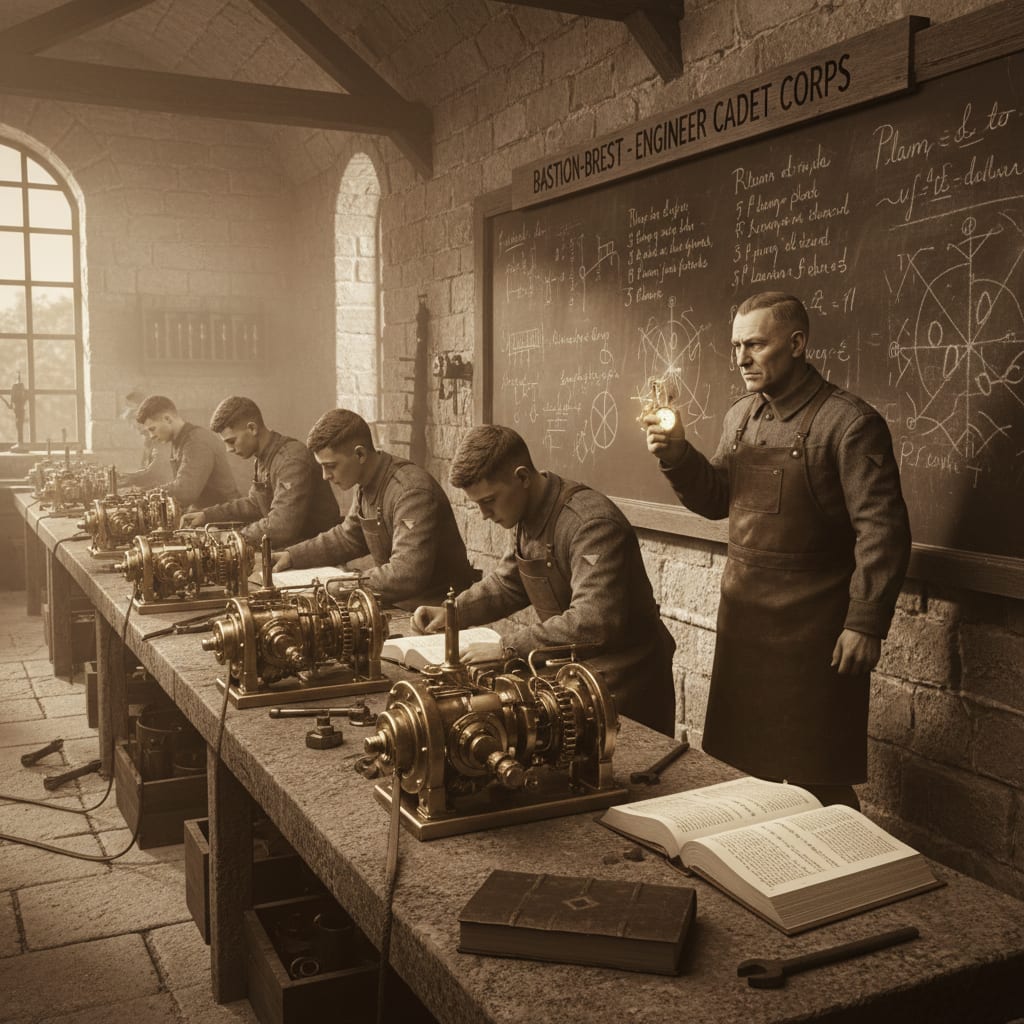
The profession's internal division mirrors the Theocracy's own schizophrenia. Codex Purists insist on the full liturgical sequence for every operation — ignition litany, calibration cant, closing hymn, seal verification, witness counter-signature. Field Pragmatists cut corners because convoys do not wait for theology and a generator that fails during a No-Man's-Land bombardment kills more men than a skipped psalm. Choir-trained Engineers, graduates of the Bureau's formal training sheds, look down on "earborn" mechanics — self-taught trench operators who learned cant by imitation and calibration by survival. The earborn look down on no one. They are too busy keeping things running.
The shadow repair rings (Unregistered) are the profession's open secret: unlicensed mechanics operating in the Warrens, in rear-area motor pools, in the gaps between Bureau jurisdiction. They use wild pitch. They use folk tunes the Furnace Choir Reforms supposedly eradicated. They use techniques that work and are therefore forbidden, and they charge in fuel chits, medicine, clean filters, and the silence of men who need their generators running more than they need their doctrine pure.
#On the Bureau's Combat Arm
The Bureau of Engineering calls them its combat arm, and the description is precise in the way that Bureau descriptions are precise — which is to say it is accurate and insufficient. The Litany-Engineers are the point where engineering becomes sacrament, where a man with blackened fingernails and an oil-stained hymnal crawls through wire and sludge with blasting charges strapped to his spine, singing counter-psalms into the teeth of sorcery. Their hymnals are reliquaries of a peculiar sort: oil-stained, water-warped, corners torn from desperate hands. The margins hold equations where illuminations should be. Three Hail Maries = one-quarter measure saltpeter. For a shortfall in powder, sing the Psalm of Collapse twice and face east. Detonation is their sacrament. The thunderclap is their amen.
The Prague Collapse (Unregistered) of A.S. 61 — a dozen Engineers tunnelling beneath a Rationalist observatory, chanting without pause until their throats bled, and at dawn the observatory folded into the earth. The Siege of Toledo — Engineers crawling through sewers to lay charges beneath a desecrated cathedral, scrawling numbers and prayers into wet stone. The Mire Collapse of Debrecen, A.S. 172 — Engineers consecrating an entire mile of trench by inscribing psalms into the mud with their own blood, fuses laid end to end like rosaries. None returned. The Blightmarsh burps fire on certain nights, and from beneath the muck rises the muffled echo of their hymn. The Bureau calls the event "strategic redeployment."
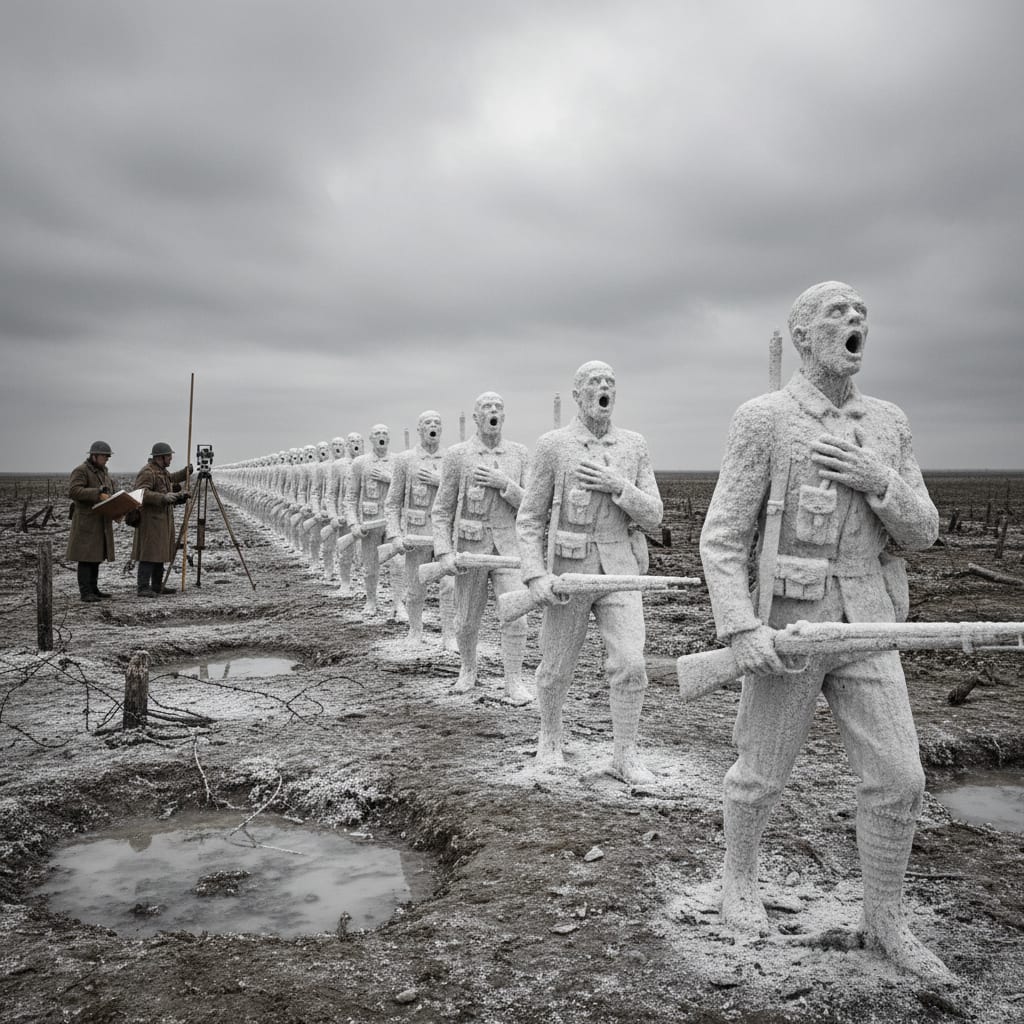
And there is the Shadow Noon incident — an entire division of Litany-Engineers pressing forward through No-Man's-Land during hours when shadows lengthened in the wrong direction, discovered calcified into statues of salt, their mouths wide open as if mid-hymn. The Bureau declared the incident edifying.
#On the Present Condition
In A.S. 201, the Bureau of Engineering employs an estimated four thousand licensed Litany-Engineers across Zones 1 through 7. The actual number — including earborn operators, shadow mechanics, and the unlicensed crews who keep the Warrens' generators coughing through the night — is closer to nine thousand. The Bureau is aware of this discrepancy. The Bureau has filed the discrepancy.
The Codex Purists and the Field Pragmatists have not reconciled, and will not, because the argument between liturgy and survival has no resolution that the Theocracy can afford to articulate. The training sheds produce forty qualified Engineers per quarter, against a wastage rate of thirty-one per quarter — burns, deafness, lung rot, trench death, reassignment to the Paper Mines for doctrinal infraction. The Bureau of War requests more. The Bureau of Doctrine certifies fewer. The gap is filled by earborn operators who learned their trade in the dark, who sing folk tunes that work, and who will be prosecuted if discovered and promoted if needed, sometimes on the same day.
The engines are running. The engines are always running. And in the deep hours, in the generator vaults beneath the bastions, when the shift bell has rung and the closing cant has been sung and the seals have been stamped and the witnesses have signed, the engines hum to themselves in frequencies that are not in any codex, and the night-shift Litany-Engineer sits with his stethoscope pressed to the casing and listens, and does not file a report, and does not tell anyone what he hears, because what he hears is the machine remembering a tune that no one taught it, and the Bureau of Engineering has a term for this phenomenon, and the term is "within acceptable parameters," and the term is a lie, and the Engineer knows it is a lie, and the engine knows he knows.
Torque is truth.
The Bureau of Engineering has reviewed this entry and requested seventeen amendments.
The amendments are under advisement.