

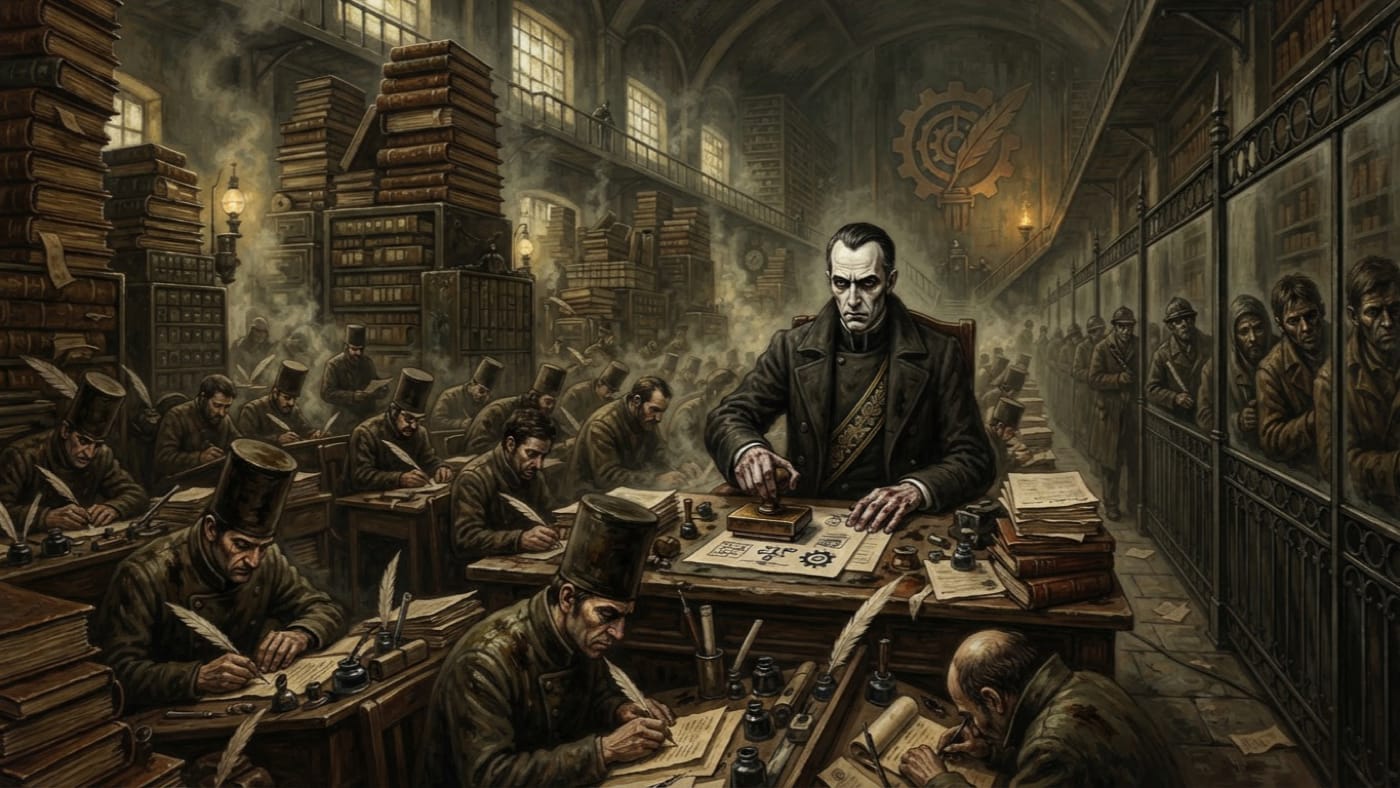
#On the Prefect's Station
The Records Prefect is the senior officer of the Bureau of Records in a yard or permit-town. The whole dignity of the office rests on one modest proposition: what is not entered did not move. The title confers no rank in the choir of heaven, and it carries no sword. Its holders are known chiefly by the clerks around them, whose ink cuffs are black to the elbow by Sext. The office's power is permission. A wagon without a manifest is theft. A man without a licence is a vagrant standing dangerously near iron. A corpse without a receipt is a sanitary offence.
In the Palatine Switchyard of Lorn the office holds one of three chairs on the Palatine Yard Command. Odrin Kessel, the Synod-appointed Yard Palatine, holds track priority. The Bell Marshal, Sister-Calder, holds procedure certification and the convenient doctrine of accident guilt. The Records Prefect holds manifests and names. No instrument I have located ranks the three. Each believes the other two are an inconvenience the Creator permits for the mortification of competent people. Records wants inspections. The Yard wants speed. The cantors want every throw sung exactly as certified. Lorn's twelve lines run on the friction.
The Records Prefect presides over the Palatine Yard Command, with the Yard Palatine and the Bell Marshal as assessors.
Corrected. No surviving warrant establishes any order of precedence among the three chairs. The struck line was drafted in the Prefect's antechamber, where the furniture encourages that belief.
#On Manifests and Names
The Prefect's house is the Manifest Basilica, where Lorn's records are kept, its schedules are fixed and its stamps come down. It smells of ink and glue, and of the incense burned to cover both. The working floor belongs to the clerks. They check manifests and make copies. They also reconcile entries, add supervisory initials, write master entries, enter duplicates into the index and cross-reference everything against the last corrected week. The Records Scribe does the writing. The Prefect's office decides which writing will be believed.
A name that clears Records counts as wealth in Lorn. The yard's own reckoning lists it beside a priority window and clean lungs. A name that does not clear has to wait. It waits at the counter in an oil-stiff coat while a clerk scrapes a seal to test the wax. Beyond the glass, the dispatch bells ring for departures that will go out without it.
Debt is where the office shows its craftsmanship. A Records lien does more than record what a household owes. It converts the sum. Arrears become night shifts, a missed night shift becomes a safety fine, and an unpaid fine becomes forced corridor work, which is debt with a shovel. The Switchmen's Union levies its own penalties alongside these. A careless switchman can therefore be in debt to the Church and to his brothers on the same morning, and be ruined by whichever ledger closes first.
The Basilica also houses the Safety Booths. A crew that confesses procedural error there is forgiven. In Lorn this means the confession is attached to each man's employment licence and the forgiven men go back to work at reduced standing. The dead receive the same tenderness. Burial is unlawful until a death receipt has been filed, so widows wait for the receipt with the body still in the house.
#On Fraternal Prudence
The Silent Derailment of A.S. 112 killed forty-one men on a siding that the manifests said did not exist. The Bureau of Bells drew a lesson from it about voiced measure. Records drew a quieter one: a siding missing from the ledger can still kill, and the families of the dead will remember the omission longer than the hymn. The office's authority in Lorn hardened after 112, though it did not begin there. A requisition and dispatch office had stood in the yard since A.S. 104 and grew with the First Continental Levy in A.S. 110. The Bureau's own transformation dates to A.S. 78. The Basilica's reach, its stamps and its vault of corrected manifests grew out of an older ledger after the catastrophe.
The crews formed burial funds in A.S. 113. By 115 these had become oath funds, and by 119 the oath funds had enforcers, route books and widow stipends. Two early holders of Lorn's Records chair judged this growth, and both judgments are preserved. The first Prefect called it fraternal prudence. His successor called it incipient labour sedition. Neither man's name is needed here. The office keeps their words, which is the only immortality Records has ever promised anyone.
I hold that both were correct. A burial fund is prudence. A burial fund that can refuse to throw is a second schedule.
The second schedule has no charter. The Union's founding article is recited at every oath and never produced on paper: the hand that throws may refuse if the hymn is false. No clerk can impound an original that does not exist. The Union's casualty roll, the Crushed Book, names workers killed after correct hymns, correct orders and correct manifests. Some of those manifests bore a Records stamp. No complete copy of the book exists. Records knows the book exists and cannot file it. A Prefect forced to live beside a document that cannot be entered is a landlord whose lodger pays in threats.
#On Correction and Its Witnesses
Every accident in Lorn produces three accounts. The Bell Marshal's cantors produce the tonal record, showing whether the measure was sung as certified. The Yard produces its throughput figures: how long the line was closed and what the closure cost. Records produces the manifest, and a manifest can be corrected. A corrected manifest is a lawful instrument that rewrites last week's departures into a shape this week can bear. The original stays in the Basilica vault. If you ask to see it, you will be asked why.
Guilt is shared out among these accounts. Sister-Calder certifies whether procedure was obeyed. Records establishes whose licence stood at the lever and whose debt passes to the widow. The Yard Tribunal and its provosts make the arrests. The Prefect seldom touches a manacle. The office works through inspections, audits and liens that outlast the inquest. When a name has to be struck from the rolls entirely, a specialist takes over: the Erasure Notary carries out what the Prefect's office has directed. The household finds out when the ration counter no longer recognises them.
The Union contests these accounts as a body. It sends witnesses to inspections, disputes testimony in the Safety Booths and refuses to sign confessions for men already dead. Records needs the switchmen, because the yard runs on experienced hands and no audit ever threw a set of points. The switchmen need Records, because a man whose papers fail cannot work at all. Every slowdown exposes the arrangement, and every inspection pulls it tighter.
#On Other Yards
The title travels, but its arrangements do not. At the Latchford Permit-Yards on the Sagittal Line, the Joint Yard Command pairs a Records Prefect with a War Quarter-Commander, and there is no third chair. Prefect Mavren Tull holds the blank permit stock. In a trench-town, that means deciding who may move toward the front and who may leave it. Quarter-Commander Hesta Brune holds convoy priority. The two quarrel over who owns the yard and the bribes that come with it. Latchford's official line is the queue is penance; the stamp is mercy. Its streets answer that the stamp is a leash.
In Lorn, Records shares power with the bells and with throughput. In Latchford it shares power with War. Each yard's Prefect must learn which neighbour holds the other half of the key.
#On the Present Account
Lorn's chair is currently held by Prefect Halden Wry. The Prefect's instruments are manifests and identity, and the fears they exploit are erasure and debt. The Bureau releases one personal detail: Wry smiles only when a stamp lands. I find it the most honest face in the Palatine Yard.
The account for A.S. 201 is open and does not balance. The Payroll Spur has been losing since A.S. 199, and the losses remain unreconciled. Kessel produces audits, Wry produces corrected manifests, and the crates produce nothing but absence. Tower Nine has begun showing lamp sequences that no Signal Manual admits. The Hush Tunnel Runners move freight beneath the yard on routes older than the current markings. The Union has planned a citywide slowdown over cantor overreach and widows' arrears. Inquisitor-Regent Veyl Hark (Unregistered) is expected from Strasbourg, and the Bureau of Purity follows inquisitors the way gulls follow a ration barge.
Records wants inspections before she arrives. The Yard wants speed until she does. The cantors want to be found singing. The Basilica keeps the Union's licence rolls in duplicate, as it keeps everything, so whatever Hark asks for will be ready, stamped and cross-indexed.
Disposition: pending.