

#On the Book on the Desk
"Procedure is mercy. Mercy is sound." — Palatine Yard Command Inscription, Main Freight Arch
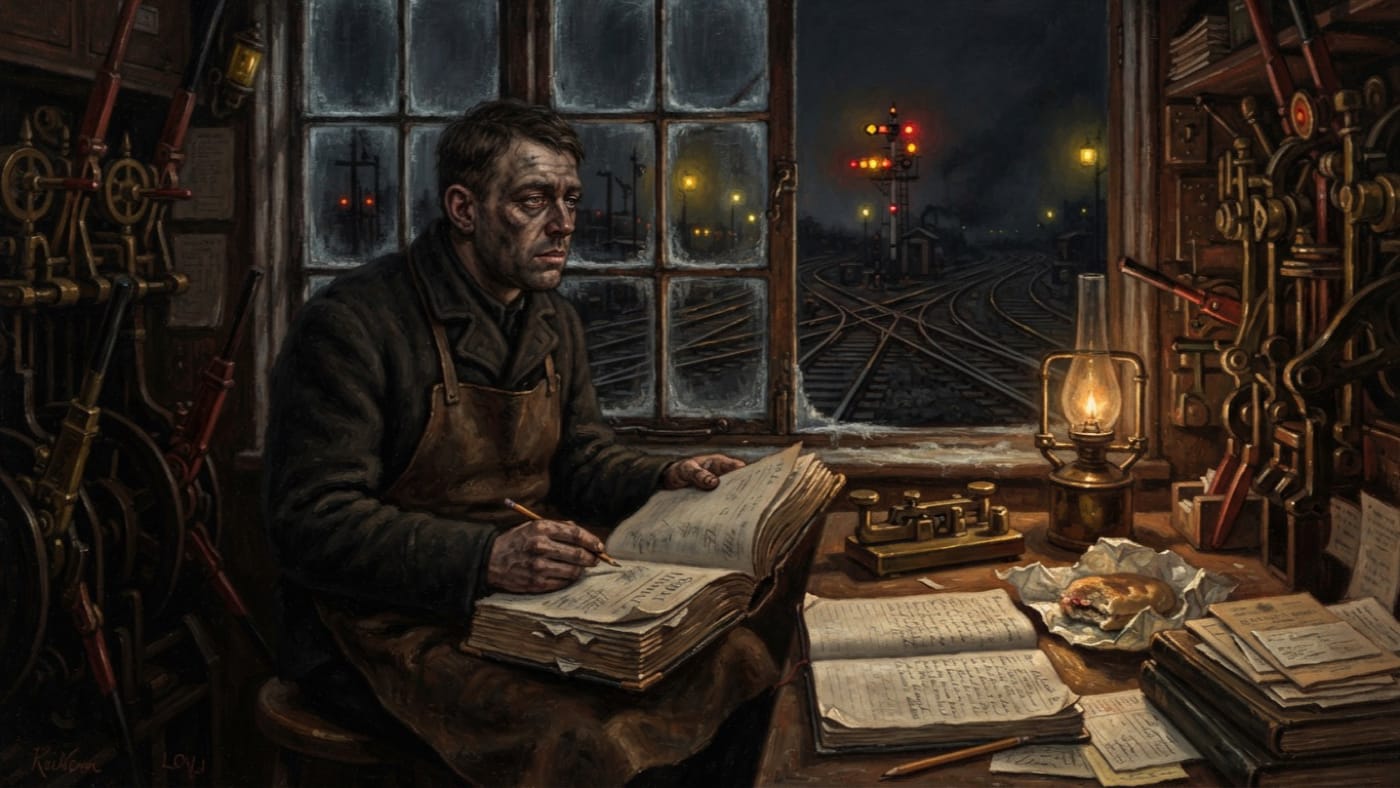
Every switch-tower in the Palatine Switchyard of Lorn has a caller, a stool, a cold meal, a logbook and a copy of the Signal Manual. The caller can be replaced. The meal is worse than replaceable. The Manual is the one object in the cage that the night does not argue with. When a lamp blinks across the yard floor through the coal haze, the caller's first duty is to recognise it. At Lorn, recognition means one thing: the sequence is in the Manual, or it is not.
That is all I can certify. The Manual is the reference against which unfamiliar tower-lamp sequences are judged at Lorn. I have not established who first compiled it, under what seal, in how many editions, or whether its authority runs past the Tri-Span Bridge. I will not invent a pedigree for a book because one would look well in the Ledger. I have seen copies. Their pages are soot-thumbed and their spines cracked. They carry pencil notes by men who had no authority to annotate anything. That much I saw. None of it is on record.
What the Manual serves is clear enough. Lorn has twelve converging lines. It reached seven hundred departures a day by A.S. 110 and has not been allowed to forget it. It holds two hundred and ten thousand registered souls. Most of them exist so that freight may be turned into motion toward the Sagittal Line, at the joint pleasure of the Bureau of Bells and the Bureau of Records. At night, part of that motion is governed by light. Lamps speak from tower to tower, and the Cinderrow wards call it lamp-talk. The Manual is the dictionary of the respectable half of that language. The other half has no dictionary, only a price list.
#On the Authorized Measure
Lorn does nothing silently, and the Manual never works alone. A switch requires a voiced hymnal count. A signal requires tonal authorisation. A departure requires the dispatch litany, sung by the platform crew in four-part harmony: route code, cargo blessing and procedural invocation, loud enough for the nearest tower caller to hear and log. The lamp blinks, the voice confirms, the hand throws and the pen records. Four witnesses attend every movement of iron, and the yard still loses trains.
The offices around this arrangement are better documented than the book. Bell Marshal Sister-Calder commands one hundred and twelve certified cantors, and so every sung authorisation in the yard. Prefect Halden Wry rules the Manifest Basilica, and so every paper that says a train moved. Yard Palatine Odrin Kessel holds yard priority and the Needle, the single-track gate where eastbound freight is inspected, and so he holds time. No record names any of the three as the Manual's author, publisher or sole keeper. In conversation, each treats the book as naturally theirs. That is how one recognises a document of real importance: everyone owns it and nobody will sign for it.
The yard does not always keep the Manual apart from its neighbours on the desk, so I will. The Bell Codex governs the bells. Its current standard was ratified in A.S. 115, and that date belongs to the Codex alone. Manifests and route books belong to Records. Sister-Calder's Missed Measures and the Union's Crushed Book are ledgers of blame. Route-code slips belong to the Hush, and then to whichever provost finds them. I once watched a tower caller consult three of these within a minute with a sandwich in his other hand. The sandwich was the only thing on the desk without a jurisdiction.
#On Correct Procedure and the Dead
In A.S. 112, a night crew of forty-one men routed a munitions train onto a siding that no manifest admitted existed. Every switch was thrown correctly. Every measure was sung to specification. Every stamp was genuine. The train met a slag wall at dispatch speed, and the Bureau of Records filed the matter as a terrain reclassification error, non-recurring.
The singing came before the dead. What the Silent Derailment added was compulsion. From that year, sung procedure at Lorn had to be certified and was mandatory, and every failure had a cantor to answer for it. The reasoning was that a procedure performed aloud cannot be falsified without audible evidence. The reasoning was sound. The forty-one stayed in the wall.
The teaching under the Main Freight Arch inscription holds that procedure is mercy: a measure sung correctly, a signal read correctly and a switch thrown correctly keep the men beside the iron alive.
Corrected. The Silent Derailment was correct in every observable particular, and it killed forty-one men. Compliance and survival are entries in separate ledgers. The inscription has not been recut. Inscriptions are expensive.
Two books dispute the lesson. Sister-Calder's Missed Measures records every cantor failure since A.S. 148, with the name, date, tonal error and consequence of each. It teaches that disaster follows a wrong note. The Union's Crushed Book is bound in oilcloth, kept after midnight and never complete. It records workers killed after correct hymns, correct manifests and correct orders. It teaches that disaster also follows the right ones. Neither is an edition of the Signal Manual. Both are commentaries on it, written in other men's blood. Like every scripture worth burning, the Manual has no opinion of its commentators.
#On the Hand and Lamp-Talk
"If the yard answers your hymn, don't take that route." — Lorn switchman's proverb
The Switchmen's Union keeps one article in its wrists: the hand that throws may refuse if the hymn is false. The cantor stands on a platform. The switchman stands beside the point, close enough to lose fingers. When the tower lamp says one thing and the iron underfoot says another, the man who has to decide is the man the Manual was not written for. Its readers sit above the yard in iron and glass. The men who bear its consequences stand below, in grease.
Experienced switchmen know things no reference prints. They can feel a lying point by touch. They can tell frost-lock from sabotage by smell. They can hear when a cantor's correct measure is a frightened one. This knowledge is real, and it has saved trains. It is also sold, withheld and fined. The Thrown Hand fines men who throw during a declared caution interval, and it bargains with delay. As a matter of plain physics, it can also hold a lamp shutter closed one blink too long. From a tower, a Union warning and a Union stoppage look the same. They are meant to.
Below the Cinderrow canteens, the Hush Tunnel Runners sell movement outside the schedule, and their stock includes tower-lamp keys and route-code slips. When tower codes stop matching the Manual, Union men buy lamp-talk from the Runners. The Runners sell it with a merchant's confidence and a merchant's accuracy. I am reliably and repeatedly told that the lamp code of Switch-Tower Nine at Lorn also serves as a smugglers' signal. The same blink can order a freight and announce that something not on the manifest is moving with it. The Manual records the first meaning, and the Hush keeps the second. Neither has shown it can read a third.
#On the Unrecognized Sequence
"Routes make men. Audits unmake them." — Lorn proverb
The Bureau of Bells classifies the Hymn-Phase Slip as a Category Two localised acoustic-mechanical disturbance. Every reference in Lorn stops where the Slip begins. A cantor sings correctly and the caller repeats correctly. The switch throws clean, the signal clears, and the train arrives somewhere it was not sent. Night crews list the signs: echoes that return a measure late, manifests that smear as if wet, a yard that turns briefly unfamiliar, and tower lamps that blink sequences found nowhere in the Signal Manual. Some callers say the lamps answer certain hymns with a delayed blink. The reports gather at Switch-Tower Nine at Lorn and at the Tri-Span Bridge, on the nights the crews least want to be there.
When such a sequence appears, the caller has the Manual open in front of him and nothing in it to match. He may be looking at a Union warning, a Runner's advertisement, a tired lampman's error, a forgery planted ahead of the audit, or the Slip. The Bureau of Purity would prefer a single answer with a name attached. Its officers have been heard to blame the unrecorded flashes on the Great Deceiver, which is a theology and also a filing convenience. I decline to fold five possibilities into one for the sake of a tidy docket. Tidy dockets are how forty-one men became a terrain error.
The countermeasures are known and unproven: double-canting, wax-sealed switch housings, salt on the tower steps, and a quiet minute held before the Needle. Wax also hides tampering, which is why provosts like it and switchmen distrust it. Three Bureau analysts, in reports the Bureau of Doctrine has sealed, attribute the Silent Derailment to a Slip. They name the pre-Synod clock tower bricked into Switch-Tower Nine's foundation as the probable resonance source. That attribution is theirs. Nobody has dug.
This year the pressure on the Manual comes from paper. The Payroll Spur losses began in A.S. 199. They include crates consigned to Bastion-Przemyśl that arrived empty under intact seals, and nothing has explained them except Kessel's own audits. The Bureau of Shadows keeps its advisory active. The Union is preparing its slowdown. In Strasbourg, Inquisitor-Regent Veyl Hark is reviewing Tower Nine's bell codes, the Payroll Spur logs and the sealed Slip reports. She has not yet arrived. When she does, she will ask which lamp sequences the Manual recognises. A caller will open the book and show her. Then she will ask about the others, and the Bureau of Records will learn whether it has a form for that.