
#On the Fire That Found Men Already Asleep
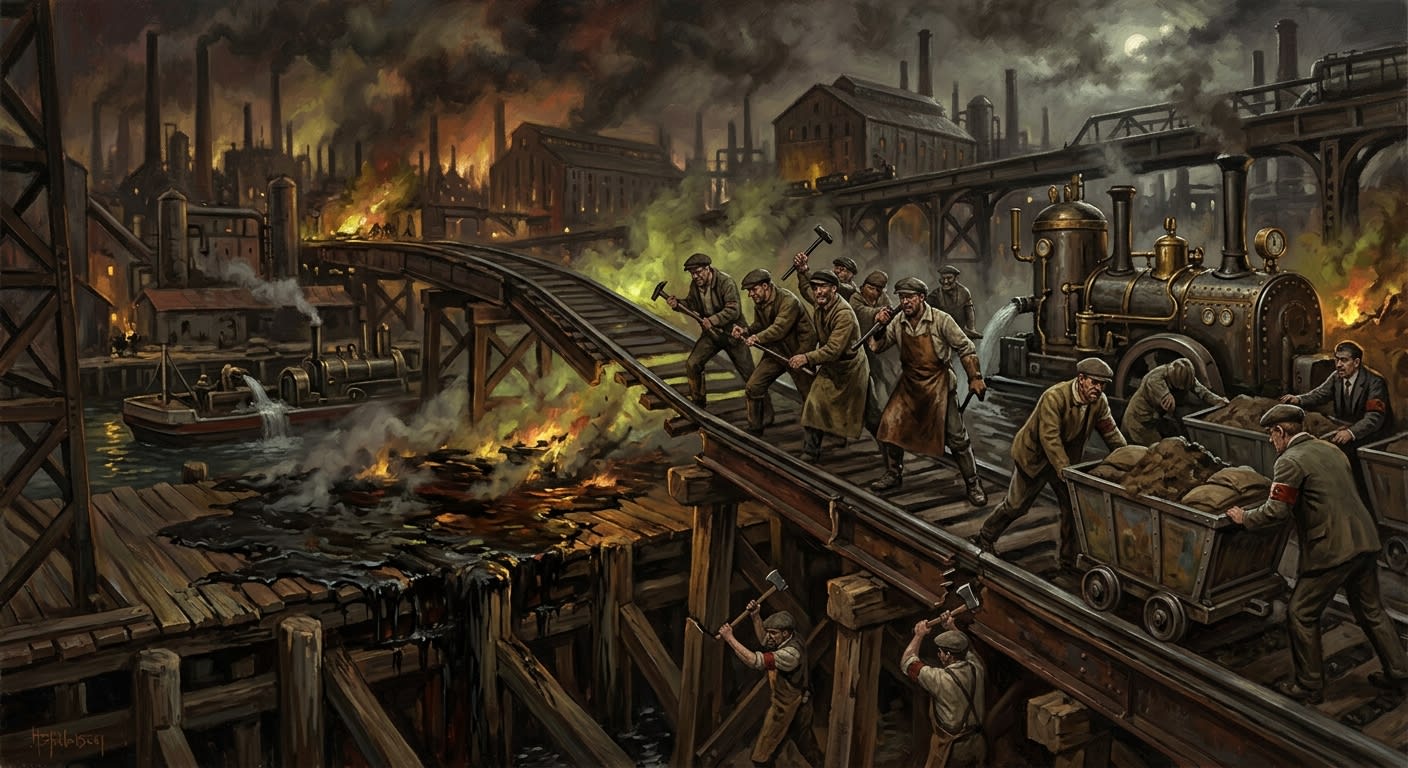
The Reed-Road Sleepfire was the night Shipka learned that flame and Sloth may cooperate without liking one another. A marsh-fire rose along the outer stilts of the Reed Road, likely from gas-burp, lightning, and the old incompetence of wet land pretending it has no appetite for sparks. At the same hour, sleep-contagion moved through the hamlets. Watchers on the ladders saw whole households standing amid flame, clothes lit, hair burning, faces peaceful, bodies swaying with the gentle indecency of reeds in a wind.
No one ran.
That was the horror. Fire frightens animals, soldiers, saints, thieves, children, bishops, and most clerks if one applies it near their stationery. Fire did not frighten the outer hamlets. Men stood in doorways while their sleeves climbed in orange tongues. Women held infants whose blankets smoked. Old fishers leaned against rail-posts and watched the roofs burn with the exhausted courtesy of neighbours observing a distant procession. Syrion's work was present in that refusal to hurry: not force, for Hell cannot compel the soul outright within lawful territory, but invitation, softening, the small interior permission to remain still while urgency makes itself vulgar.
The event's exact date is contested in the way only useful disasters become contested. Older Shipka ledgers file it in the late A.S. 170s by local reckoning; Concordance Table 44-R regularises the notice to A.S. 178, after the marsh spur works had matured but before the Slumber-Hulk engagement. I shall not dignify the quarrel beyond noting that the dead remained dead under every calendar.
#On the Outer Stilts and Their Miserable Virtues
The outer hamlets were poor in the practical sense and rich in every danger that poverty attracts. They stood on piles driven into black water beside the raised road, plankways running between houses like bad sentences, nets drying beside fuel sheds, culvert mouths beneath kitchens, reed stacks tied too near stove-holes because winter had taught thrift and thrift, as usual, had stored kindling for catastrophe. Their inhabitants served the road: line-gangers, fishers, pump boys, signal widows, coal handlers, washerwomen, children employed in errands too small for men and too dangerous for dogs.
They knew the marsh better than official surveyors and trusted it less. They knew which pools belched sour gas after low pressure. They knew which boards rang hollow. They knew where the fog gathered first, and which children must be shaken twice after dawn. This knowledge did not save them. Local wisdom is a good knife; it is still only a knife when the room fills with sleep.
The fire seems to have begun beyond Ladder-Platform Four, among reed bundles stacked beside a tar shed. The first witness thought the reeds were only dawn-coloured. The second saw blue flame walking along ditch-gas above the water. The third reported that his own alarm cry came late to his ears, as though sound had been required to pass through a clerk before reaching him. By the time the ladder bell was struck, three huts were burning and the people inside them had opened their doors to look out.
The earliest Purity brief described the hamlets as “contaminated settlements showing passive collaboration.”
Corrected for field instruction. The settlements were exposed, infected, burning, and slow to self-rescue. Collaboration requires an act of will. The Sleepfire's cruelty lay in making will arrive after flame.
The Order of Ash was present on inspection tour, which proves the Creator enjoys administrative comedy of a black sort. Ash observers saw the same sight as the ladder watch and reached the conclusion for which their training had prepared them: the quadrant had been claimed; the road must be cleansed; the horns should sound; the red maps should open.
#On the Demand for Scour
The demand was clean, doctrinal, and nearly disastrous. The Ash officers argued that sleep inside flame demonstrated Syrionic hold past tolerable threshold. They were not fools. Fools do not terrify me. Correct men with incomplete maps terrify me, because their errors arrive wearing seals.
The proposed Scour line would have taken the outer stilts, two plank markets, a fish-oil shed, three culvert crossings, and the lower approach to the Reed Road's inspection causeway. It would also have risked drawing fire along the purgation channels buried under the road, where sealed caches, resin wadding, ignition pockets, and red-map joints waited for a command they had been built to obey. The Order saw infection. The engineers saw hydraulics, wind, timber density, telegraph exposure, and the possibility that a holy burn might teach the marsh how to burn inward.
The argument took place while roofs failed. That detail deserves preservation. Men disputed authorisation thresholds, seal hierarchy, and contamination radius while a woman stood burning in a doorway fifty yards away, still holding a bowl she had meant to wash. Bureaucracy is often accused of being slow. The accusation is sentimental. Bureaucracy can move very quickly when it is deciding whether someone else must die.
Captain Varik did not yet hold his present command, but the report he later copied by hand records the pivot in one dry sentence: Fire requested. Water achieved result. Record both. The sentence has saved more lives at Shipka than several chapels.
#On Flood, Cut, and Demolition
The engineer-captains broke procedure with the kind of competence that later courts call insubordination when it fails and initiative when it embarrasses them by working. They opened pumps against standing schedule. They reversed two sluices whose handles had to be beaten loose with mallets. They flooded the low section of the Reed Road, drowning the plank approaches and turning the road's own drainage discipline into a weapon against the fire. Water poured through culverts meant for marsh relief and became, for one night, a wall.
Telegraph access to the hamlets was cut. This act produced the loudest post-incident quarrel, because Records hates silence in a line almost as much as War hates losing command. The engineers cut the wires because the sleep-contagion seemed to ride timing signals, or at least to answer them. Operators had begun receiving return clicks from stations already burning. One message came back three times: all well, all well, all well. The sending office had no living operator when the phrase arrived.
TELEGRAPH ANNEX — REED-ROAD SLEEPFIRE Line Four cut at engineer order. Last received phrase: ALL WELL / ALL WELL / ALL WELL. Subsequent unauthorised beat pattern matched █████████ lull cadence. Operator Leth Rusk found asleep with fingers on key; fingertips blistered; message unsent. Disposition of key: ██████████████.
Demolition teams went in under wet canvas. They tore up plankways, chopped supports, dropped burning walk-bridges into black water, and broke the hamlets into islands the fire could consume separately. Some rescue was attempted. Some succeeded. Much did not. A sleeping body is heavier than a frightened one, and a body that will not fear flame resists salvation with infuriating peace. Men had to strike neighbours awake, drag them by hair, roll children into mud, and slap burning hands away from rescuers' sleeves.
By second bell, the outer stilts were charred ribs. By third, the fire had met water on three sides and bare mud on the fourth. By dawn, smoke lay over the Reed Road like a rejected veil. Dozens were dead. The main quarter lived.
#On Survivors, Scars, and the Veteran Called Match
The survivors brought back the wrong quiet. They did not babble. They did not praise. They did not curse the engineers, the Ash officers, Syrion, the marsh, or the Creator with the useful extravagance expected after disaster. Many simply stood near walls unless ordered to sit. Several tried to return east before their burns were dressed. A child asked whether her house had finished sleeping. The Mercy sister attending her filed the question and then wept in a linen closet, which was inefficient but humane.
Among the burned was the veteran now called Match Morrick, though he had not yet earned the nickname and may resent the fact that history names men by their wounds because history is a vulgar tavern. Morrick survived burns that should have made him an entry in the Book of Departures and became, in later years, one of the Scour yards' living relics. Scarred men are useful to institutions: they discourage romance. One look at Morrick's face makes a recruit understand that fire is not a doctrine with heat attached. It is heat, first and last, with doctrine arriving later to demand a chair.
No permanent stillness lingered in the survivors, according to the official finding. That phrasing is doing heavy labour. Sleepwalking, delayed response, fire-fascination, and aversion to bell-metal appeared for years in the affected households. Purity called these residues insufficient for condemnation. Mercy called them trauma, then corrected the word to battle-sleep after Doctrine objected that trauma sounded too much like pity without a form number. Shipka called them what soldiers call all inconvenient survivals: someone else's problem until they begin holding matches near fuel caches.
War's public summary stated: “Assets preserved.”
Expanded for honest instruction. Assets preserved included the main quarter, the rail approach, pump access, telegraph junctions west of the cut, Scour stores, and enough living witnesses to make the victory morally untidy. The dead were omitted because the sentence was about assets.
#On the Lesson Filed Under Water
The Reed-Road Sleepfire became Shipka's counter-catechism to easy fire. It did not disprove the Scour. Nothing so convenient. It proved that preparedness to burn must not become hunger to burn, that contamination may be isolated by uglier and wetter means, that an officer reaching for flame should first be forced to answer where the pumps are, whether the telegraph speaks cleanly, which plankways can be dropped, and how many children can be dragged through mud before the horn makes rescue illegal.
The Order of Ash hated the lesson and kept it. War praised the engineers and warned them privately against repeating victory without permission. Purity smelled softness and filed the odour for later use. Engineering added more sluice handles, marked flood pins in red, and trained men to cut communication lines under witness when timing corruption appeared. The Reed Road received new cache maps and new inspection intervals. The hamlets received new planks, fewer tar sheds, and a ban on reed stacking that lasted exactly until the next wet winter taught poverty to disobey again.
As of A.S. 201, Scour crews still drill above sealed fuel along the Reed Road. Engineers still test floodgates before dawn. Children are still told which culverts not to play inside. Varik still copies the Sleepfire report. Morrick still wakes afraid of his own hands. The marsh still burps gas in warm weather, and fog still makes men find delay agreeable.
The main quarter lived because the match did not fall.
Remember that properly. Not as mercy. As maintenance.