

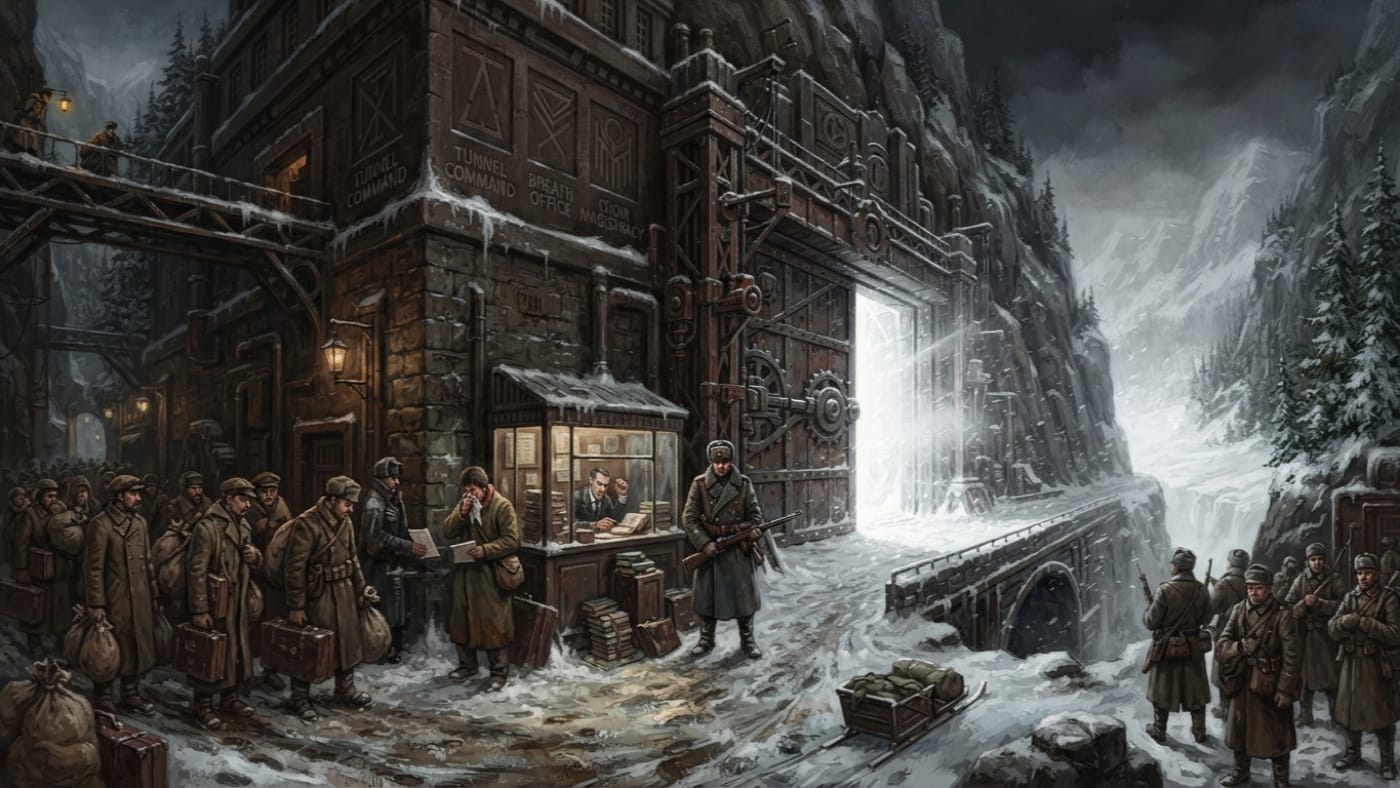
#On the Western Exit
"Name your gate by taste."
Every recruit at Bastion-Irongate learns the shibboleth within a week, usually from a sergeant who regards it as the only catechism the mountain requires. Iron is the Intake. Pine is the Snowmouth. Walk a man blindfolded down the Transit Spine and he can tell you which way he is being taken by what settles on his tongue. If he cannot, he has spent too long in the Breatheries to be taken anywhere.
Snowmouth Gate is the outbound exit on the mountain's western face, where the bored and inhabited stone of the Iron Gates gorge gives way to slope, snow and pine. It should not be confused with the river works. Chain Gates One and Two belong to the Danube, with their booms, batteries and eighty yards of forged link. The Snowmouth has no business with the water. The dossier filed in Strasbourg calls it the Second Gate. Nobody inside the mountain does, partly because the river already has a Gate Two and partly because the garrison prefers a name it can taste.
What it tastes of is pine pitch and gun oil. The pitch comes off the trees outside. The oil comes from the sentries, who keep their weapons wet against the cold and their faces dry against the wind. Work details go out through this gate to strip needles from the nearer branches for the garrison's tea. That errand is the fortress's one daily commerce with the open air, and no one has ever needed to order volunteers for it.
Then there is the light. Men who have spent months under lamps come up the last stretch of tunnel and meet a white glare off the snowfield that stings like lye. Veterans narrow their eyes before the turn, and new men learn to.
#On Permission to Depart
"Every license is a leash."
Leaving the Irongate requires the consent of three authorities, and none of them has ever been persuaded that the others are needed.
Commandant Hadrik Sorn holds Tunnel Command, which holds the Transit Spine and the Snowmouth along with it. His soldiers keep the gate. His schedules decide when it opens and for how long, and in the event of a breach his keys and charges decide whether a compartment stays open at all. Sorn is unsentimental about departure. A gate, in his reckoning, is a hole in a fortress that happens to have a guard on it.
The Transit & Breath Office issues the paper. Gate passes, convoy manifests and quarantine clearances all pass across the permit desk of Seal-Broker Lysa Murne, and her seal goes on every one of them. A soldier finishing his eighteen months, a wagoner bound for Bastion-Sibiu, a clerk recalled to the Bureau of Records: each of them comes to the Snowmouth with Murne's brass pressed into the corner of a document, and the sentries read the seal before they look at the face.
Faces at the Irongate are not to be trusted, as the Bureau of Purity will explain at length to anyone who has not yet heard of Morwen. A departing soldier's discharge certificate carries the Magistracy's stamp and a line in the smallest script the Bureau of Records allows, confirming his identity as of the date of departure and accepting no liability for later alterations. It is the most honest sentence the fortress issues, and it is issued at this gate.
The third authority is Cantor Ys Varr's Magistracy, and its power at the Snowmouth is exercised mostly from a distance. The Magistracy does not keep the gate. It keeps the voice-license, and the license decides heat, bunk and ration. When a worker's lungs thicken with ice-lung and he fails the stanza test, nobody shows him the door. The Irongate expels no one. It simply stops warming him. Within a short time, how short depending on the season, the unlicensed man finds that he has made a decision without being asked.
He may then present himself at the Snowmouth for discharge. This is lawful and orderly. His papers are stamped and his name is struck from the breath ledger. He is then permitted to walk into the Carpathian winter in whatever coat he has kept, with a certificate the Bureau of Records will honour and a body the Bureau of Medicine will not treat. Nothing in the certificate gives him a fire, a surgeon or a road that stays open. Its only promise is that he is entitled to leave.
#On the Snowmouth Fee
"The pass doesn't care who's right."
Where there is a queue, there are Tollers. The Tollers are a trade compact working the gate plazas of the Irongate with booths, clerks, hired guards and a great deal of paperwork, and they describe their purpose as fair pricing for transit. The dossier in Strasbourg is less generous. It says they extort both sides of the pass. The garrison has a word for the result. Whatever a traveller pays at the Snowmouth beyond what the Breath Office charges, he has paid the snowmouth fee.
Their methods are clerical. They hold a convoy over a misnumbered manifest. They lose a wagon's papers and find them again for a consideration. They tighten rations on teams already waiting at the plaza until the teamsters decide that paying is cheaper than eating snow. Master Toller Ivon conducts this business in a cloud of scent that reaches the inspection desk before he does, and his clerks have no trouble finding a man in a queue.
Winter does half their work. The western slope takes whiteouts and avalanches, and the mountain gives no notice of either. A convoy held over for weather has to be warmed, fed and kept in order while it waits, and every hour spent at the plaza is an hour someone can charge for. No Toller has been heard asking the Creator for snow. They keep their price lists ready for it all the same.
#On Quiet Passage
"Silence is a blade with no handle."
Some people cannot afford the gate. Some cannot afford the walk beyond it. For them, the Underchords sell another way out.
The Underchord Cartel's best product is the quiet pass: a route memorised in tap-code and then destroyed, running through the sub-grade voids beneath the fortress and around the checkpoints, the permit desks and the auditions alike. It does not lead out of the mountain by some hidden door beside the Snowmouth. No such door has been shown to exist, and I decline to invent one for the convenience of the desperate. The route comes up instead on a less closely audited stretch of the Transit Spine, among freight waiting to go out. There a rail hookman, suitably paid, looks the other way while a body climbs into a grain cart. The cart may be bound for Sibiu or for Shipka. For the passenger, its real destination is anywhere other than here.
The Cartel takes no coin. It takes gasket-rings, the small stamped brass washers of the Valve Quarter, which are portable, interchangeable and outside the reach of any tithe-collector, since no tithe-collector has jurisdiction inside the mountain. A worker who has lost his heat allocation does not usually have many rings. What he has is a choice between two prices. The Snowmouth charges him nothing and gives him the winter. The Cartel charges him everything he owns and gives him a cart, a hookman who may or may not stay bribed, and a ride through the dark among the grain bricks.
There is no guarantee. A route can be wrong, or sold twice, and the rails can change hands. The Cartel deals in passage. Whether the passenger arrives anywhere is no part of the bargain.
Older descriptive material in the Irongate dossier puts the Snowmouth on a "North / High Pass" and treats the gate as a col high in the Alps, in the country once implied by the fortress's deprecated name, Bastion-Savoy.
The Snowmouth faces west from a mountain above the Danube in the Iron Gates gorge, near Orsova, in the foothills of the Carpathians. The snow is real and so are the avalanches. The high pass belongs to a fortress that was never built, and the Bureau of Records has been asked to stop sending its weather to this one.
#On the Present Condition
"Sing clean, sleep warm."
As of A.S. 201, the Snowmouth remains busy, as it always is when the rest of the mountain is going badly.
Since the lung-rot outbreaks of A.S. 199, the Breath Office has had the power to isolate any worker whose candle test falls below the threshold. Ward Seven of the Breatheries is full. Ward Eight is being cut out of the rock. Every failed test sends someone toward one of three outcomes: a quarantine bed, a cold bunk, or the western face. Meanwhile the Choir sings without pause, because the mountain's seals depend on it, and the Magistracy keeps the singers it needs by auditing those it does not. Each audit adds a name to the outbound ledger. The Counterkey Circle, which the Bureau of Purity has been able to see since A.S. 198, recruits among the same people at the same rate. The Circle teaches that the Magistracy has been prescribing the wrong frequencies. That claim remains the Circle's, and nothing has been confirmed. What is confirmed is that the people who come to the Snowmouth with failed lungs are not asking about frequencies. They want to know whether the road is open.
Sorn's schedules stand. Murne's seal turns up on every pass. The Tollers have adjusted their lists for the season, and the berms along the approach are, by every official account, only snow.
The pine tea is still brewed from needles gathered at this gate. Hardly anyone in the garrison has ever asked who goes out for them. The answer appears in the duty rolls, filed between the discharge certificates. The Bureau of Records considers that an efficient place to keep it.