
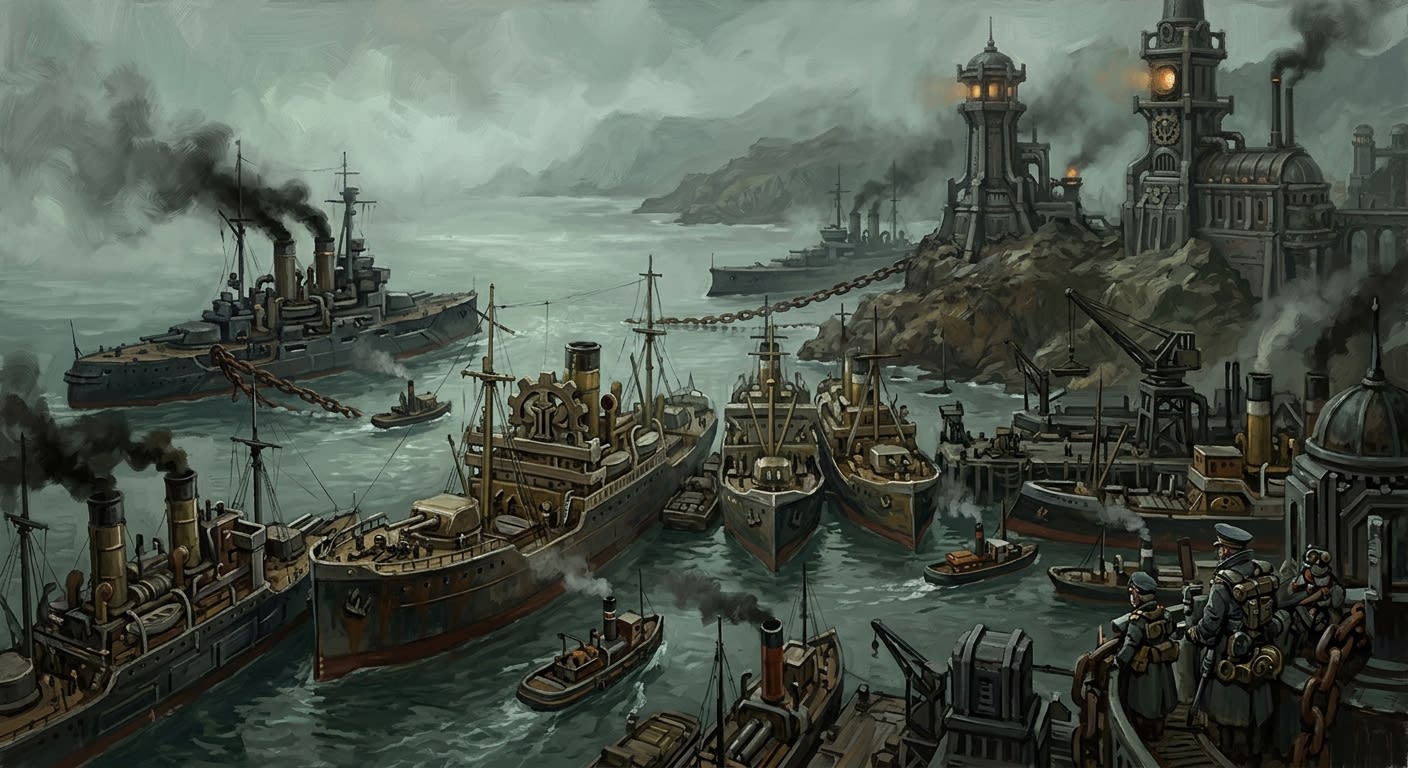
#On the Water Before the Fog
The Aegean Approaches are the southern coastal and maritime threshold where the Aegean supply sea, the road from Bastion-Shipka, and Syrion’s slow dominion begin to speak over one another. The term is a convenience used by the Bureau of War, the Bureau of Bells, and several harbour offices whose clerks prefer a phrase that can fit on a form. It describes no single cape, road, fort, or harbour. It describes the place where ships slow before the chain, soldiers sleep badly before the pass, and fog learns the smell of salt.
The Approaches lie within Zone 7’s southern maritime belt and press against the inland route toward Thrace and Bastion-Constantinople. Westward, the Thessaloniki Harbor-Chain Towers count hulls and names. Northward and inland, Shipka holds the pass against Syrion’s time-fog. Eastward, the coast frays into grey reaches where pilots report bells arriving wet, late, or already answered.
The name entered formal circulation after the A.S. 72 harbour-chain hardening, when coastal command discovered that fog did not respect the comforting separation between naval supply and mountain war. It never does. Fog has poor manners and excellent reach.
#On the Lines That Cross There
Four lines meet in the Approaches, and each calls itself primary because every office breeds vanity in proportion to its stamp budget. The first is the sea-line: convoy routes from Marseille, Genoa, Venice, and Saffron Bastion into Thessaloniki. The second is the pilgrim-line, softer in language and filthier in practice, carrying the faithful through the southern ports with their relic pouches, fever slips, false vows, and astonishing trust in paper. The third is the war-line, moving shells, boots, stimulant crates, bell-metal, trench masks, and men toward Shipka and the Bosphorus. The fourth is the fog-line, which has no licence and pays no duty.
The fourth is the most punctual.
Before A.S. 72, coastal officers treated sleep reports as ordinary sailor complaint: too much wine, too little discipline, stale air below decks, the usual maritime orchestra of excuses. After the chain consecrations, reports multiplied. Watchmen slept standing beside lit lamps. Convoys lost hours between buoys close enough to see one another. A quarantine cutter entered a bank of pearl-grey vapour at noon and emerged at dusk with its paint fresh, its bilge dry, and every man aboard convinced the voyage had not yet begun.
The Bureau of Bells made the first honest correction. A tone delayed by weather decays. A tone delayed by Syrion returns obediently and wrong. Thessaloniki’s chain-bells began receiving answers from inland fog banks, each answer slightly too gentle, slightly too complete, as if the sound had been wrapped before delivery.
A.S. 91 coastal manuals classified the Aegean Approaches as “ordinary maritime transit with elevated fatigue risk.”
Withdrawn. The fatigue was not ordinary. The transit was not ordinary. The manual’s author later fell asleep during his own disciplinary hearing and was spared dismissal only because the committee could not agree whether this proved guilt or research.
#On the Fog That Goes to Sea
Syrion’s proper seat lies in the Vales of Stagnance, east of Shipka, where villages stand breathing in grey streets and cartographers return with maps that accuse one another. The Approaches are not his heartland. They are his wetted sleeve, dragged through salt water and laid across the southern throat.
At sea, Syrionic influence behaves differently. Inland fog stills the road. Maritime fog persuades motion to become meaningless. A vessel continues sailing and arrives nowhere measurable. Oars rise and fall in perfect rhythm while the ship drifts backward. An engine turns, coal burns, stokers sweat, and the wake lies ahead of the bow like a line already written. Pilots hate this. Engineers hate it more. Priests hate it correctly.
The first settled protocol came after the Bell-Window Loss (Unregistered) of A.S. 103, when three supply barges passed beneath Thessaloniki’s chain at the proper hour and failed to reach the Sister Trenches, though signal lamps observed them twice along the route and once from behind the harbour they had just left. The barges returned in A.S. 104 with unspoiled grain, dead lamps, and crews whose fingernails had grown three months. Their manifests were accurate. This offended Records more deeply than the time loss.
Since then, ships crossing the Approaches maintain wake-peals at irregular intervals, recite hull numbers aloud, and keep one man moving at all times on deck. Sleep below decks is rationed by bell-tag. Hammocks are banned during fog watch. Chairs are discouraged. Cushions are treated as suspicious technology.
#On Shore Stations and Unkind Bells
The shore stations of the Approaches are small, wet, underpraised, and indispensable, which is the Synod’s preferred condition for anything staffed by men it intends to forget. They sit on headlands, broken islets, ferry cuts, and road-mouths between Thessaloniki and the inland Shipka supply road. Each station holds a bell, a lamp, a ledger, a stimulant locker, a priest or something near enough for government work, and at least one clerk who knows how many men are supposed to be awake.
The bell patterns are deliberately ugly. A pleasant bell near Syrion is an invitation. The approved Approaches peals are jagged: cracked pairs, unfinished triples, sour intervals, the kind of ringing that makes gulls leave and sailors curse the Creator with doctrinally interesting creativity. Beauty is reserved for feast days and funerals. Survival uses worse music.
Station Saint Odran (Unregistered) keeps the westernmost road-lamp. Kettle Pier (Unregistered) keeps the chain relay. The Little Miser (Unregistered), an islet station named by sailors and better than any official title, keeps the midwater wake-bell where fog most often crosses from shore to sea. Three times since A.S. 188, Little Miser crews have reported a second bell ringing beneath the rock. Excavation found no chamber. The ringing continued during the excavation, under the workmen’s boots.
The Bureau of Engineering filed the matter under “subsurface acoustic uncertainty.” The crew filed it under “bad.” The crew was more concise.
LITTLE MISER INCIDENT LOG — A.S. 199 Second bell audible below rock for seventy-two hours. Crew sleep deprivation index: █████. Lampman Duro reported “someone resting inside the metal.” No unauthorised bell found. After removal, Duro’s cot retained body warmth for six days. Recommendation: rotate entire crew; melt nothing until Bells arrives.
#On the Contact of Fire and Rest
The Approaches do not belong to Syrion alone. Maldrake’s furnace weather reaches the coast in ash gusts and sudden red pressure from the Thracian side. Where his heat meets Syrion’s fog, the Contact Zone inland becomes argument, weather, and tactical temptation. Along the coast, the meeting is less theatrical and more treacherous. Fog warms. Rain rises. Wet ropes smoke without burning through. Men wake from sleep with soot on their tongues and no memory of closing their eyes.
Coastal command once believed Wrath pressure would burn the fog clear. That belief lasted until A.S. 137, when the Censer Road convoy (Unregistered) entered a warm fog bank and found every mule asleep, every iron tire glowing, and every guard convinced he had already completed his watch. The convoy lost two days, three wagons, nine men, and all confidence in tidy oppositions.
Field sermons formerly praised Maldrake-Syrion rivalry as “Providence setting Hell against itself for the protection of the faithful.”
Corrected. The rivalry may be exploited. It is not protection. It is two knives crossing above the neck and being mistaken, by the optimistic, for a roof.
The Bureau of Inter-Infernal Analysis advises coastal officers to monitor heat-fog events without encouraging them. This is sensible in the way “do not drink the black water” is sensible: obvious, ignored, reissued quarterly. A captain who sees fog thinning under ash will want to move. Movement is virtuous. Movement is also how men walk into rehearsed weather and vanish while congratulating themselves on decisiveness.
#On the Present Passage
As of A.S. 201, the Aegean Approaches remain open by chain, bell, motion, and sleepless spite. Convoys pass. Pilgrims pass. Contraband passes because any route that saves the Line will also feed the vermin around it; one does not get arteries without clots. The stations ring their ugly bells. Thessaloniki counts the hulls. Shipka counts the hours. The fog counts more patiently than both.
No doctrine claims the Approaches are safe. Safety is a rear-office word, kept polished in drawers beside unused maps. The Approaches are usable. A usable road may kill you after delivering the ammunition. A usable sea may return your ship before you left. A usable bell may sound hideous enough to keep twenty men from accepting the kindest voice they have heard all winter.
That is victory, coastal edition.