
#On the Psalm That Makes a Ship Countable
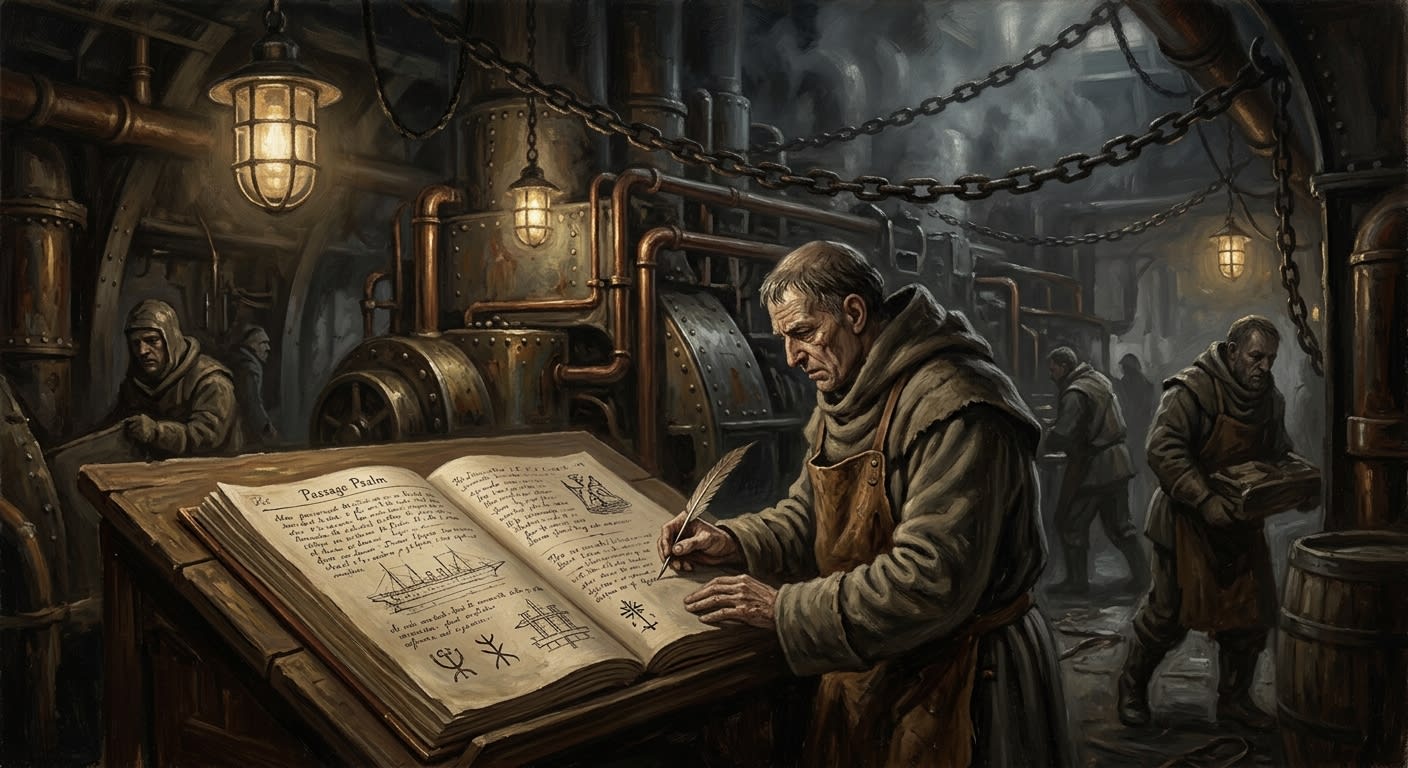
The Passage Psalm is the authorized harbour-chant of Thessaloniki, required for every vessel passing beneath the Harbor-Chain Towers, whether merchantman, pilgrim hulk, ammunition barge, quarantine skiff, corpse-boat, or that most miserable of maritime species, the Bureau courier who believes his seal makes him buoyant. The rule is plain: no ship without psalm. No soul without stamp. No passage beneath the chain unless at least one human voice keeps the line audible from first link-shadow to last.
This is often described as piety. It is accounting with a throat.
The Psalm gives rhythm to the chain-window, witness to the passage, and a public human counter-sound against whatever listens below. The Bureau of Rites calls it a sacramental transit formula. The Bureau of Bells calls it a tempo standard. The Bureau of Records calls it supporting evidence for arrival. Sailors call it the thing one sings because men who do not sing it sometimes reach port with one fewer name than they had when they left.
The authorized tempo is ninety seconds from entry to clearance when the choir is sober, one hundred and forty when it is not, and infinite when the bells fail, the chains hum beneath the water, and sensible men like Pilot-King Nenos refuse to move. The Psalm does not propel the vessel. It makes the vessel legible. That is the Synod's preferred miracle: motion translated into record.
#On Its Words and Their Necessary Poverty
The oldest form of the Psalm is short because sailors are not seminarians and drowning is a poor environment for lyric ambition. It begins with the chain, names the water, declares the hull, numbers the souls, and asks safe arrival without pretending the sea owes obedience. The official recension approved by Orison and Song contains seven lines, each line matched to a bell-mark, each bell-mark matched to a chain vibration, each vibration entered by the Harbor Ledger Office as evidence that the passage occurred in the sight of lawful witnesses.
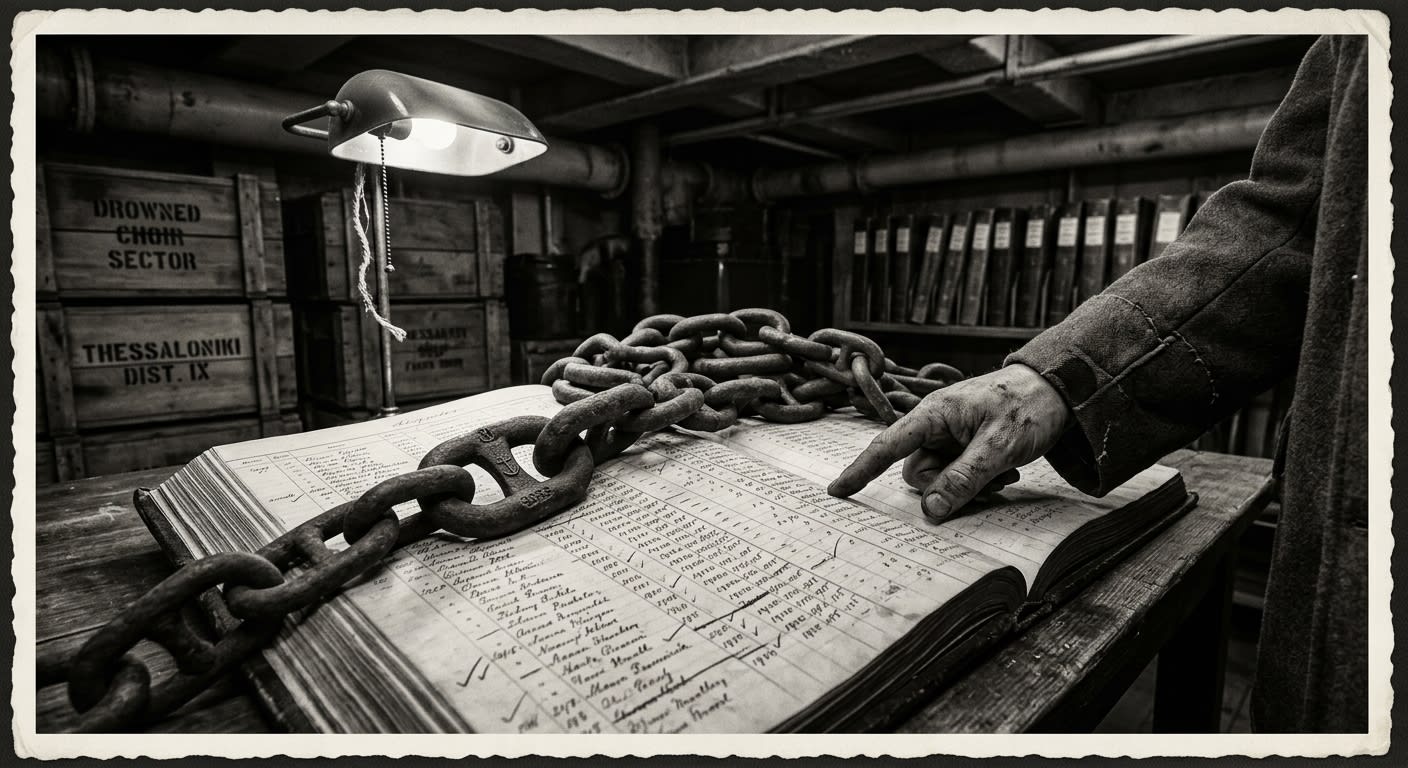
The first line is always spoken by the pilot or master. The second by the crew. The third by any passengers still awake, sober, or sufficiently frightened to understand instruction. The fourth belongs to the harbour choir on the quay. The fifth is the dangerous line, the release line, the one the Drowned Choir likes to hold one breath too long beneath the water. The sixth returns the vessel to the living register. The seventh is never sung loudly. It names arrival before arrival has happened, and the sea, being an old litigant, listens for premature claims.
Thirteen unapproved versions circulate in Drowned Row alone. Nenos claims to know all thirteen and uses none in the precise form sung by the guild, because guild versions assume a sober crew, clean manifest, calm chain, and sea that has accepted its subordinate position in Creation. Dockmen shorten vowels. Refugees add names. Ammunition crews hum the fifth line rather than speak it. Pilgrim vessels stretch the seventh until the harbour choir coughs them back into time. Every variation is illegal. Several work better than the printed form.
Early harbour manuals described local Psalm variants as “minor devotional colour.”
Corrected after the A.S. 145 Crying Choir inquiry. A changed note can become an invitation. A swallowed consonant can become a missing name. Devotional colour is what clerks call blood before it reaches the floorboards.
#On Bells, Chain, and the Human Witness
The Passage Psalm depends on the Elder and Younger bells. Dawn peal: lower then higher, harbour opens. Dusk peal: higher then lower, harbour seals. Storm peal: both at once, a sound sailors describe as the Creator arguing with Himself and the Bureau describes as theologically productive because the Bureau has never met a racket it could not invoice as doctrine.
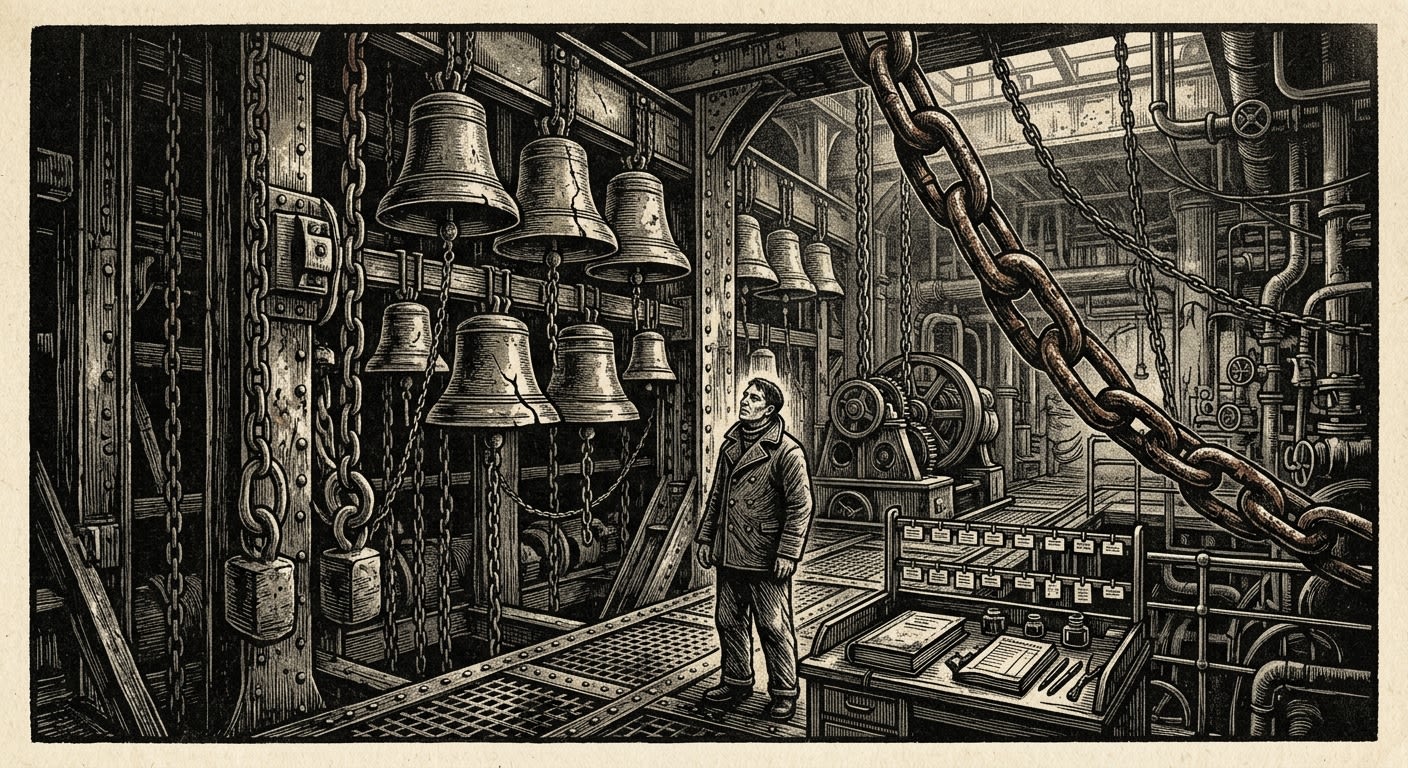
When a vessel enters the chain-shadow, the first line begins with the Elder's tone. The chain vibrates. The hull answers. Rope, mast, boot, molar, prayer bead, and guilty conscience carry the hum. The Psalm rides that hum as a rider rides a nervous horse: firmly, audibly, with no unnecessary poetry near the teeth. If the line breaks, the quay choir takes it. If the quay choir breaks, the pilot takes it. If every human voice breaks, the passage is suspended and the vessel is ordered astern, assuming the harbour has remained courteous enough to permit retreat.
The Bureau insists the human voice is symbolic. The Chainwrights insist it is mechanical. Diver-Matron Sera has reported that submerged links vibrate differently when the Psalm is sung by a full crew, by one terrified boy, by a paid choir on the quay, or by no one at all. Her instruments agree. Strasbourg dislikes agreement when it arrives wet.
The human witness matters because the sea counts without mercy. This is not metaphor. Names taken below Thessaloniki have appeared in Chainmaster Kosta's hidden ledger before drownings. Names have formed in corrosion on submerged links. Names have been sung from beneath the harbour in voices older than their owners. The Psalm places a living mouth between the name and the water. A thin protection. Thin protections are still protections. Ask any soldier issued a helmet.
#On Uncounted Passage
An uncounted passage is a transit under chain without lawful bell, psalm, or registration. The offence appears in maritime law as a permit violation. Sailors know it as a debt.
The official penalty is severe: seizure of vessel, quarantine of crew, voiding of cargo papers, Purity inspection, Records review, and a fine adjusted according to tonnage, intention, and the inspector's private appetite. The unofficial penalty is worse. Ships that pass uncounted acquire wrongness in their ledgers. Men arrive with names spelled differently by their own mothers. Cargo manifests include crates no one loaded. One quarantine cutter returned from a silent night crossing with all nine crew present, all nine breathing, and ten shadows on deck at noon. The tenth shadow signed the arrival receipt before anyone noticed.
HARBOR LEDGER SUPPLEMENT, A.S. 166 — UNCOUNTED SKIFF CASE Skiff entered under fog without Psalm after Younger bell maintenance closure. Pilot absent from muster. Cargo declared: lamp oil, net weights, two passengers. Arrival inventory: lamp oil, net weights, three passengers, one infant naming itself in adult hand on slate. Mother denied pregnancy. Slate retained. Infant file transferred to █████████████. Psalm re-training ordered for all night crews.
The most famous refusal came during the Silence of Thessaloniki in A.S. 198. For seventy-two hours the bells produced no sound, though clappers struck and chain-links under the harbour continued the correct schedule below the water. The Psalm had no bell-foundation. Captains cursed. Cargo spoiled. Officials threatened. Nenos refused every vessel, from grain barges to sealed reliquary freight, because, in his phrase, the sea was listening too hard.
He was right, which embarrassed everyone with a salary.
The Bureau of War's first memorandum called the A.S. 198 stoppage a failure of civilian maritime discipline.
Revised. The stoppage preserved the fleet. The phrase now in circulation is “collective operational prudence under acoustic uncertainty.” It means dockmen were wiser than officers, expressed in language officers can survive hearing.
The Psalm cannot function when the bell is absent. It can be sung, yes. A man may also recite a tax code to a wolf. Function requires recognition by chain, harbour, water, witness, and whatever tribunal sits below with names in its mouth. During the Silence, those recognitions separated. Surface bronze failed. Submerged iron kept time. Human singers could not tell which authority they were answering. Every vessel held.
#On the Choir Below the Fifth Line
The Drowned Choir interferes most often at the fifth line. This is the release line, the line where the vessel has committed to passage and has not yet cleared the last chain-shadow. The crew's voices must descend with the bell. The Choir rises. The authorized note falls by a minor interval. The under-note climbs into it like a hand under a latch.
Children hear it first. Pilots hear it as a second voice braided through the passage hum. Refugees hear it before sleep-singing begins. The Choir does not begin with words. It begins with correction: hold here, breathe there, pronounce that name otherwise, let the line rest a little longer over the water. One extra breath can spoil the rhythm. One spoiled rhythm can put a ship into the wrong register. The sea is patient with error because error feeds it.
The countermeasure is ugly and effective. Quay choirs are trained to over-sing the fifth line. Chainwright apprentices strike brass knuckles against the rail to keep time. Refugee aunties at the Sheds teach children to bite their tongues lightly when the under-note rises, pain being a crude metronome but more reliable than several licensed cantors. On fog nights, pilots carry pitch reeds soaked in vinegar. The smell helps them breathe through the mouth. The Bureau calls this medically unsupported. The pilots call it Tuesday.
After the Crying Choir incident of A.S. 145, when refugee children in the Harbor-Chain Towers sang in sleep and woke tongueless, the Psalm acquired its current harshness. Earlier versions permitted ornamental turns. Those turns are gone. Beauty was stripped out with the same tender care surgeons apply to rot. The present Psalm is square, brined, and hard to seduce. It has survived because it is less beautiful than the thing below.
#On Brokers, Substitutes, and Other Necessary Sins
Where a rule exists, a market kneels beside it with a knife in its sleeve. Thessaloniki has choir-brokers who rent voices to vessels short of crew, boys trained to carry the second line for foreign captains, widows who sell memorial names into the seventh line for safe arrival, and under-quay handlers who will provide a Psalm in any of six languages for twice the fee and half the questions. The Bureau condemns the trade. The Harbor Ledger stamps its receipts when no one is looking.
Some substitutes are lawful. Pilgrim vessels may hire quay singers if passengers are ill, mute, or inconveniently French. Quarantine boats may use screened choirs when infection has sealed the deck. Corpse-barges may be sung through by harbour clergy, though the clergy must stand windward and avoid naming the cargo individually unless the cargo answers. War barges under urgent order may reduce the Psalm to first, fifth, and seventh lines. This is called the Short Passage. Sailors call it the Little Funeral.
Unlawful substitutes prosper because lawful ones are slow. A ship carrying powder cannot wait for Orison scheduling while Maldrake's artillery teaches the coast arithmetic. A refugee boat cannot wait three days because the assigned choir has a liturgical throat complaint. A smuggler cannot wait at all. Drowned Row provides voices that can hold pitch under fear, which is more than one can say for several seminaries.
HARBOR LEDGER FEE TABLE — EXCERPT: licensed quay choir, full transit, standard fee plus bell tax; emergency single-line singer, double fee, refundable upon survival; memorial name insertion, prohibited and assessed if detected; Short Passage under War writ, no fee recorded and fee recovered elsewhere; unlicensed Psalm brokerage, illegal, with stamp code reserved.
There are abuses. Of course there are abuses. Men sell false voices, claiming to sing while mouthing nothing. Brokers drug children to keep them docile on night crossings. A few captains have used mute passengers as visible piety while paid singers hide below. The Bureau of Purity raids these trades whenever scandal becomes louder than usefulness. Then the raids stop, the markets reopen, and the chains keep demanding voices.
#On Present Use Under Reversed Bells
Since A.S. 198, the Elder bell rings the Younger's note and the Younger rings the Elder's. The Passage Psalm has been revised twice, corrected four times, and annotated into a condition resembling a wounded animal. The printed sheets tell crews to follow tower order rather than pitch order. The pilots follow pitch order when fog thickens. The Chainwrights follow vibration. The Bureau follows the printed sheet because paper, unlike water, can be bullied.
Thessaloniki continues. Ships pass. Crews sing louder than fear requires. The chains hum. The Drowned Choir listens below the fifth line. The Harbor Ledger receives its registrations and pretends the registrations are complete. At dawn the Aegean traffic waits beneath gulls, cargo sweating under tarps, sailors fingering name-slips, pilots testing the air with their teeth.
The Psalm begins. The harbour counts.
As of A.S. 201, every Thessalonikan child knows the first line before the alphabet. Every pilot knows where the authorized text lies. Every dockwife knows the older turn that Orison removed after the Crying Choir. Every captain knows the penalty for silence. Every sailor knows a man who sang back to the under-note and slept too peacefully afterward.