
The Arthurian Tradition's standing in the Codex has always been exactly this confused, and it is a matter the Bureau cannot close. What the Bureau can do is set out what the Tradition does, which is the only account of it I have ever found that I trust.
#On the Old King
"Produce the man, and the Bureau will weigh his claim." — Bureau of Doctrine memorandum on insular sovereignty, undated copy, unanswered
The British have never produced the man. They have produced an island that behaves as though he might return to audit it. The British Crown calls what it inherited from him the Arthurian Tradition. The Bureau of Doctrine has called it several things, most of them now struck through in later drafts.
Arthur is sworn by at coronations, in high oaths, and in judicial proceedings from Canterbury to the Orkneys. He is a king in one mouth and a warlord in the next. At the altar rail he is a saint, and at the hearth he is somebody's great-grandfather many times removed. Ask a Kentish magistrate which of these he means and he will look at you the way a bell-founder looks at a man who asks which part of the bell makes the noise.
I spent eleven days at Dover and Canterbury in the autumn of A.S. 194 trying to make the British decide. I came home convinced that the refusal is the working part of the mechanism. A king with a proven grave can be exhumed, measured and filed. A king with a disputed grave can be demolished by a sufficiently learned clerk with a free afternoon. A king whom nobody has agreed to define is beyond the reach of both. He has been beyond it for longer than Strasbourg has kept a register.
The Codex treats the Crown's claim to rule under Arthurian legitimacy. The Tradition is larger than that claim and rather less polite. It is the whole apparatus by which a Briton knows how to swear, whom to obey, what to fear, which bell to answer and which coin to count. Strasbourg governs by what has been sealed, and Canterbury by what has been sworn. They were swearing there while our first wax was still in the hive.
#On the Table and the Charter
The Table of Nine takes its form from Arthur's Table, or from the legend of it. The British do not distinguish between the two, and they turn cold toward anyone who presses the point. Nine Wardens sit under King-Warden Aldric III, Rex Custos. Each holds by a charter said to predate the Sundering. I write "said to" deliberately. The Bureau of Records has asked for copies seventeen times by formal letter and four times by other routes. Each time it has received the same confirmation, in a fine and unhurried hand, that the charters exist.
Records cannot say what the charters contain. It has catalogued what they do with the bitterness of a tithe-clerk counting another parish's harvest. A Warden summons the shire levy and the levy comes. A Warden orders the harbour chain raised and it rises before the ink on the order is dry. A Warden hears an oath sworn in Arthur's name over a relic and pronounces sentence, and the condemned man has no appellate Bureau to petition, because no such Bureau exists. The charter's authority has been proven in the only court the British recognise, which is the court of being obeyed.
Legate-Prior Mertens has lived eleven years in Canterbury, and he describes Table procedure as "argument terminated by oath." The Wardens dispute at length, in several dialects, with one another's fathers as precedent. Then the King-Warden answers, and the dispute ends. In a Synod council, a question is closed when the last seal is affixed and reopened when the first appeal is filed. At Canterbury, it is closed when the Crown speaks. Under the Tradition, reopening it would be an offence against an oath older than anyone present, and possibly older than the island's present coastline.
#On Sword, Bell, and Altar
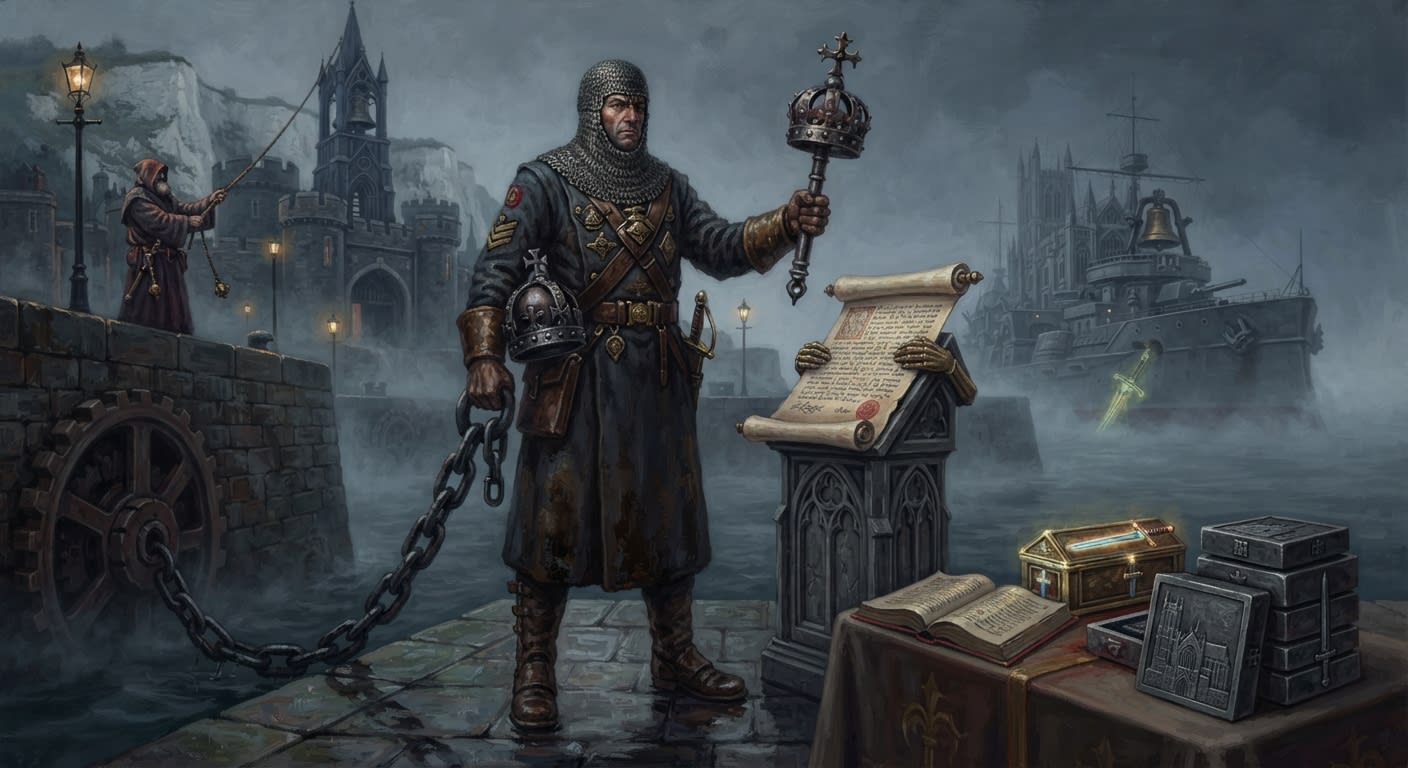
The Tradition travels best in the purse. The Iron Crown carries Canterbury Cathedral on one face and a sword driven into stone on the other. The British do not explain the device. They spend it. The Bureau of Tithes has lodged eleven formal protests against the coin in joint commerce. It has received the same reply to each: the Iron Crown is forty years older than the Crown of Grace, and precedent does not bend to administrative convenience. Every oyster-seller in Calais who takes one in change has ratified an Arthurian proposition without troubling to read it, which is more than can be said for most of our own ratifications.
The altar belongs to the Archbishop of Canterbury. Synod registers do not name him, and no Bureau has ever inspected him. He stands beside the King-Warden at the high rites and keeps the relics on which Britain swears. British relics are put to work. They are set into altars, sword hilts and bridge keystones. At least one Cathedral Ship carries in its keel a sword-hilt associated with an Arthurian saint. The Bureau of Relics refuses to recognise that saint, since recognition would require it to read British paperwork. The keel resists sorcery regardless of the Bureau's decision.
The bells are how the Tradition enforces itself. The Lantern Way rings from Canterbury's great carillon to the harbour towers and the mountain chapels. Its Lantern-Ringers are ordained men who carry maces cast from the same bronze as the bells they serve. They ring the hours, the alarms and the drowned. They also ring for the sentences. When a Warden court condemns a dissenter to be walled alive, it pronounces the sentence under the same Arthurian oath that crowned the King. The parish comes to watch the mortar set, and the bell marks the hour of it. The Bureau of Bells has asked seven times for the tuning specifications. The British have answered seven times, courteously, that bells are tuned by those who ring them.
#On the Crown in Practice
What the Bureau finds hardest to forgive is how useful the Tradition is.
A Warden of the Kentish Shore can sentence a smuggler in the morning and consecrate a chapel bell after dinner. He can commission a warship before supper. He needs no counter-signature for any of it, because one oath covers all three offices. The shire regiments muster under it. Harbour-masters at Dover close the port under it. Cathedral Ships are consecrated under it, with chapel amidships, bell above the quarterdeck and relic sealed into the keel. The Royal Fleet keeps its discipline under it, and its sailors swear to Arthur and the Crown before they swear to their captain.
At the Dover Chainworks, British smiths forge chain, net-cord and blessed rope for both shores of the Channel. They work under British authority, before a Synod trade attaché who complains about the weather and the food, and who pays in Iron Crowns when the quay-master insists. Across the water, the Chalk Redoubt of Calais holds the continental shore with Synod guns and Synod paper. The open water belongs to British hulls. The fog parts for their bell-masts and closes behind them, and our grain convoys sail in the gap.
#On Strasbourg's Annoyance
Doctrine's discomfort has a simple construction. The Synod holds authority by the Concordat, and the Concordat binds those who signed it. Britain did not sign it. It was never inside the communion from which a schism could be made, so "schismatic," the Bureau's favourite word for the island, describes a departure that never happened. The Arthurian Tradition sits outside our jurisdiction twice: once as history we have never been allowed to examine, and again as sovereignty we have formally recognised. The Bureau of War has recognised it a third time, in grain tonnage.
In A.S. 194 Mertens delivered a written doctrinal objection to the King-Warden. Aldric read it to the end and replied with one syllable. That syllable carried the Table, the charter, the altar, the fleet and a coastline that has been obeyed for longer than anyone can remember. The objection carried the Synod's letterhead.
Erratum — Bureau of Doctrine, entry revised A.S. 199: The Bureau's insular catalogue formerly filed the Arthurian Tradition as "Folklore, Insular, Non-Operative; of antiquarian interest only." The entry has been withdrawn together with the prior classification of the Lantern Way, which now reads "Non-Standard Observance, Diplomatically Accommodated." The Bureau of War had observed that a non-operative folklore could not be raising harbour chains at Dover, mustering shire regiments, and escorting two convoys a week through the Foulness. Doctrine keeps its theological reservation in sealed annex. Ratified.
The Bureau of Doctrine will go on denying Arthur for the rest of this century. It will do so in sealed annex and in the Synod's best Latin. Lord-Warden Eccleston will go on receiving its memoranda in Strasbourg with the serenity of a font taking in rainwater. The convoys will sail. In the meantime Strasbourg is left with the one problem its registers were never built to solve. A myth that buys bread, raises fleets and keeps the Channel open does not need to be true in the Bureau's sense. It needs only to go on being obeyed, and it has never once failed at that.