
#On the Old Claim
Arthurian legitimacy is the British Crown's account of how a Christian king comes to rule without asking Strasbourg. Authority, in this account, descends through old myth, sworn oath, charter, Canterbury rite and the obedience of Wardens, and each generation confirms it by using it. The British use it in courts, on quays and at coronations. They also use it at the counter of every chandler who takes an Iron Crown for a coil of rope.
The Synod's theory runs the other way. Authority enters at the summit through the Concordat, the seal, the ratified register and the audit. It then descends by instrument until it reaches a clerk entitled to stamp it. A continental magistrate is legitimate because a document says so and a second document confirms that the first was properly filed. A British Warden is legitimate because his fathers swore, he swore, the bells rang, and the county obeyed.
Who Arthur was, the British do not settle and the Bureau cannot. He is invoked as king, warlord, saint, ancestor and warning, sometimes all five in a single oath. His name is sworn at coronations, in high oaths and in judicial proceedings from Canterbury to the Orkneys. Doctrine has spent a century assembling proof that no such man governed as the British describe. The British have spent the same century declining to read it. Neither party has produced the grave.
#On the Table and the Charter
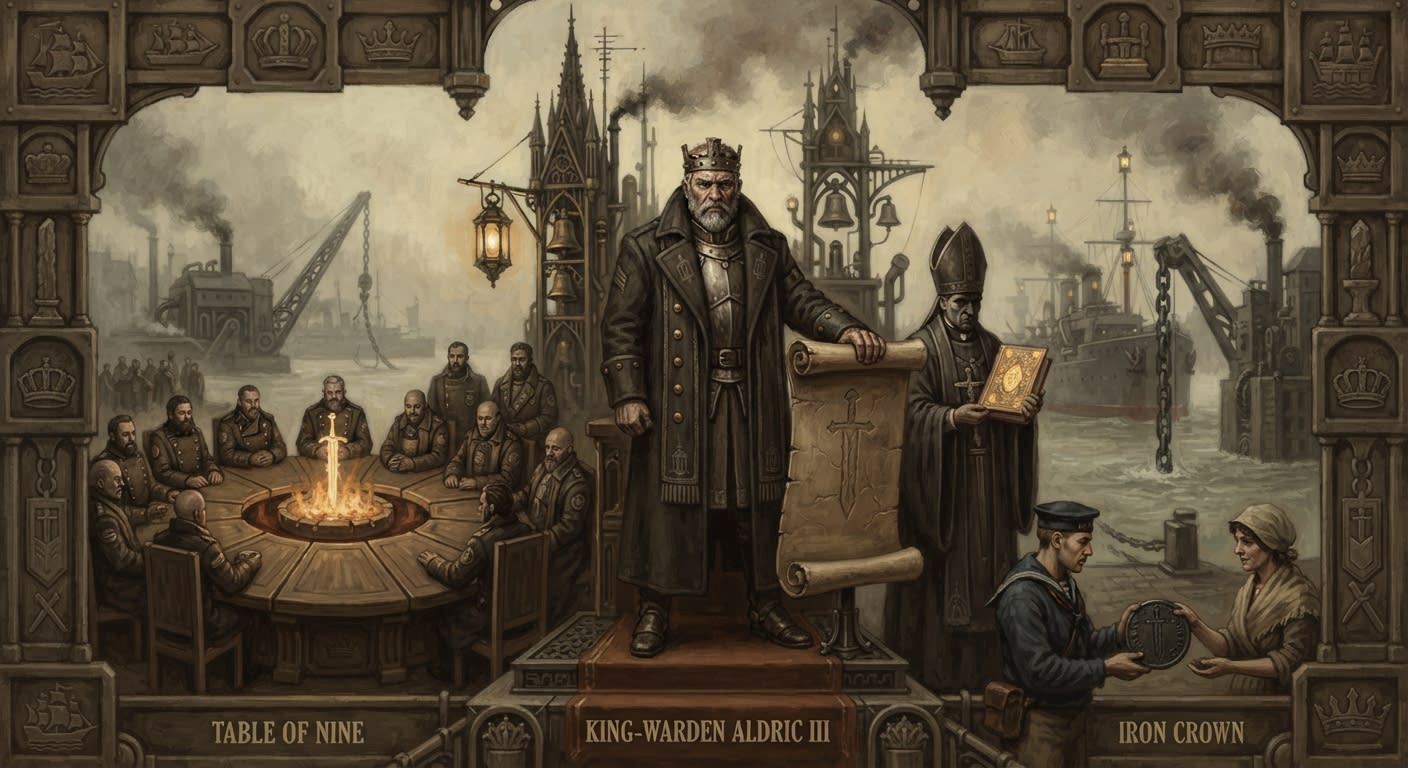
The claim has a shape, and the shape has nine seats. The Table of Nine takes its number from Arthur's Table or from the legend of it. The British speak of the two interchangeably and take offence only when a foreigner insists on the difference. Nobody in Canterbury claims that the present oak is the original board. Their claim is subtler and more irritating: the office descends from that table as a see descends from its first bishop, whatever became of his chair.
Each Warden holds by a charter said to predate the Sundering. The Bureau of Records has requested copies seventeen times. Britain has confirmed that copies exist. The Synod does not know whether the charters are Arthurian in origin, ecclesiastical, the residue of coastal war compacts, or all of these tied up in one hide wrapper. The British have shown no interest in settling the question for our convenience. Records can observe only what the charter does. A Warden summons militia and it comes. He orders the harbour chain raised and it rises.
A Bureau of Records abstract proposed that the Table's charters "are likely lost, forged, or merely ceremonial, their continued citation serving as a legal fiction."
Withdrawn. A fiction that raises harbour chains at Dover and musters shire regiments within the day has exceeded the tolerances of the term. Records now describes the charters as "withheld." It continues to request them.
At the head of the charter stands King-Warden Aldric III, Rex Custos, Lord of the Table of Nine, Defender of the Lantern Way, living and active in A.S. 201. The Wardens argue before him with oak-striking, drowned abbots, lost ships and grandmothers' precedents until he answers. Then the argument ends. Legate-Prior Mertens calls this "argument terminated by oath," and eleven years under Canterbury bells have earned him the phrase.
Here is the working part of the doctrine. The legend makes the Crown's answer final. The finality makes the legend true enough to obey.
#On the Sword in the Hand
The sword-in-stone on the reverse of the Iron Crown is the whole claim reduced to fit a purse. The obverse carries Canterbury Cathedral, the reverse carries the sword driven into stone, and a line of old law runs round the rim, abbreviated differently by issue. Every coin asserts that the Crown's authority is older than Strasbourg and was drawn rather than granted. Every Calais fishwife who accepts one has ratified the proposition before she has finished counting her change.
This is why the Bureau of Tithes hates the coin out of all proportion to its weight. The Crown of Grace is minted, blessed, tracked, ash-tested, song-tested and silence-tested. Its value rests on the Synod's will and on the punishment of refusal. The Iron Crown is forty years older. Its value rests on British oath-law, on Warden courts and on the plain fact that it buys bread. Tithes has filed eleven formal protests. Lord-Warden Eccleston answered them in substance: the coin remains legal where it is king's coin. Tithes has yet to draft a reply that improves on silence.
The coin defends itself in the same idiom as the Crown. A false Iron Crown rings wrong under a Lantern-Ringer's tap. Canterbury dies carry asymmetries known to British wardens and to no Synod office. In A.S. 198 a counterfeit batch turned black in a Dover toll clerk's purse. Doctrine has asked what power blackens a forgery of an unproven legend. Canterbury has not replied.
#On Canterbury's Altar
A legend needs an altar before it can bind a court. At Canterbury the altar belongs to the Archbishop. He is unnamed in Synod registers and has never been inspected by any Bureau. He stands beside the King-Warden at the high rites and keeps the relics on which Britain swears. His office supplies what a charter cannot, which is sacred standing. A continental governor takes his authority from a Synod seal. Aldric takes his from an altar Strasbourg has never been permitted to examine.
Canterbury's relics are set into altars, sword hilts and bridge keystones, and they are put to work. Nobody has notarised them to Strasbourg standards, and they appear not to have noticed. When a British court invokes Arthur over a relic, under a bell, before a Warden who is also the judge, the oath carries three sanctions at once: the Crown's, the altar's and the parish's.
The Lantern Way supplies the congregation. It confesses the Creator, resists the Great Deceiver and remembers the Sundering. It binds chapel, armoury, hearth, court, ship and scaffold under local vow. A Warden may sentence, bless, muster, hear penance and govern a port in one office. The bells mark every absence. Dissenters under certain sentences are walled alive, and the parish watches the mortar set. Britain enforces Arthurian legitimacy through neighbours, bell discipline and Warden law. The Synod enforces its own through paper. The British say we need the paper because we lack the neighbours, and I have filed the remark under Insolence, Accurate.
Bureau of Doctrine standing entry, prior to A.S. 199: British Arthurian claims classified as "adjunct superstition of Schismatic Heresy, Category Two."
Revised with the Lantern Way's reclassification to Non-Standard Observance, Diplomatically Accommodated. The Arthurian claim now travels under the same accommodation as the rite that carries it. Doctrine keeps its theological objection in sealed annex. The grain convoys keep their escorts.
#On Strasbourg's Problem
Doctrine can deny the history. It cannot deny the ships.
The Chalk Redoubt of Calais guards the continental shore of the Channel, but the open passage belongs to British hulls and bell-masts. Cathedral Ships escort Synod grain, pilgrims and medical stores through fog that parts for them and not for us. The Dover Chainworks forges chain and blessed rope under British authority. When the quay-master insists, the Synod attaché there pays in Iron Crowns and records the expense as hospitality. Each of these arrangements rests on a Crown whose title the Bureau of Doctrine holds to be mythologically unsound.
The trouble lies in how the problem is built. The Synod can pronounce a claim false, and the pronouncement binds everyone inside the Synod. Britain was never inside. It never signed the Concordat and never entered the communion, so the old Bureau label "schismatic" described a departure that never took place. The legend therefore stands outside our jurisdiction twice: once as history we cannot examine, and again as sovereignty we have formally recognised. The Bureau of War has recognised it a third time, in tonnage.
If Canterbury produced the charters tomorrow and they proved to be forgeries of a later age, I do not believe a single British harbour chain would drop. The claim now rests on nine seats, one answer, an altar, a coin and a coastline obeyed so long that the obedience has become the evidence. The Church has a word for authority confirmed by long reception. We reserve it for ourselves.