
#On an Absence Filed as an Event
The A.S. 199 Skip is the only entry in the Hourglass registry that consists of nothing and still requires a folio number.
An event normally has the decency to happen. A wall falls, a Hulk approaches, a choir loses its altos to the fog. The Skip commits no such vulgarity. Every day at Station Two, two kilometres east of Bastion-Shipka on the Reed Road, ninety seconds go missing from the station's record, and the record carries on as though it never owned them. Senior Adept Meryth Vesk of Lyon filed the first formal field abstract in A.S. 199. Strasbourg received it, and has gone on receiving it ever since.
#On the Ninety Seconds
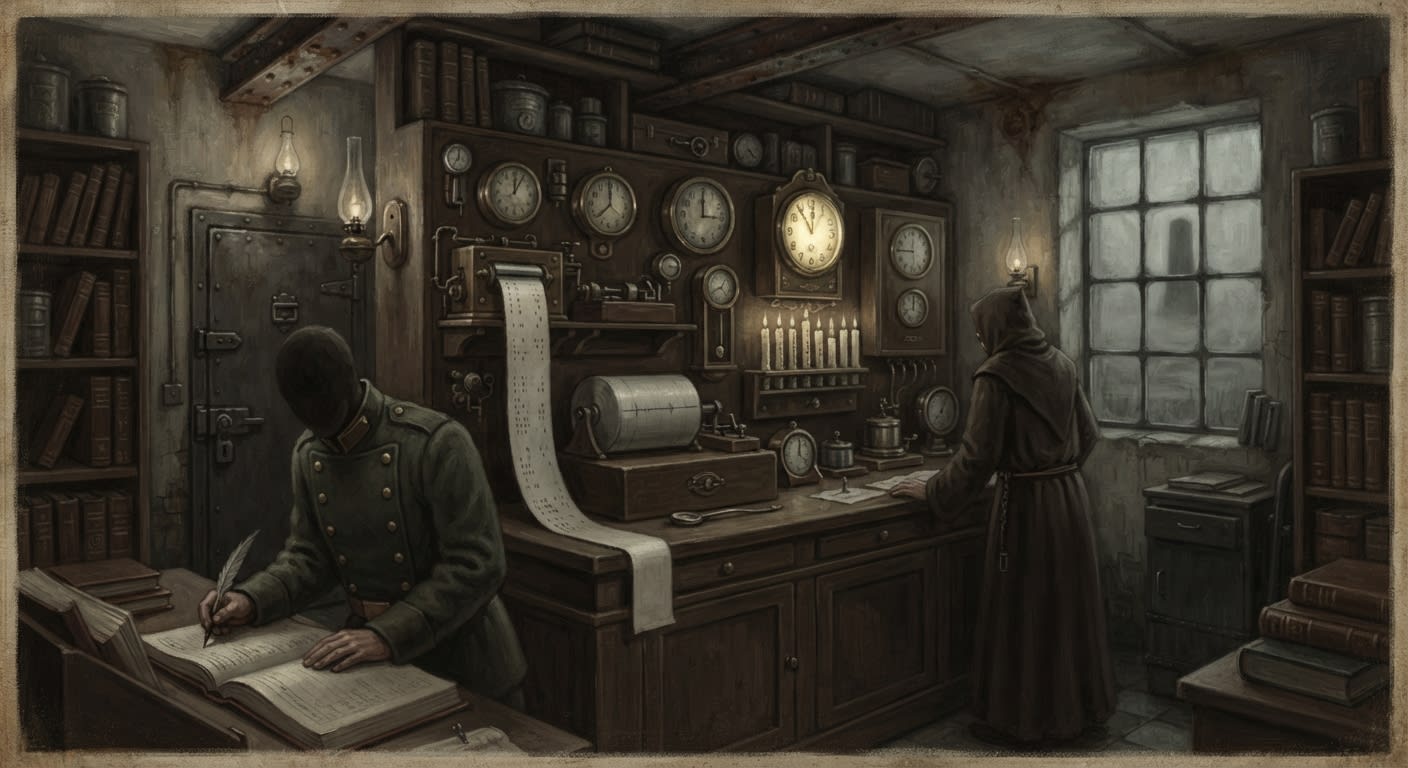
Anyone expecting a stalled clock will be disappointed, and a stalled clock would be a mercy. A stalled clock confesses. Station Two's master clock ticks straight through the interval without hesitation, and when the telegraph brings the bastion's time in afterwards, the station is exactly ninety seconds behind. No tick is missing. The telegraph tape shows even punch spacing, with no crowding or blank run where a clerk could put a pencil and say there. The candle-burn registers have burned to the line their own count demands, with no flare, gutter or wax anomaly. The water clock has dripped honestly and the spring chronometer has kept its oath.
Every instrument in the vault agrees with every other instrument in the vault. Together they disagree with the rest of Creation by a minute and a half.
Each morning at first bell the station is set back to the bastion's time, and each day it falls behind again by the same amount, at the same hour, in one clean interval. Vesk calls this the Skip. The registry calls it the long name printed above. The soldiers call it Vesk's missing minute and a half, and they are the only party to the dispute that has kept the arithmetic in its name.
Nobody at the post reports drowsiness, a lapse, or a sentence broken off and resumed. The men finish their words, the kettle finishes boiling, and the frogs finish their calls. By every sense a soldier owns, the day has been continuous. The station is ninety seconds short all the same, and the bastion's clocks, the Lyon-transmitted standard and the sun at noon sighting all agree on it.
#On Station Two's Witnesses
The post trusts no single witness. That is its entire method, and in a marsh where Syrion's fog leans on every window it is the only sensible one. The master clock is compared against the drag-gauges, resonance-bells, telegraph tickers, candle arrays, water clocks, spring chronometers, seismographs and breath counters. Unofficially it is also compared against the frogs.
Vesk has kept frog tables for years. The Phocis Marsh chorus falls into a doubled meter before strong readings: seven calls, a pause, eleven calls, a pause, then seven again. The pattern appears in no approved taxonomy and in none of her formal reports, because no Bureau in the Synod reads a report faster for finding amphibians in it.
Tick, the junior instrument-keeper, clicks his tongue in time with the chronometers and no longer reliably answers to his baptismal name. He reports a counter-rhythm under the instruments shortly before the Skip, faint and irregular, like a second heartbeat under the first. Publicly Vesk calls this auditory pareidolia. Privately she logs his pulse. Sergeant Hallin Creed, three tours by request, keeps the watch rota arranged so that no man stands the outer causeway alone at the relevant hour. He has not written down why, and nobody has asked him.
Commandant Gaius Tarvor distrusts the whole business. He suspects Vesk of unauthorised experiments along the Reed Road and cannot prove it, because every instrument she moves is properly requisitioned and every wax tag carries the right countermark. Her paperwork is immaculate, and at Shipka immaculate paperwork is treated as grounds for suspicion.
PUBLIC-COPY HANDLING INSTRUCTION — BUREAU OF DOCTRINE The hour of the Skip is removed from all public and instructional copies. Station bell of occurrence: ████████ Minute of onset by master clock: ██ Reason: to prevent the faithful from gathering at the relevant hour with watches, lanterns, dogs, children, pamphlets, and the confidence of amateurs. Supplementary: onset before A.S. 199 neither affirmed nor denied. Earlier Station Two ledgers held in annex pending ███████ review.
#On What It Is Not
The Hourglass knows the Enemy's time-crimes by their handwriting, and the Skip's hand is foreign to the whole file.
Syrionic deceleration thickens. It slows the filament, softens the hand on the rifle and makes rest feel like a sacrament the soldier has earned. Stillness Fields come as envelopes, with a centre, a gradient and a fog-lull you can map by the hour at which men start sitting down. Drag Corridors run along a line, eating routine while the walker keeps walking. Bell-lag shows as a bell answering late. The Minute Drift of the Queue Road is extraction, and extraction leaves a wound: bodies older than their papers, and ledgers fattened on time that belonged to someone.
Each of these conditions has a curve. The Skip has an edge.
The A.S. 194 Slumber-Hulk engagement is the obvious comparison and it does not hold. When the Slumber-Hulk came through the marsh, Vesk's drag-gauge flatlined for eleven minutes because time was not passing at the thing's centre. That reading came with the Hulk itself, chains and bulk and a stillness envelope, and it faded into measurable drag at distance. The Hulk had a body and a direction, and it gave the gunners something to shoot at. The Skip comes with no monster, no fog surge, no envelope and no gradient. It has a timetable.
Earlier Shipka sector digests referred to the Station Two anomaly as "a localised Syrionic delay" and, in one War Directorate precis, as "Minute Drift at Shipka."
Withdrawn. The Station Two phenomenon shows no deceleration curve and no extractive signature. Approved wording: non-taxonomic absence in local duration. The War Directorate precis has been recalled. Its author has been reminded that the Queue Road is one hundred and twelve miles long and does not reach the marsh.
In the ossuary depths of her notebooks Vesk has written that Syrion slows what he wants to keep. The Skip, whatever it is, takes its ninety seconds with the neatness of a clerk trimming a page to regulation margins. Doctrine requested that the word clerk be struck on grounds of institutional dignity, and the word stayed.
#On the Monolith's Blank Answer
Every serious drag-gauge on the Sagittal Line takes its final correction from the Lyon Hourglass Monolith, the black standard under the great clock hall. It should not be confused with Syrion's Hourglass Monolith, the hostile original, which has been sighted twice and measured never. The Lyon stone is how the Bureau of the Hourglass tells Syrion's heaviness from the Apparatus's theft, and a faulty instrument from a faithless hour.
After the A.S. 199 report, Vesk sent a comparison note to Lyon through Station Two's own line. Its contents are short. The Skip has no Monolith analogue. At the hour in question the Lyon baseline does not slow, speed up, reverse, thicken or answer in sympathy. It stays blank.
In the Hourglass, blankness is a result. The Monolith was built, or obtained, to measure how far time strays from obedience, and it can grade drift, excision and every shade of Syrionic sludge between them. It has no column for duration cleanly removed while the instruments that should have noticed stay content. The standard has no pigeonhole for the Skip, and the Bureau depends on that standard for every classification it makes.
Vesk's private hypothesis has to be pieced together from where she puts her instruments, since she has never been foolish enough to state it in front of me. It points downward: beneath the Shipka Marsh, below the old Phocian strata, below the drowned shrine, below the earliest ossuary-settlement levels. Either something down there removes ninety seconds from Station Two, or something down there receives ninety seconds sent from elsewhere. Extraction would imply appetite and delivery would imply correspondence. The Bureau has ruled on neither, and I record both only as her inference, inferred again by me from brass stakes and survey pegs.
#On Strasbourg's Queue
The report sits fourth in Strasbourg's queue. At the last inquiry it was still fourth.
Vesk has filed seven reports. One was acknowledged, one appended, one sent back for revised terminology and one misfiled under bell-metal reclassification. One went to a clerk whose desk later stopped being assigned to any corridor, and one went to Doctrine. The seventh she handed to a courier and watched him leave at the correct hour. He reached the bastion three hours late and swore he had stopped for no one. Records logged the delay as weather.
The queue is the real horror of the Skip, and it is a Synodal horror. A monster in the fog can be shot, and a stillness envelope can be sung against. An anomaly that behaves like a clerk has met the clerks, and the clerks recognise a colleague. Fourth place, held without movement for two years, is not neglect. Holding it is an administrative act, performed daily and on time.
The station still loses its ninety seconds. Creed still keeps men off the outer causeway at the hour. Tick still hears the second heartbeat, and Vesk still logs it. The frogs call seven, eleven, seven. Her request for a marsh excursion at the relevant hour, with instrument bearers, a Bellwarden, an engineer, two soldiers and one resonance stake for ground the marsh-folk avoid, has been neither granted nor denied.