
#On Ash Becoming Tender
Coins rust. Gold corrupts. Ash keeps. What keeps can be counted, and what can be counted belongs, under the oldest law of the Ledger, to whoever holds the scale.
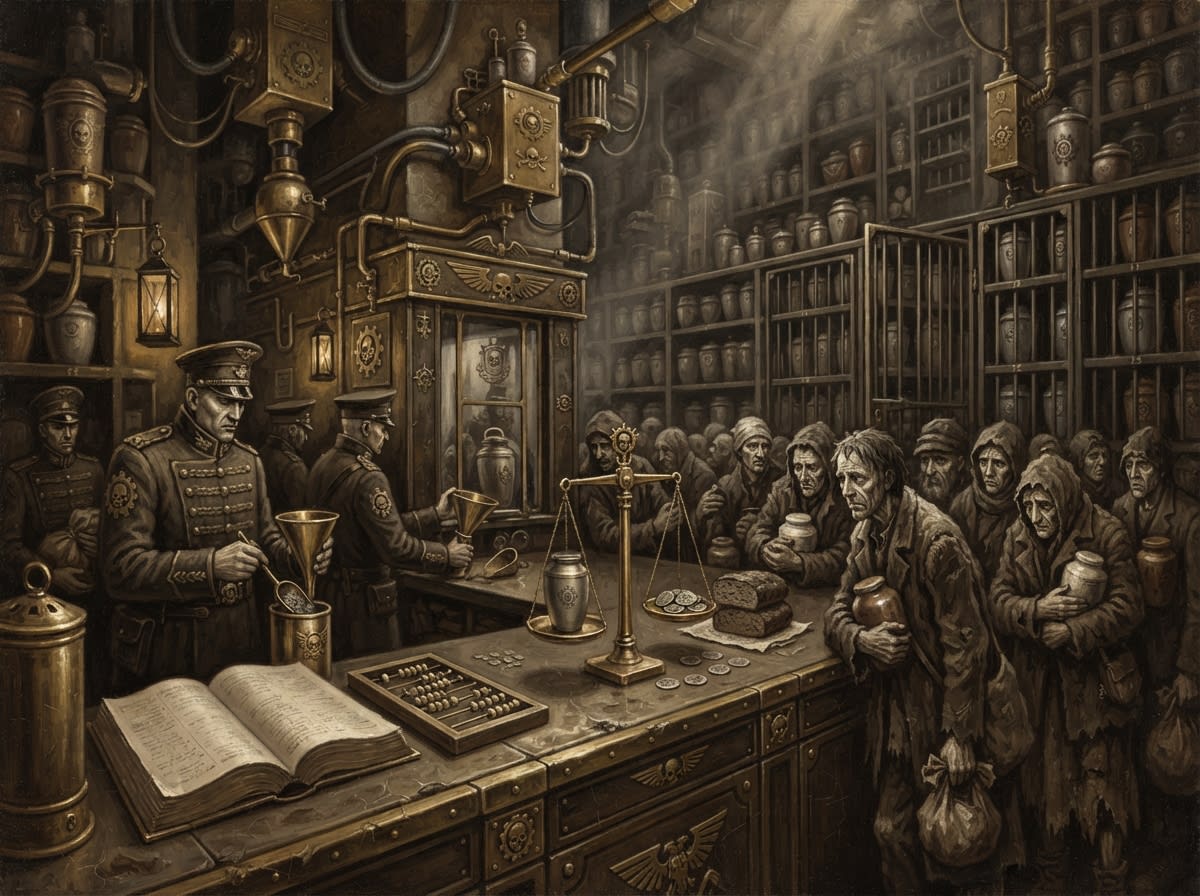
An Ash Bank is a house of deposit whose depositors are mostly dead. It takes in cremains, bone-dust, crematory sweepings and the pledged remains of people who are, inconveniently, still breathing. It pays out in what a hungry diocese can actually swallow: bread, salt, absolution tokens, ration priority, a season's grace on rent. Around that plain counter the Synod has raised a whole liturgy of instruments. The dust future is a contract on ash that does not exist yet. A family sells the eventual cremains of a grandmother, or of itself, for flour this week. The saint-share is a grace allotment redeemable in indulgence credit. Behind them come the ash security, the transfer writ and the vault certificate, walking like acolytes who carry the train and never ask whose train it is.
Nobody has settled who owns the stuff. The Bureau of Tithes holds that ash is coin. It has decreed dust futures lawful tender and adds, with the confidence of an office that has never gone hungry, that to pledge is to prove faith. The Bureau of Doctrine holds that ash is relic, because the body the Creator raises must presumably be located first. The Bureau of Purity holds that ash is evidence, and it is certainly evidence of something. The Bureau of Relics reserves the right to seize any deposit that glitters. The Bureau of Mercy has entered its dissent on the record in a sentence I reproduce here, because suppressing it would only give it glamour: "A corpse is not currency. Dust is grief, not coin."
No council has reconciled these positions, and none will. An Ash Bank works because every Bureau is right at a different window. The deposit clerk tells relic from collateral only when the form has a box for it. Tithes prints the forms.
#On the Cologne Vaults
Every city of consequence on the Rhine keeps ash. Cologne keeps it with conviction. The city is an archive-bank hive and the vault-finance throat of the Rhine Heartlands. Its cellars lie between the Cathedral of the Holy Column and the counting-tables of the Mint-Chapter, and its credit runs out across the river to Deutz and down the corridor to anyone with a seal. Confession, paper, guilt and dust are stored there in adjoining rooms, and the walls are left to sweat. The brass funnels of the confessor-kiosks and the brass scales of the ash counters are cast, I am told, at the same foundry. I have not asked for confirmation. Some procurement records are more useful unread.
The famous house is the Bank of Eternal Dust. It boasts that it has never defaulted. I have examined its books, and the boast is true. The books were built to make it true.
Twice the vaults of the Bank of Eternal Dust have collapsed under their own weight of bone-ash. Records supplies no years for either event, and I will not supply them for Records. Whole neighbourhoods vanished in the slides. Cremains came down through the stairwells and into the lanes like grain from a split silo, and the people in those lanes suffocated in the pledged remains of their own parish. The survivors came out pale and coughing, their lungs lined with the dust of strangers.
The Bureau of Purity declared them living reliquaries. The Bureau of Records filed them under Collateral. Both entries stand. A single coughing labourer may be both a holy vessel and a pledged asset at once, and Cologne sees no contradiction, because each office reads only its own column.
Early ward notices described the event as "vault collapse with loss of holdings."
Corrected per Bank memorandum and Records concurrence: Incident not collapse, but redistribution. No holdings were lost. Holdings were relocated to street level, and certain holdings to the interior of certain depositors. The Bank's record of never having defaulted is unaffected.
PURITY SCHEDULE — LIVING RELIQUARY, COLOGNE (SUPPLEMENTAL) Subject: survivor, vault slide, ward ████████ Pulmonary deposit: foreign cremains, provenance mixed, estimated ██ depositors Relic status: provisional; veneration discouraged pending Doctrine Collateral status: see Records cross-file ████████ Question referred upward: whether ash held in a living chest accrues interest to the Bank, to the dead, or to ████████████ Response: ████████████████████████
The city's street watch understands this better than its theologians. The Lantern Brotherhood patrols near the old vault stairs and learns which gratings breathe dust on damp nights. The Mercy Preachers know that a family queuing at an ash counter is a family ready to hear any voice that does not first ask for a weight. When the Schism of A.S. 178 entered Cologne's civic memory, it went into the same cabinet that already held the councils, the kiosks, the archive vaults and the Ash Banks. The Bank took no side in that quarrel. Banks of its calibre never do. They hold everyone's paper already.
#On Deposits, Withdrawals, and Pious Arithmetic
The procedure is simple, and that is the obscenity of it, which I decline to name as such. A family comes to a barred counter with an urn, a sack or a contract. The clerk sets the deposit on a brass balance. The relatives watch the needle and calculate in their heads whether grandfather becomes four loaves, a measure of salt, or a fortnight's delay on the levy. The clerk writes the figure. A second clerk seals it. The bread arrives from a side hatch still warm, which is considered good practice. Cold bread invites reflection.
Pre-pledging requires more ink. The living debtor signs for his own eventual ash, and his name enters the vault register with a blank where the date of delivery will go. Mothers pledge children. Children, once literate, pledge mothers. A man with nothing left to sell may pledge the ash of his future grandchildren, which the Bank accepts at a discount for uncertainty and a premium for enthusiasm.
Now for the no-default claim. A bank pays its liabilities in bread and holds as its assets the dead. While the Sagittal Line stands and the dioceses keep dying at their customary rate, such a bank cannot run short of assets. When a pledged debtor dies at the front, burns elsewhere or drowns in the Rhine, the ash never reaches the vault, and Records reclassifies the shortfall. It may become a contribution to the war. It may become a relic of the absent. It may become a debt transferred to the nearest relative who can hold a pen. A loss the Ledger may rename is not a loss. It is a heading.
Default is theologically impossible, and this is Doctrine's position as much as Tithes'. To default, the Bank would have to admit that the dead had failed to pay. The dead are, by Synodal definition, beyond failure.
#On Other Cities' Imitations
Cologne is the exemplar. It is not the only house.
In Rouen the Ash-Banks take deposits of bone-dust into vaults that smell always of lime and incense, and they pay out in bread, salt and absolution tokens. A rumour holds that one Rouen vault contains the cremains of an entire diocese, pledged in advance for a grain shipment that never arrived. Records denies the rumour. I note only that Records does not usually trouble to deny rumours about vaults that don't exist.
Rheinscarp has built its own temple of the trade, the Ash Exchange of Saint Pelagia. There saint-shares and dust futures change hands in a gallery of chalk air and cold incense, and brokers taste deposits on the tongue to verify them. The Exchange cites the Cologne collapses in its instruments as precedent for "vault slide risk," which is the first time I have seen a catastrophe entered as a clause. The dust-futures scandal of A.S. 199 belongs to Rheinscarp and its hunger waivers, and to no Cologne ledger. I record it here so that no clerk in either city tries to borrow the date.
Metz serves as the ash-credit node between them, trading dust futures and relic-particulate disputes along the river. In Metz a man may mortgage his grandmother's dust. In Ghent, by attested practice, a woman may pre-sell the ash of her infant, with the contract notarised before the first cry. In Mainz a Bishop-Praetorial once defaulted on his own ash-credit, and his creditors exhumed his parents to collect. The corpses were burned in the square, and the ashes were bagged in sacks stamped with the Synod seal. Far to the salvage end of the trade, the Lime Yards of Marrowgate render unclaimed remains into bone-lime, road powder and more ash-credit, which reaches the banks by cart without a family at the counter to watch the needle.
#On Present Custody
As of A.S. 201, the Bank of Eternal Dust is open, solvent, watched and indispensable. Tithes audits its reserves. Purity keeps a schedule of living reliquaries and examines their coughing at intervals. Doctrine has not ruled whether a relic can bear interest, and it does not intend to rule while the bread keeps rising. Relics waits by the gold-fleck counter. Records files the whole arrangement across four registers that do not agree, which is how Records knows it has been filed correctly. Mercy keeps its dissent on the record and its preachers at the queue.
The families keep coming. The vault registers are long. Somewhere beneath the city, under floors that have given way twice, the dust of whole parishes lies pledged, weighed and sealed, waiting for the next depositor.