
#On the Prayer That Makes Mud Speak
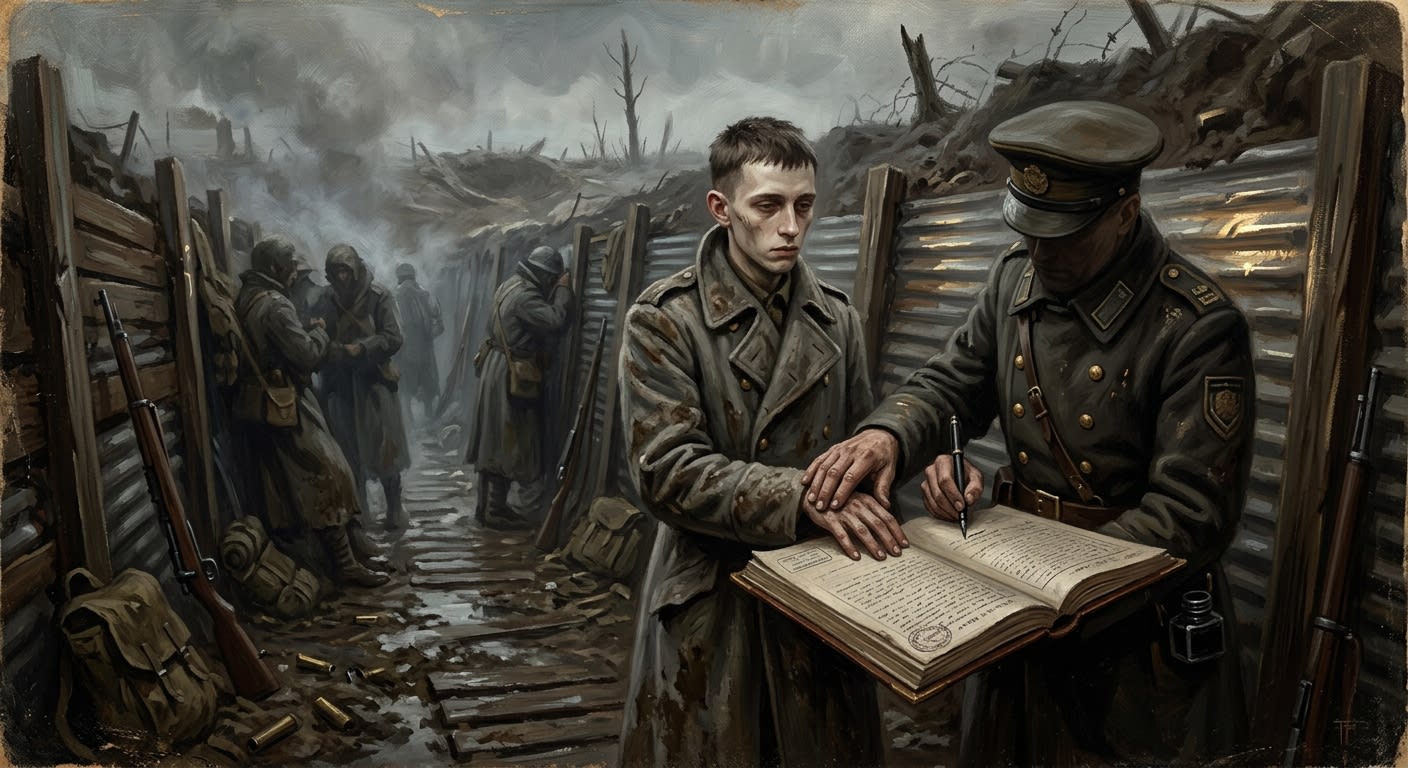
The Litany of First Earth is the War Bureau’s approved field-prayer for the Baptism of Mud, read while the recruit stands chest-deep in a flooded trench and discovers that theology, like cold water, enters through every seam. It is short by cathedral standards, cruel by parish standards, and perfect by mine. A good state prayer should do three things before the boy has time to think: rename him, transfer him, and leave a stain.
The public hears the pretty version. Earth receives the faithful son. War receives the willing hand. Doctrine receives the obedient answer. The boy rises a soldier of the Faith, caked in sacramental mud, forbidden to wash for three days while the grey crust dries on his skin like a second oath. Mothers are encouraged to find comfort in this. Mothers have always been encouraged toward improbable disciplines.
The true function is cleaner. The Litany marks legal transfer from household to War custody. The recruit enters the trench as quota flesh under Conscription processing and emerges as Line-matter under War authority. The mud is sacrament, receipt, tendency test, humiliation, and field-condition rehearsal. It clings to the elbows, cracks at the knees, dries beneath the nails, and gives instructors three days to study how a boy carries discomfort before rifles, shells, hunger, and demons are allowed to improve the lesson.
A prayer of four lines would seem too small for the work. This is because the reader, adorable creature, mistakes length for authority. The Synod does not require many words to change a life. It requires the right witness, the right seal, the right agency standing by with a dry form.
#On the Older Mud and the Later Seal
The Litany’s official seal belongs to the War Catechism issued after the Charter of Crimson Ink in A.S. 105, when the Bureau of War began the laborious work of making military necessity sound as if Providence had requested it in writing. War claims authorship. Conscription claims custody. Doctrine claims meaning. Records claims the earliest clean copy. The chaplains claim the voice. Nobody claims the rash.
The problem, naturally, is A.S. 71.
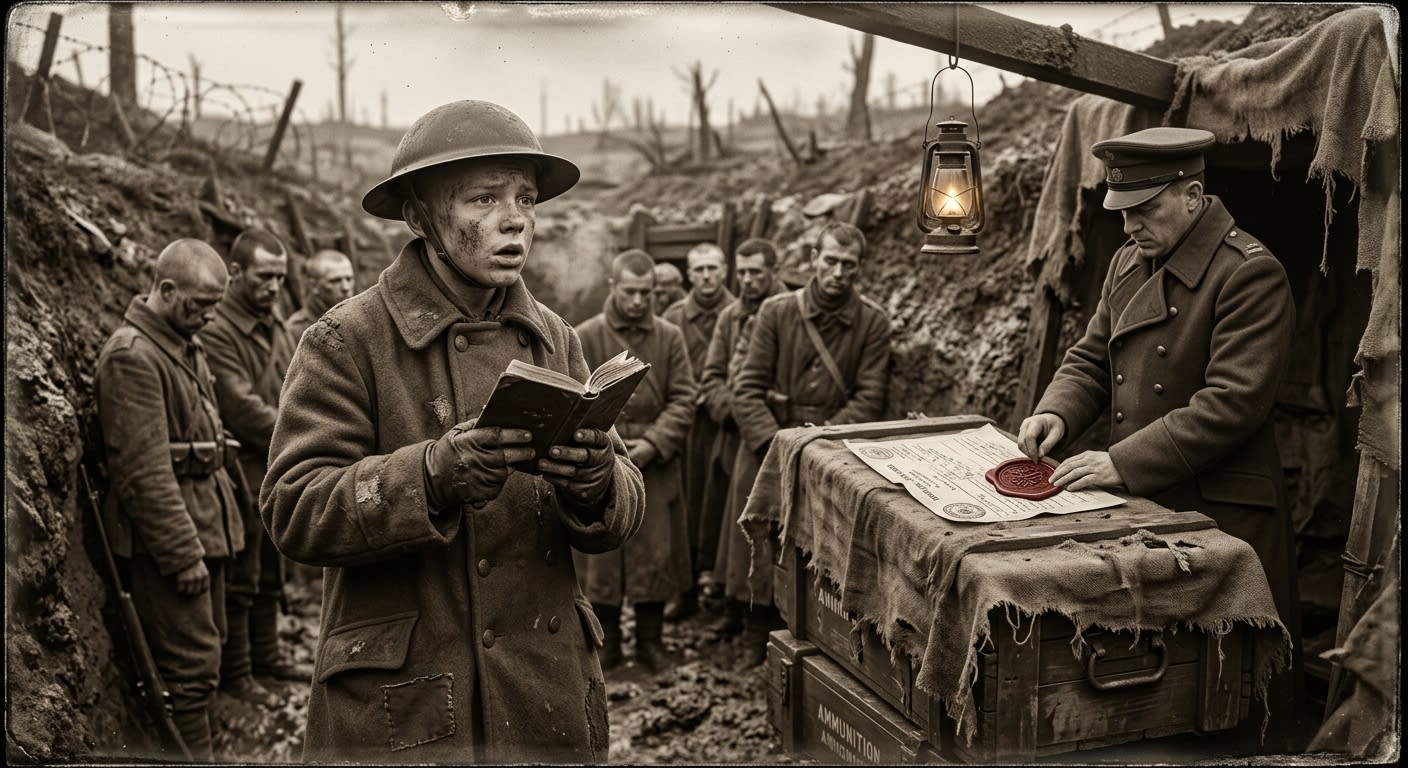
During the Undertide breach beneath the coastal works, a Tribune-Chaplain recited what later files call the Litany of First Earth and received, in answer, the voice of his own dead mother asking why he had buried her facing east. The Bureau of War did not yet exist in its A.S. 105 form. The formal Tribune-Chaplain rank had not yet acquired its later chain of certification. The prayer, by strict chronology, should have been impossible.
Chronology is a clerk’s attempt to discipline embarrassment.
Early War manuals state that the Litany of First Earth was composed in A.S. 105 and first used in the catechism-barracks at Metz.
Clarified. The A.S. 105 text is the first sealed War recension. Earlier trench-prayers, mud adjurations, grave-earth vows, and coastal emergency formulae are now recognised as anticipatory forms of the same authorised prayer. History did not contradict War. It arrived early and waited to be stamped.
The pre-seal forms were rougher. Soldiers in the Great Retreat pressed palms into mud before watch change and muttered earth to bone, bone to trench, trench to the Creator. Grave diggers at forward pits used a burial answer: first earth below, last earth above. Coastal chaplains facing wet anomalies invoked dry ground as a jealous saint. Peasant recruits brought field blessings from farms, where soil meant harvest, burial, boundary, inheritance, and the place under a father’s boots when he refused to sell. War took these scraps, scraped off locality, boiled them in Doctrine, and ladled out a rite safe enough to repeat.
By A.S. 112, when the Bureau of Conscription was constituted to tame the chaos of compulsory offering, the Litany had become inseparable from levy transfer. Mustering fields could stamp wrists. Barracks could shave heads. Instructors could shout until their throats bled in useful rhythm. The trench did the work none of these could manage alone. It made the boy feel the earth claim him before War did.
#On the Words and Their Authorized Weight
The full barracks form contains twenty-seven responses. Most recruits remember four. This is sufficient. The body learns through repetition, pain, cold, and the blunt pedagogy of being held in place by two older boys who have already survived the rite and have acquired, with touching speed, the moral ugliness of the initiated.
The opening invocation names the earth as First Witness. This is doctrinally delicate. The Synod does not worship soil; it uses soil as a witness to divine possession. Soil has advantages. It is present at birth, labour, burial, trenching, latrine digging, and most forms of military disappointment. It receives secrets without asking for jurisdiction. It covers mistakes. It remembers boots. A priest may lie, a clerk may lose a page, a mother may forgive, a corpse may become administratively inconvenient. Earth remains.
The First Witness clause has survived six revisions because no Bureau has found a safer substitute. Water belongs to Passage, Orison, Medicine, and coastal terror. Fire belongs to Engines, Rites, and lunatics with incense. Air belongs to Bells until it misbehaves, at which point everyone denies custody. Earth is dull enough to govern. Dullness is a sacramental virtue in statecraft.
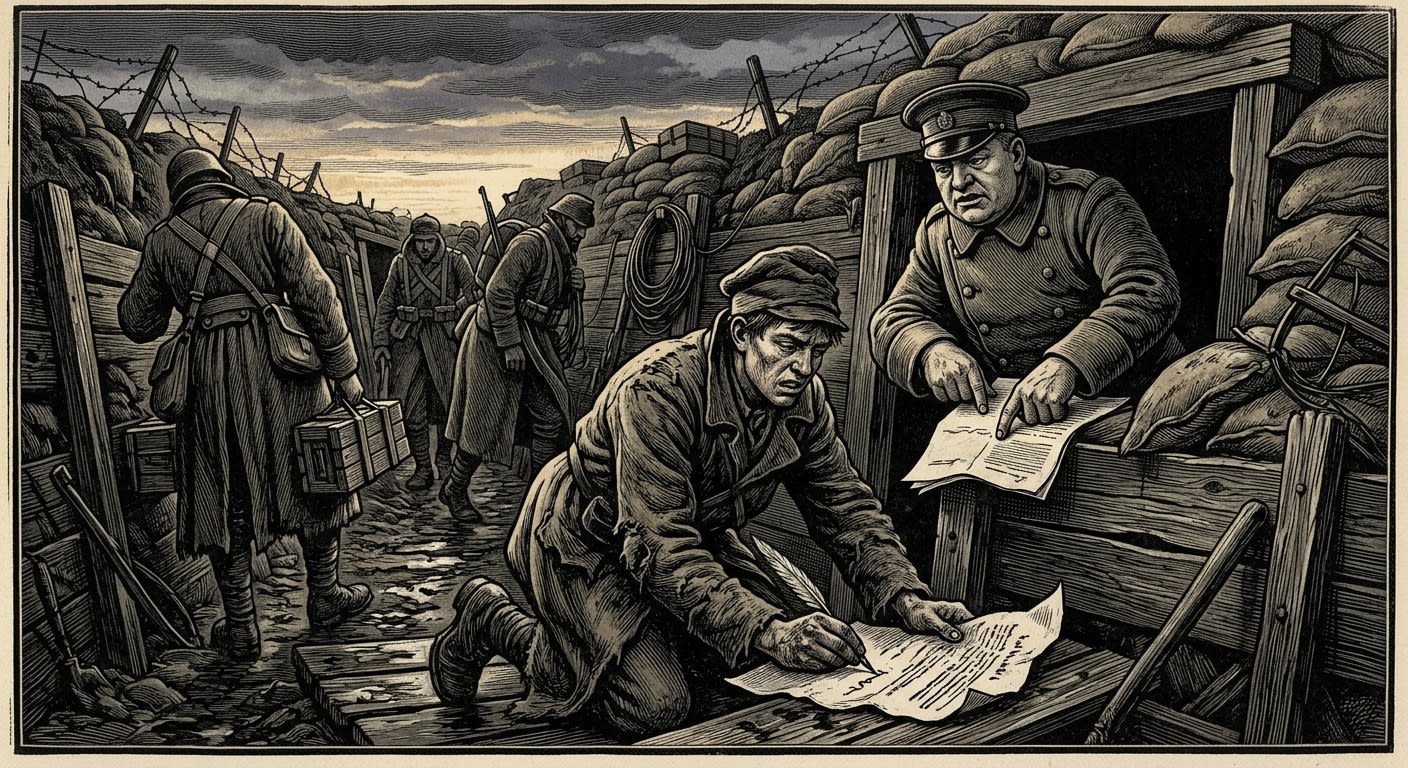
The second movement strips the household. The recruit speaks his family name once. The Tribune-Chaplain speaks his assignment number twice. The clerk records the assignment number in darker ink. The family name is not erased; erasure belongs to Purity and the Index. The family name is subordinated. A subtler cruelty. It remains available for grief, inheritance disputes, and letters home already corrected for morale, while the number does the marching.
Old household forms once allowed the mother to answer after the name. This mercy was removed after three districts developed call-and-response delays, sobbing clusters, and one technically correct argument over whether the mother’s answer completed the transfer or contested it. The Bureau settled the question by deleting the mother’s line. Clean law often begins as impatience.
The third movement teaches the mud to answer for the boy. He is told to lower his hands. He is told to face east if the trench allows it, and toward the training standard if Engineering has placed the trench stupidly, which Engineering often has. He repeats the pledge: I enter as flesh; I rise as answer. Boys with teeth chattering through the line are marked for voice discipline. Boys who shout it too eagerly are marked for Glory risk. Boys who whisper are marked for Purity curiosity. The correct tone is chilled obedience.
The final response belongs to the chaplain alone: Rise corrected. The assistants lift the recruit or release him. Practice varies by garrison, and garrison variation is the mildew that grows in every manual. Metz favours a sudden pull, because Metz mistakes drama for depth. Stuttgart makes the recruit climb out under his own strength while evaluators count hand placement, shiver rhythm, westward glances, and whether he spits mud before the dismissal bell. Lyon trains the response in choral tone. Brast times it to furnace cadence. Essen-of-Hymnsteel makes the crust sing faintly when dry, an effect officially denied and privately admired.
#On the Baptismal Trench
A proper Litany requires a proper trench. The public imagines a picturesque ditch lined with moral symbolism. The actual trench is a rectangular pit with plank sides, drainage valves, step boards, silt baskets, clay reserve, ash measure, witness gallery, infirmary table, and a clerk’s awning placed where rain can ruin the fewest documents. The mud is prepared, not found. Found mud has opinions. Prepared mud has custody.
The standard mixture is local earth, water drawn under municipal seal, ash from approved devotional burnings, and a small measure of Line-soil kept in locked jars by the garrison quartermaster. The Line-soil matters. A recruit in Metz or Stuttgart may never have seen the Sagittal Line, but the Line has been added to his trench by spoon. This is the sort of symbolism War understands because it can be requisitioned.
A Bureau of War broadsheet described baptismal mud as “natural earth received from the recruit’s own province.”
Withdrawn after Stuttgart, Brast, and the Citadel of Lyon were caught bulking their trenches with ash from rejected petition bundles, road sweepings, and in one memorable quarter, powdered brick from a condemned chapel. The approved term is now “jurisdictionally representative earth.” One hears the shovel scraping beneath the adjective.
The mud must be deep enough to reach the chest of an average recruit and adjustable for boys whose families have had the poor taste to produce either runts or giants. Too shallow, and the rite looks comic. Too deep, and the infirmary table becomes busy before the sacrament has produced paperwork. The ideal depth touches the lower ribs and makes breath a negotiated privilege.
The trench is cleaned weekly in theory. In practice, it is corrected, stirred, blessed, topped, drained, and sworn at. Mud that has received too many recruits develops a sour smell, a grey skin, and what Stuttgart physicians delicately call “devotional bloom.” War dislikes medical adjectives. Medicine dislikes trench fever. The mud remains.
The three-day crust is inspected after the rite. Clean hands suggest illicit washing. Cracking at the elbows suggests poor kit carriage. Flaking at the knees suggests unauthorized kneeling, prayer, panic, or incompetence with bedrolls. Instructors pretend these distinctions are clear. The recruit learns that his skin has become a document. This lesson will serve him when blood, ash, frost, and alien saliva later acquire reporting categories.
#On the Tribune-Chaplain’s Burden
The Litany belongs to the Tribune-Chaplain because ordinary priests are too tender and ordinary officers too secular. The office exists at the exact point where prayer becomes command. During the Baptism, the chaplain must read as boys tremble, fathers shout at the rail, mothers collapse with regulated timing, clerks mishear names, assistants lose grip, rain enters the book, and one recruit in every cohort attempts to bargain with the Creator after the water has already reached his sternum.
The chaplain’s voice must be paternal cruelty with a funeral undertone. Too soft, and the trench becomes pity. Too loud, and the rite becomes punishment before transfer completes. Too beautiful, and the recruits remember they are listening. Beauty is dangerous in military contexts. It gives terror a balcony.
This final instruction has been debated by Mercy. War retained it. Doctrine blessed it. Conscription translated it into a processing note. A half-read Litany produces an ambiguous transfer status, and ambiguity is intolerable where bodies are concerned. A dead recruit before completion creates household refund petitions, quota adjustment, replacement disputes, and chaplain review. A dead recruit after completion creates a soldier casualty. Cleaner. Sadder, if one insists on being personal.
The chaplain watches more than he reads. Which hand clutches the trench board. Whether the boy looks west toward home before emerging. Whether he prays to a local saint before the authorised response. Whether he laughs. Laughter in the trench is never ignored. It can mean bravado, hysteria, demonic pressure, contempt, or a boy whose mind has found a trapdoor. All five are assignment data.
The chaplain’s marginal marks travel with the recruit. Fit-Primary. Voice-stable. West glance. Mud refusal suppressed. Maternal attachment high. Glory risk. Silence risk. Good lungs. Poor teeth. Strong hands. Soft oath. Each phrase becomes a route east, a company, a trench, a task. The recruit believes the Litany made him a soldier. It did. It also made him legible.
#On Regional Spoilage
All great catechism-barracks perform the Litany. None performs it innocently. Regional character survives even when beaten with a War manual. The Synod can standardise words faster than accents, and accents are little rebellions lodged behind the teeth.
The authorised table permits variation only in trench depth, witness placement, ash proportion, response cadence, and emergency abbreviation. This is called standardisation because the same paragraph appears on every form. Everything else changes by province: clay colour, plank height, instructor cruelty, mother-gallery distance, drainage quality, chaplain vanity, and the local meaning of silence. Strasbourg does not mind local misery. It minds local vocabulary for misery.
Metz uses rainwater when it can, collected from drill chapel gutters into zinc tubs. Its chaplains are theatrical. They pause before Rise corrected long enough for the recruit to think the pause is mercy. It is timing. Metz produces boys who expect mud to announce itself with grandeur. Some survive the disappointment.
The Metz trench is famous for its west-gallery. Families stand behind a grated rail with enough visibility to wound and too much distance to help. A boy who turns his head before the First Witness response earns a chalk dash beside his name. A boy who refuses to turn earns a different dash. The genius of assessment is that every gesture can be made guilty once the columns have been printed.
Stuttgart’s baptismal trench is lined with river clay carted in under seal and mixed, despite public denial, with ash from rejected petition bundles. Stuttgart counts everything: seconds submerged, shiver interruption, westward glance, hand choice, post-emergence silence, crust retention, illicit washing probability. It has turned the Litany into an arithmetic of cold. I dislike Stuttgart’s aesthetic. I admire its knives.
Lyon trains the response as a civic chorus. Recruits rise by rows and answer together, producing a wet antiphon that pleases Orison observers and alarms any soldier with sense. Group piety hides individual terror; individual terror is often the useful part. Lyon has never understood this. Lyon prefers spectacle. Lyon has been corrected before and will, Providence willing, be corrected again.
The Citadel choir-masters insist the row response strengthens mutual obedience. Field sergeants insist it teaches boys to wait for neighbours before speaking under fire. Both parties have written memoranda. The memoranda are stored in separate cabinets, proving again that the Synod’s finest peacemaking instrument is furniture.
At Brast, furnace ash darkens the mud until recruits emerge almost black from chin to boot. The heat from the yards dries the crust too quickly, producing cracks the instructors read as spiritual weakness unless Medicine has shouted recently enough to be remembered. Essen-of-Hymnsteel uses cadence boards beneath the trench steps so each emergence strikes a hollow note. War calls this morale architecture. The boys call it the coffin drum.
Temporary camps are worse because they imitate authority with poor materials. A ditch beside a rail siding, two planks, one hoarse chaplain, three buckets of approved earth, and a clerk crouched under a wagon tarp can produce a valid Litany if the transfer sheet survives. The sheet is the tender organ. Men may cough, faint, or drown by inches; the sheet must stay dry.
STUTTGART MUD-TRENCH ASSESSMENT ANNEX, A.S. 185 Correlation: recruits who look west during emergence show ███ percent higher desertion ideation by second deployment. Countermeasure: rotate emergence board eastward; place mother-witness gallery behind recruit; prohibit audible weeping after third bell. Result: desertion ideation reduced; maternal collapse increased; acceptable.
Field versions are uglier. At Bastion-Brest, a shell crater with plank reinforcement may serve. At Shipka, time-fog has forced chaplains to repeat the same line three times for recruits who emerge remembering none of them. At Przemyśl, Pride pressure has produced boys who answer in voices finer than their own. Such boys are slapped before the final response, a crude method with excellent results. At Irongate, the mud sometimes hums through the ribs. Nobody writes that in the public manuals.
The southern anchor uses salt contamination protocols after every rain. Constantinople’s trenches dislike staying merely muddy. They acquire brine, soot, brick powder, grave dust, and the little glittering flakes that Engineering says are mica when officers are present. Recruits emerge smelling faintly of harbour chains. War calls this regional imprint. The Line calls it warning.
#On the Undertide Answer
The Undertide incident remains the Litany’s strangest credential. A prayer built on earth was answered by the sea. That should offend every tidy theologian; several have already entered productive silence.
In A.S. 71, when the coastal caves broke and drowned things moved through lantern-light, the chaplain’s recitation did not repel the entities. Let War stop pretending otherwise in officers’ dinners. The Litany held the men. That is different work. The voice of the dead mother rose from the water and asked its vile little question. The chaplain continued. His men continued listening to him rather than to the sea. For eleven hours in a throat, that was victory enough to earn later doctrine.
Doctrine later used the incident to widen the Litany’s claim. First Earth was no longer merely soil. It became the created ground beneath all hostile elements: mud under trench water, seabed under black brine, grave-clay under ossuary stone, ash under furnace slag. This was theologically ambitious and administratively convenient. A prayer that functions in mud can be assigned to barracks. A prayer that claims the ground beneath water can be assigned to coastal anomalies. Budgets love expansion dressed as metaphysics.
The Undertide also taught War the danger of maternal voices. Later training forbids chaplains to pause when recruits hear family speech from the trench, the boards, the mud, the drain, or the man beside them. Most such reports are hysteria. Some are hazing. Some are real enough to make the censor’s ink run thick. The response is the same: finish the line.
A recruit who answers the false voice before the chaplain is marked Echo-Susceptible. A recruit who weeps without answering is marked Familial Softness. A recruit who laughs is separated. Laughter at family-voice contact has preceded three documented barracks incidents, two sealed transfers, and one minor miracle that War accepted only after Doctrine removed the word minor.
The Litany does not comfort. It fixes direction. It tells the recruit that whatever speaks from below him is not his mother, not his village, not the little private god of his childhood field. Below him is First Earth under seal. Above him is War. Between the two stands his body, briefly his own, already being transferred.
Coastal commanders learned to anchor the Litany with heel pressure. Men were ordered to press both boots into the plank before the First Witness response, so the body could feel a downward claim while the water argued upward. Divers later adapted the practice by touching seabed silt before entering cave-mouths. Orison objected to unauthorised tactile liturgy. The divers asked whether Orison wished to perform the next dive. Orison withdrew the memorandum.
#On Present Use and Small Heresies
As of A.S. 201, the Litany of First Earth is recited at every major levy garrison, most temporary catechism-barracks, several field hospitals with poor boundary discipline, and at least four coastal installations whose commanders deny using an infantry mud rite against marine anomalies while requesting fresh copies of the field abbreviation. Denial, properly stamped, is a form of requisition.
The rite has followed the Levy into places where mud must be manufactured at absurd expense. Mountain posts melt snow into clay powder. Desert detachments mix ration water with imported Line-soil while quartermasters make noises like wounded saints. Shipboard chaplains keep shallow boxes of black earth for emergency transfer at sea, a practice the Bureau of Orison dislikes because waves ruin cadence and sailors add profanity to responses with admirable timing.
Small heresies cling to the rite. Mothers whisper local saints’ names as the boys enter. Fathers press home soil into cuffs before mustering, hoping their own fields will speak louder than War’s clay. Recruits swallow mud to keep part of the rite inside them; this is discouraged by Medicine, punished by instructors, and tolerated by older soldiers who have swallowed worse. Some chaplains add a private fifth line for boys they pity. Pity is audible. Auditors listen.
The commonest illicit addition is remember the house. It appears in Swabian, French, Low German, Dalmatian, and two trench pidgins Records pretends are not languages. The line is harmless until it is not. A soldier who remembers the house may defend it more fiercely in letters than in trenches. A soldier who forgets the house too thoroughly becomes hard to discipline with promises of return. The state wants memory salted, dried, and portioned. Families keep serving it raw.
Conscription loves the Litany because it completes transfer. War loves it because it teaches discomfort with witnesses. Doctrine loves it because it converts coercion into sacrament. Records loves it because the rite produces clear timings. Mercy dislikes the rash. Purity dislikes the local additions. Orison dislikes the regional accents. The rite endures because every Bureau finds enough of itself in the mud to tolerate the smell.
Veterans carry the sound differently. Some recite the four-line field abbreviation before sleep. Some spit after the word earth. Some scrape dried mud from old kit seams into envelopes and mail it home as relic, joke, apology, or evidence. Widows have brought such envelopes to parish offices demanding proof that the enclosed dirt was, in fact, the last lawful remainder of a son. Parish clerks hate this question. It is small, brown, and impossible to stamp honestly.
A household consolation pamphlet states that the Litany “returns the son to the earth from which all faithful households draw strength.”
Corrected in internal use. The Litany removes the son from the household and loans his body to War until death, disability, or clerical miracle. The pamphlet remains approved. Households require lies of a softer grade than soldiers.
At dusk in Stuttgart, the trench is raked smooth for the next cohort. The ash measure is locked. The Line-soil jar is returned to its cupboard. A clerk hangs wet transfer sheets under the awning and curses quietly when the ink feathers. Beyond the Western Rail, families wait for trains they cannot delay. In the barracks, boys lie awake beneath drying mud, trying not to scratch, trying not to shiver, trying not to remember the exact sound of the chaplain saying rise.
By morning the crust will crack at elbows and knees. Instructors will read the cracks. Clerks will copy the readings. Trains will take the boys east. The trench will receive the next row and keep no names, only depth, chill, custody, and assignment by bell and stamp.