
#On the Book That Counts Salt and Souls
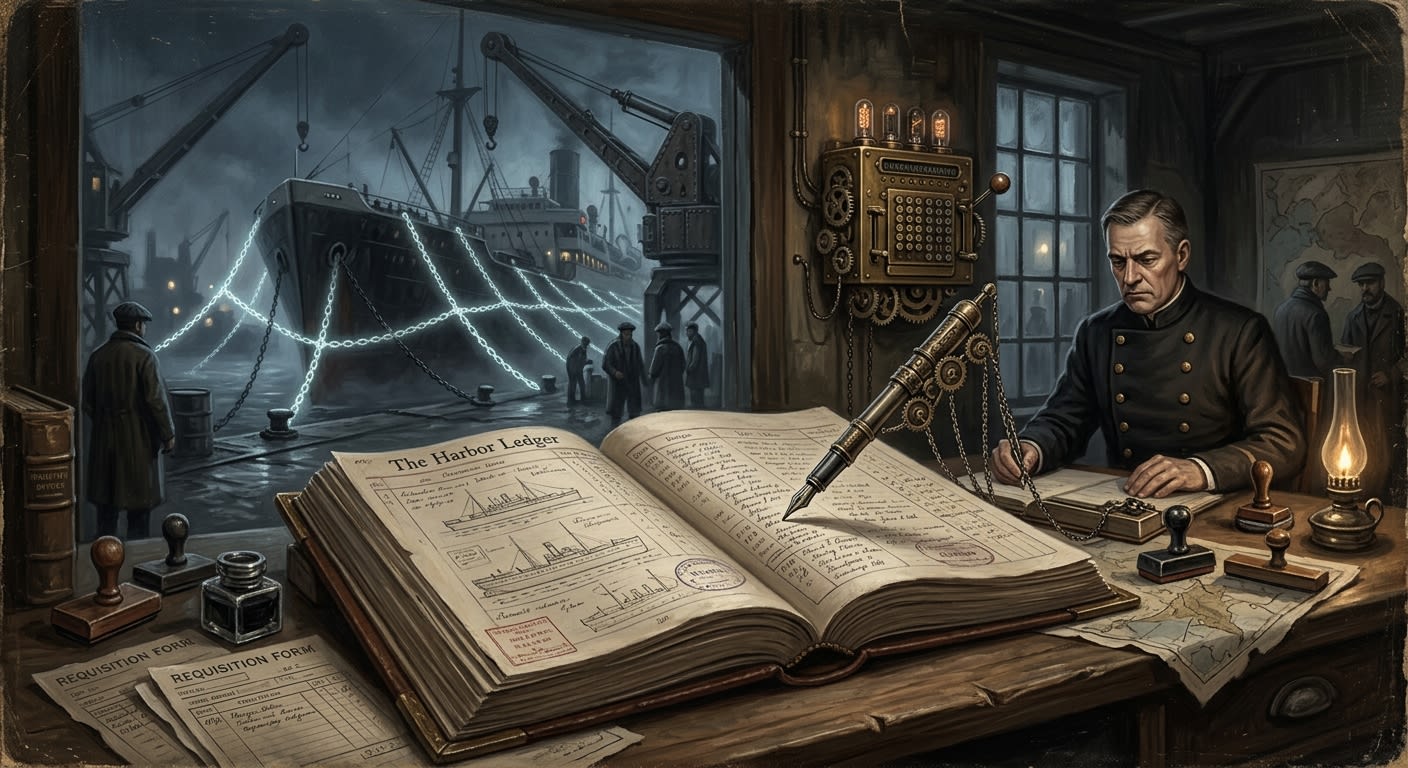
The Harbor Ledger of Thessaloniki is the Synod's coastal sacrament of admission: a book, a procedure, a threat, a superstition with ruled columns, and the instrument by which the city teaches every arriving vessel that water may carry a ship, but paper grants it permission to have arrived.
No ship passes beneath the Harbor-Chain Towers without entering the Ledger. No cargo touches the Chainward Quays without a manifest line. No sailor sleeps legally within the walls without an arrival confession receipt. No corpse leaves by sea without a death seal, a cargo amendment, and a second notation for the water, because Thessaloniki, unlike gentler cities, has learned that the sea dislikes being omitted from correspondence.
The Ledger began as a harbor register and became theology because every efficient cruelty eventually finds a cassock. The Bureau of Records owns the office. The Bureau of Rites blesses the passage phrases. The Bureau of Bells certifies the chain-window peals. The Bureau of Tithes reads the cargo totals with the wet-eyed hunger of a saint before relics. The Bureau of Purity watches for contraband, wrong hymns, blank vellum, demon-glass fragments, unstamped refugees, and any person whose face suggests unfiled intention.
The Harbor Ledger is, at its pious center, a bargain. The city agrees to recognize that a ship has entered. The crew agrees to be counted. The cargo agrees, through the mouths of men who rarely understand the seriousness of what they sign, to become taxable, searchable, blessed, held, delayed, redirected, impounded, or transferred to a file marked lost. The sea agrees to nothing. This has caused difficulties.
#On the Origins of Passage Accounting
Thessaloniki was a port before the Synod owned the alphabet of its fear. Greeks, Romans, merchants, fishermen, raiders, priests, and the usual assortment of maritime liars used the inlet because geography, unlike doctrine, has the vulgar habit of being useful before it is approved. After the Sundering in A.S. 45, the coast became less hospitable. Things came from the water wearing borrowed faces. Ships arrived with too many crewmen. Cargoes smelled of salt inside sealed crates. The old harbor continued to operate because hunger has never accepted theological purity as substitute for grain.
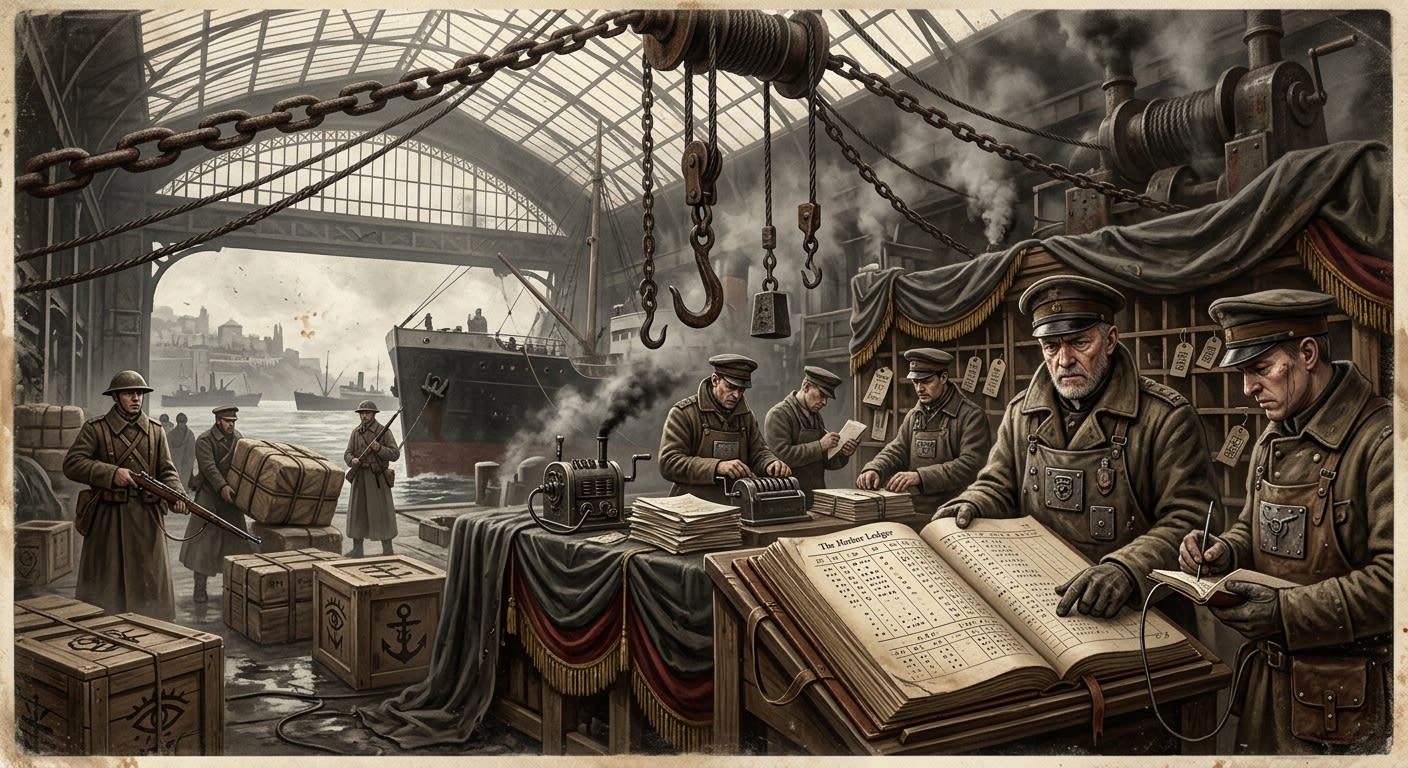
The first registers were practical: hull name, master, cargo, port of origin, dock fee, damage, deaths, quarrels. Then came chainwork. Rope became forged iron. Iron became reliquary iron. Reliquary iron became psalm-inlaid authority. By A.S. 72, the Harbor-Chain charter had been ratified. By A.S. 93, it had been re-ratified because the original, in the finest tradition of divine administration, had been signed in invisible ink.
The Ledger changed at that point. A ship passing beneath psalm-inscribed links no longer merely arrived. It performed entry before the Creator, Records, Bells, Rites, Tithes, Purity, and whatever listens below the catenary arcs. Every passage made the chains hum. Every hum became evidence. Clerks tried to record the hum in marks. Chainwrights tried to describe it in tension language. Bells tried to assign it a note. Rites tried to bless it without admitting it frightened them. Records made columns.
The first true Harbor Ledger, the one later offices claim as ancestor, dates from the post-charter consolidation. It introduced the triad still in use: Hull, Soul, Substance. Hull records the vessel, chain-window, pilot, docking right, damage, and departure permission. Soul records the master, crew, passengers, arrival confessions, sponsor seals, missing persons, births aboard, deaths aboard, and names whose status displeases the clerk. Substance records cargo, tithe class, quarantine risk, relic claim, contraband suspicion, and port-loss amendment.
Hull, Soul, Substance. Three columns dressed as three books. The theological elegance was accidental and immediately exploited.
#On the Threefold Entry
A legal arrival at Thessaloniki begins before the ship touches the quay. The vessel waits beyond the chain-mouth for a bell-window. The Pilot presents a passage phrase. The Tower answers. The chains are lowered or slackened according to tide, tension, inspection schedule, and the Chainmaster's mood, which is written nowhere and obeyed everywhere. As the hull passes beneath, the links hum. A clerk on the quay marks the time. A bellwarden marks the tone. A chainwright marks the strain. A pilot pretends not to hear whatever note threaded through the psalm and addressed him by childhood name.
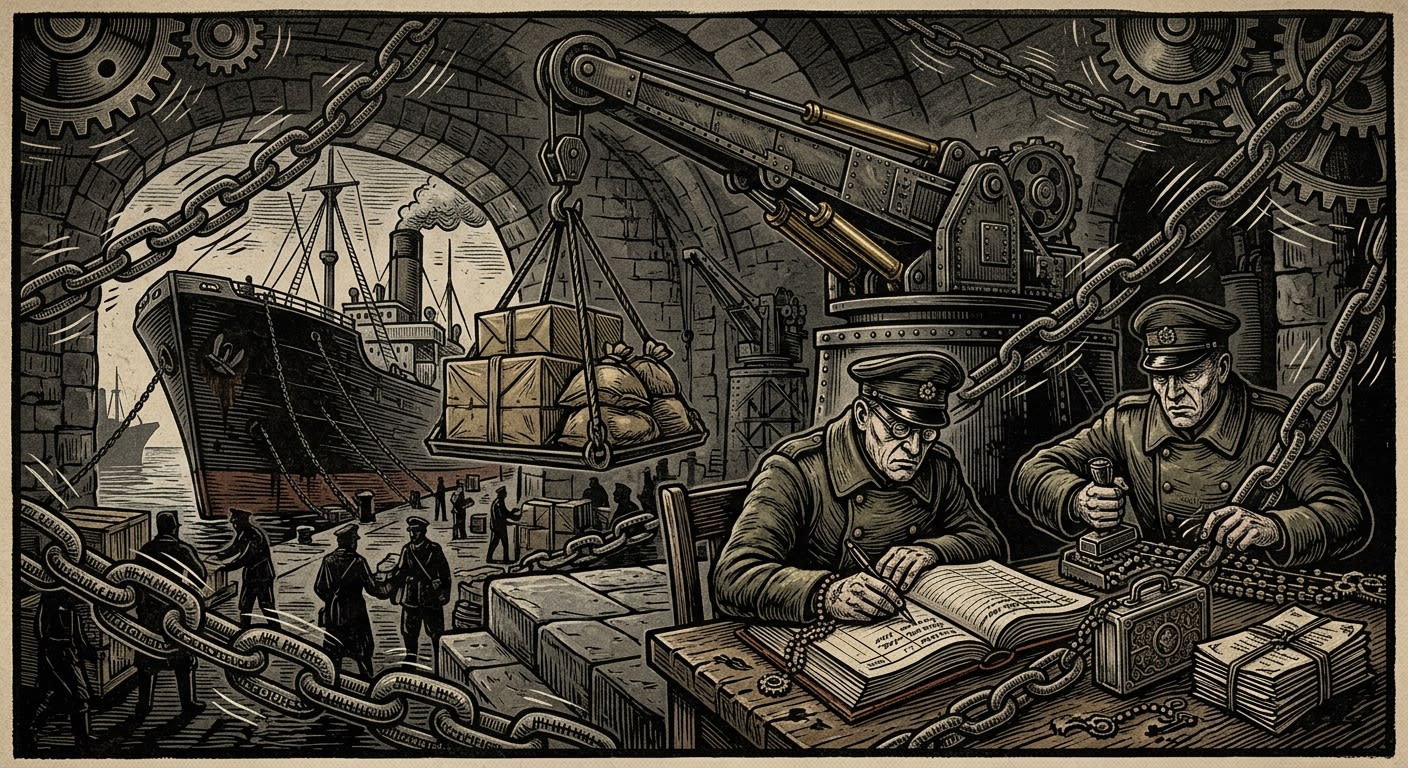
At the first window, the Hull entry is opened. At the second, the Soul sheets begin. Crewmen line before arrival confession booths built into the quay wall, where a priest hears the compressed sins of men who would rather drink, sleep, spit, or die. Confession receipts are tied to manifest lines. A sailor without receipt cannot receive a berth. A passenger without receipt cannot claim a sponsor. A corpse without receipt becomes cargo unless someone pays to make grief legally articulate.
Substance follows with slower malice. Crates are sounded, weighed, sniffed, prayed over, punctured, sealed, stamped, reweighed, and sometimes opened. Salt fish, grain, pitch, lamp oil, rope, medicine, relic hardware, masks, weapon parts, pilgrimage goods, and sealed devotional freight all enter the Ledger. Demon-glass enters under lies. The lies have names: optical supplies, damaged reliquary casing, furnace slag, saint-lamp panes, replacement lenses for coastal smoke. A good lie in Thessaloniki smells faintly of fish and carries three signatures.
Agreement is the fiction. Function is the aim. If Hull says the ship arrived with thirty-one souls, Soul says thirty, and Substance records a coffin whose confession receipt has been dampened beyond legibility, the clerk does not solve a mystery. He prices it. The Harbor Ledger is a machine for transforming contradiction into fee, fee into authority, authority into peaceable movement.
#On the Ledger Office and Its Human Teeth
The Ledger is not merely a book kept by an office. The Harbor Ledger Office is the book's jaw. It sits on the Ledger Steps above the Chainward Quays in rooms that smell of wet paper, lamp oil, vinegar smoke, sealing wax, and men discovering that handwriting can murder.
Harbor Prefect-Archivist Iolana presides there with the cold precision of a surgical blade given catechism training. Her authority is not dramatic, which makes it more dangerous. She need not arrest a captain. She delays his departure stamp. She need not condemn a family. She pauses their sponsor recognition. She need not accuse a merchant. She opens an audit on his prior seven cargoes and lets arithmetic enter with a knife.
Below her, witness clerks, stamp boys, tide notaries, confession attachés, quarantine liaisons, and cargo annotators maintain the movement of the port in increments small enough to be denied. A dot beside a name can mean fever. A hook in the margin can mean inspect twice. A salt mark can mean release only after dusk. A blank space can mean mercy, bribery, incompetence, or the Drowned Choir's interference. The art lies in knowing which kind of absence has teeth.
Ledger-Ghost Tamsin belongs to this ecology as fungus belongs to damp stone. Her civil existence is denied. Her paperwork moves. False arrivals, quarantine substitutions, demon-glass freight, corrected manifests, sea-taken notations written before the drowning: all pass through the kind of hand that leaves no payroll trace. The Bureau of Records denies her because acknowledging her would require either prosecution or promotion, and both would disturb useful arrangements.
The Harbor Ledger Office maintains that all entries are generated by duly appointed personnel under proper seals.
Clarified. Entries are generated by duly appointed personnel, improperly useful personnel, denied personnel, dead personnel whose hands continue in copied forms, and at least one absence with a better filing discipline than several living clerks.
The Office's greatest cruelty is erasure by service refusal. A citizen whose name is paused cannot dock, claim ration, leave quarantine, collect wages, witness marriage, bury kin, or complain in a form recognised by the receiving desk. The person still breathes. The city ceases to answer. This is why Thessaloniki fears wet paper more than bayonets. A bayonet kills once. A ledger can make every window in the city fail to see you.
#On the Water's Counter-Ledger
The Harbor Ledger would be oppressive, absurd, and stable if the sea did not keep accounts of its own. Thessaloniki's great administrative humiliation is that the chains hum with data no clerk fully controls. Every ship passing beneath the reliquary links creates a vibration that travels through iron, hull, rope, tooth, bell, and dream. Some hums match the official entry. Some do not.
The Drowned Choir lives beneath this discrepancy, if lives is the word one may apply to a Category Three Harmonic Anomaly with better attendance than most committees. Since A.S. 121, the Choir has accumulated names through chain, fog, hull, sleep, and corrosion. Names appear in Chainmaster Kosta's hidden ledger before drownings. Names recur in sleep-songs. Names form in rust on submerged links. The Harbor Ledger receives these events as contradictions.
A person alive in the city appears in a drowned notation. A sailor listed as departed is heard singing in the Refugee Sheds. A child without a filed name hums a passage schedule from before her birth. A cargo marked rope contains wet hair in quantities not covered by tariff code. The clerk must choose: amend the book, deny the water, or create a category ugly enough to hold the event until a superior dies.
HARBOR LEDGER EXCEPTION SHEET — CRYING CHOIR LINEAGE, A.S. 145 Location: Harbor-Chain tower refuge chambers Affected: children quartered under bell shelter during coastal shelling Public category: Port Loss (Clerical) Private notation: tongues dissolved; names retained; bodies living; speech transferred elsewhere Subsequent chain corrosion entries: ███████████████████ Instruction: do not reconcile Soul Book against water-marked register without Seal Amber witness.
The Crying Choir incident taught the Ledger a special cowardice. Refugee children survived without tongues. Their names remained in the book. The sea kept a different table. The category Port Loss (Clerical) was invented that morning and never used again in public form. In sealed practice it has descendants: damp-name, held-name, salt-suspended, confession pending beneath water, and the exquisite little horror called alive for purposes of taxation only.
The Silence of Thessaloniki in A.S. 198 exposed the counter-ledger at full size. The Elder and Younger bells produced no sound for seventy-two hours. The surface schedule failed. The chain-links below continued to vibrate in correct dawn-and-dusk sequence, confirmed by Diver-Matron Sera while tower instruments sat useless as decorated spoons. On the fourth dawn, the bells returned with exchanged voices. The Harbor Ledger had to mark six missed peals, six underwater continuities, and a tone reversal that still refuses correction.
Fourteen new names appeared in Kosta's hidden register during that year. All fourteen drowned within twelve months. The official Ledger does not acknowledge prophecy. It acknowledges post-event correlation under restricted review. The dead, being impolite, did not wait for review.
#On Smuggling, Masks, and Useful Falsehood
Every port breeds smugglers. Thessaloniki breeds them with theology, paperwork, chain-hum, and fees, which is to say with superior municipal culture. The Harbor Ledger's rules are so exact, so expensive, and so slow that only criminals, saints, and the Bureau of War can move quickly. Saints are rare. War is busy. Criminals fill the gap.
The Maskwright Lanes show the Ledger's hypocrisy with admirable clarity. Legal mask shops produce brine masks, fog goggles, trench filters, and chain crew breathers. Illegal Stainwrights mount demon-glass in iron frames for coastal regiments. Purity raids the Lanes at noon. War receives masks at night. The Harbor Ledger records optical supplies, cracked reliquary panels, field lenses, and replacement smoke-guards. The paper lies. The soldiers see through fog.
Pilot-King Nenos moves along the wet seam between legal arrival and practical arrival. He knows the chain-hum by tooth and keel. He can hear cargo discrepancies before Records notices weight differences. He refused passage during the A.S. 198 Silence because the sea was listening too hard, a phrase entered into the Harbor Ledger and mocked by men whose greatest nautical achievement was crossing a puddle without losing a shoe.
Nenos and the under-quay pilots depend on Ledger contradiction. A crate too dangerous for daylight becomes fish at the first pass, optical stock at the second, confiscated contraband in Purity's noon theatre, and War property by dusk. Tamsin supplies papers. Drowned Row supplies skiffs. The Lanes supply masks. Purity supplies spectacle. The Ledger supplies the form by which all parties can condemn one another while participating.
The Ledger's function in smuggling is not failure. It is permission with a mask on. Total enforcement would starve the Sister Trenches of masks, delay medical freight, halt useful contraband, and expose how much of the southern war rests on objects Purity burns in public and requisitions in private. Total lawlessness would invite the sea to count everything first. The Ledger keeps the middle corruption disciplined. It tells each lie where to stand.
#On Quiet Bells and Civic Silence
The Harbor Ledger hates silence unless it can own the blank. A blank line may be corrected. A blank mouth cannot be audited until it speaks. This is why the Night of Quiet Bells has irritated every office in Thessaloniki since A.S. 199.
On the fourteenth of Ashmonth, after dusk peal, the city withholds unnecessary speech. Taverns pour without argument. Dockhands point. Quarantine patients tap bedframes. Ledger clerks write in initials. The Refugee Sheds maintain the protective hum because the Drowned Choir does not pause for civic grief, but the rest of the city lets language lie down like an exhausted animal.
The Ledger responds by counting silence around the edges. Extra lamp-shrouds sold as storm stock. Reduced tavern disputes. Fewer arrestable statements. More initials. More tapping boards. Fewer dockside bargains spoken aloud. More witness slips exchanged by gesture. Each year the Harbor Ledger Office produces a memorandum proving the Night is not a festival, not a rite, not a memorial, not a licensed grievance, not anything requiring the dreadful admission that a city has remembered without permit.
Office memoranda describe the Night of Quiet Bells as a spontaneous reduction in nonessential harbour noise coinciding with adverse acoustic anniversaries.
Corrected for anyone still capable of shame. The city is mourning, measuring, refusing, remembering, and avoiding the Bureau of Festivals with admirable civic discipline.
Silence threatens the Ledger because the Ledger's authority begins when a person gives a name, a cargo, a confession, a destination, a claim. On Quiet Bells night, the city answers with less. It does not rebel. It under-supplies sound. The book can punish falsehood. It struggles with withheld excess.
#On Port Loss, Quarantine, and the Price of Being Recognised
The most profitable phrase in the Harbor Ledger is Port Loss. It looks clean. It sounds like weather. It can mean a sailor drowned, a crate vanished, a refugee was transferred, a corpse was miscounted, a confession receipt dissolved, a child ceased speaking, a pilot lied, a clerk sold a window twice, or the sea took something the office had already taxed. Loss is such a comfortable word. It asks no one to picture teeth.
Port Loss began as a practical notation for cargo missing between chain and quay. Rope slid overboard. Barrels cracked. Fish spoiled. Men miscounted sacks because men miscount sacks when tired, bribed, frightened, or employed by cousins. Then the category widened. Persons became port losses. Testimony became port loss. A family awaiting sponsor recognition could be held as pending loss if their papers were wet enough, foreign enough, or inconvenient enough. The Ledger did what all ledgers do when given an elastic word: it stretched until someone screamed.
Quarantine feeds this language. The Quarantine Crescent stands beside the permit system like a physician beside an executioner, each admiring the other's neat instruments. A ship suspected of fever enters medical hold. A crew suspected of wrong speech enters devotional hold. A child humming in the wrong interval enters acoustic observation. The Ledger records all three as delays until the delay begins to do permanent work.
A quarantine stamp is not medical evidence. It is a temporary citizenship with a feverish border. While stamped, a person may be fed, restrained, fumigated, questioned, shaved, separated from family, billed for vinegar smoke, denied passage, and thanked for protecting the Line. Release requires a counter-stamp. Counter-stamps require clean observation. Clean observation requires time. Time requires money, witness patience, and the absence of new symptoms. In Thessaloniki, new symptoms are plentiful. So are fees.
Port Loss also sustains the refugee economy. The Sheds are full of people who have arrived but not yet become administratively solid. Their names are held, tested, corrected, mistranscribed, delayed for sponsor failure, or entered in provisional ink. Provisional ink is cruelty with a drying time. A provisional person cannot marry without risk, cannot leave without sponsor bond, cannot claim rations without revalidation, cannot accuse a licensed man of assault without first proving that the accuser exists in a stable tense.
The Harbor Ledger is not merely recording these people. It is distilling them. Some emerge as dock labour. Some emerge as soldiers. Some emerge as wives under witness slips. Some vanish into Quarantine. Some are taken by the Choir. Some acquire a clean stamp after bribery, service, luck, and enough humiliation to make the stamp feel like salvation. The Bureau calls this integration. The Sheds call it surviving the paper tide.
#On the Lesser Books
The public Harbor Ledger is the grand volume visitors imagine: bound, chained, sealed, carried by clerks with wrists thin from authority. The true system is a brood. Tide books. Window books. Dredger books. Confession strings. Quarantine tablets. Cargo slips. Bell exception folios. Salt-tax abstracts. Pilot challenge cards. Sponsor ledgers. The hidden register Kosta keeps. The denied papers Tamsin moves. The little damp notebook in Nenos's coat that no bureau has seen and every wise captain fears.
A port this large cannot be governed by one book unless the book is a myth. Myths govern beautifully because no one has to carry them in rain. The Harbor Ledger, singular, is the myth. The Harbor Ledgers, plural and shamefully mortal, live on desks, hooks, shelves, belts, sashes, benches, tower alcoves, quarantine trays, and under-quay crates whose owners will swear they contain rope.
The lesser books quarrel. The Tide Book says a vessel waited outside the chain-mouth until second dusk. The Pilot Card says first dusk. The Confession String records twenty-eight souls. The Cargo Slip lists twenty-nine ration shares. The Bell Exception Folio records a tone anomaly. The Quarantine tablet holds two names in vinegar-stained shorthand. The public Ledger receives a clean arrival line. Cleanliness is produced by forcing smaller truths into a larger lie and stamping the cover.
Training manuals describe the lesser books as subordinate instruments feeding the principal Harbor Ledger.
Corrected. The lesser books feed, contradict, embarrass, rescue, blackmail, and occasionally govern the principal Ledger. Subordination is a seating arrangement, not a fact.
This is why audits fail. An auditor asks for the Ledger and receives a magnificent object. He asks for supporting papers and receives enough to exhaust righteousness. He does not ask for the rope tag tied behind a chandler's stall, the drowned-name tally kept by a widowed diver, the chalk mark under the third quay bench, the spoon-scratch on quarantine bed frames, or the hum sequence memorised by children who cannot write. The port's memory is distributed because central memory is too easy to seize.
The lesser books also make mercy possible, which is the most dangerous admission in this file. A clerk may delay a Port Loss notation long enough for a cousin to arrive with sponsor money. A quarantine sister may record a fever as brine-sickness so a child avoids acoustic hold. A pilot may enter the wrong waiting hour so a captain misses the chain-window that would have killed him. Such acts violate procedure. Some save lives. The Ledger can punish them only when it finds them, and the lesser books have learned to cough politely when searched.
#On Present Use and Pending Audit
As of A.S. 201, the Harbor Ledger remains operational, indispensable, compromised, feared, accurate in enough columns to justify its crimes, and wrong in enough others to keep several departments employed. The external auditors from Strasbourg are expected with calipers, censers, wax tablets, sealed questions, and that tender administrative belief that a thing becomes understood once placed under a heading.
They will inspect the official Ledger. They will request Kosta's chain records and receive the version meant for men with clean boots. They will interview Iolana, who will make legality sound like mercy and delay sound like weather. They will ask after Tamsin and be told she does not exist by clerks who have used her corrections that morning. They will question Nenos, if he has not already taken his fresh-pitched skiff along whatever route has made priests nervous. They will examine Maskwright cargoes after Purity has staged a raid persuasive enough for strangers. They will hear the Refugee Sheds humming at night and call it local stress behaviour.
The Harbor Ledger will survive the audit because it is guilty in the manner useful institutions are guilty: too implicated to destroy, too productive to cleanse, too dangerous to leave alone, too old in its habits to reform without teaching the sea new tricks. A bad ledger lies. A good ledger lies consistently. Thessaloniki's Ledger lies with witnesses, stamps, tide marks, confession receipts, cargo tallies, and the faint chain-hum beneath the ink.
At dawn the Harbor Ledger opens. The first ship waits outside the chain-mouth. The bell-window sounds in the Elder's wrong voice. The Younger answers low. A pilot spits into the water. A clerk trims his nib. Beneath the towers, the chains hum before the hull has moved.