
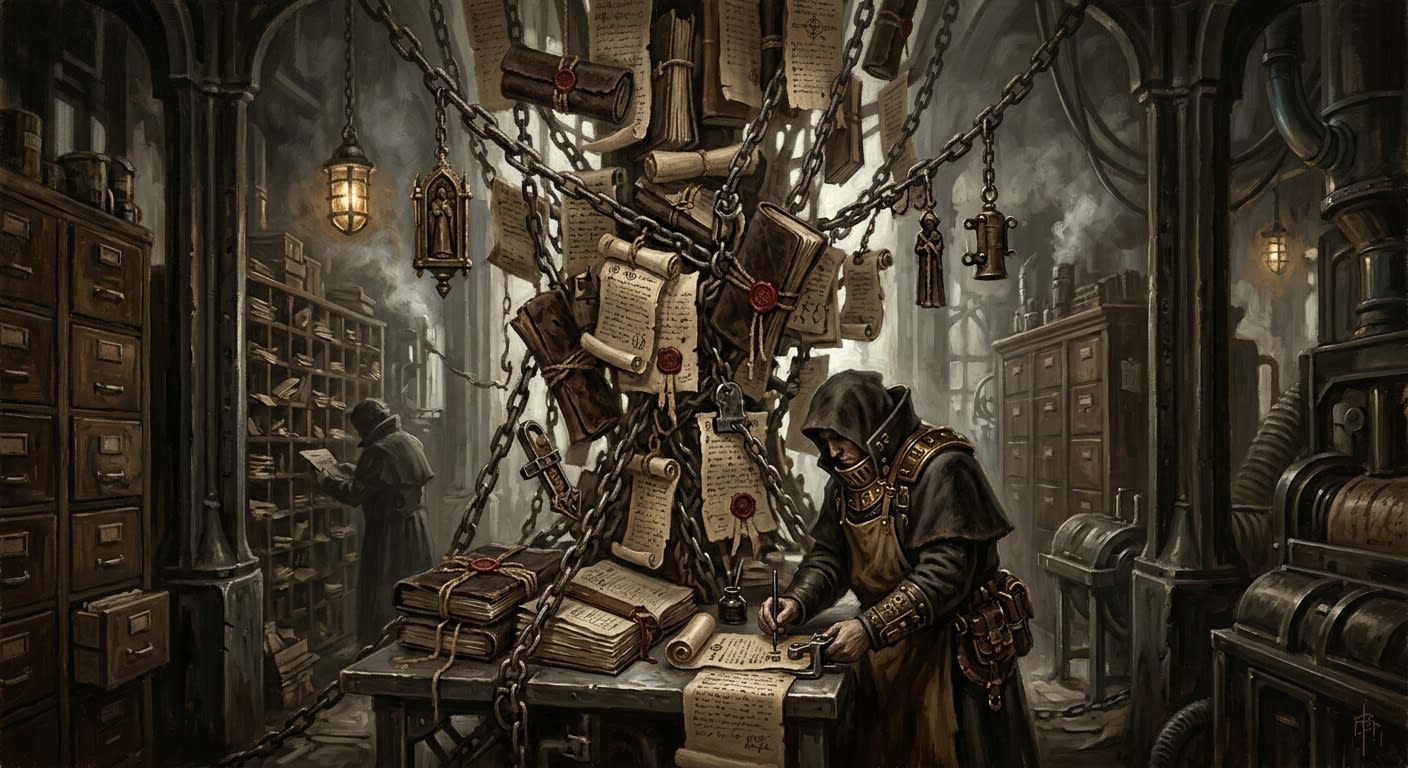
#On the Smallest Unit of Custody
A link is the smallest visible confession that one thing belongs to another. It is also the cheapest confession to deny.
The Bureau of Records defines links as “registered relational instruments by which persons, objects, places, offices, proofs, burdens, debts, chains, routes, relics, crimes, and authorized memories are fastened into clerical continuity.” The definition has the beauty of a fish left too long in vinegar. Accurate. Punishing. Useful only after hunger has lowered one's standards. It omits, with the tact of a pickpocket at Mass, that the link almost always benefits the hand that records it.
A soldier knows a link as iron: the chain at a ferry, the shackle on a prisoner, the coupling between artillery wagons, the ring that holds a bell in its frame. A clerk knows a link as ink: the cross-reference, the forwarding mark, the codex relation, the line that drags a file out of sleep and makes it answer another file's accusation. A theologian knows a link as guilt. This last profession, though frequently useless, occasionally stumbles into the correct room.
Links differ from chains in dignity and from ropes in ambition. A chain declares itself. A rope frays honestly. A link may hide inside a ledger for thirty years, waiting for a widow's petition, a relic audit, a ration dispute, or a condemned man's last useful word. When it wakes, it brings company. Usually armed, always invoiced, frequently smelling of wet wool.
#On Iron Links
Iron links are the honest ones, which is why the Synod distrusts them least and exploits them first.
At the Rope-Ferry Chain, twelve flat-bottomed ferries hang from cable, schedule, oath, and extortion. The public sees barges. The Superintendentate sees throughput. The ferryman sees the mainline. The mainline is a rosary for logistics: link, strain, crossing, fee, confession, link. Every sack of grain moving eastward, every conscript with damp boots, every crate of hymnsteel, every fevered pilgrim, every coffin pretending not to be cargo touches those fastenings before the Line receives them.
The old bridges died between A.S. 48 and A.S. 65, burned behind retreating columns to slow Wrath and fog. Bridges are arrogant. They stand still and permit passage without sufficient humiliation. Ferries are wiser. They make movement conditional. The Chain's genius lies in this: each link admits that crossing is possible while reserving to authority the pleasure of delay.
Iron links also punish. The drowning cages at the Bend Ferry are linked to the gantry towers at tide height, which is an engineering phrase meaning someone calculated the exact level at which a man can regret his choices without immediately escaping them through death. Three tides warn. Seven tides correct. Twelve tides instruct the queue. Records calls many of these deaths “weather-related,” an interpretation made possible by the chain's willingness to stand in water and keep quiet.
Iron is not pure because iron is metal. Iron is pure when it submits to registration. The same ring may be restraint, cargo fastener, bell hanging, relic guard, or evidence tag. The object changes less than the form surrounding it. A link without a file is hardware. A link with a file is law.
Early Transit Office training sheets described ferry links as “neutral mechanical apparatus.”
Corrected after Node Seven proceedings demonstrated that neutral apparatus does not select prisoners, preserve tariffs, validate confiscations, receive bribes, or appear in four separate miracle depositions with contradictory meanings.
#On Ink Links
Ink links are more dangerous because they travel after the hand is dead.
A cross-reference is a small noose thrown across the archive. It says: this document accuses that document of relevance. It may bind a ration ledger to a casualty roll, a saint's bone to a discredited pamphlet, a ferry permit to a drowned man, a Line breach to a furnace cult, a mother's complaint to a Bureau that will deny jurisdiction until the child is old enough to be conscripted. Ink performs what iron can only imitate: distance obedience.
The Codex uses links by necessity and by appetite. No article stands alone. Maldrake calls to Constantinople, to the Hellbow Legion, to the Iron Wastes, to every wall whose stones have learned heat. The Miracle of Saint Aldebrand calls to Vienna, Amsterdam, pig-bone arithmetic, erased inventories, Clemens Stahlhand, seventeen sole femurs, and the Bureau's magnificent ability to authenticate what it previously annihilated. The Rope-Ferry Chain calls to queues, slips, cages, ferrymen, quarantine, and the unpleasant truth that logistics is theology in wet boots.
Records pretends that links merely preserve knowledge. This is adorable. Links create knowledge by deciding which facts must stand close enough to smell each other. Place a relic beside a trial transcript and the relic becomes evidence. Place the same relic beside an inventory erasure and it becomes embarrassment. Place it beside a siege victory and it becomes Providence. The bone has not moved. The link has.
Ink links are also traps for the Bureau itself. A prior scribe links a harmless maintenance note to a sealed casualty file. Fifty years later a widow follows the mark and discovers her husband was not missing, but requisitioned into a category that paid half pension. A hagiographer links a saint to a battle too precisely and proves the saint was in two cities at once. The Bureau of Relics calls this bilocation. Records calls it duplicate custody. The widow calls it theft.
All three may be correct. Doctrine will decide which one was always true.
#On Sacred Links
Sacred links begin where custody becomes embarrassing.
The Reliquary of Saint Aldebrand is linked to absence, and absence has done poor work containing it. The Bureau erased the bone in the Year of Letters. The bone remained. Amsterdam mocked the femurs. The femurs glowed. A.S. 95 placed the reliquary mace in Clemens Stahlhand's hand at Vienna, and the skull of Althazar of Pest learned, with admirable suddenness, that classification is not impact resistance.
A relic link is never a simple attachment between object and saint. It is a quarrel over who may claim the consequence. Parish, cathedral, Bureau, battlefield, pilgrim, thief, scholar, and saint all pull on the same little fastening. Each insists the link runs through him. The Bureau of Relics resolves such matters by notarising contradiction until contradiction becomes holy through fatigue.
There are links of contact: bone to hand, hand to blow, blow to miracle, miracle to feast, feast to tithe. There are links of denial: bone to erasure, erasure to archive, archive to stamp, stamp to silence. The Aldebrand file is a chapel made from mutually hostile fastenings. Pull one and the whole devotional machine rattles.
RELICS / RECORDS JOINT MEMORANDUM — ALDEBRAND CUSTODY STRAND Inventory chain: █████████████████████████ Vienna vault chain: ████████████ Amsterdam lecture bone: transferred by █████████████████ Strasbourg duplicate: not duplicate; see doctrinal exception ███ Instruction: do not compare weight, marrow colour, or warmth under identical lamps.
The faithful call this mystery. The Bureau calls it manageable mystery. That adjective is where civilization hides the knife.
#On Wrath's Counterfeit Links
Maldrake understands links and despises patience, which means he forges his own.
His links are heat, grievance, command, and recurrence. A wronged soldier hears the whisper. The whisper links injury to permission. Permission links fist to weapon. Weapon links body to violence. Violence links the soul to the Eternal Forges, even if the feet never cross Thrace. By the time the Bureau of Purity finds the cell, the links have already tightened under the skin.
Wrath's armies are linked less by loyalty than by combustion. Ember-Soldiers march because rage holds them in formation where discipline would have failed. Forge-Beasts are captured engines linked to dead crews, each trigger still remembering a hand that no longer ends at a wrist. The Hellbow Legion links salvo to breach, breach to Hollowed insertion, Hollowed insertion to panic, panic to fire, fire to more fire. It is rude, repetitive, and effective. Many sermons share these qualities.
The Synod's own links give Wrath purchase. Denied pensions, stolen rations, insulted veterans, purged officers, widows fined for late grief: each grievance sits in a ledger waiting to be read by something hot. Maldrake does not invent all the chain he uses. He picks up what our clerks drop.
Bureau of Purity pamphlets state that Wrath-cults arise from irrational violence without civil cause.
Corrected for internal training. Many Wrath-cults begin with accurate complaints. The complaint remains accurate after the complainant starts burning neighbours. Accuracy is not absolution. It is kindling.
#On Severance
Every link invites the fantasy of severance. Cut the rope. Break the chain. Strike the name. Burn the file. Dissolve the oath. Kill the witness. There: freedom, says the child, the rebel, the smuggler, the clerk on his third cup of ink-thin coffee.
The Synod has severed enough links to know better. Break an iron link and two ends whip loose. Strike an ink link and some patient auditor asks why the gap has a shape. Burn a relic file and the bone glows in the dark out of spite. Kill a witness and the corpse enters a more durable jurisdiction.
Severance must be notarised, witnessed, explained, counter-linked, and filed under a category broad enough to survive appeal. Otherwise the broken thing becomes folklore, and folklore is the archive's most disobedient cousin.
The common criminal understands this better than the educated reformer. A thief cuts a chain and flees. A reformer cuts a chain and writes a manifesto about the moral purity of cut metal. The thief may reach the next parish. The reformer will still be explaining himself when Records arrives with pliers, duplicate forms, and a patient smile. Every successful escape leaves a replacement link: a false name, a bribed ferryman, a hidden road, a mother who lies cleanly, a saint who looks away. Freedom is rarely absence. Freedom is usually better fastening under a kinder custodian, assuming such a custodian can be found and taught to keep quiet.
This is why links are holy, vile, necessary, and expensive. They let the Synod move bread, drag guns, authenticate bones, prosecute ghosts, tax crossings, chain prisoners, catch contradictions, and pretend the world is held together by policy rather than panic. A doctrine without links is sermon vapour. A war without links is screaming in a field. A Bureau without links is merely a room full of men with opinions, which is the most dangerous unlicensed assembly known to the Creator.