
#On the Claim to a Roof and a Grave
"Space is sanctity." — Allocators' saying, author unregistered
The Housing and Burial Codes govern two questions the Synod has never managed to keep apart: where a person may sleep, and where that person may lie once sleeping is no longer the issue. Every bastion, parish and ossuary belt in the Synod's territory answers both questions with the same short supply of stone. A wall niche assigned to the dead this season will be wanted by the living the next. A grave-field staked out for interment becomes, by the second winter of a war surge, a village with epitaphs for street signs.
I am often asked who wrote the Codes. Junior clerks ask, and so do visiting prelates. Once a widow in Bastion-Irongate asked because she wanted to know whom to curse. Their year of enactment, their compiler and their original seal are established in no file I have been permitted to read, and I have been permitted to read a great many. What the files do establish is that the need came before the law. After the Sundering, the columns hauling their dead westward produced two populations at once: refugees with no roofs and corpses with no records. Someone had to decide which threshold belonged to whom, which slab covered whom, and which household could prove either. The Codes are what was left of that deciding. They read like a statute and smell like a burial pit.
#On the Registered Threshold
"A door without a Knot is a mouth." — Gate-Carver proverb
The Codes are best known through the instrument that invokes them. Standing Order 14-C belongs to the settlement of A.S. 90, the year of the Concordat of Strasbourg, when Theobald of Worms's geometry for the Triune Knot was fixed along with nearly everything else that would hold still long enough to be sealed. The Order names the surfaces and sets the conditions. Then it hands the consequence to the Codes.
I will not reproduce the separate wording of Articles 7 through 14. The parish copies I have handled disagree with one another, and the Bureau has never rewarded a Hieromnemon for guessing. The relationship between the two instruments is clear enough without them. The Standing Order puts the obligation on the threshold, and the Codes supply the authority to take the property when that obligation fails.
The Bureau of Heraldry reads the three loops as Mercy, Order and Sacrifice. Heraldry claims that reading as its own doctrine. Whether Heraldry also invented the mark, or inherited it from the crude scratchings that refugees cut into lintels during the retreat, is a question on which the Bureaus have filed seven contradictory claims. I add none.
What matters to the Codes is validity, and validity is not a matter of beauty. A Knot can be correct to the last angle and still be worthless at law, because its force comes from the serial punch, the registry entry and the ledger line that ties that particular cut to a licensed hand. In the Cologne river quarter in A.S. 112, fourteen houses bore Knots of perfect geometry and counterfeit punches. The Lintel Pogroms followed. Doors were stripped to bare wood and every resident was re-documented. The Knotwright Registry came out of the wreckage, a central roll of carvers, stencils and punches that the Bureau of Masks and Seals now audits every quarter.
#On Accommodation and Interment
The Codes treat a living tenant and a dead one as two entries against the same square of stone. The procedures for the two run in parallel, and on a crowded day they share a corridor.
For the living, the work starts with the Ossuary Housing Allocator. The allocator classifies the applicant as citizen, pilgrim, indentured or refugee, then as sealed or unsealed, then by the state of their clean tag. Next comes a space: a wall niche, a bunk row, a corridor alcove or a grave-field plot. The allocator issues an occupancy tag with a ration tie, redraws the corridor map, and keeps the emergency lanes clear. When the Bureau of Purity smells contagion, the allocator also signs the relocation and quarantine orders. In the bastion ossuaries the walls themselves may be built from bone and the rent paid in marrow-tithes. That is the bastion arrangement. A timber house in a Rhineland parish answers to the same Codes and has to make do with ordinary oak.
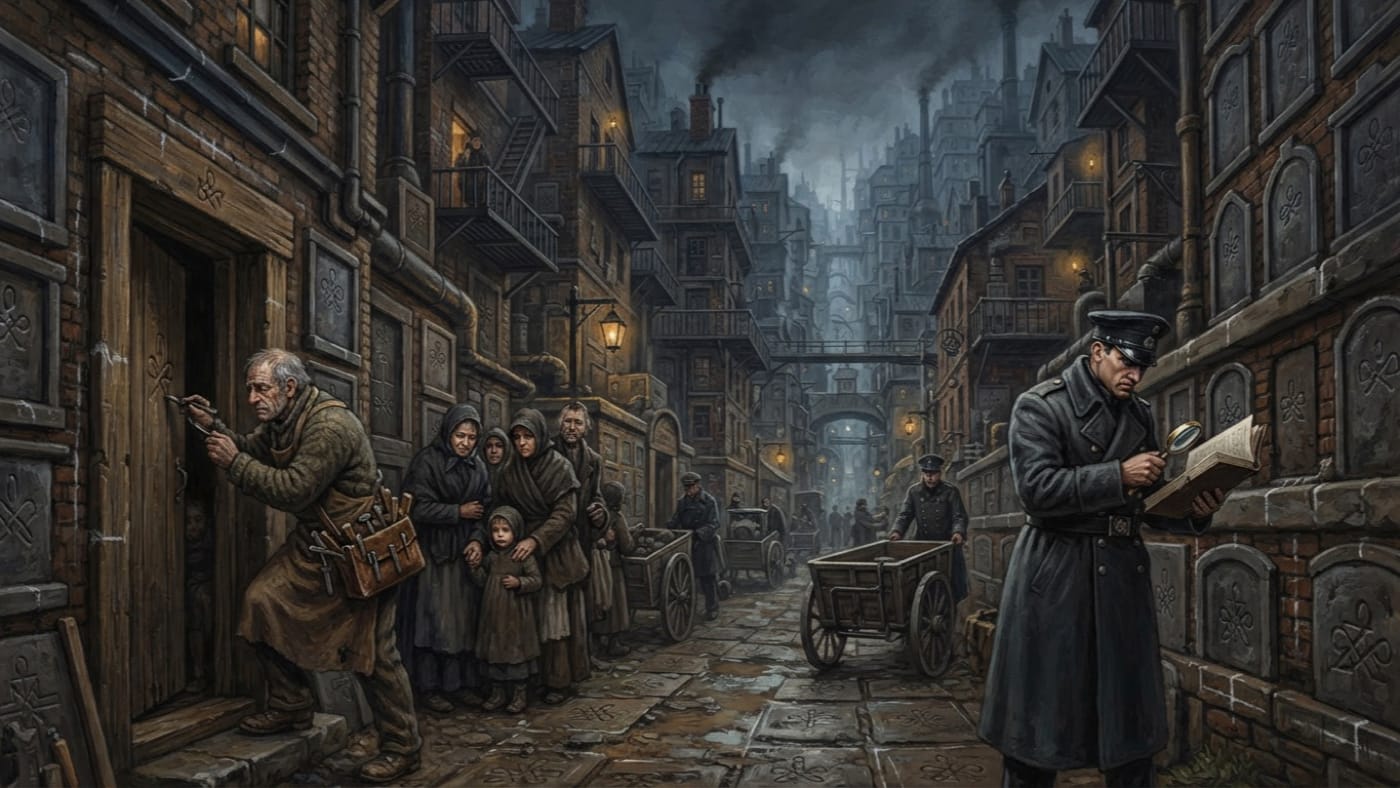
Then the Gate-Carver comes to the threshold. The carver checks the claim against papers, a sponsor or the local ledger. They choose the knot class (household, ward, warehouse, grave or ossuary niche), measure with the tri-cord, cut, chalk the consecration line, and register the punch, location and class. The Bureau of Settlement counts the resulting housing registration, and the household becomes legible to the authorities.
For the dead, the Dead-Goods Tariffer goes first. The tariffer matches the death-tag, classifies the remains, clears them or holds them, and sends them under sealed transport tag to a grave, an ossuary or another authorised destination. The Ritual Bone-Stamper then authenticates the remains, tags the bone, logs the location and count, places them and reseals. Only after that does the Gate-Carver mark the slab or niche that encloses them. The stamper marks the dead and the carver marks what shuts them in. Confuse the two in front of either trade and you will hear about it until Ninth Peal. Behind all three stand the Bureau of Records, which holds identity and location, and the Bureau of Tithes, which holds an assessment against every step.
The cost of failure is the same for a roof and for a grave. An unmoored household cannot claim rations, cannot call for the Wardens, and cannot prove that its dead were properly filed.
#On Inspection and the Exceptions That Survive It
The Sigil Inspector closes the circle once a year. The inspector measures the depth, compares the geometry against the authorised set, and checks the punch against the Registry. The result is a citation, a correction order or a confiscation. The Codes make an unmoored property liable to seizure, and liability is where the bargaining starts. What happens next depends on the ward, the inspector's patience, the household's patron and how many other doors are failing on the same street that week. Most failures end in a repair, a re-consecration and a fee. Some end with a cart.
Emergencies tighten everything. In A.S. 134, during the Ossuary Breach Winter, unsealed niches in the eastern catacombs of Bastion-Irongate were blamed for reports of movement in the bone-walls and scratching from sealed chambers. The Bureau of Engineering called the disturbances structural, and the Bureau of Doctrine called them spiritual. Heraldry declared nothing and tripled the Knot quota across Zones 3 and 4. For nine months the carvers sealed every niche, slab and alcove under the Codes' threshold rule, and the stone-dust cough killed carvers at a rate the official tally recorded as "occupational attrition."
ERRATUM — Standing Order 14-C, Authorised Variants
An earlier statement of the threshold requirement listed forty-seven permitted geometries. The governing figure is forty-three. Four variants were withdrawn as "insufficiently angular." Properties already carved in a withdrawn variant are not thereby declared unmoored by this notice. Neither are they declared otherwise.
Then there are the exceptions, which every administrator denies and every administrator relies on. Ordinary construction is restricted on consecrated burial ground, and that is exactly why the living crowd onto it. The Grave-Field Shanty Broker acquires interment rights, anchors a lane with legitimate graves, and leases shanty space as "caretaker housing." When an audit approaches, the broker rotates the residents. None of this is a statutory entitlement, and none of it is a guarantee against eviction. A lane can be swept clear in a single morning.
Inside the walls, allocators sell the same niche twice and issue "ghost permits," and patron letters override the queue. Shadow knotters cut protective marks for refugees whose papers would not survive inspection. The one line an allocator does not survive crossing is housing the living in a sanctified dead chamber without authorisation. Everything short of that line is negotiable.
#On Present Application
In A.S. 201 the Codes govern a territory that cannot house its living or bury its dead at the pace the Line supplies them. The Knotwright Registry carries 6,411 active serial entries. The queue outside any Gate-Carver's shop at dawn holds landlords, widows, warehouse bosses and cemetery clerks, and each of them is trying to become legible before an inspector arrives to read them.
The Codes demand that every roof and every grave be recorded, registered and marked to the eighth of an inch. They are enforced by an administration that keeps its streets from burning by tolerating brokers, exceptions and shadow work that no registered threshold could survive. Heraldry calls this a temporary condition. The condition has outlived every officer who called it temporary.
Seals still fail. A niche cut to depth, in an authorised geometry, punched and consecrated and inspected, sometimes fails to hold what it encloses. The Bureau files these cases as installation error or material degradation, and the carvers keep their own counsel. The Codes have no article for a seal that was valid and failed anyway. They recognise only that the property is now unmoored.