
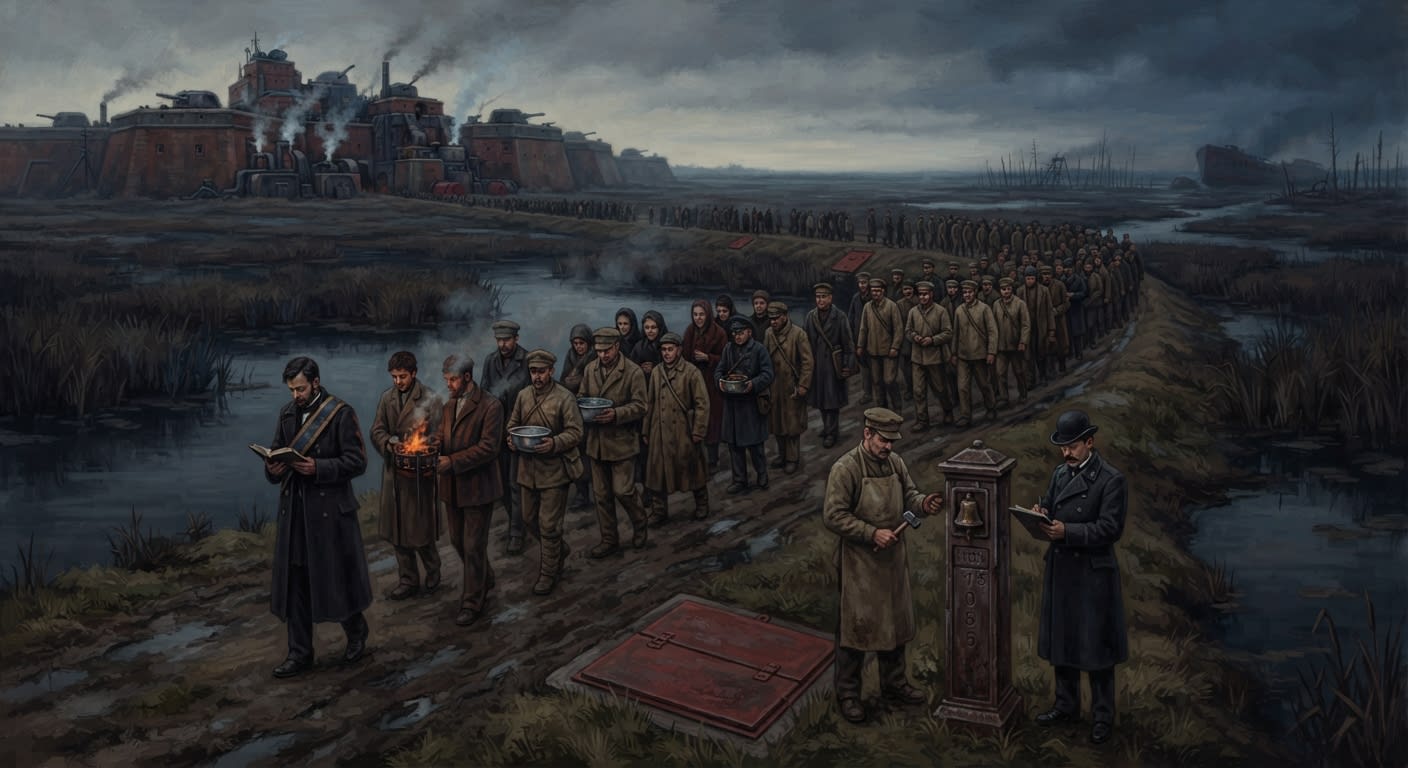
The Ash Toll of Bastion-Shipka is the Bureau of Festivals' name for the route east along the Reed Road, from the yard beneath the west bastion to the last ladder platform before the burned stilts. Everyone Shipka can spare walks it once a year, along with several people it cannot. On paper it is a day in the Prescribed Register, filed with the Founding Salvo of Bastion-Brest and the Chainforging Day of Thessaloniki as a regional observance that is small, licensed and useful. On the ground it is two kilometres of embankment and a little more, with sealed fire underfoot and black water on both sides.
#On the Route That the Bureau Calls a Festival
"Mourn in order of march."
The Bureau files the route as a ceremonial precinct. The rail quarter files it under drills. Both registrations are correct. In my experience, that is how one recognises a Synodal institution in good working order.
Nobody at Shipka will tell you when the Toll began, because nobody at Shipka agrees. The oldest engineers say there was always a Procession of Ash along the road: a Scour crew walking the fuel caches with lanterns and a chaplain, reminding the rail quarter what lay under its boots. In their account the Bureau of Festivals only noticed it, measured it and sent an invoice. The Bureau says it licensed a spontaneous local devotion, which is its phrase for anything it did not invent and cannot abolish. Records holds no founding entry. I have looked, and I shall not supply one.
The rail quarter's own account places the present form of the Toll in the years after the Reed-Road Sleepfire. The whole town will swear to that much, usually while drinking.
For some years the Bureau of Tithes read the word toll with the literalism of its calling, treated the observance as a levy, and collected accordingly. The name has since been clarified. The collection has not stopped.
#On Ash, Bells, and the Reed Road
"One stroke per post. No encore."
The Toll begins in the pump-room under the west bastion. There the adept of the Bureau of Bells strikes the first bell over the thud of the engines, and a Scour crewman lights a measure of drill-fuel in an iron basin. The fire burns for the length of one psalm verse. Then a pump-man opens a valve and drowns it. The wet ash is scooped into lidded bowls, and the bowls go out onto the road.
That is the whole liturgy. Everything after it is repetition on worse footing.
The procession moves east along the crown of the embankment, between the rails. It halts at every iron marker post, the waist-high posts with stamped number plates and small bells keyed to the sector code. At each post a Bellwarden strikes the bells in the sanctioned sequence, and the gunners on the wall confirm range out of habit. A bowl-bearer smears wet ash across the number plate. A Records clerk notes the time and the Bellwarden notes the tone. An adept of the Hourglass notes whether the two agree, which at Shipka is a devotional question of the first rank.
Between the posts lie the inspection hatches of the purgation channels, where the Scour stores wait sealed beneath the road. These are the Ash Stations proper. At each one the hatch is opened before three witnesses, the seals are read aloud, the pitch is sniffed and the hatch is shut. The Chorus-Master then leads a verse that the Bureau of Festivals composed and the Order of Ash corrected. It thanks the Creator for fire held in readiness. The crowd sings it with the enthusiasm of people standing on top of the fire.
The procession stops longest at Station Two. The Chorus-Master's licence does not cover drag-gauges, so the script does not consult the instruments. Everyone watches the Hourglass hut anyway. The Toll waits while the adept on duty compares the station clock with the bastion clock, then nods or does not nod. If the frogs are calling out in the reeds, the Toll goes on. If they have gone quiet, the Bellwarden rings the wake-peal and the Toll becomes a patrol without anyone changing costume. The Bureau of Festivals has no category for this conversion and files such years as "Observance Completed, Format Adjusted."
On the way past, every bearer touches the red door of the cache shed with an ash-marked palm. No one prescribed this. The Bureau has twice tried to forbid it, on the grounds that unlicensed gestures dilute the script. Both times it watched the crowd do it anyway in perfect silence, and silence cannot be reported to Purity as noise.
The route ends at Ladder-Platform Four, beyond which the Sleepfire began. The bowls are emptied into the black water and the last bell is struck once. The procession then turns west and walks home without song. The licence covers only the outward route; the return, the Bureau has ruled, counts as transport.
#On the Sleepfire and the Scour That Did Not Fall
"Fire requested. Water achieved result. Record both."
The Bureau's approved text of the Ash Toll commemorates the fire held in readiness. It presents Shipka as the bastion that stood so near the Scour that the nearness purified its faith. The authorised sermon, read beside the pump-room basin, praises the Order of Ash for its vigilance and the garrison for its willingness to burn. It names A.S. 178 once. The dead appear in a subordinate clause.
The rail quarter keeps a different text, and no chaplain teaches it. In that version the basin is lit so that the water can put it out. Every child in the yard knows why the pump-man opens the valve.
The facts behind both texts are short. In A.S. 178, marsh fire and sleep-contagion reached the outer stilts at the same hour. Households stood in their doorways with their sleeves alight and did not run, because Syrion had taught them that hurry was vulgar. The Order of Ash, present on inspection tour, demanded Scour of the quadrant. The engineer-captains opened sluices, reversed pumps, flooded the low road, cut telegraph Line Four and dropped the plankways into the water until the fire had only islands left to eat. Dozens died. The main quarter lived. War's public summary said "assets preserved," and Shipka has spent the years since arguing over the noun.
Local pride holds that Shipka has burned the marsh twice and itself never. The Toll is the one day the town says this aloud in a form the Bureau can license.
Earlier copies of the Prescribed Register described the Ash Toll as "commemorating the Scour of Bastion-Shipka."
Corrected. There has been no Scour of Bastion-Shipka. The observance commemorates a Scour that was requested, withheld and replaced with sluices. The responsible clerk explained that the Register's standard template for bastion ash observances assumed a burning. The template has been amended. Several other bastions have asked that it not be.
Captain Varik's Scour company marches directly behind the bowls, masked, in oil-slicked canvas. Match Morrick marches with them unmasked. In all the years he has walked, the Chorus-Master has never asked him to cover his face, and no Auditor has found a column in Standard 12-F for what the crowd does when he passes.
#On Who Must Attend
Attendance is mandatory for the off-watch garrison, the Scour company, the rail gangs, the pump crews and a delegation from the stilt-hamlets of Tithes-End. The Tithes-End delegates are counted twice, once by Festivals for attendance and once by Tithes for reasons Tithes does not explain. The Bellwardens attend because bells do not strike themselves. Shipka's four-month rotation means a given Bellwarden cohort sees one Toll at most, and some see none. Veterans of the posting judge the latter the luckier.
The Attendance Auditors walk the verge with counting frames and a copy of Standard 12-F, and every year they meet the same difficulty. The Joy Compliance Index scores smiling, cheering, kneeling and song. The proper expression of the Ash Toll is exhausted vigilance: eyes on the reeds, lips counting under the breath, a flinch at every bell. By the Index, such a crowd is "Insufficient in Zeal." Every year the Toll is scored that way, and every year the local Chorus-Master files a variance citing "the character of the observance." Every year Strasbourg accepts the variance and docks the licence.
The present Chorus-Master holds a provisional licence. No one of higher grade has asked for the posting.
Yesse Tren's line gang walks the Toll carrying hammers, spike keys and chalk, and taps the rails between posts. One Auditor's return listed the tools as "unsanctioned implements." The gang replied, through its sergeant, that sleepers crack on feast days too.
#On the Present Condition
"Keep the bowls lidded until the water."
As of A.S. 201, the Ash Toll is licensed, walked and scored insufficient. It remains useful to everyone who pays for it. Strasbourg cites it as proof that Shipka honours the Scour, and Shipka keeps it as proof that it has never needed the Scour. The Bureau of Festivals keeps it on the Register because abolishing it would cost more than the licence brings in, and because no one in the capital wants to be the signatory who struck ash from a frontier calendar.
The road it walks has grown more crowded with danger. The Slumber-Hulk turned beside the Reed Road in A.S. 194, and the Toll has halted a little longer at Station Two ever since. Somnolent Communion Cells, formally classified since A.S. 196, gather at the marsh edge in sight of the Drowned Shrine, and the bowl-bearers at Platform Four have learned not to look east at dusk. Since A.S. 199 Station Two has lost ninety seconds a day to the Skip, and the Hourglass has asked that each year's procession be logged as a timing test. Inside the bastion, Rest Societies among clerks, nurses and rail hands now argue that a vigil walked by exhausted people in honour of wakefulness is a cruelty dressed as a feast. The Chorus-Master has been instructed to keep the verses short.
The Bureau of Bells has lodged a protest that wet ash on the marker plates dulls the small bells by a measurable fraction of a tone. The plates are washed the same evening. The washing is not part of the licence, so no one is counted doing it, and it is the best-attended part of the day.