
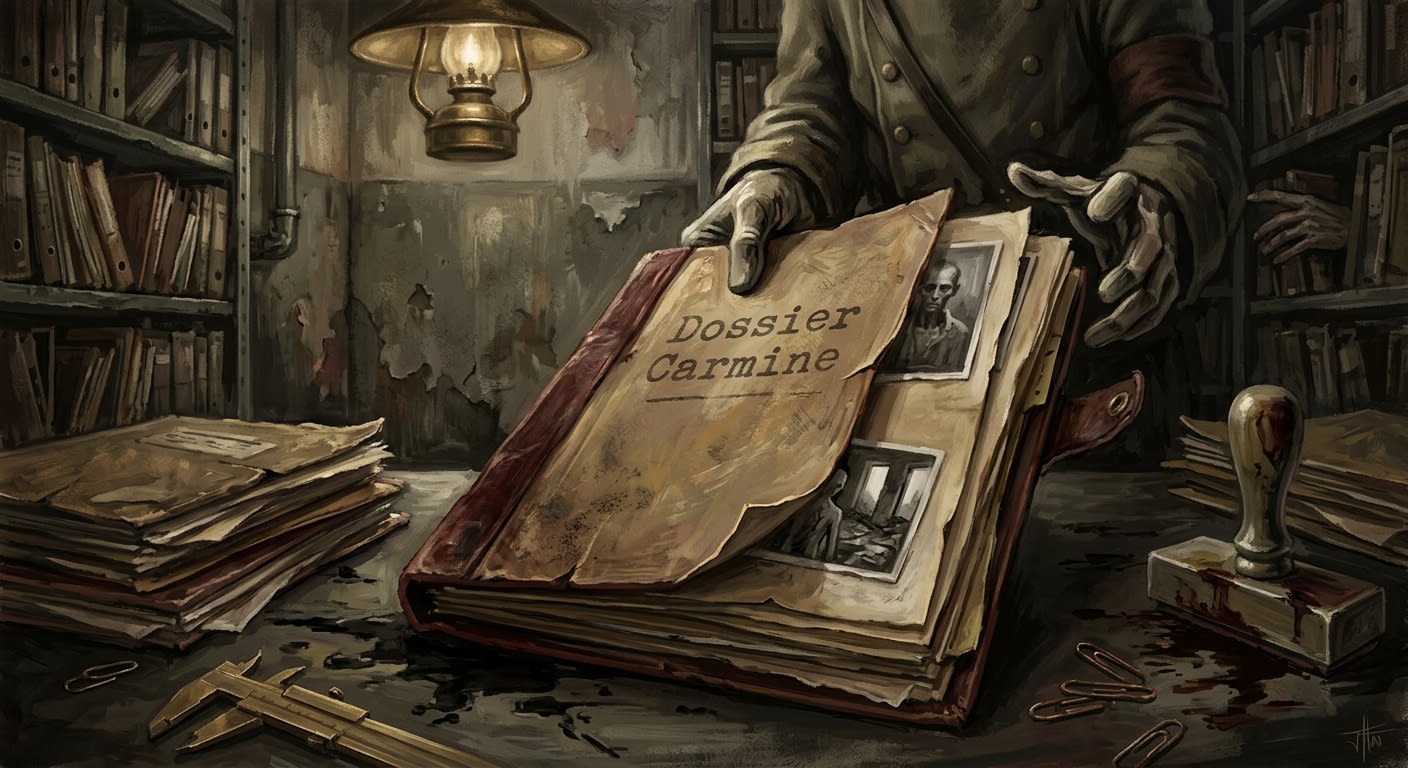
#On the Thinnest File
Dossier Carmine is the Bureau of Inter-Infernal Analysis file on Kargath, the Maw of Endless Hunger, Sin-General of Gluttony, forward horror of Bastion-Constantinople, lord of the Blightmarsh, and patron saint of every analyst who has ever wished an enemy would become more interesting for professional reasons.
It is the thinnest of the Seven files. Kargath is not obscure. He is appallingly present. The Blightmarsh expands, the Famine Pits radiate need, the Abundance Fields bloom like a joke told by a butcher, and the Cauldron Citadel smokes where Hungary used to feed empires. Carmine is thin because its subject resists complexity. He eats. He remains hungry. The file has spent a century and a half discovering that the sentence requires no ornament.
#On Haugen’s Summary
Assessor-Tertiary Haugen’s latest summary of Carmine has already become office scripture, which means a clerk has copied it incorrectly at least twice. The authorised version reads: “He is hungry. He goes where the food is. He eats the food. He remains hungry. Repeat.”
That is analysis stripped to bone. Earlier directors attempted finer language: migratory consumption pressure, famine-vector strategic patterning, caloric-denial campaign logic, appetitive theatre. All were serviceable phrases. All failed because they placed curtains before the pit. Kargath has no grand strategy in the Velmoran sense, no usurping architecture in the Atheronic sense, no doctrinal seduction, no courtly game, no hidden hierarchy of intention waiting beneath the mud. Hunger moves toward food. The terrible part is that everything is food.
The A.S. 121 Carmine digest stated that Kargath lacked strategy and could be treated as operationally predictable.
Corrected. A falling millstone lacks strategy. Stand beneath it and learn how little comfort intention provides.
The file’s thinness is deceptive. One page may contain a county. A single line reading grain failed after passage, third year may represent twenty villages, four parishes, and a generation of children whose names reached Records as blanks between ration figures. Carmine does not swell with contracts because Kargath issues none. He leaves absence. The Bureau, being made of paper, has trouble filing absence until it begins smelling.
#On What Carmine Contains
Carmine’s first division tracks movement: Blightmarsh boundary revisions, Bosporus marsh seepage, Drava distortions, Cauldron smoke columns, Hollow-Walker sightings, Maw-Born pressure, and the obscene little half-mile-per-generation creep that seems minor until one remembers the Line is measured in lives, not miles.
The second division tracks famine aftereffects. Kargath’s passage is rarely done when the army moves on. Wheat fails three years later. Wells sour, clear, then sour again. Storehouses develop rot without breach. Children disappear before census. Rations acquire the texture of ash in sealed tins. The file’s best intelligence often arrives late because hunger is a slow clerk and never signs at the desk.
The third division tracks abundance. These entries are the worst to read because they begin beautifully: fields growing at the Marsh’s edge, fruit out of season, grain heavy enough to bow the stalks. Then come the bodies with full cheeks and hollow eyes, the men chewing and starving, the soldiers who eat from prohibited gardens and spend the next week begging for more while their stomachs split. Kargath’s miracles work. That is why they are miracles and not traps. A trap fails if recognised. A miracle ruins recognition.
The fourth division is bestiary overlap: Hollow-Walkers, Maw-Born, the Gorged, Blightbearers, Self-Devoured, and the other ambulatory appetites the Bureau of Doctrine names so that soldiers may die using approved nouns. The fifth is Inter-Infernal: Kargath against Velmora over hoarded grain, Kargath against Maldrake when fire spoils provender, Kargath against Syrion because waiting is another way of starving, Kargath against every creature that prevents eating by owning, burning, stilling, seducing, envying, or crowning what might otherwise enter the mouth.
#On the Analyst’s Temptation
The Bureau’s temptation with Kargath is to invent subtlety because subtlety flatters the observer. If the enemy is simple, then centuries of analysis look like liturgy performed before a latrine. Analysts dislike this. So they name patterns where appetite suffices. They find arcs, feints, symbolic feedings, famine sermons, ritual pacing, geographic punctuation. Some of this is useful. Much of it is embarrassment wearing spectacles.
Kargath humiliates the clever by requiring them to be right in short sentences.
Haugen instituted the Carmine Rule after the A.S. 193 overinterpretation incident, in which three analysts concluded that a Blightbearer movement toward the Lower Danube represented a symbolic strike at Velmora’s liquidity operations. The entities had smelled a cattle train. Fourteen pages of theory died under one butcher’s manifest. The rule now stands: every Carmine hypothesis must survive the question was there food there? If the answer is yes, begin with the mouth.
The A.S. 193 memorandum “On Caloric Semiotics in Kargathan Lateral Movement” remains cited in two officer-school syllabi.
Withdrawn. The movement followed cattle. The author has been reassigned to commissariat mathematics, where food is at least expected to matter.
#On Rivalries Measured by Appetite
Kargath’s rivalries are mostly collisions between appetite and obstacle. He hates Velmora because she hoards what he would consume and sells relief where he creates need. Their feud is tidy enough for catechism: hunger against ownership, maw against ledger, famine against interest. The truth is more practical and more filthy. Velmora profits from Kargath’s aftermath. Kargath feeds on territories Velmora has priced. Each makes clients for the other while loathing the bill.
He shares roads with Maldrake near the southern approaches when terrain forces proximity. Fire cooks. Fire also burns food to uselessness. Their accommodations never last, but they recur with sufficient frequency that Carmine carries six small red tabs marked do not mistake quarrel for separation. This is how Hell teaches the Bureau humility: by letting two disasters find a schedule.
Atheron offends Kargath by raising food out of reach and calling the elevation sovereignty. Morwen offends him by wanting what another has already swallowed. Velkara offends him by making appetite beautiful, which is an insult to the blunt holiness of the gut. Syrion offends him by delay. Hunger despises waiting, and Sloth is waiting made throne.
CARMINE INTER-INFERNAL NOTE — A.S. ███ Observation: Kargathan host halted at fog-bound perimeter of Syrionic stillness. Duration: ███ hours. Acoustic record: chewing without motion. Result: fog thinned; host advanced seven yards; nine observers requested immediate food and received ash instead. Classification: mutual non-accommodation.
#On Thin Files and Thick Graves
Dossier Carmine’s smallness has saved lives. It leaves little room for romantic error. Commanders who read Auric worry about signatures. Commanders who read Vermillion worry about posture. Commanders who read Carmine learn to burn grain before retreat, poison wells already lost, shoot livestock rather than let them wander east, bury the dead with speed, and refuse every impossible harvest no matter how sweet the fruit smells.
This is brutal doctrine. It is also doctrine that works. Against Kargath, denial is defence. Food denied to him may starve a village today and save a province tomorrow. The sentence should make the reader sick. If it does not, the reader is unfit for command or already has one.
The file records no final countermeasure. Kargath cannot be bribed, reasoned with, crowned, flattered, seduced, shamed, purchased, delayed for long, or made full. He can be diverted. He can be denied. He can be made to chase easier flesh while the Line repairs a breach. Every success against him has the moral elegance of throwing meat to wolves while children run.
#On the Present Hunger
As of A.S. 201, Dossier Carmine remains open, thin, stained, and operationally sufficient. The Blightmarsh expands at the edge of maps that no longer deserve confidence. The Cauldron Citadel smokes. The Abundance Fields bloom where no sowing occurred. Kargath’s hosts press the southern Line, and Constantinople counts flour with the reverence other cities reserve for relics.
Haugen’s latest notation has no flourish: “No pattern superior to hunger identified.”