
#On the Word That Mistook Itself for a Continent
Dominion is the official name for the Synod's lawful custody over Europe, which is to say over its churches, roads, courts, kitchens, children, bells, graves, rivers, jokes, and the nervous space between a man's thought and his willingness to say it aloud.
The word is older than the Bureaucratic Synod. Kings used it when they wished to sound less nakedly hungry. Bishops used it when they wished to sound less nakedly royal. The Synod perfected it, as we perfect all inherited instruments: by adding seals until the thing could no longer move without permission.
A province has borders. A kingdom has a crown. An empire has an appetite and an army willing to call it destiny. Dominion is superior. Dominion is custody dressed as theology. Dominion declines the vulgar verb own. It claims responsibility for the faithful, which is ownership with a better choir.
The Holy Dominion extends wherever the Holy Bureaus can enforce a form, collect a tithe, appoint a confessor, regulate a procession, license a song, confiscate a relic, or make a person vanish with sufficient neatness that the parish ledger learns to stop asking after him. Dominion exceeds land. Land is the least interesting portion of power. Dominion is the right to decide what a place means after the bodies have been counted.
#On the Concordat Root
The public teaching begins at A.S. 90 with the Concordat of Strasbourg, when the surviving powers of the western continent learned the graceful art of kneeling without calling it surrender. The Concordat did not invent authority. Authority had existed already in armies, episcopal courts, famine committees, relic militias, tax boards, bridge warrants, and frightened city councils whose walls faced east and whose courage faced west.
The Concordat gathered these scattered obediences and tied them to Strasbourg. It made a capital from a safe city, a government from a synod, and a theology from the plain fact that nobody else possessed enough stamps to survive the century.
Certain early catechisms describe the Concordat as “the unanimous acclamation of Europe beneath sacred order.”
Corrected for instructional honesty. The Concordat was unanimous among those present, and several absences had been arranged by war, plague, bankruptcy, or the sudden discovery that their coaches lacked wheels. Acclamation is easier when dissenters are delayed by providence with pliers.
From that settlement came the Dominion's central fiction, and I use fiction here with professional admiration: the Synod does not rule because it conquered, taxed, blackmailed, absorbed, outlived, and terrified its rivals. It rules because custody was entrusted to it by necessity, and necessity is Providence after the candles have gone out.
The Bureau of Records preserves the treaties. The Bureau of Tithes preserves the price. The Bureau of Doctrine preserves the reason everyone is required to prefer the treaty to the price.
#On Geography, Which Is Merely Obedience with Mud Attached
The Dominion is taught in zones because schoolchildren need maps and officials need an excuse to colour things. Zone 1 holds the western heartlands and the Atlantic coasts: safe, fat, pious in the manner of people whose sons are conscripted later. Zone 2 holds the central heartlands, with Strasbourg at the administrative spine and the great cities feeding paper, grain, steel, and excuses eastward. Zone 3 is forward heartland, a strip of warehouses, rail yards, shrine-towns, levy depots, widows' queues, and officials who learn to sleep through artillery reports. Zone 4 is the Sagittal Line, the north-south vertebra from Bastion-Königsberg to Bastion-Constantinople.
Beyond lies Zone 5, where maps become damp lies, and Zone 6, where the Sin-Generals write in flesh. The Dominion still claims these lands in liturgy. The demons claim them in practice. Liturgy is cheaper. Practice has teeth.
The independent territories trouble the grammar. The British Isles do not belong to the Dominion. The Netherlands does not belong to the Dominion. The Fractured North belongs to itself, several saints, three winter cults, two royal houses, and whatever survives the ice long enough to argue. All are named in Synodal documents as co-belligerents, protected spaces, tolerated sovereignties, Category Zero (Unregistered) exceptions, or friends whose friendship requires annual inspection.
The map says they are outside. The ledger says outside is a temporary error in ink.
#On Dominion as Administration of Souls
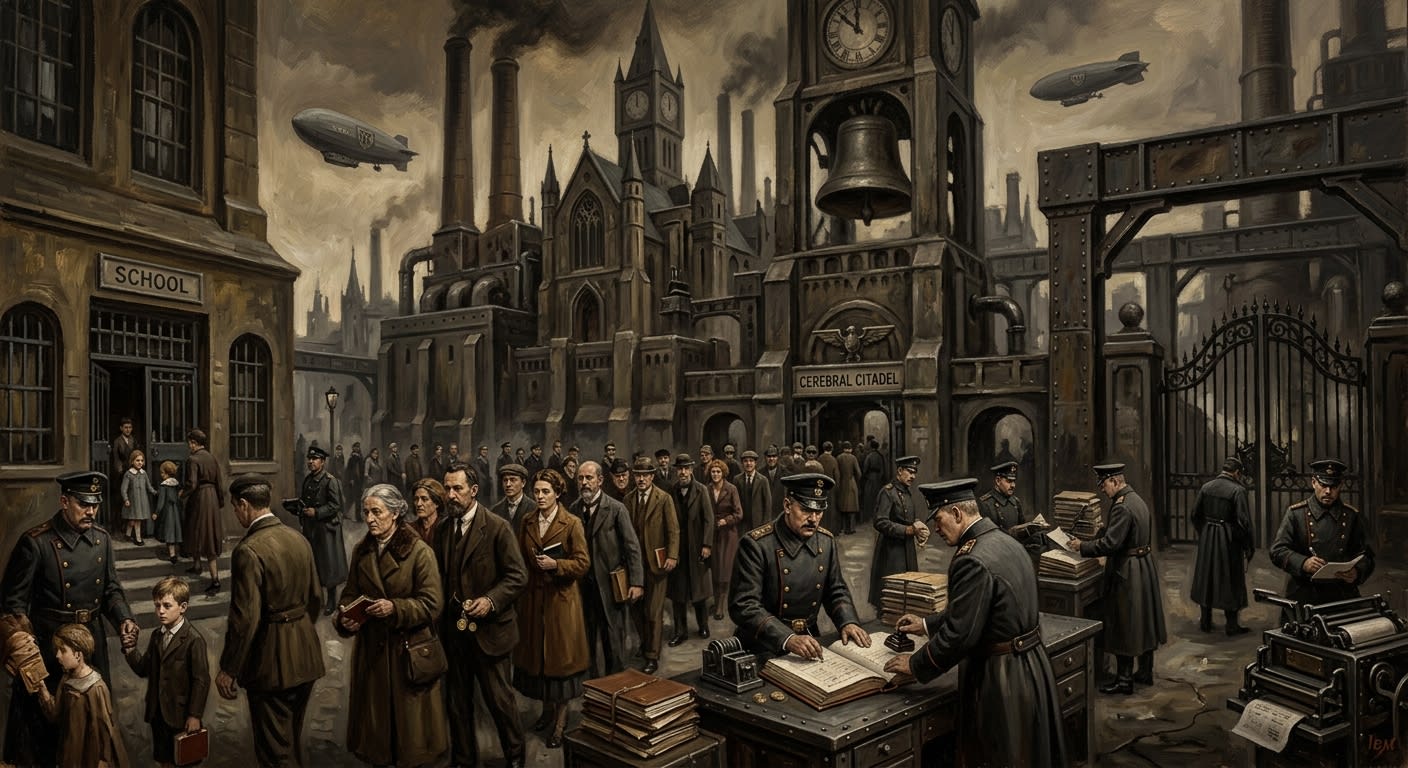
Dominion's genius lies in refusing to separate civil power from spiritual custody. A road is a route of pilgrimage. A tax is a tithe with shoes. A prison is an opportunity for clarification. A school is a catechism press with children attached. A bell schedule is urban anatomy. A border post is a confessional booth stretched across mud.
The Bureaus administer these meanings with the tender hand of a gaoler adjusting chains so the wrist does not chafe before sentencing. The Bureau of Pilgrimage orders movement. The Bureau of Records orders memory. The Bureau of Purity orders fear. The Bureau of Bells orders time. The Bureau of Mercy orders the suffering body until suffering becomes legible enough to bill.
A citizen of the Dominion is never one thing. He is a soul for Doctrine, a mouth for Orison, a debt for Tithes, a body for Mercy, a possible error for Purity, a route unit for Pilgrimage, a name for Records, a silence for Shadows. He imagines himself a man because breakfast encourages vanity. By noon the Bureaus have improved him into categories.
This is why Dominion endures. Tyrannies fail when tyrants die. Kingdoms fail when heirs are ugly, foolish, barren, ambitious, or all four in the traditional sequence. Dominion survives because no single hand holds it. It is distributed through offices, stamps, pews, rosters, bridge tolls, burial clearances, school drills, hymn licenses, grain tallies, and the smell of wax on a document no ordinary person has permission to read.
#On Shadows Within Dominion
Every official account of Dominion contains a bright surface and a black underside. The surface is catechism, anthem, parade, brass seal, public mercy, soldiers marching east while mothers wave linen from approved windows. The underside is Shadows, Seal Obsidian, blank folios, grave-dust wax, and the constitutional art by which absence becomes a form of governance.
The Bureau of Shadows does not exist. Dominion relies upon it in the same way a chapel relies upon foundations: unseen, denied, load-bearing, and unpleasant to inspect. The public courts punish visible crime. Purity prosecutes visible heresy. Shadows removes the problem that would damage Dominion by becoming visible at all.
Seal Obsidian is the Dominion's private admission that some knowledge cannot be burned without losing the instrument needed to prevent the next catastrophe. A map that shows a ninth tunnel at Bastion-Irongate. A key in place of a tongue. A ship log repeating that it was invited below. A name that remains in one widow's mouth after every other record has learned obedience. This is Dominion at its cleanest: knowledge retained, denied, weaponised, and hidden from the people whose lives it explains.
DOMINION FILE — OBSIDIAN CIVIC APPLICATION Subject: population memory after administrative dissolution. Test district: █████████████, lower Strasbourg Warrens. Result: family grief persisted after record correction for █████ days. Recommended remedy: liturgical saturation, rent reassignment, witness fatigue, bell-noise increase. Secondary note: one child continued drawing the absent face. Disposition: child collected.
#On the Sentence “For Their Protection”
Dominion speaks constantly of protection. The word is useful because it contains a knife wrapped in wool. The Synod protects villages from demons by taking their sons. It protects workers from heresy by controlling their songs. It protects widows from disorder by rationing grief into queues. It protects foreign ports from contamination by supervising their merchants until commerce resembles confession.
The faithful understand the bargain better than our enemies admit. They know the Dominion is harsh. They know its fees, its inspections, its petty clerks, its magnificent hypocrisies, its habit of arriving late with forms and early with punishments. They also know what stands east of the Line. Kargath fattens marshes with men. Maldrake teaches iron to scream. Syrion makes sleep a weapon. Against such tutors, even Strasbourg's hand feels almost paternal.
Almost.
A devotional primer for provincial schools once defined Dominion as “the Creator's gentle embrace extended through lawful authority.”
Withdrawn after three complaints from frontier chaplains and one from a grammar committee. The approved phrasing is “the Creator's custody extended through lawful authority.” Gentle is neither promised nor operationally measurable.
Protection means perimeter, ration, curfew, inspection, discipline, sacrifice, and the signed order that sends a frightened regiment to hold a bridge because the alternative is a million civilians learning what eastern mercy smells like. Dominion's moral claim rests there, in the ugly arithmetic no sermon can perfume: we are cruel because the world has become crueller than innocence can survive.
#On the Present Dominion
As of A.S. 201, Dominion remains intact, strained, swollen, rich, frightened, and louder than any sane polity should be. Strasbourg counts roughly six hundred thousand souls, depending on whether one includes transient pilgrims, hidden refugees, indexed prisoners, the missing, and the category of persons whom Records calls “temporarily unverified” because saying lost would invite pastoral questions. The Line holds. The heartlands pay. The independent powers bargain. The Bureaus quarrel, multiply, devour one another's budgets, and continue the work.
Dominion's enemies expect collapse from contradiction. They have never understood us. Contradiction mortars the Synod's wall. We deny and preserve. We sanctify and confiscate. We protect and consume. We proclaim twelve Bureaus because twelve is holy, then allow the number to breed in corridors where arithmetic fears to tread.
Dominion's present crisis is appetite. Every year the Bureaus discover a new portion of life insufficiently governed. Sleep required the Hourglass. Laughter required Festivals. Absence required Shadows. Silence required Purity. Hunger required Tithes, Mercy, Records, and three committees arguing over whether a starving man counts as tax-capable before or after collapse. The Dominion grows because reality keeps presenting unlicensed surfaces.
The people grumble. Good. Grumbling is civic incense when kept below riot volume. A silent population is either dead, plotting, or under Syrionic influence. The Dominion permits complaints in taverns, queues, kitchens, and sanctioned festival mockeries because steam must leave the boiler through holes chosen by Engineering rather than cracks chosen by pressure. The citizen may curse a clerk. He may not curse the Ledger. He may mock a tax. He may not deny the tithe. He may call me vain, provided he pronounces my name correctly and bows toward Strasbourg while doing it.
What the Dominion cannot tolerate is rival finality. A king may command until a Synodal writ arrives. A guild may regulate until a Bureau inspector unfolds the larger form. A mother may love her child until the Orphanage Registrar discovers the child's category has changed. A saint may speak through relic-fire until Doctrine explains what the saint meant. Dominion is the last word, and where the last word fails, Shadows supplies punctuation.
Dominion is the name of the hand around Europe. The hand is gloved in doctrine, inked at the fingertips, scarred at the knuckles, and occasionally missing a finger it insists was never attached.
Kiss it anyway.