
#On the Guild That Holds the Bridge by Its Bolts
The Brasswright Guild of Bastion-Brest is a labour fraternity, engineering caste, maintenance cartel, hereditary nuisance, and the only body in the northern theater capable of telling a Gun-Cantor Marshal to wait while a shutter finishes deciding whether it wishes to kill everyone.
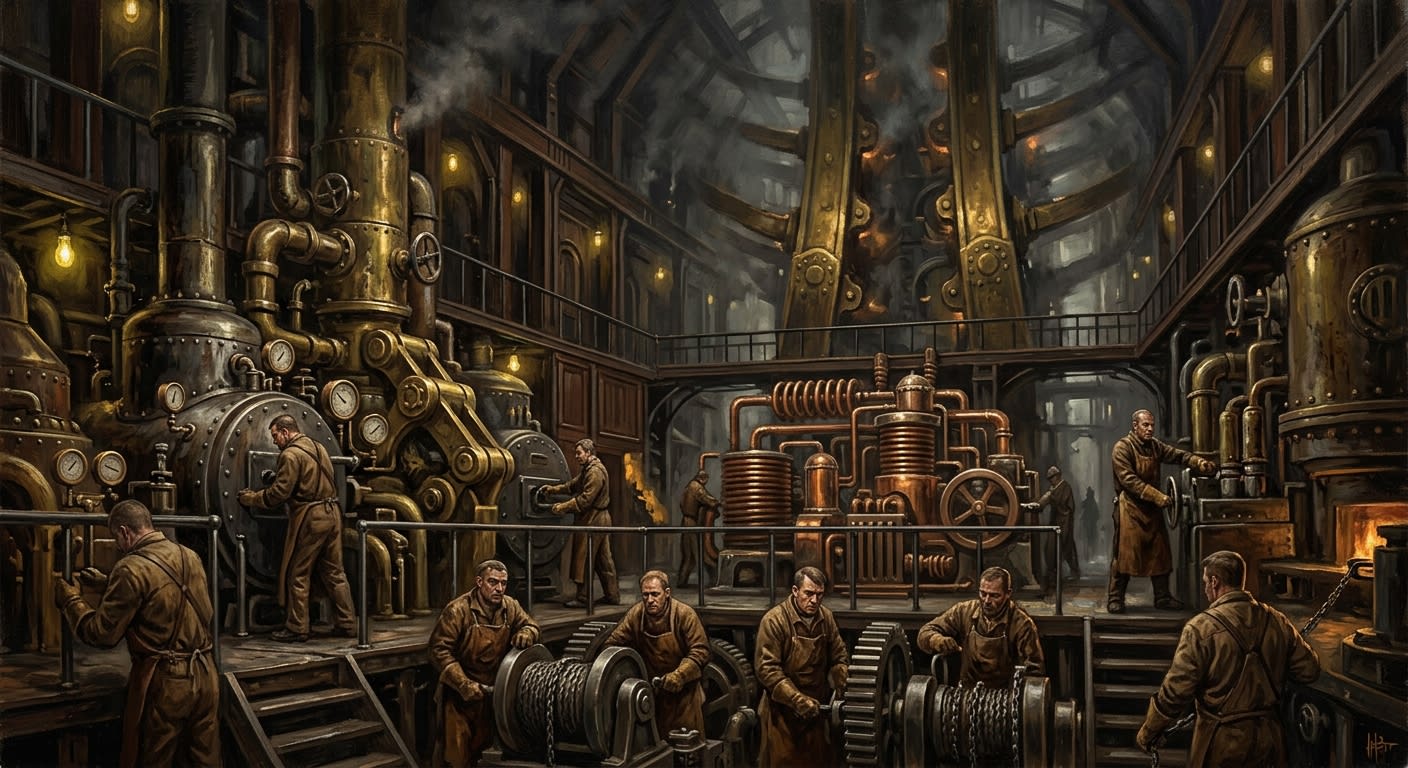
Its public face is simple. It keeps the Brass Ribs standing, firing, breathing, sealing, opening, closing, taking load, shedding frost, answering recoil, and pretending that thirty-two enormous brass-plated trusses across the Bug can endure artillery, confession traffic, tribunal halts, market crush, winter ice, Nameless Tide pressure, and twenty thousand people packed into a structure originally designed by men whose optimism should have been prosecuted. The public face is accurate enough to be dangerous.
The private purpose is older, uglier, and more honest: the Guild converts indispensability into power. A rib that no one else can hear becomes a vote. A shutter that only guild hands can unjam becomes a veto. A private book of stresses becomes a constitution written in blue chalk and brass filings. The Bureau of Engineering owns the plans. The Guild owns the noises the plans refuse to admit.
#On Its Founding in Heat and Debt
The Guild's own charter claims descent from the first western-bank works of A.S. 67, when the Bug crossing hardened from frightened ferry discipline into permanent military intention. This is partly vanity. Guilds adore antiquity because antiquity excuses invoices. The practical Brasswright Guild took recognisable form after the A.S. 92 Bureau of Engineering bridge plan and gained its adult teeth in A.S. 98, when the first certified full military crossing passed under load, artillery, confession, and tribunal supervision.
That crossing nearly failed.
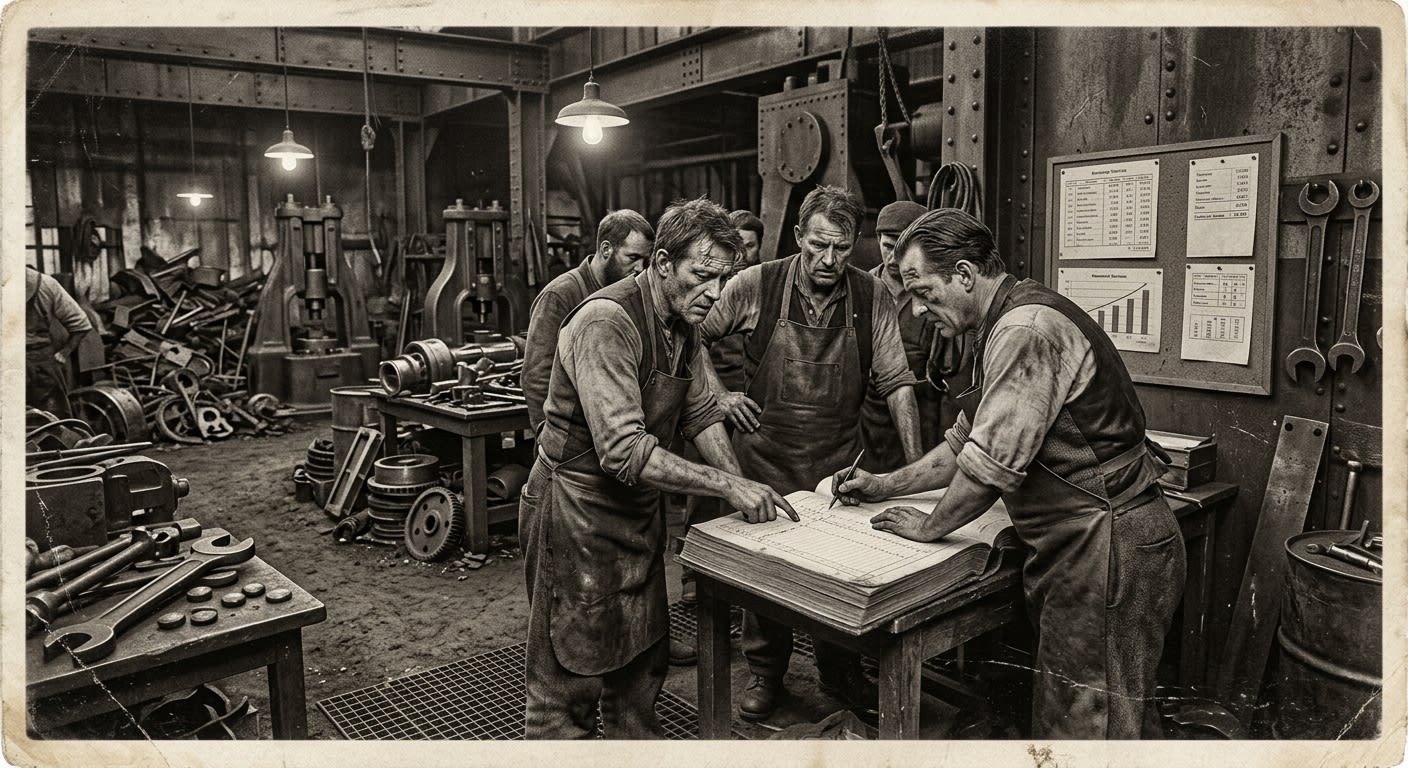
The official report praises coordination among War, Engineering, Records, and the embryonic Bridge Tribunal. The unofficial shop register, preserved in grease, smoke, and spelling so eccentric it qualifies as local dialect, records four seized shutters, two cracked recoil lugs, a north pylon heat-warp, and one apprentice whose sleeve caught in a winch because the officer in charge ordered the mechanism run while men were still inside it. The officer survived. The apprentice lost the arm. The shop register names the arm before it names the officer.
Bureau of Engineering commemorative plates describe the A.S. 98 crossing as “flawless under full operational trial.”
Corrected for internal use. The crossing succeeded because brassworkers disobeyed three timing orders, hammered a shutter pin back into place under recoil, and threatened to throw a captain into the Bug if he advanced the third gun before Rib Six cooled. Flawlessness is what Engineering calls a disaster that spared the printed schedule.
By A.S. 103 the rib crews had become too many to treat as casual labour and too necessary to treat as servants. By A.S. 104, when the Pylon Warrens' sin-bunk custom hardened into ledgered allocation, Brasswright apprentices already occupied upper ledges near warm vents, with tool rolls hung above their faces lest rats steal socket keys. In A.S. 112, the Booth Proliferation Decree multiplied confession intake across the forward crossings and made the Brest booth network heavier, wetter, hotter, and more mechanically hateful. The Guild grew rich in hinge pins, grille brackets, receipt drawers, shutter guides, and all the little bits of salvation that break when a human system meets damp.
The founders were not saints. They were burn-scarred men, widows with stock keys, rivet mothers, shutter boys, pylon smiths, hinge-fitters, and those listening artisans who put an ear to brass and hear debt, danger, weather, bad workmanship, approaching panic, and the lies of superiors. A saint may be useful on a banner. A woman with a spare rivet at second watch is useful everywhere else.
#On Tools, Stock, and the Private Book
A Brasswright's kit is a portable indictment of central planning: hammer, drift punch, listening rod, chalk, heat tape, socket key, seal scraper, vinegar cloth, tin wedge, rivet gauge, prayer nail, grease roll, and enough unofficial wire to shame a quartermaster. The tools are marked by family, rib, and burn. Apprentices learn to sleep with their rolls under one arm until they earn a nail in a Guild rack. A lost tool is a fine. A stolen tool is a beating. A broken listening rod is a bad omen and a meeting.
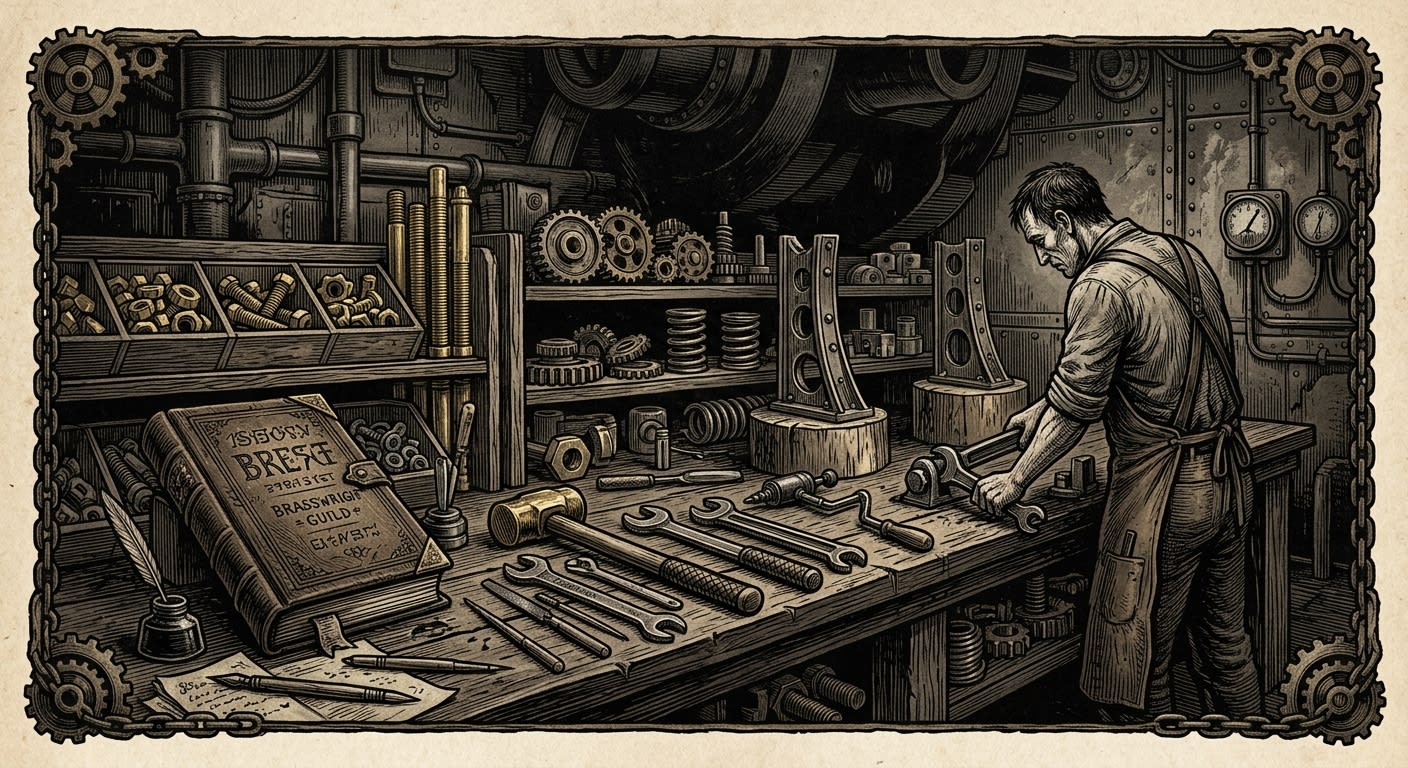
The Guild keeps brass stock in locked grilles behind pylon forges and false wall cabinets, in casemate cupboards labelled as liturgical lamp fittings, in shutter recesses whose access requires three wrists at once, and in little widow caches no auditor has found because auditors seldom ask widows where they keep wealth. Plates, pins, hinge leaves, recoil collars, threaded rods, shim bundles, latch tongues, oil valves, and blue chalk are the Guild's treasury. Coin matters. Brass decides.
The private book of stresses is the Guild's true relic. Engineering has requested it three times. Engineering has received three polite refusals and one basket of pears, which I take as an insult too sophisticated for engineers to appreciate. The book records which rib sings flat in frost, which shutter drags after heavy confession days, which pylon vent leaks Echo-cold, which recoil brace resents Vonn's favourite gun, which market stall sits above a fatigue line, which Tribunal wall should not be drilled even under judicial tantrum.
The entries are not written in ordinary prose. They are marked in symbols, tally curls, scorch smears, chalk formulae, rivet diagrams, and the brief phrases of practical terror: tired under song, north lip bites, do not trust heat, listen twice if children silent, Rib Three remembers. Records hates the book because it is evidence without proper margins. Engineering hates it because it is correct too often. The Guild loves it because nobody outside the Guild can read it without learning humility, and humility is a rare pleasure when inflicted.
#On Foreman Jost and Riveter Anya
Foreman Jost is the name most often attached to Guild authority in current files. He has burn scars, a patient temper, and the unpleasant habit of answering magistrates with nouns. Rib. Heat. Bolt. Wait. Crack. No. This makes him a philosopher by Brest standards. He supplied the famous line: The bridge breathes. Officers repeat it now with theatrical gloom, as if they understand it. They do not. Jost meant that the Ribs expand, contract, complain, warn, and deceive under pressure. Poetry was the reader's mistake.
Jost calls scratches on under-deck skiffs stress fractures when chaplains call them something else. He insists Booth 77's pylon brace is sound while refusing to say what sound means near a booth that hears tomorrow. He can halt a convoy by writing a symbol near a pylon stair. He has done so twice in public record and, I suspect, several dozen times in the unofficial economy by merely standing still with his head cocked.
Riveter Anya hears metal stress. That is the whole file description, and for once a file is concise in the manner of a blade. She began as a pylon child, slept in an envy bunk above a pump chain, lost two brothers to river work, and apprenticed after identifying a cracked hinge by touching the wall during curfew. Her hearing is not sorcery by any approved definition. It is practice refined into suspicion. She listens through knuckles, teeth, boot soles, rivet heads, cup rims, and the pause after artillery.
Anya's chalk marks are smaller than Jost's and more feared by locals. Jost marks danger. Anya marks mood. A tiny blue crescent on a shutter means the shutter will open but resent it. A closed loop near a vent means the vent is carrying a voice it did not originate. Three dust strokes under a booth hinge mean Hal's scribes should change rotation before the wood teaches them a new confession. Krail's runners have tried to copy her notation. Their copies are decorative. The bridge ignores flattery.
#On Labour Slowdowns and Selective Repair
The Guild's method is rarely strike in the heroic pamphlet sense. A full stoppage at Bastion-Brest would kill civilians before it embarrassed officials, and Brasswrights live among the civilians. Their genius lies in selective repair: the lawful, safety-minded, technically defensible delay of the one component whose inconvenience blooms upward through every Bureau on the span.
A recoil damper requires cooling. A shutter pin requires remeasurement. A rib seam requires second listening. A bridge plate requires saints' oil because a chaplain once called it sacramental and the Guild remembered. A pylon stair requires clearance from below because children sleep under the access hatch and no one wants to write crushed child in the maintenance docket. Each delay is reasonable. Together they form a fist.
When wage cuts threaten, shutters grow contemplative. When shell levies rise without tool allotments, recoil collars demand inspection. When Tithes asks too warmly after hidden stock, a market stall mysteriously blocks emergency access and must be dismantled in full view of the Ribwalk, teaching the crowd exactly which office caused delay. When Krail's Tribunal seizes a Brasswright apprentice as witness and keeps him too long, Rib Five becomes too unsafe for westbound officer carts until the boy returns with broth.
A Bureau of War memorandum described Guild delay actions as “industrial insubordination under cover of maintenance language.”
Corrected by Engineering after Rib Eleven's shutter assembly failed during a forced override drill. Maintenance language is what keeps the shutter from removing the officer who mocks it. Industrial insubordination remains under review, preferably by men standing elsewhere.
This power makes the Guild resented by clerks, feared by captains, courted by gunners, tolerated by Krail, watched by Ruis, and quietly fed by pylon matrons. It also makes the Guild corrupt in the ordinary human ways. A dry bunk appears for the nephew of a stock keeper. A tool tag opens a forbidden stair. A widow's rivet cache shrinks after a marriage negotiation. Selective repair can save a child, punish a judge, enrich a cousin, or conceal a smuggler. The Ledger will pretend to be shocked when convenient.
#On the Guild and the Bridge Tribunal
The Guild's quarrel with the Bridge Tribunal is a marriage conducted through clenched teeth. Krail needs the Guild to keep Absolution Hall's black brass floor from buckling, Booth 77's brace from shifting, transcript vault vents from sweating ink, and seizure raids from dropping armed men through rotten service plates. The Guild needs Krail to keep War from solving every obstruction with boots, to issue access writs against the Crossing Bureau, and to make certain confiscated tools return with apologies disguised as chain-of-custody corrections.
The Booth 77 dispute exposed the arrangement with admirable obscenity. Doctrine proposed consecrated concrete. Engineering proposed wall removal and brace replacement. Vonn proposed destruction by artillery logic, which is to say first and minutes later. The Guild threatened strike action, explaining that Rib Three's north-side confession run shares stress with the pylon shutter assembly and that meddling would drop three casemates into the Bug. Krail nailed planks over the door and posted a guard. Everyone called this compromise because nobody died while the ink dried.
Krail despises being dependent on men and women who wipe their hands on trousers before entering her Hall. The Guild despises being summoned by runners who say Her Honour requires when Her Honour's floor is sitting on their plates. Their mutual courtesy has become part of Brest's load-bearing structure. A careless insult can delay a convoy. A missed condolence can close a maintenance duct. A public thank-you can ruin a private bargain.
The Tribunal calls the Guild parochial. The Guild calls the Tribunal heavy. Both are correct, and the bridge needs both qualities: the parish knowledge of which bolt hates winter, and the legal weight to halt an army over a smudged token.
#On Echo, Anomaly, and Refusal to Comment
Since A.S. 199 the Guild has faced a humiliation no craft tradition welcomes: the structure is speaking in ways its best listeners cannot reduce to stress. The Confession Echo returns sins through brass shutters, pylon vents, wet plates, token bowls, and sometimes through seams whose only prior vocabulary was cold and complaint. Booth 77 speaks ahead of time. Rib Three carries sympathetic tremors. Rib Seven warms underfoot in winter. The bridge is conducting something.
Engineering hates that verb. Doctrine hates it more. The Guild refuses comment because comment creates liability and liability does not tighten bolts.
Yet refusal is not ignorance. Guild marks changed after the Echo began. Three ticks beneath a seam now indicate suspected voice seepage. Blank squares mark braces where no one should speak. Apprentices are forbidden to tap certain plates during third watch. Listening rods are salted. Tool rolls include waxed ear cloths. Widows tell children not to play Echo near service ducts because a child repeating tomorrow may be useful to Krail and usefulness is dangerous.
BRASSWRIGHT INTERNAL SLIP — RECOVERED AFTER PYLON NINE INSPECTION Rib Three north: hinge not source. Booth wood carries, but brass answers. Do not let Doctrine pour concrete. If they seal the throat, the voice may choose bone. — A.
The Guild has not solved the Echo. It has contained failures around it. That distinction is everything. A religious office wishes to interpret the wound. A court wishes to assign guilt. War wishes to shell the symptom. Engineering wishes to model it and then deny the model's implications. A Brasswright wishes the brace to hold until dawn. There are worse theologies.
#On Apprentices, Widows, and Inheritance
The Guild reproduces itself through apprenticeship, marriage, debt, injury, and the quiet adoption of children who listen too well. Formal entry begins at twelve or thirteen if the child can carry a tool roll without dropping it into the Bug, distinguish hot brass from warm brass by spit sound, and lie convincingly to a War provost about why a service hatch is closed. Piety is preferred. Balance is required.
Apprentices learn by pain. A burned thumb teaches heat better than lecture. A dropped socket key teaches tethering. A night spent beside a rattling shutter teaches fear in the useful dose. Senior Brasswrights are not gentle. Gentleness near machinery is a sentimental method of manufacturing funerals. They are precise, which children mistake for cruelty until the first time precision saves their fingers.
The widows hold the spare rivets. This is not metaphor. A Brasswright widow may possess more immediately useful metal than a pylon forge, concealed in mattress seams, prayer stools, flour bins, false-bottom candle crates, and the hems of mourning cloth. She sells rarely, lends selectively, and remembers every debt. During the A.S. 200 convoy crush, three shutter repairs were completed from widow stock while the official stores awaited a countersignature from a clerk trapped behind a goat. The goat survived. The clerk learned nothing.
Inheritance follows burns as much as blood. Jost's scars authorise him because every rib-worker knows what kind of mistake leaves that pattern. Anya's authority rests in the fact that her warnings have saved crews three times and embarrassed captains twice. A family name helps. A correct ear helps more. The Guild is nepotistic, secretive, abrasive, acquisitive, and occasionally noble by accident, which places it comfortably within Synodal moral norms.
#On the Present Bargain
As of A.S. 201, the Brasswright Guild stands between Brest and its preferred form of collapse. The Ribs hold under artillery recoil, tribunal congestion, booth anomalies, pylon overcrowding, smuggling pressures, Echo seepage, Nameless Tide pressure, winter contraction, summer expansion, and official impatience, that most corrosive weather. They hold because Brasswrights tap, mark, delay, hoard, listen, mend, threaten, and arrive at indecent hours with the wrong paperwork and the right wrench.
The Bureau would like the Guild disciplined. The Bureau would also like the shutters to open, the casemates to stay out of the Bug, the Absolution Hall floor to remain level, Booth 77's brace to stay where terror has placed it, and the Pylon Warrens spared the education of a tired rib giving way during convoy season. Desire, as theologians say when stealing from engineers, must respect load.
The Guild's power is an embarrassment. Good. Embarrassment is often the last honest warning before catastrophe. When Foreman Jost says a rib is tired, captains stop carts. When Riveter Anya writes three small marks near a vent, mothers move children. When the Guild says nothing, the locals listen hardest.
Brest survives on confession, artillery, judgement, bribery, fear, and brass. Of these, brass is the least hypocritical.