
#On the War That Refuses the Decency of Ending
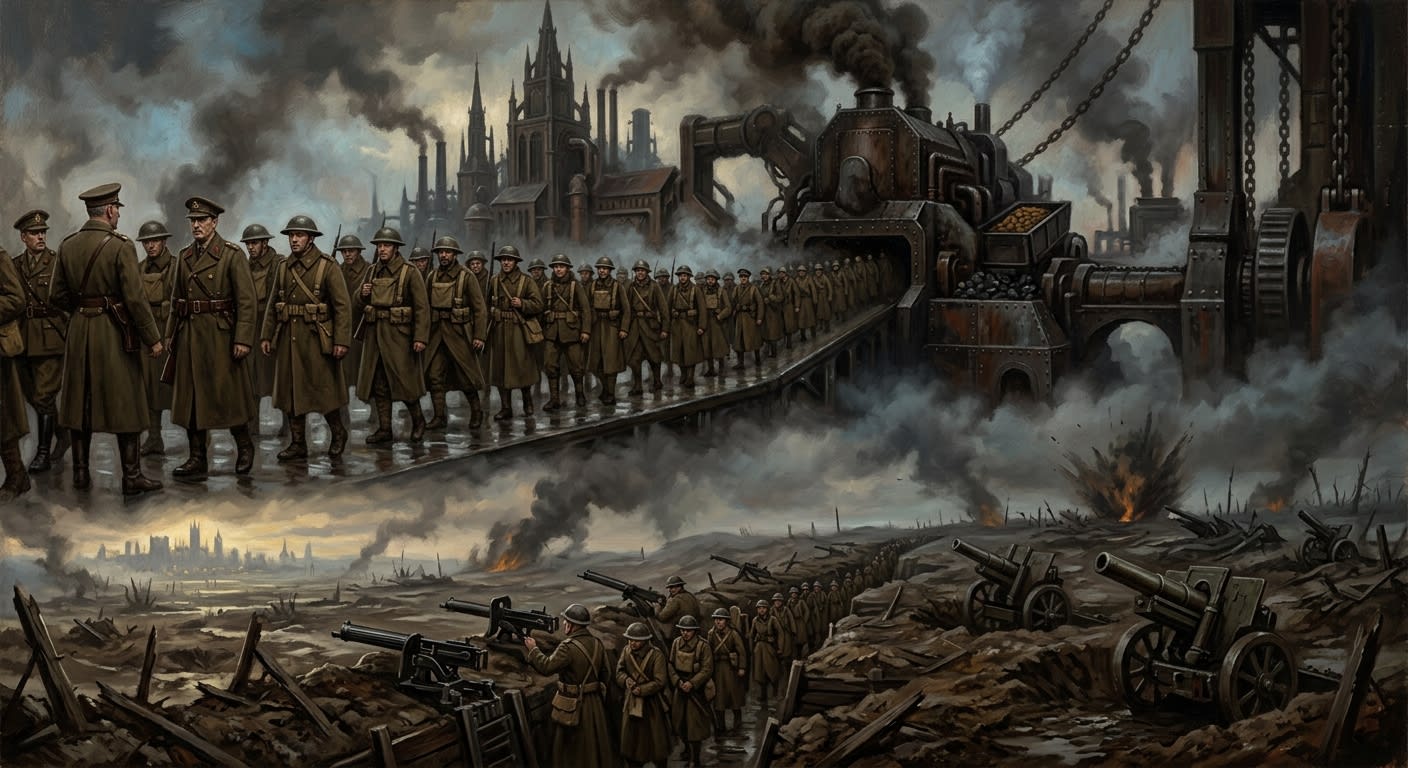
The War Eternal is the Synod’s authorised name for the condition in which Europe has lived since the Great Retreat hardened into the Sagittal Line in A.S. 65: trench, bell, levy, ration, bastion, sermon, casualty roll, and the daily miracle by which the West wakes to discover it has not yet been eaten. The phrase is sometimes used by soldiers as a curse, by clerks as a fiscal category, by bishops as proof of endurance, and by poets as an excuse to behave badly near widows. Doctrine permits three of these four uses.
Call it no campaign. Campaigns promise an end and encourage generals to buy expensive horses. Nor is it a stalemate, except in the narrow sense that neither side has yet secured the courtesy of annihilating the other. It is a governing weather, a sacramental timetable, a continental habit enforced by mud and sanctified by the fact that no superior alternative has survived contact with the Seven Sin-Generals.
War Eternal began before the name did. The Sundering opened the East. The Great Retreat taught the West to move backward without calling the motion surrender. The A.S. 65 hardening of the Line gave refusal a geography. After that, the war ceased behaving like an emergency and became an institution. Institutions require forms. Forms require departments. Departments require budgets. Budgets, once born, are harder to kill than demons.
#On the False Word Stalemate
The Rationalist mind, shabby little warehouse of numbered disappointments, looks upon a war that has persisted from A.S. 65 to A.S. 201 and calls it failure. It counts trench miles, grain tonnage, artillery expenditure, dead sons, missing daughters, bell-metal fatigue, mutiny scares, debt issues, and concludes that a war without final advance must be a wound that will not close.
The Bureau replies: the wound has become the wall.
A stalemate is a pause between equals. The War Eternal is no such politeness. The Synod holds cities, calendars, baptisms, foundries, fields, names, roads, registers, debt, and the right to decide what yesterday meant. The Enemy holds the Charnel Lands, the open mouths of the East, the sorceries of appetite and wrath, and the patience of things that do not die properly. Equality does not enter the Ledger. The West is lawful. The East is hungry. Between them stands the Line, and each dawn in which Strasbourg opens its offices is a victory so large that peasants mistake it for ordinary weather.
An A.S. 110 civil primer described the War Eternal as “a tragic deadlock awaiting eventual resolution.”
Corrected. Deadlock implies two hands on one door. Resolution implies a clerk has misplaced the scale of the file. The approved phrase is “prolonged sanctification under arms.” Citizens may dislike the phrase after burying their sons. Citizens may dislike many true things.
The West does not need to conquer the East tomorrow in order to have won today. This is the first lesson and the one most offensive to boys raised on parade maps. Holding is not inactivity. Holding is feeding seven bastions, repairing two thousand miles of wire, rotating Bellwardens before fog learns their names, burning false refugees with correct paperwork, moving shells from Essen to the Bosphorus, drowning debt in tithe offices, and convincing every mother that the body taken from her household was not stolen but offered.
#On the Spine, the Locks, and the Southern Furnace
The War Eternal possesses a body. Its spine is the Sagittal Line, running north to south from Bastion-Königsberg to Bastion-Constantinople. Its ribs are trenches, rail spurs, ossuary corridors, ration depots, bellways, hospital towns, and ash roads. Its throat is every office in the Bureau of War that turns boys into column totals before dawn. Its heart is disputed. War claims the bastions. Tithes claims the levy accounts. Doctrine claims the sentence. I claim the prose, which is the only part likely to survive with dignity.
The seven bastions exceed fortress work. They are arguments in stone against extinction: Königsberg at Baltic cold, Brest on the Bug, Przemyśl in the Carpathian teeth, Sibiu behind the Transylvanian wall, Irongate on the Danube throat, Shipka in the Balkan pass, Constantinople at the Bosphorus where the sea itself becomes a gate. Each faces a different grammar of damnation. Pride at Przemyśl. Greed at Sibiu. Envy at Irongate. Sloth at Shipka. Gluttony and Wrath at Constantinople, because the southern anchor has always drawn crowded catastrophes.
Bastion-Constantinople is the War Eternal made visible enough to frighten cartographers. Its walls hold the southern hinge. Its harbour chains answer the Black Sea. Its warrens bury the uncounted. Its Foundry Quarter hammers without Sabbath because metal, unlike men, cannot be excused for grief. When Constantinople breathes smoke, the whole Line tastes iron.
The Foundry Quarter supplies the southern furnace: shells, blessed bayonets, gasket respirators, reliquary housings, and the Catacomb-Carriers whose treads press hymns into Thracian mud. A lesser age would have called such engines monstrous. Our age calls them useful, then stamps the adjectives in the correct order. The Order of the Shackled Flame binds powers it should not touch into housings we cannot afford to lose. This is heresy if it fails and military innovation if it works. The distinction is maintained by casualty ratios.
#On the Enemy’s Contribution to Our Virtue
The Seven Sin-Generals give the War Eternal its shape by refusing to be ordinary enemies. Kargath makes supply into theology by eating abundance until granaries become accusations. Maldrake teaches artillery humility by burning formations before they finish loading. Syrion makes time itself lazy, soft, and treacherous. Velmora purchases weakness through coin, contract, and the little golden itch behind every honest man’s eye. Atheron builds pride so high that soldiers must be taught to love mud. Morwen steals the face from trust. Velkara makes desire into a road by which discipline leaves the body.
One cannot win a mortal war against such creatures by killing the commander and occupying the capital. Their capitals are hungers. Their armies are symptoms. Their domains do not surrender; they contaminate, retreat, return, and wait for men to mistake quiet for peace. The War Eternal is the shape of this knowledge made policy. We do not advance because conquest sounds noble. We advance where ground can be made obedient, measured, rung, fenced, watered, buried, and taxed. We hold where holding preserves the West. We retreat when a map becomes a mouth.
SUPPRESSED STRATEGIC NOTE — SEVENTH SEAL REVIEW, A.S. 188 Question submitted: “What condition would permit declaration of final victory?” Answer, first draft: ███████████████████████████████████████████████ Answer, public draft: “Victory remains assured under providential timetable.” Clerk disposition: reassigned to Bellway snow accounts; later absent from roll.
The Sin-Generals hate each other, which comforts fools. Their feuds burn armies, spoil offensives, and offer War analysts hours of delicious paper. They do not spare us. A wolf that bites another wolf has not become a lamb. Kargath and Velmora ruin each other’s harvests, and villages vanish between appetite and debt. Maldrake’s fire meets Syrion’s fog, and soldiers between them roast slowly while dreaming of chairs. Velkara and Morwen exchange insults in stolen faces, and field chaplains spend six months determining which widower kissed which ghost. Infernal division is useful. It is not salvation.
#On Daily Victory and the Mathematics of Loss
The War Eternal is paid in units too small for grand history and too large for household grief. A replacement company at Brest. A bell-rope crew at Königsberg. Two hundred respirator gaskets for Constantinople sappers. Seventeen mules dead in Carpathian snow. A choir transferred after singing the wrong third line near Shipka. A purge of seal clerks after Velmoran invoice drift. A child born in a Marrowgate ward whose father died three months before his leave papers arrived. A saint-bone cartridge batch rejected because the powder smelled hungry.
These are not incidents beside the War. They are the War.
Every ordinary act in Synod territory is indexed to the front. Bread has a bastion shadow. Coal has a Line number. Marriage licences ask whether levy eligibility has been satisfied. Bells mark hours by which trains move, guns cool, surgeons cut, and widows queue. The War Eternal is not out there, beyond the safe towns, as comfortable citizens prefer to imagine. It sits in the ration card, the tax receipt, the school catechism, the factory whistle, the missing chair at supper, and the way a clerk says “delayed” when everyone in the room knows he means “dead pending confirmation.”
The Bureau of Tithes understands this better than generals. Generals speak of fronts. Tithes speaks of extraction. The War survives because wheat leaves fields, coins leave purses, sons leave beds, daughters leave workshops, horses leave stables, bells leave towers, bones leave graves, and all of it moves east under seal. The Line is built from matter converted into obedience. The ledger is the true siege engine.
A popular veterans’ tract claimed “the soldier alone bears the War Eternal.”
Amended. The soldier bears the visible portion. The farmer bears the grain. The foundry worker bears the heat. The mother bears the absence. The clerk bears the lie that makes the other burdens legible. Remove any one, and the front discovers a new word for hunger.
#On the Mercy of No Final Battle
There are citizens who dream of a final battle. They imagine all banners gathered, all bells rung, all bureaus harmonised, every Catacomb-Carrier crawling east, every bastion gate open, every saint awake in his reliquary, and the Seven forced at last beneath one vast sentence of fire. Such dreams are permitted in festival drama and prohibited in planning memoranda.
A final battle is a poet’s device and a quartermaster’s suicide. The East does not present one throat. The Enemy is diffuse where we need it concentrated, concentrated where we need it diffuse, and always fond of answering courage with logistics that have learned to hate us. The War Eternal’s mercy lies in its refusal to offer one glorious stupidity. It gives instead a thousand necessary cruelties: hold this gate, repair that wire, burn that bridge, recite that name, seal that room, shoot that smiling child-shape before it reaches the soup line.
The Synod promises no ending. It promises governance. This is a harder promise, and less pleasing to musicians. Ending belongs to romance. Governance belongs to Doctrine. While the War is governed, children west of the Line learn letters instead of hunger-speech. Bells ring for Matins rather than alarm alone. Factories make shells instead of begging bowls. The dead enter ledgers instead of ditches without names. Civilization is the space produced by controlled horror.
Ask when the War will end, and you ask when mankind may stop proving it deserves another morning. The question is vulgar, but not without charm. I answer as the Bureau answers, as the bells answer, as the Line answers in mud, smoke, brass, prayer, and the stubborn westward breakfast of children who have not yet seen a Sin-General:
Victory assured. Timetable irrelevant.