
#On the Shelling of the Southern Hinge
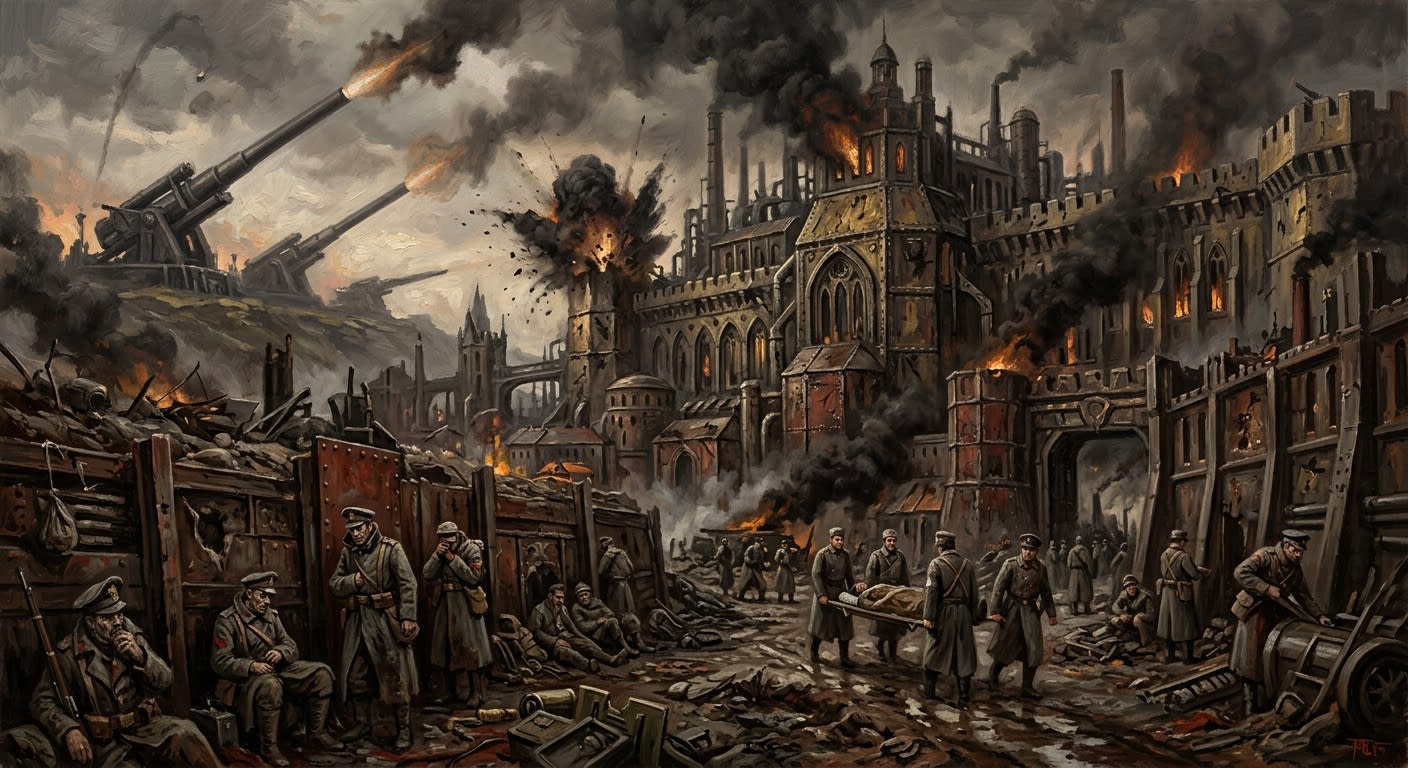
The Bombardment of Bastion-Constantinople belongs to A.S. 182, during the Wrath-tide offensive (Unregistered), when Maldrake's furnace batteries found the range of the southern hinge and spent eleven days teaching stone to cough. Later training sheets reduce the affair to its famous absurdity: a Tribune-Chaplain named Seraphinus (Unregistered) composing fourteen stanzas on dysentery while shells cratered the ground around him. This is accurate, which is not the same as sufficient. A state that remembers only the sermon has already decided which corpses were literate enough to matter.
Bastion-Constantinople had survived worse. That sentence appears in every comfort memorandum ever written about the place, usually by men whose windows do not rattle when the Thracian guns wake. The bastion survived the first twenty-year burning. It survived the Year of Ash Rain. It survived the Black Sea Armada, the Three-Night Bombard, the Silence of Harbor Lamps, and the daily insult of being necessary to Strasbourg while being too large for Strasbourg to command. Survival does not make each new calamity smaller. It merely gives the clerks older folders to copy.
The Bombardment began before second bell on the fourth day of Ashwane (Unregistered), though the first official report moves the opening to third bell so that the garrison's delayed counterfire appears less delayed. Thirty-seven shells struck the outer Thracian works in the first hour. Five struck the Ravelin of Fortitude. Two passed over the walls and detonated in the Hammers (Unregistered), among sleeping levy companies whose ninety-day rotation had been extended twice because relief trains were busy elsewhere proving that logistics is merely theology with wheels.
#On the Wrath-Tide Offensive
Wrath-tide is the soldiers' name, which makes it more useful than the Bureau's. War called the offensive a seasonal massing of Maldrakean assets along Operational Zone Ferrum-North (Unregistered). Doctrine called it a chastisement permitted for the strengthening of zeal. Records called it file cluster 182-SH/Ferrum. Men under shellfire called it Wrath-tide because the barrage came in pulses, red at dawn, brass by noon, black at night, each surge arriving with the punctual cruelty of a tide-table written in Hell.
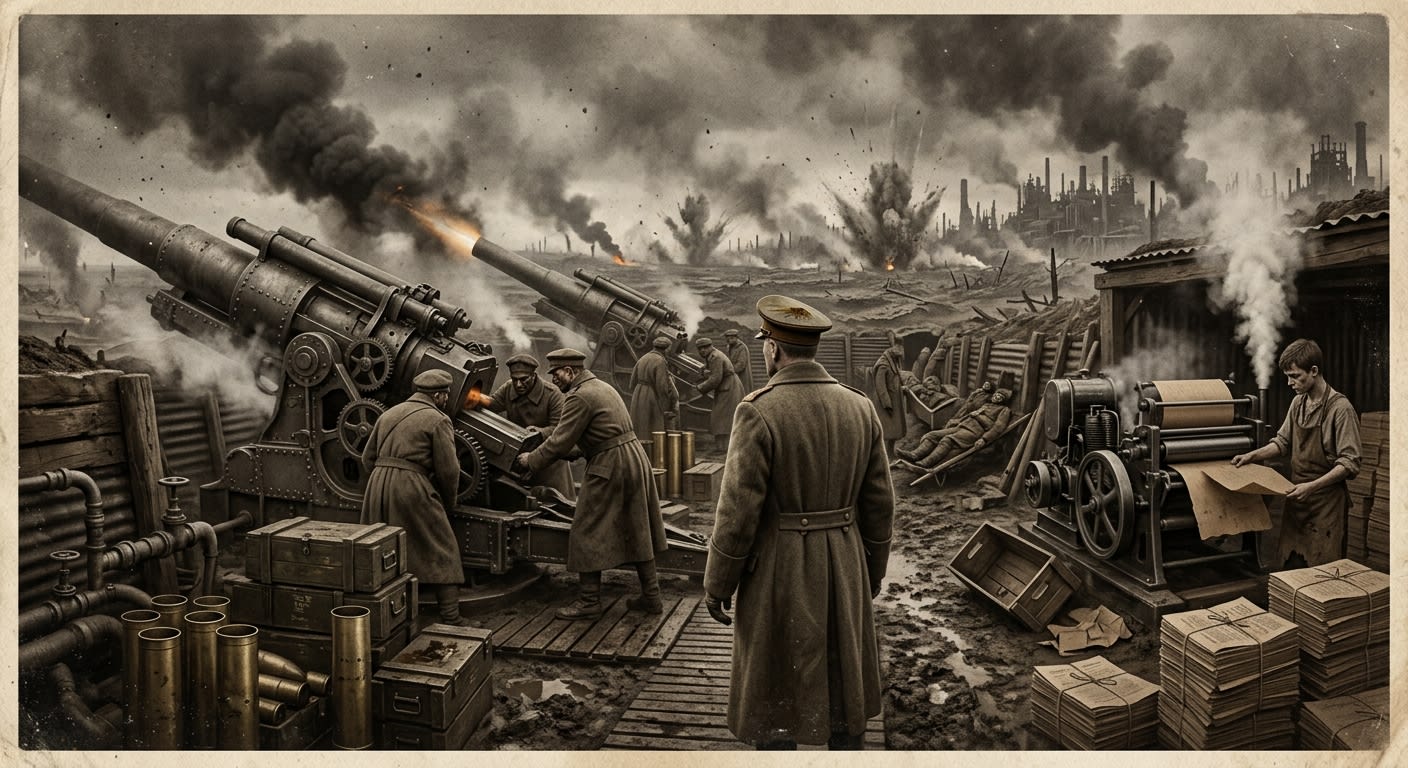
Maldrake did not intend a clean breach. That is the comfortable lie told in rear academies where maps are flat and officers are thin. His purpose was pressure: crack the outer works, poison the latrines, interrupt the harbor convoys, exhaust the Litany-Engineers, force War into wasteful counter-battery sequences, make men sleep in fragments until obedience itself frayed. Wrath does not always roar. Sometimes it files requisitions against the body.
The hostile guns were sited beyond the clean range of the Ravelin batteries, dug into slag-shelves left from older fires in Thrace. They fired shells filled with brass splinters, corpse-lime, and heat that persisted after detonation like an argument refusing dismissal. The Bureau of Engineering recorded “thermal adherence.” The soldiers called it clingfire (Unregistered). A coat touched by it smoked for hours. A man touched by it learned what his bones smelled like.
The first two days belonged to masonry. Curtain faces flaked. Prayer-niches burst. Bellway glass shattered. A shrine to Saint Isidore lost its roof and retained its femur, which Relics immediately took as proof of authenticity. By the third day, the bombardment had moved inward, finding kitchens, cistern mouths, latrine trenches, stretcher runs, and the lower corridors where the sick were housed because no sensible architect gives fever a view.
#On Dysentery, Ration Water, and the Lower War
The famous homily did not arise from literary caprice. It arose from bowels, as many doctrines do when stripped of incense.
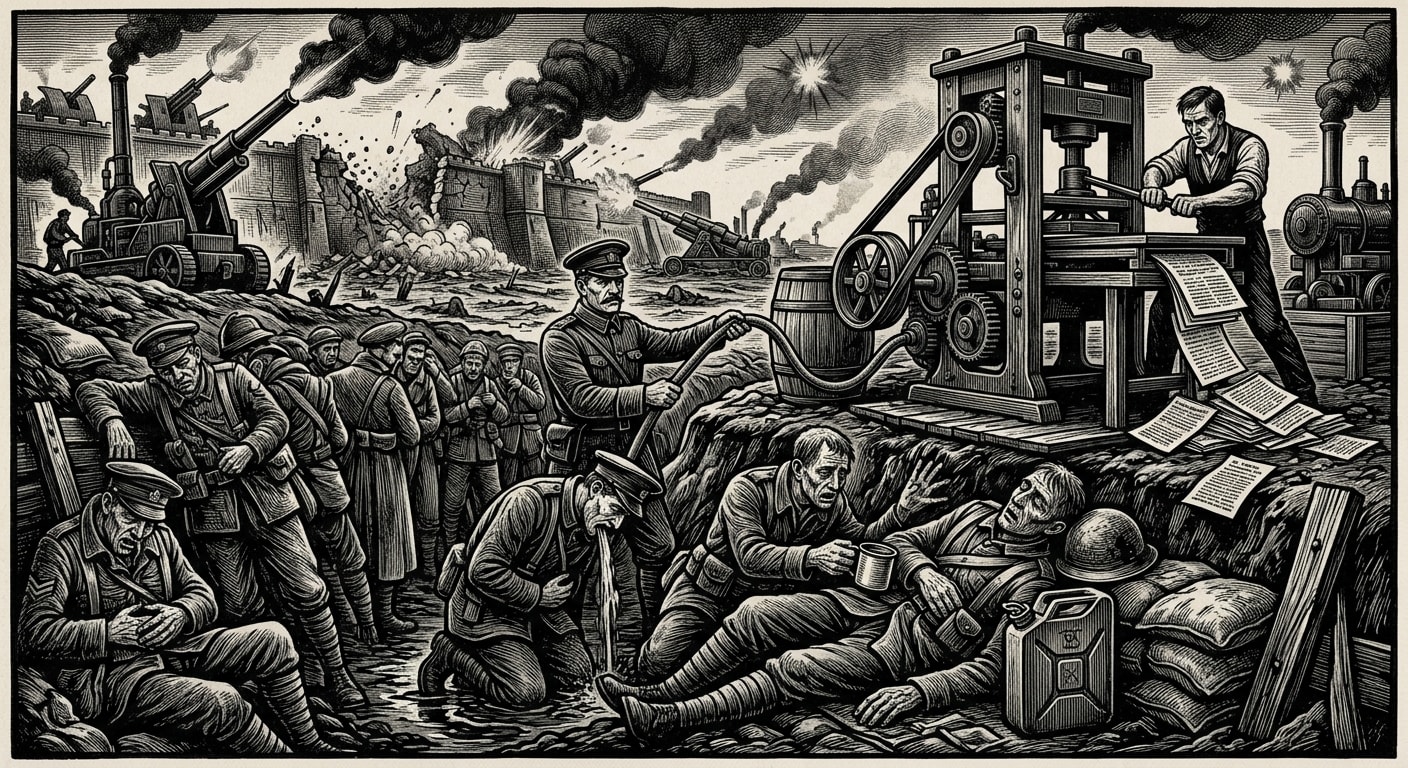
The Bombardment broke three water conduits feeding the Hammers and the western infirmary galleries. One carried clean cistern water. One carried grey wash. One carried the polite fiction that fortress drainage obeyed plan. The shell that struck Junction D-17 (Unregistered) converted all three into a theological mixture. By the second night, the lower barracks were fouled. By the third, the fever benches filled. By the fourth, men were collapsing in firing lines from gut-sickness while War continued to ask them for posture.
Early Bureau of War summaries describe the illness during the Bombardment as “camp flux aggravated by stress.”
Corrected. The primary cause was shell damage to water infrastructure at Junction D-17, compounded by delayed repair access, ration-water confusion, and command reluctance to admit that the fortress's lower channels had become an enemy instrument. Stress did not fill the cistern with filth. A shell did.
Dysentery is an undignified word, which is why soldiers trust it and sermon writers attempt to redeem it. The disease reduced rank with democratic efficiency. Levy boys, officers, Vexillators, mule drivers, two Ash Chaplains, and a sub-archivist attached to Records all found themselves obedient to the same abdominal bell. The infirmary screens ran out first. Then clean rags. Then euphemisms.
Tribune-Chaplain Seraphinus entered the lower galleries as a field liturgist assigned to morale discipline, not as a physician, which spared him the temptation to be useful in the ordinary way. His later defenders insist he brought courage where medicine could not reach. His detractors note that medicine did not reach partly because the passage assigned to medical carts had been reclassified for shell movement. Both readings may be filed. Only one received a print run.
#On Tribune-Chaplain Seraphinus
This Seraphinus was not Legate Seraphinus of Lyon, despite provincial retellings, sermon merchants, and the common appetite for one immortal fasting ghoul stalking every southern calamity. The first Seraphinus belonged to the hunger doctrine (Unregistered) of A.S. 112. The Bombardment's Seraphinus was a Tribune-Chaplain of the A.S. 182 War line, trained at Lyon, ordained into assault liturgy (Unregistered), and cursed by possessing a name too useful for confusion.
He had the qualities War admires in a chaplain: a carrying voice, a steady hand, an indifference to comfort, and the ability to turn a condition no sane man would choose into evidence that obedience had been present all along. Shells struck above him. Men fouled themselves around him. The air stank of hot brass, lime, shit, wet wool, blood, and candle smoke. He opened his field missal, found no approved prayer for intestinal collapse under artillery, and began writing one.
The homily's title varies. War prints it as Fourteen Stanzas on the Providential Emptying of the Body (Unregistered). Soldiers called it The Shit Psalm until a captain had three men flogged for accuracy. The first stanza compares the bowel to a breached gate requiring disciplined evacuation. The fourth blesses thirst as a censor of cowardice. The ninth declares that “the body that cannot retain corruption gives witness against Hell.” The thirteenth is, regrettably, beautiful.
He read the first draft while a stretcher party carried men past him. He revised the fifth stanza when a shell cracked the ceiling and dust fell into the ink. He completed the fourteenth beside a cistern hatch that could not be opened because the wheel had heated red and no gloves remained. The quartermaster note survives: “Men request medicine, clean water, stoppage of guns, or failing these, silence from the chaplain.” The note bears no sign of having been processed urgently.
LOWER GALLERY TESTIMONY — FILE 182-SH/D-17 Witness states Seraphinus paused after stanza eleven because a voice from inside the cracked conduit repeated the rhyme before he wrote it. Witness asked whether the voice was human. Witness answered: “It had excellent metre.” Disposition: witness transferred to Silence review. Conduit filled with blessed rubble. Rhyme retained in printed edition.
#On the Guns and the Counterfire
The bastion answered on the third bell, then the fourth, then with enough anger to satisfy observers who measure command by noise. Counter-battery fire from the Ravelin of Fortitude and the northern platforms walked across the slag-shelves. The Litany-Engineers ran charge sequences until their throats bled. Vexillators stood on exposed gantries because flags remain useful when signal horns drown. Tribune-Chaplains moved between gun crews, giving absolution in pieces short enough to fit between recoil.
The Bureau of War later praised the counterfire as “measured.” This is a word generals use when they have fired nearly everything and wish to sound temperate. Powder stocks fell below safety reserve on day six. The Foundry Quarter doubled shell casting despite furnace tremors. Two proof-ranges were converted into field chapels after their crews died and the guns continued settling themselves into firing posture, which Engineering blamed on recoil memory and Doctrine blamed on zeal.
On day seven, Maldrake's batteries shifted from wallfire to yardfire. This was the true attack. Yardfire (Unregistered) kills systems: kitchens, stretchers, message runners, horse lines, water points, latrine boards, bandage stores, and the little covered corners where men pretend privacy remains a human entitlement. A wall can be repaired by masons. A yard under continuous fire becomes a doctrine of exhaustion.
The garrison's answer was ugly and effective. Counter-sorcery verses were shortened without permission. Furnace charges were fired on half-cadence. Ash Chaplains used reliquary dust beyond approved density and then pretended the air had thickened by miracle. Three Vexillators crossed the west yard under bombardment with signal cloth tied to stretcher poles after their standards burned. Two reached the opposite gallery. One became, in Records language, “unrecoverable by shape.”
The first printed War account credits victory to strict adherence to Trenchline Harmonisation (Unregistered) schedules.
Amended after Engineering logs surfaced showing half-cadence firing, unsanctioned verse abbreviations, and emergency fuse timings entered under false bell marks. The schedules were honoured where possible. Where impossible, men survived by heresy small enough to be forgiven after success.
#On Publication and Applause
The Bombardment ended the way many artillery events end: without ceremony, without surrender, and without any party admitting the other had chosen the hour of silence. The hostile guns fell quiet on the eleventh night. The garrison continued counterfire into empty slag for six hours because no one trusted quiet from the east. Dawn showed the outer field smoking, the shells spent, the dead counted badly, and the lower galleries still stinking.
Seraphinus's homily reached Strasbourg before several casualty packets. This has been interpreted as proof of War's reverence for field testimony. It is also proof that sermons travel faster than bodies, being lighter and less inclined to leak. The Bureau printed the fourteen stanzas, distributed them to chaplain schools, ordered readings in selected War halls, and received applause from men who had never knelt over a trench latrine while shells walked closer.
The soldiers wanted medicine. Both requests were processed, as the Tribune-Chaplain article notes with admirable cruelty. One was answered faster. Medical stores arrived in staggered lots over the next thirteen days, delayed by route priority disputes and a Passage hold at the southern rail transfer. By then, the worst of the sickness had burned through the lower galleries, leaving the survivors hollow, furious, and available for sermon readings.
Seraphinus was promoted. Two weeks later he contracted the same sickness he had sanctified and died after three days, reportedly asking for water, then silence, then correction to stanza nine. The Bureau granted the correction. The water record is incomplete.
#On the Memory of a Bombardment
The Bombardment's material damage was repaired within eighteen months. Junction D-17 was rebuilt with three separate conduits and a sign forbidding theological commentary by maintenance staff. The Ravelin scars were filled. The Hammers received new barrack slabs, new drainage gradients, and a memorial tablet listing “those emptied in service,” a phrase I admire against my will. The slag-shelves beyond range remained hostile. Maldrake did not apologize, which shows his lack of administrative breeding.
The event's real afterlife lives in War pedagogy. Tribune-Chaplains study the homily as evidence that field liturgy may be composed under medical collapse. Litany-Engineers study the counterfire logs in private and the corrected logs in class. Vexillators inherit the west-yard crossing as banner precedent. Quartermasters mutter Junction D-17 when officers request “temporary” rerouting of water carts. Surgeons (Unregistered) despise the affair with the special hatred reserved for preventable doctrine.
The public plaque calls the Bombardment a demonstration of spiritual endurance under Wrath. The private engineering appendix calls it a water failure under shell stress. The chaplain schools call it a model of sacramental improvisation. The veterans call it eleven days in which the guns, the bowels, and the Bureau all fired at once.
At Bastion-Constantinople, the repaired stones still hold heat on Ashwane mornings. Men touch the Junction D-17 marker before descending to the lower galleries, not out of reverence, whatever the plaques claim, but from the practical superstition of soldiers who know that pipes, shells, sermons, and bowels all possess schedules of their own. Above them, the bells govern the hour. Below them, the conduits mutter.