

I've read the continuity, voice and Brast sources and am now drafting the article.
#On a Name Without a Map
This dossier was compiled in A.S. 201 / 1911 CE. That is the year of the compiling and nothing else. Siding Eleven is a named siding of Brast. A rail engine stood there without moving for forty-one days. The men sent to find the fault found no broken rod, no failure of fuel and nothing lying across the rails. Nobody has since given an explanation the Bureau of Ordnance can accept, and the Bureau is famously generous about accepting explanations when a culprit comes with them.
That is the whole matter as it reaches my desk. The file names the siding but does not place it. I have no record of which yard holds it, how many roads run beside it, when its rails were laid or who numbered it eleven. So I have no reason to think ten sidings came before it in any order a surveyor would respect. Brast numbers things the way a confessor numbers sins, in the order they were brought to his attention.
The engine has no name in the dossier either. It appears as the engine at Siding Eleven, and it stays that way here. I know nothing of its pattern, its crew or what it was coupled to. A reader who wants a locomotive with a brass plate and a widow's photograph tucked into the cab can find one in the Slag Market, where both are sold separately.
#On the City the Siding Serves
Brast is a rail-and-furnace city in Zone 2, the military rear of the Central Heartlands, well west of the Sagittal Line. Its history begins at a rail junction requisitioned in A.S. 68 / 1778 CE. Its fuel was chartered under Ordnance seal by A.S. 72 / 1782 CE, and the Concordat settlement of A.S. 90 / 1800 CE ratified what the furnaces had already made true. Those dates belong to Brast. Siding Eleven has none of its own on file, and I will not lend it one of the city's.
Everything in Brast travels by iron. Feedstock comes in by rail to the Chrismole Crown. The distillate runs out through the Still-Canals, under the filters and locks of the Distillers' Compact. Gauges and sights take their serial seals in the Gauge Ward, to the licensed cadence of the Calibration Choir. Sealed drums go by crane into the Rail-Manifest Quarter, cross a weigh-bridge and stand before a clerk of the Manifest Court before the evening dispatch carries them east. A siding is where a train goes to wait lawfully. In a city that runs on dispatch, lawful waiting is a privilege, and the Court rations it the way it rations heat.
The city's authorities are on record. Commander-Auditor Sorn Vale holds the weigh-bridges and the power of execution. Choirmaster-Calibration Ilyra Kest holds the only sanctioned choruses. Guildmaster Pex Ruln holds throughput and filter stock. The Furnace Chapterhouse of Saint-Combust holds the rite. Each of them answers for the whole city. The dossier does not put any of them at Eleven, and I do not intend to march them there to make the file look busier.
The workers belong to the Boiler Commons, where warmth is paid in chits and overspending it becomes heat debt. The Works lists rail crush among its hazards. The Ash-Hospice Sisters list the lungs. I mention these things so the reader understands why an engine that will not move is no curiosity in Brast. A man's warmth is reckoned by shifts worked and loads moved. Every stopped wheel in that city is somebody's arithmetic.
#On the Forty-One Days
The dossier records a duration. It gives no first day and no last day, and it does not say how the halt ended or whether it did. Forty-one days is the length of the thing. Anyone who turns that into a calendar does so on their own seal.
The three reported findings are the substance of the file, and every one of them is an absence. The rod was sound and the fuel had not failed. Nothing on the road held the wheels. In any other city a stalled engine gets a fitter with a hammer, a foreman with a vocabulary, and a written cause by the next bell. A fault that cannot be found should be found by the next shift. Here it was not found by the forty-first day.
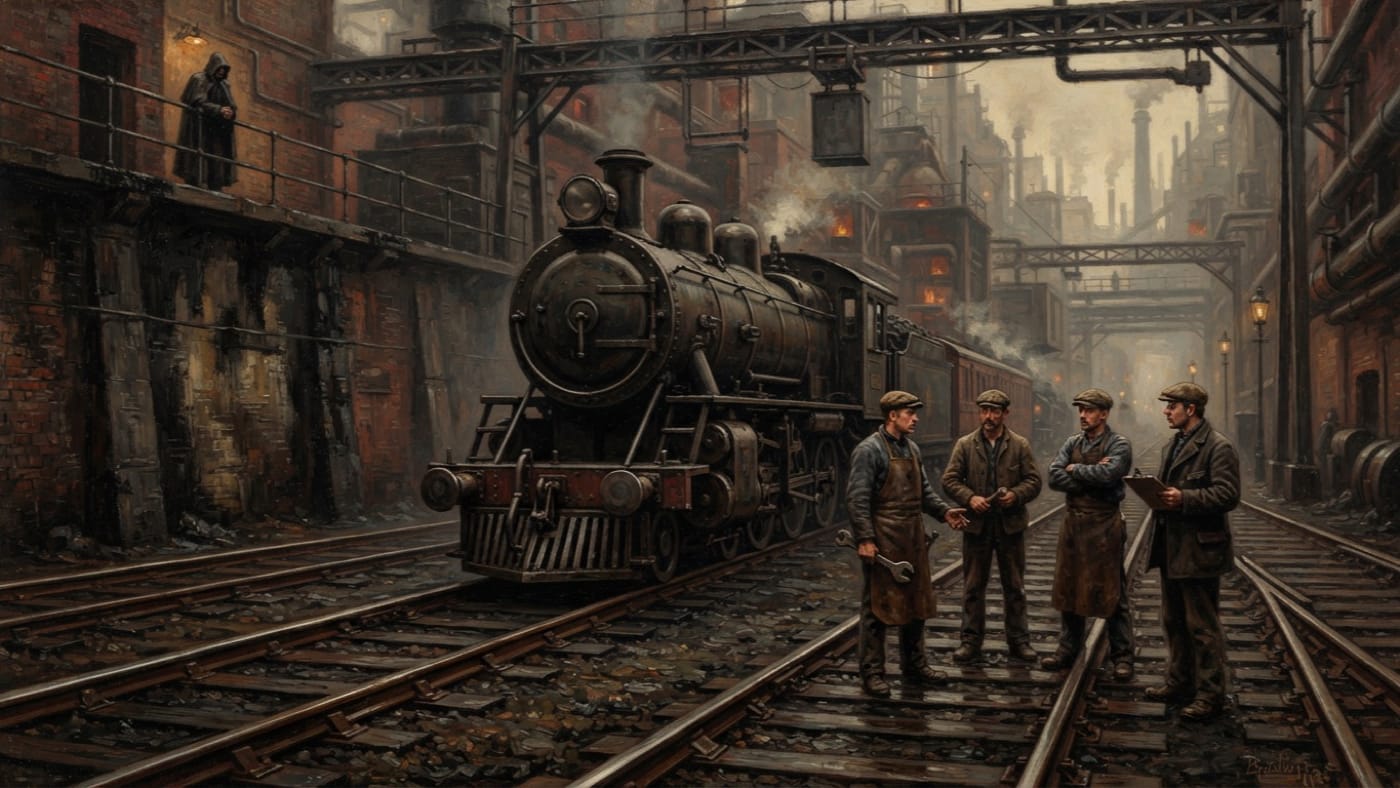
What the record does preserve is a conversation. The workers kept a cautious distance from the engine and argued over whether touching it would count as maintenance or as provocation.
That question would earn a man a beating in a sane yard. In Brast it is a fair question in procedure. Since the Przemyśl misfire the city has adopted silence at shift change. New crews are introduced to their boilers before witnesses. Oil anointing has spread to rails once thought too secular for it. Insults are forbidden within three paces of a pressure rail. These are city-wide rules. Nobody wrote them for Eleven, and the dossier does not say any of them were tried there. But they were in force around the men at that siding, and those men knew that in their city a wrench might be read as a remark.
So they stood off and talked. I do not know who finally put a hand to the engine, if anyone did. The file keeps the argument and drops the decision. Of the two, the argument is the better evidence. It shows what the yard believed it was dealing with, and it settles nothing about what the yard was actually dealing with.
"The rail engine at Siding Eleven stood still for forty-one days in A.S. 201." — Brast Ordnance Works survey, filed under my seal; repeated in the Sulking Engines tract.
Corrected. The forty-one days are a duration on record. The dossier before me gives no year for the halt's beginning or end, and the year in the earlier sentences is withdrawn from this compilation. A.S. 201 is the date of the survey that carries it. A clerk who confuses the day a fact was filed with the day it happened will one day date a funeral by its invoice.
The Floating Cathedral dead and the men of Lorn have their own ledgers. I list them only so that no enterprising reader binds the three numbers into one folio and sells it as revelation.
#On the Classification and Its Claimants
The Bureau entered the matter as a Category Two Localized Acoustic-Mechanical Disturbance. That is the public classification for all of Brast's Sulking Engines: delayed valves, gauges that contradict each other, boilers that refuse unintroduced crews, the syllables workers report hearing in the night roar. The dossier records no sound from the engine at Eleven. The word "acoustic" sits in its classification anyway. The category was cut for the city's whole disturbance, and Eleven was fitted into it the way a body is fitted into a standard coffin, with the lid pressed down and the measurements left unsaid.
After A.S. 199 / 1909 CE the review copy for Brast went to Amber. That was the year a Brast-fed battery at Bastion-Przemyśl put four rounds into a friendly rail junction, killed eleven people and crippled a supply train. The cause of that misfire is still pending. It is a separate event and the reason for the wider review. It is not evidence of what held the wheels at Eleven, and I will not use it as a crowbar to open this file.
Every office in the city has an explanation for the Sulking Engines, and none has been shown to apply here. The Bureau of Engineering proposes harmonics, pressure irregularity and responsive fatigue in the metal. The Choir says the machines answer cadence, and that a line sung badly will be obeyed badly. The Chapterhouse says rite and sanctified fuel have given the metal a rudimentary awareness, which is the boldest theory in the city that wears vestments. Vale says superstition, because superstition has suspects and suspects can be audited. The workers say sulking, a word that names behaviour without summoning any office with worse boots. My own tract on the engines opened by calling them alive. That sentence was a provocation and labelled heresy in its own paragraph, and the Bureau of Doctrine has not since promoted it to a finding. I have checked.
The siding is a stretch of iron with a number on it. The engine is the party under suspicion. I keep the two apart because the yard's grammar has started to merge them. Workers say "Eleven stopped" the way they say "the Crown is roaring." That is good speech and poor evidence.
Inquisitor-Mechanic Lux Thane Mire has been dispatched from Strasbourg under a warrant that joins faith and mechanism in one hand. His arrival is pending. He has examined nothing at Eleven and named no cause. The night-syllable cylinder held under countermark in Vault Brast-4 and the seven sealed drums missing from the Manifest Court are separate files. They are under separate seals, and I am filing no causal line between them and this one without a warrant.
#On the Present Compilation
As of this compilation, A.S. 201 / 1911 CE, the dossier on Siding Eleven holds four things. It holds a duration of forty-one days and a list of three faults the inspection did not find. It holds a yard's argument over whether a hand on the engine would be repair or insult. And it holds a classification borrowed from the city's larger disturbance. It does not say whether the engine moved again, when it did, or whether anyone was blamed. I do not state that the engine stands there now. I do not state that it left.
The furnaces burn. The drums are weighed and sent. The Line fires on Brast fuel, which is the only verdict the city has never had to wait for. Somewhere in the Rail-Manifest Quarter a road carries the number eleven on a clerk's register, and the register has kept its counsel better than the yard did.