

#On the Repository and the Running Furnaces
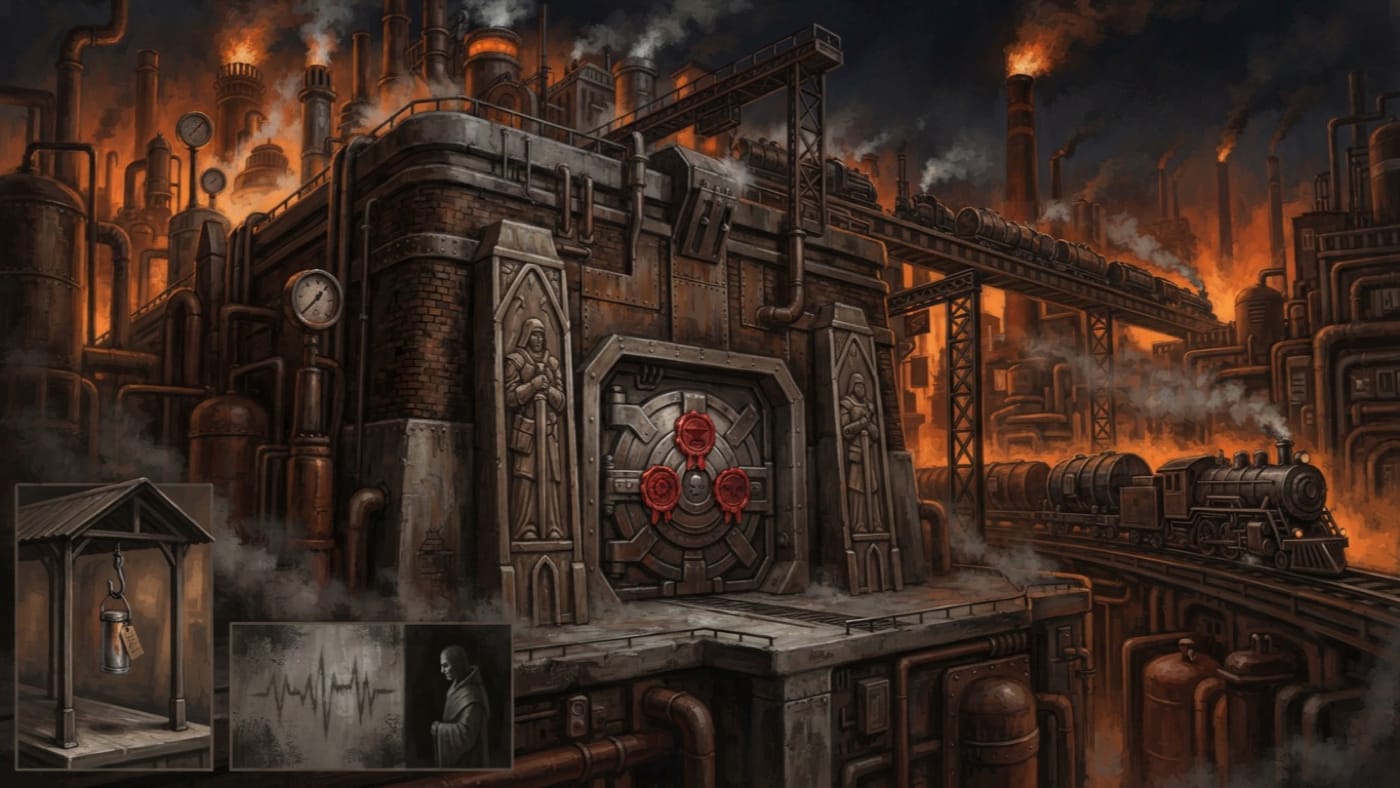
Vault Brast-4 is where the Synod keeps a sound it wishes it had never heard and cannot afford to lose. The published record of Brast names three things: the repository, its most dangerous tenant, and the terms of that tenant's confinement. A wax cylinder holding a recording of the night-syllable rests there under countermark. The Bureau of Ordnance files the same custody as triple seal. After those phrases the record goes quiet with the discipline of a well-trained clerk. I propose to respect the quiet, since I did not write it and cannot be blamed for it.
No register available to me names the vault's district. Nobody has published a plan of its rooms, the date of its first bolt, or the names of the men who carry its keys, if keys are what it uses. Readers who want a fortress should apply to the novelists. This survey concerns what the vault holds, why it holds it, and who in Brast lies awake because it does.
Outside, the furnaces keep burning. That is the first fact of the place, and the most offensive one. The kilns of the Chrismole Crown go on rendering fuel. The pressure bells go on dividing the city's night into lawful portions. The drum trains go on leaving for the guns of the Sagittal Line. Whatever the cylinder caught, it caught inside that roar. The roar has not been sealed. Only the cylinder has.
Everything that follows depends on that distinction. A city can lock up a recording. It cannot lock up the furnace night, because the Line would cool by the second week and the Bureau of War would arrive with opinions. So Brast is in the position of a magistrate who has sealed the testimony while the witness goes on talking in the next room.
The vault's purpose follows from this. It preserves evidence for an examination that has not yet happened, and it prevents further exposure to an object whose first playback did harm. The two duties hold the same wax between them and pull. Every hour the cylinder is kept, it stays available to answer questions. Every hour it is kept, someone may try to ask them.
#On Brast Around the Seal
Brast lies in Zone 2, the military rear. It is a rail-and-furnace city whose fortunes began in A.S. 68, when an officer of the emerging War authority requisitioned a coal-seam rail junction and built crude furnaces to feed forward artillery. Doctrine arrived to sanctify the product. By A.S. 72 the fuel had been sung over, named chrismole, and chartered under joint Ordnance and Doctrine seal. The Concordat settlement of A.S. 90 ratified what the furnaces had already made true: Brast was too necessary to be properly disapproved of. These are the city's dates. The vault has none in the published file, and I decline to lend it one of Brast's.
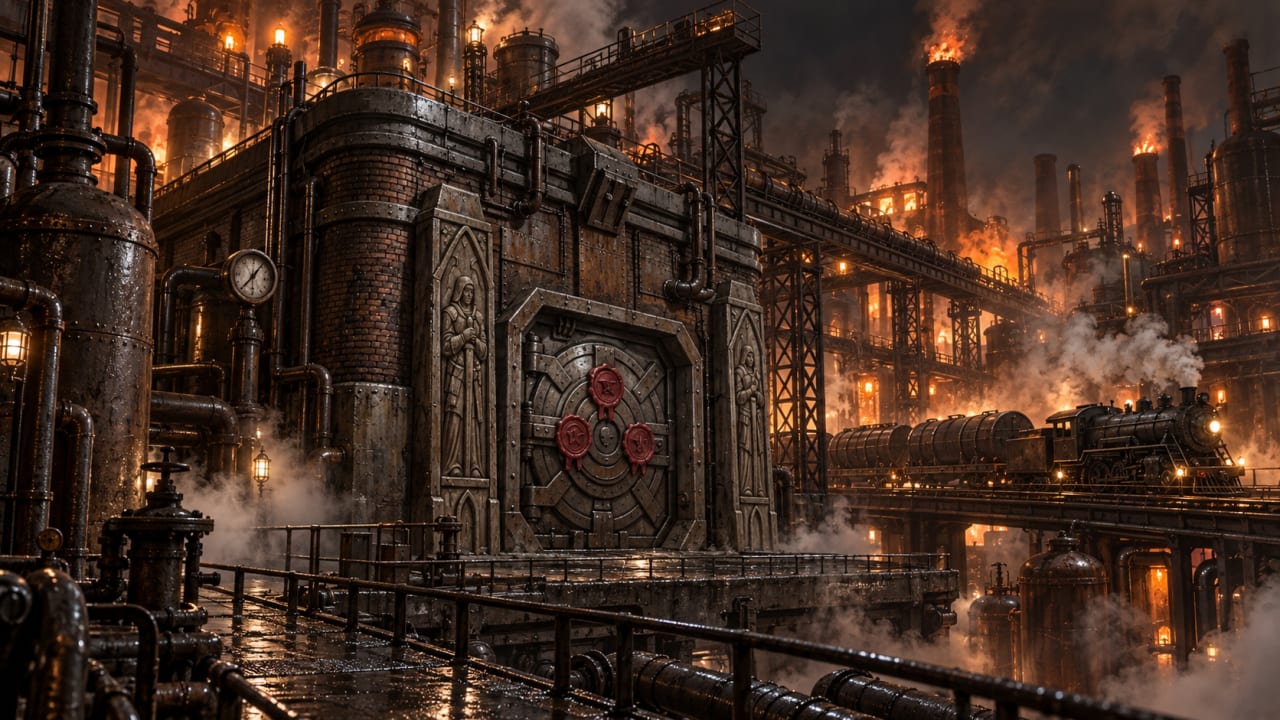
The city spreads in rings around the Crown. The Gauge Ward lies closest, all calibration benches and ranked pressure banks. The Boiler Commons sleeps and coughs beside the shift bells. The Still-Canals carry condenser water through the locks of the Distillers' Compact. The Rail-Manifest Quarter weighs and blames. Ash-Hospice Row sits downwind. The Slag Market sells whatever falls off the procession. Ninety-two thousand souls are registered among these rings. A shifting multitude is not, and Records accepts the variance the way a cellar accepts damp.
The city is built of kiln brick, rust-iron, bone-lime cement, tallow-wax seals and salvaged gauge glass. Pipe bridges cross the streets, catwalks hang under the soot, and warm tunnels run below. The air tastes of ash, hot iron, oil-incense and resin filters, and the metal underfoot hums. I list these so the reader may smell Brast. The file does not say whether any of them went into the vault, and I will not fill a blank wall with borrowed brick.
What matters for the vault is how the city arranges its power. Brast governs fuel, sound and time together, as one property. Pressure bells mark curfew and shift. Hymn-checkers at gates and bridges listen for licensed cadence. A calibration verse sung without licence is a matter for provosts. In Brast a voice that moves a valve is a tool of production, and every tool of production belongs to somebody. The Calibration Choir, called Kest's Measures, owes its practical power to being the only body permitted to sing sanctioned song to machinery. Its monopoly is a monopoly on what the machines are allowed to hear.
Into that arrangement the night brought an addition. Choir-technicians reported a syllable inside the furnace's night roar. It matched no hymn and no sanctioned interval, and no human throat would admit to it. A sound like that is a breach of licence with no licensee. If its first hearing is any guide, it is a hazard. It is evidence for any inquiry into the Brast machines. And it insults every office whose authority rests on owning sound. One box has to hold all of that, and the box has a number.
#On Custody and What the Record Contains
Four things must be kept apart. Every office in Brast has an interest in blurring at least one of them.
The first is the night-syllable itself, the reported addition to the furnace roar. It is a phenomenon. It occurs, or occurred, in the city at large, and nothing in the file suggests it has been confined anywhere.
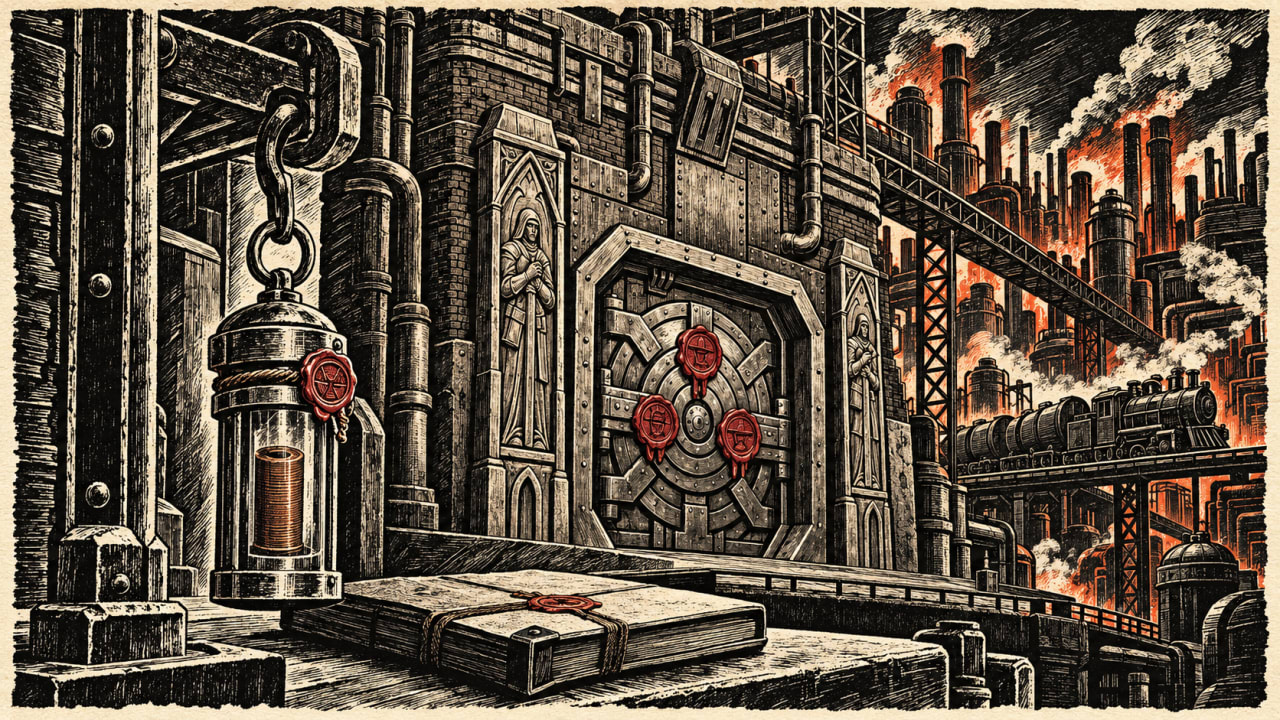
The second is the cylinder, the wax recording associated with that sound. It is an exhibit: physical, breakable, sealable.
The third is the transcript, the written account of what happened when the cylinder was first played. It is filed under the vault's designation. That means it was filed there. It does not tell you which room the playback happened in.
The fourth is the vault, the repository that holds the cylinder. It is a place, the subject of this survey, and the least talkative party to the matter.
Confuse the first with the second and you will believe Brast has captured the sound. Confuse the third with the fourth and you will draw a floor plan from a filing label. Both mistakes are popular, and both are for sale, hot, in the Slag Market.
The custody wording varies by office. Brast accounts say countermark. The Bureau of Ordnance says triple seal, and attaches that apparatus to the Mire warrant governing Amber review. Triple seal tells the reader that three seals bind the matter. It does not say whose seals they are, how many doors carry them, or whether three hands must meet to break them. I know the Synod's habits well enough to guess, and its archive well enough to keep the guess out of print.
The sealing hand is on record. Choirmaster-Calibration Ilyra Kest sealed the cylinder. The accounts agree on that, and on her stopping the first playback. The Gauge Ward record adds an account of transit. Inside Kest's glass booth, which workers call the Throat and clerks call Calibration Point One, a sealed hook held the Vault Brast-4 cylinder for one permitted transit before the night-syllable was locked away. One hook, for one passage. The account places the cylinder in the booth once, on its way somewhere else. It does not place the vault beside the booth, beneath it, or anywhere at all.
Ordnance Bureau summaries for A.S. 201 refer to "Kest's night-syllable," and Rail-Manifest notices to "Kest's wax-cylinder," as though she composed the sound and made the recording.
Corrected. The night-syllable belongs to no licensed throat, and that is the whole scandal. Kest sealed the cylinder and stopped its playback. The published file does not say who made the recording. The possessive has been withdrawn before some clerk in Strasbourg bills her for it.
Why preserve the thing at all? A cruder city would have melted the wax the night of the playback and filed the residue under maintenance. Brast cannot. In the whole Sulking Engine inquiry, the cylinder is the only exhibit that records the furnace doing something unprompted at a known moment in the working night. Every office in Brast has an explanation to defend, and every explanation will one day have to survive that recording. Destroy it and each office keeps its theory but loses its defence. Keep it and each office keeps its hope of acquittal along with its risk of ruin. The wax is the only party in Brast that cannot be bribed into a better story.
Three separate powers operate here. To preserve is to keep the wax whole. To grant access is to decide who may stand in a room with it. To interpret is to say what the sound means. The published record shows the first power exercised. The second has been limited to one permitted transit and one first playback. The third awaits an examiner who has not arrived. Brast has been allowed to hold the object. It has not been allowed to hold an opinion of it.
#On the Playback Record
Two published accounts describe the playback. They agree in substance and differ in vocabulary, which is the normal state of truth in a city with more than one ledger.
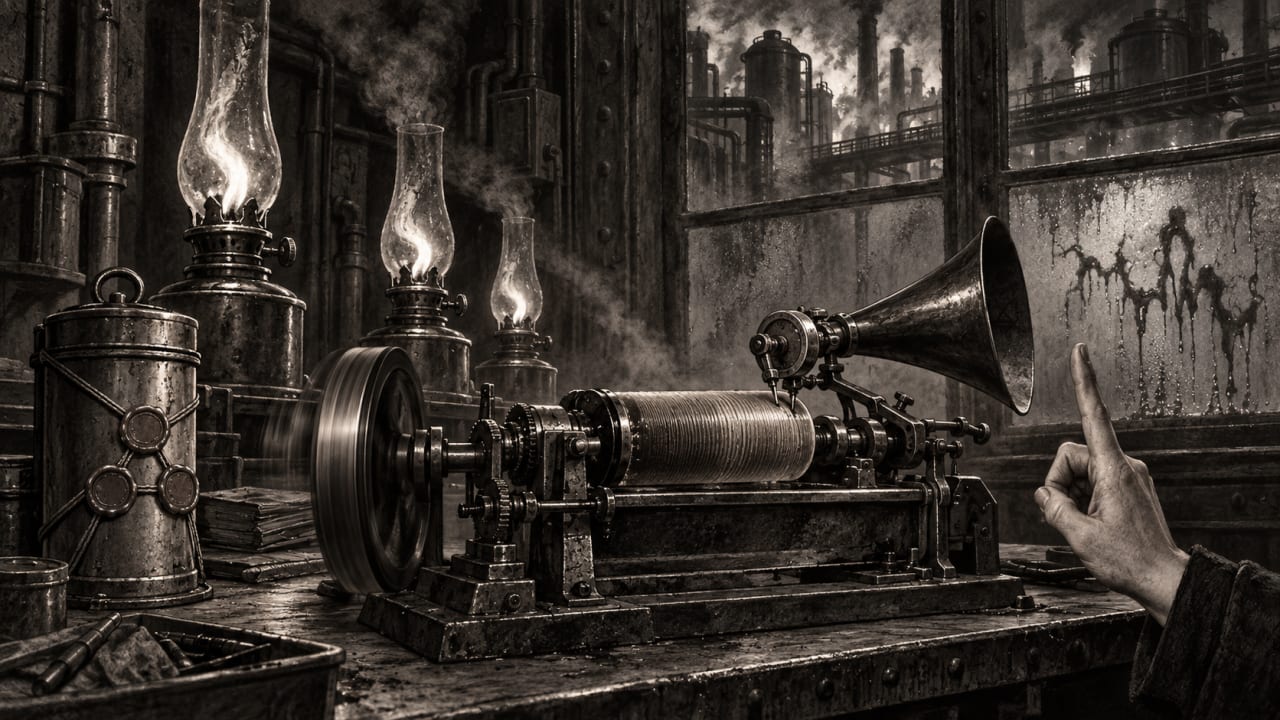
The fuller account is in the file on the Sulking Engines. It reports that the first playback reversed the pressure in three lamps and wrote an unapproved mark in moisture. Kest stopped the cylinder by raising one finger. The machine obeyed late.
The order of events is the horror. First the lamps: three flames whose pressure ran the wrong way, against their feed. Then the moisture, gathering on some surface the account does not name into a mark no office had approved. Then the raised finger, the gesture by which the Gauge Ward knows Kest means stop. The choir floor answers it, and so do the valves. Last, the stop itself, late. The file does not say how late. In Brast the delay is the testimony. Every mechanism in the city is trained to obey that finger, and one mechanism finished its sentence first.
The transcript survives in the vault file, redacted wherever the Bureau judged that the reader's curiosity outran the reader's fitness.
Vault Brast-4 transcript fragment, A.S. 201: night-syllable recorded between fourth-bell cadence and condenser return. Acoustic shape resembles ████████████ with secondary pressure bloom consistent with spoken name response. Personnel below red seal reported left-ear heat and the smell of wet iron. One clerk wrote "it is waiting for the second half" before fainting. Clerk reassigned to non-listening duties.
The fragment is entitled to say only so much. "Between fourth-bell cadence and condenser return" fixes a position in Brast's working night, the interval between two things the machinery does. It is no calendar date, and I will not turn it into one. Nor will I reconcile it with the night roar by inventing a second timetable, since the city already has bells enough. The "secondary pressure bloom consistent with spoken name response" is the transcript writer's interpretation. Consistent with is a clerk's phrase: it admits resemblance and declines kinship. Left-ear heat and the smell of wet iron are bodily reports from the personnel below the red seal. The sentence about a second half belongs to the clerk, who wrote it before he fainted. His reassignment is the Bureau's only published conclusion, and it is a conclusion about the clerk.
The Gauge Ward account changes the wording. Where the transcript records heat, it speaks of left-ear intrusion. Where the Sulking Engines file speaks of an unapproved mark in moisture, it speaks of condensation-writing on Gauge Twelve. Gauge Twelve is a known instrument of the Ward and has crept toward amber on choir floors before. The published record does not decide whether the moisture mark and the writing on Gauge Twelve are one event described twice or two events packed into one sentence by a hurried scribe. I leave it undecided too. Readers who need Gauge Twelve installed beside three lamps in one tidy chamber may install it themselves and accept the liability.
It was not a controlled trial either, whatever the Bureau of Engineering now wishes. The file shows a first playback, personnel, effects and a stop. It shows no prepared instruments, no comparison measures and no stated question. Engineering memorandum 41-R complained that responsive machinery remained "unproven by controlled trial." The night-syllable answered the complaint by not waiting for one.
The record withholds on purpose. It gives no syllable in letters, renders no legible mark, names no name and supplies no second half. The Bureau wants its readers to reach the end of the transcript with exactly the clerk's information and none of his symptoms. On the whole I approve. Brast already has enough men writing on tables.
#On the Offices Waiting Outside
The cylinder is one exhibit, and Brast has at least four explanations waiting for it. The exhibit could ruin any of them.
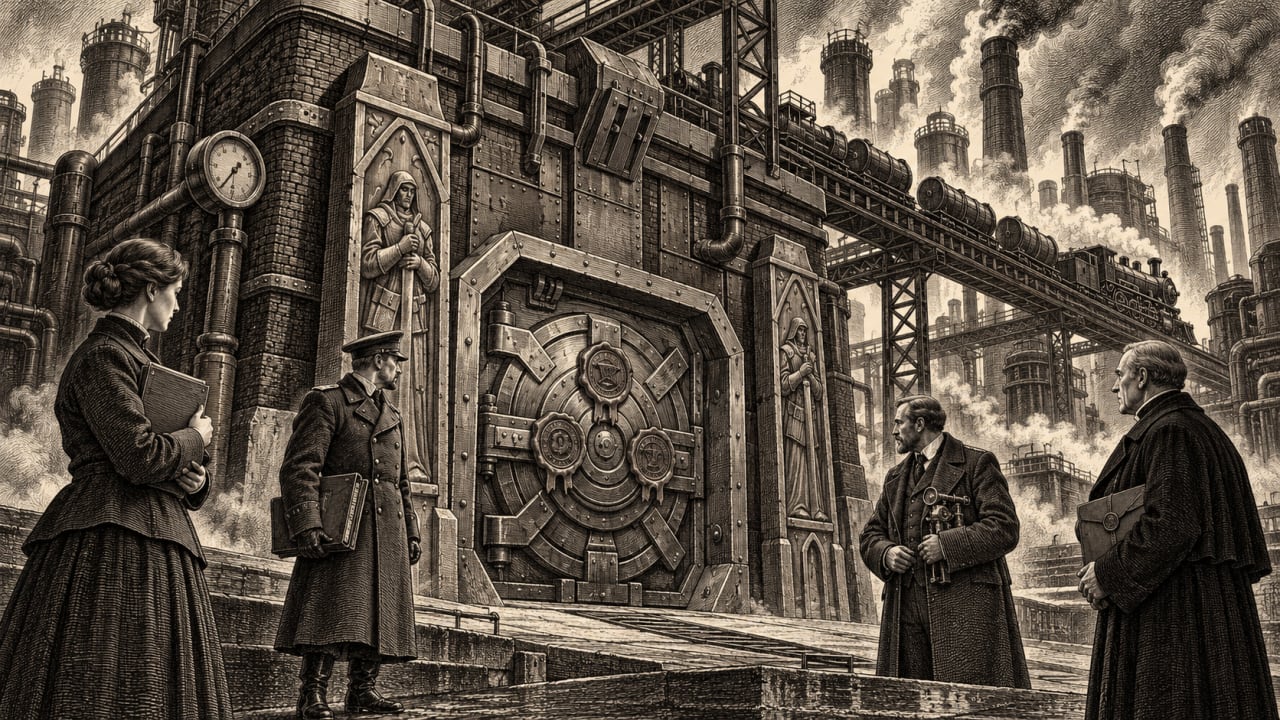
Kest's authority rests on cadence. Her Measures stand in fourth-bell spacing, match fourteen stanzas to condensation within three beats per minute, and keep the machinery obedient through licensed song. Her sentence from the Przemyśl inquiry has become Brast's working scripture: The furnace does not care whether you believe. It cares whether you sing. A syllable nobody sang is the one fact that sentence cannot absorb. If the furnace sings unprompted, the licence book governs one voice among several. Kest sealed the cylinder with the same hand that stopped it, and since then she has grown quieter. In a woman who never speaks above a murmur, that takes some menace.
Commander-Auditor Sorn Vale runs the Manifest Court on the premise that failure is criminal and every crime has a body. His ledgers can hang a siphon runner, a seal-cutter, a clerk who altered one digit. They cannot hang an interval between fourth bell and condenser return. For Vale the cylinder is one of two things. If someone produced the sound, it is the best evidence of sabotage Brast has yet offered. If no one did, it proves his whole method has been arresting the wrong category of offender. He wants it preserved and examined. Above all he wants a human hand somewhere in the transcript, and the transcript has so far supplied only a fainting one.
Pex Ruln and the Compact hold throughput, filters, condenser locks, and the receipt chains nobody reads aloud. The transcript places the sound at condenser return, and condensers are Compact territory in every sense but the charter. Ruln has more reason than most to want the record's interpretations kept narrow. Brast's published holding order already tells every office to suppress substrate speculation. A recording made at the condenser line will generate speculation for as long as the wax lasts.
The Furnace Chapterhouse of Saint-Combust holds ritual authority over the burn. It has long preferred to read the machines' moods as a rudimentary awareness conferred by rite, ash and sanctified fuel. To the Chapterhouse the cylinder may look like a relic. To Engineering it is a harmonic artefact with bad manners. To the Bureau of Doctrine it is a liability, and the Bureau has not yet tailored a theology to dress it in. Each office can read the same wax into a different vestment. None can make it say one thing to all of them.
Each office also bears a risk from mere proximity. Whoever next touches the seal will be the first name in the next inquiry. Whoever asks for a second playback will own whatever the second playback does. Whoever argues for destruction will be remembered as having feared the evidence. Brast has many ambitious officials. The vault may be the only room in the city that none of them is racing to enter.
None of these offices has published a claim to the keys, and none has been shown to hold a formal right of entry. I record their interests because interests are evidence of a kind, the kind that does not require anyone to have met in a locked room. The vault needs no conspirators to be dangerous. It needs only a recording that every party must one day allow to speak.
#On Sounds Sold Beyond the Seal
A vault is a public statement that something valuable lies inside. In Brast, a valuable thing behind a lock acquires counterfeits immediately.
The city already trades in illicit sound. The Slag Market sells quiet hymns, black measures, half-stanzas, valve phrases, condenser lulls and tap patterns: slivers of cadence that let a worker coax a private boiler through one more night without licensed attention. The Warmth Thieves buy such fragments when stolen heat needs persuading. The Calibration Choir punishes hymn leakage more harshly than warm-chit fraud. The market has its own maxim about the trade, painted above three stalls and obeyed by none of them: never sing what you cannot afford to hear answered.
The night-syllable came into this trade as a brand. The published accounts say fragments, or things claiming to be fragments, reached the market within weeks of the cylinder's sealing. Vendors sold the New Sound scratched onto slate, hummed through tin pipe, encoded as tool taps, or folded into paper like a devotional charm. Those accounts judge most of them frauds. The market has never needed authenticity. It needs a rumour that the original exists and that the original is locked up. Vault Brast-4 supplies both, free, under seal.
The one reported seizure needs closer attention, because it ends at the vault door. In Ashmonth of A.S. 201, according to the Slag Market and Warmth Thief accounts, provosts recovered a slate fragment bearing six tap-marks and one breath notation. An authorised choir-technician tested it and produced no audible tone. A pressure gauge designated C-19, with no line contact, moved from black to amber. The technician asked for water and then wrote something on the table with a burnt finger; the record withholds what. The slate went to Vault Brast-4. The seller was never recovered. The Warmth Thief account adds a notation found on the reverse: do not sell to men with clean boots. I note it without comment, since every reader in Brast will already have thought of the same boots.
Three categories must stay separate here as well. First, there is an authenticated recording: the cylinder, attested by every published account as the wax associated with the night-syllable, and under seal. Second, there is a claim of copying: the vendor's assertion, made in a market that sells assertions by weight, that a slate reproduces that sound. Third, there is an anomalous test result: a disconnected gauge moving and a technician injured during a silent trial. The slate is firmly in the third category. Nothing published moves it into the second, and still less into the first. A forgery may set a gauge moving for reasons of its own. A true copy may be silent. The seizure proves that this slate did something during testing and that the Bureau thought it fit company for the cylinder. It proves nothing about what the slate is a copy of, or whether it is a copy at all.
Nor does the seizure turn the whole market into an armoury. Most fragments remain frauds by the market's own reckoning. Kest's listeners, the published accounts say, buy some fragments, burn some, seal some and let others circulate as bait to learn which engines answer. That is cruel and competent, and it means some of what moves through the market is moving on Choir sufferance. A city that sets traps with sound cannot be shocked when its traps are copied.
The vault's relation to all this is plain. The Bureau deposited a market object of unproved provenance beside the one exhibit whose provenance is the only firm thing about it. That deposit is a judgment about danger. It is no judgment about kinship. I expect the clerks of Strasbourg will confuse the two by Advent.
#On the Separate Cases and the Expected Examiner
Three other files lie open on the same table as the vault. Readers keep sliding them into one pile. I keep sliding them apart.
The first is the A.S. 199 misfire at Bastion-Przemyśl. Four rounds fed with Brast fuel struck a friendly rail junction, killed eleven men and crippled a supply train. Ordnance named sabotage. The Compact named the Choir. The Choir named degraded feedstock. Engineering named harmonics. The Chapterhouse named insufficient rite. The cause is still disputed, and the misfire is what moved Brast's review copy to Amber. It also explains why every office now hoards anomalous evidence as a miser hoards teeth: after Przemyśl, an office without exhibits is an office available for blame. No published evidence places the night-syllable at Przemyśl. Nothing shows it existed in A.S. 199. Nothing puts it in that inquiry. The misfire made the vault necessary. It did not fill it.
The second is the seven drums. In spring of A.S. 201, seven sealed drums of finished chrismole vanished from Manifest Court inventory. Fourteen arrests produced three confessions and no drums. These are Manifest Court losses from Manifest Court custody. Nothing places them in Vault Brast-4, nothing ties them to the cylinder, and no published account names who took them. The market has whispered about drums that knock from inside storage that does not contain them. The vault file is not that storage.
The third is the wider Sulking Engine escalation: delayed valves, contradictory gauges, boilers that demand introductions, Siding Eleven halted forty-one days with no broken rod. The public file calls it Category Two Localized Acoustic-Mechanical Disturbance, and the review copy stands at Amber. Amber is Brast's grade. The vault has received none of its own, and I will not supply one, however much the Bureau of Ordnance enjoys colours.
The tract on the Sulking Engines, filed under my own seal, opens: "The machines of Brast are alive."
Clarified. The classification of record is Category Two Localized Acoustic-Mechanical Disturbance, under Amber review. That opening sentence was a provocation, labelled heresy in its own paragraph, and it remains a provocation. The Vault Brast-4 file does not settle what the machines are. It records what one of them did and how late it stopped.
Then there is the examiner. Inquisitor-Mechanic Lux Thane Mire has been dispatched from Strasbourg. His title confesses in two words what a century of Bureau modesty spent denying: faith and engineering share one warrant. His train is late. The Gauge Ward account expects him to test the Ward first. His published methods for testing responsive substance include contact, resonance, heat, oath and controlled doctrinal insult, along with others the Bureau redacts to keep lesser readers from developing hobbies. He has opened nothing. He has entered nothing. He has examined neither the cylinder nor the slate, and his verdict exists only in each office's prayers about what it will be.
Those prayers are easy to list. If Mire calls the fault mechanical, Engineering inherits the disgrace. If he calls it doctrinal, Doctrine inherits a bill it cannot itemise. If he calls it human, Vale gets his hanging and the night roar keeps its syllable regardless. If he calls it something Purity must handle, Purity inherits the bodies. Each verdict will need the cylinder, eventually, as its witness or its victim.
#On the Present Holding
As of A.S. 201, Vault Brast-4 holds the night-syllable cylinder under countermark, in the custody Ordnance calls triple seal. According to the Ashmonth seizure account, it also holds a Slag Market slate whose test disturbed a disconnected gauge and injured the man testing it. The playback transcript is filed under the vault's designation, redacted where the Bureau judged redaction kinder than reading. Kest's hand sealed the wax. Vale's court wants a culprit. Ruln's condensers are mentioned in a document he did not write. The Chapterhouse hopes for a relic. Mire's train is somewhere on the eastern approach, delayed by engines that may or may not have opinions about his arrival.
The vault does what repositories do. It keeps, refuses and waits. Its door, wherever it is and whatever it is made of, has not been reported open since the slate went in. No second playback has been recorded. No fresh voice has been filed. Nothing has escaped, which in Brast is the closest a room comes to praise.
Around it the city carries on. The fourth-bell hymn is sung. The condensers return. In the Rail-Manifest Quarter the drums are weighed hot and weighed cold, sealed, called and sent east. The Gauge Ward polishes its tiles until the old cracks shine. The Commons coughs. The market sells a New Sound on slate to any buyer foolish enough to hum it. At night the furnace roar fills the rings of Brast, and the published record does not say whether the syllable is still in it. That silence is the most honest line in the file.
The Line keeps firing on Brast fuel. Whatever the cylinder holds, it holds it under three seals in a city that cannot stop working long enough to listen to it properly. That arrangement suits every office, because it postpones the hearing. The examiner is coming to end the postponement. Until he does, the wax stays whole and the question stays shut.