

#On the Division and This Survey
This survey of the Tariff-Chapel Division of the Bureau of Tithes was compiled in A.S. 201 (1911 CE) from what the Division leaves lying about: posted notices, stamped tickets, ledgers kept in duplicate for the auditors, and one feast. The year belongs to the compilation. It is not the year of the Division's founding or its charter, nor of any inspection of its scales or any ceremony kept under its name. Those years are not in my hands, and I have no intention of forging them to comfort an infobox.
What the record establishes would fit on a lintel. The Division belongs to Tithes. Its name stands under the weighing formula the clerks quote at the counter, "None shall eat unweighed, lest he forget his dependence," and it appears again on the certification nailed above the scales, which names Tithes, the Division and Strasbourg in that order. The Division holds licensed scales in custody, and it keeps the feast of Saint Calibrus over them. The rest of this tract describes what custody looks like once it has a sack of wheat in front of it.
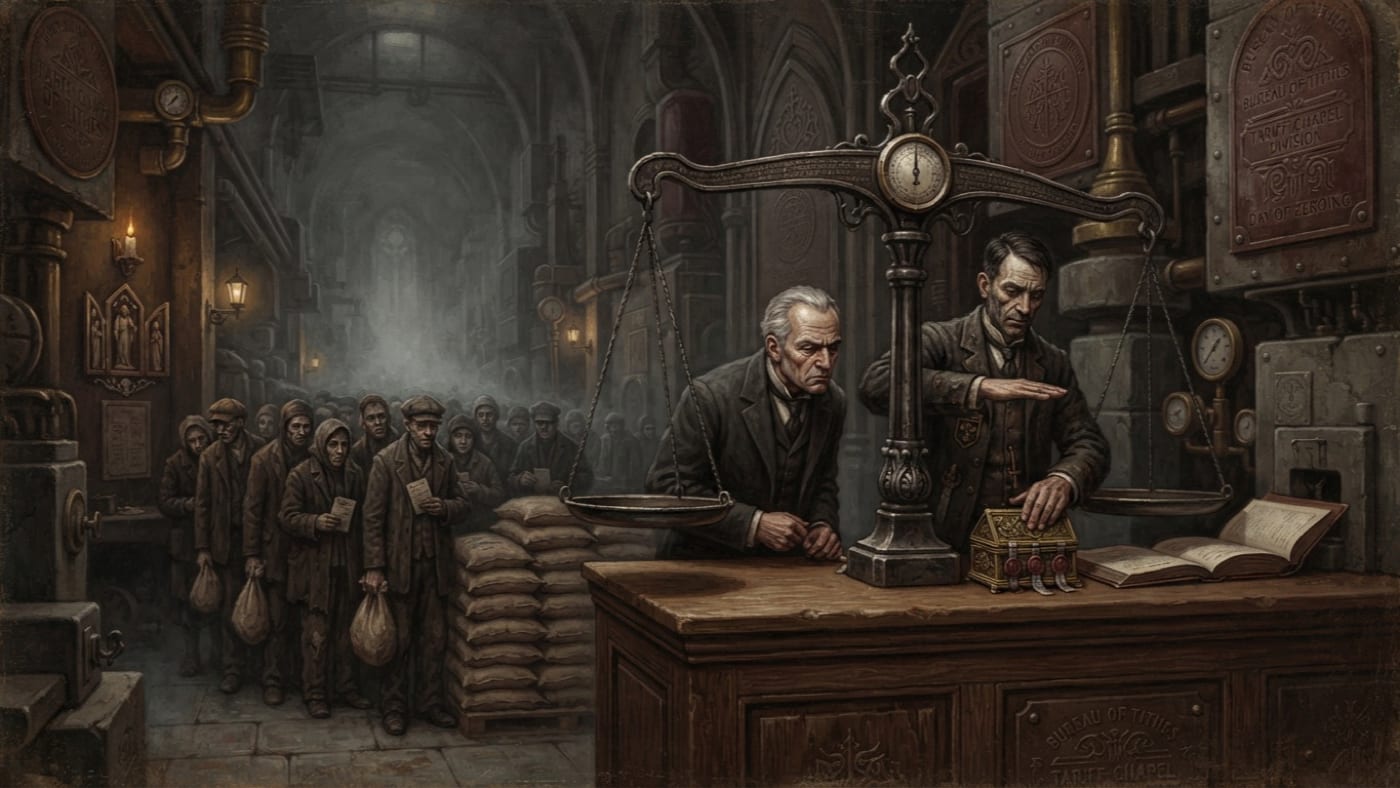
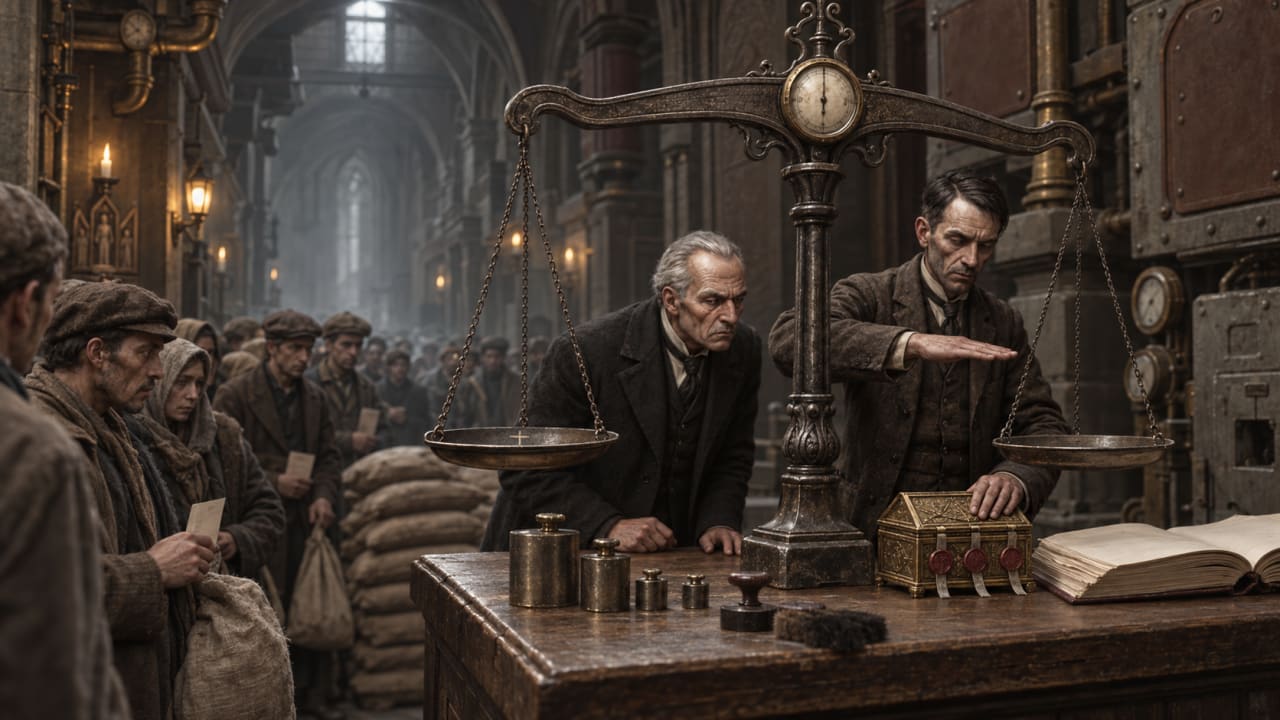
The Division has no face to describe. What it has is an instrument. Take any licensed scale on the Sagittal Line. It has an iron beam with scripture cut down both arms and the cuts packed with wheat dust, and a pan hanging on chains. A casket sits on the shelf, a ledger lies open at the morning's zero, and a stamp waits for a wrist. That is the Division as a carter meets it. Everything behind the scale is paper, and all of the paper leads back to Tithes.
#On the Inheritance of Licensed Measure
Before A.S. 97 (1807 CE) a scale belonged to whoever owned it, and so did its verdicts. At the southern gate of a bastion that the file declines to name, a grain guild poured lead into the civic pans. Every sack weighed heavy and every tariff was overpaid, and every receipt was in order. The city kept paying lawful prices for grain it never received until hunger outran patience. Then it burned the gate, the guild hall and any building unlucky enough to stand next to them.
The Synod answered by seizing everything. Private measurement was prohibited. The civic scales were taken into licensed custody, and weighing was declared a sacramental act. The Bureau of Doctrine ratified that declaration with the appetite of an office that has just been handed a fresh category of heresy. Within the year came reliquary calibration: scales anchored to fragments that were rare, hard to counterfeit well and beyond public argument. That is the Bread-Scale Uprising and its settlement. The Church's founders had been dead for nine years and more by the time the gate burned. Nobody may hang their seals on the seizure, and I will not try.
The hungry of a southern bastion rose against guild fraud and burned the gate.
Corrected to Bureau of Records language: the Bread-Scale Uprising is classified as a supply-chain irregularity, and the structures lost are classified as voluntarily decommissioned. The Division's custody of the scales commemorates no riot. It maintains instruments.
The practical cause was plainer than the doctrine. The Church held a frontier of shattered provinces, mixed coin and forged weights. It needed one standard that a vendor in a port and a quartermaster in a trench could both be made to accept. War plans by the sack, and Tithes taxes by the sack. A weight nobody trusts closes a gate, and a closed gate starves the men behind it in about the time it takes to hear the appeal.
The reforms of 97 explain why licensed custody exists. They do not give the Division a birthday. The record does not say that the Division was raised that year, or the year after, or what title was used by whoever first answered for the seized scales. A reform shows that an office is needed, but it does not issue the office's letters patent, and no such letters have reached my desk.
#On the Instrument and the Record
Custody begins at night. The calibration fragments are bone slivers, saint-ash and splintered hymn-metal. At night they go into the reliquary casket behind three seals. The profession agrees on one error that nobody survives: mis-sealing the casket, or losing a fragment.
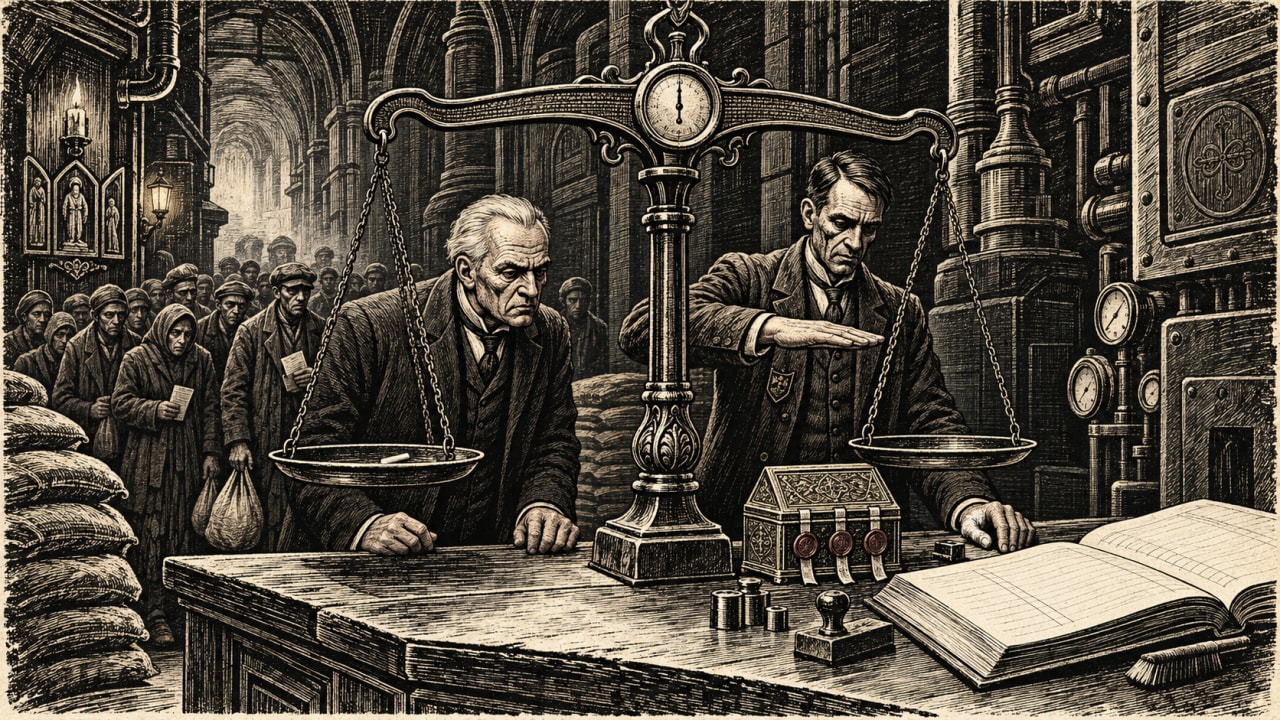
At opening the casket is unlocked in front of a witness. The clerk touches a fragment to the scale-arm, recites the calibration line, chalks a small cross on the pan and enters zero in the ledger. Then the door opens and the queue comes in, bringing its dust.
In the Division's chapels grain is weighed against the bone of the saint.
Withdrawn by the Warden of the Sacred Ledger. The fragment anchors the calibration. It touches the arm at the zero and goes back to its casket, and the sack is weighed against stamped weights like any honest sack. No sliver of any saint has ever held up a bushel of wheat. The image was handsome, and it has been taken down.
After that, every cargo goes through the same order. The identity and manifest are examined, and the calibration is verified before a witness. The sack is weighed gross, then net, and the difference is set against the manifest. The tariff is computed at the current rate, which moves with war, with the season and with what the files call "sector discipline." The goods are either cleared under a purity mark or condemned under a slip. A seal and ticket are issued. The ledger is reconciled, and a copy is kept for the auditors. In the evening the pans are cleaned and the calibration checked again. The fragments go back behind their seals, and the scratch tallies are burned.
The zero set at opening and the check made for each cargo are separate acts. Accounts disagree about how often the second is repeated over a long day, and I have left the disagreement where I found it.
Three figures pass through this procedure, and the Division's competence depends on keeping them apart. The first is the mass on the pan, the second the tariff in the ledger, and the third the stock in the granary. The Division certifies the first and computes the second. Over the third it has no jurisdiction at all.
This is how the Division reaches the queue. It sends no officer to the gate. It sends a stamp, a ticket, a seal with a known impression and a ledger whose columns any stranger from Tithes can read without asking the clerk a question. The clerk's chalk-stained thumb carries the Division's authority as far as the sack, and the paper carries it the rest of the way. Paper does not tire at four in the afternoon.
#On Calibrus and the Day of Zeroing
After 97 the seized scales needed a face above them. Calibrus had one. He also had a hand held level and a reputation for refusing to lift the weight. The Division adopted his feast and named it the Day of Zeroing.
On the feast, every licensed scale in the Division's custody is cleaned, checked, blessed and re-zeroed in front of a witness. The clerk holds the right hand level above the empty pan, palm down, with the forearm copying the beam, and recites the Level Prayer. The surveys agree on all of this. They disagree on exactly where in the four acts the prayer belongs, and I will not settle the order for the Division. Its words are not reproduced here, because a survey is not a hymnal.
A witness is required, but the files I hold say nothing about who may serve as one. They record no rank, no appointment and no qualification. A witness is a second pair of eyes on the pan. Clerks prepare as though every witness were also an inspector. That is prudence. No law requires it.
Nobody recorded the year the feast was founded, its day in the calendar, or the name of the first person to keep it. Its length is recorded, and the record is unequal. The feast lasts one morning in the rich ports and three days in the poor trench depots. The survey of the feast gives no reason for the difference. The clerks blame the queues.
Most licensed scales have the approved icon hanging above them in some form, anything from a bone-inlaid triptych to a print curling in the candle damp. The Bureau of Heraldry fixes its attributes: a suspended balance over a kneeling crowd, a level forearm, a closed mouth and unmarked pans. Heraldry allows two readings of the crowd. Either it kneels in prayer, or its legs have given out. Heraldry has not ruled between them and is not expected to.
His relics are no better settled. No authenticated hand survives. The Bureau of Relics classes the rival forearm bones as "devotionally consonant," which classifies them without identifying them. The Division asks a fragment to hold a zero. Whose bone it was is a question for another office.
#On Certification and Liability
The certification is the Division's most public sentence. It hangs over the scale at roughly the height of a vendor's eye.
With one sentence the notice turns a tool into a holy object and an adjustment into a defilement. It cites Martial Code 14-A and gives the offence's classification. It does not give the code's full text, the year it was enacted, the sentence it prescribes or the court that tries it. The trade does record punishments against its members: demotion, loss of the seal, reassignment to the plague wards, immurement for false measure and erasure for systemic distortion. None of these is the code's schedule of penalties. I have no such schedule.
The offices around the scale divide the work by function. Doctrine ratified weighing as a sacrament and decides what counts as heresy. The Bureau of Purity enforces that definition, and Relics authenticates the fragments. The Relic Counterfeit Scandal of about A.S. 117 found pig-bone and ground pumice in calibration caskets from Thessaloniki to Calais. After it, every fragment had to be assayed against a master set in Strasbourg. The Bureau of Masks and Seals provides the counter-seal that makes an assay binding. Tithes calls its rate extortionate and Masks calls it actuarially appropriate. Records keeps the proof, and War eats whatever clears. The wall does not say which of these offices sits in judgment on a greased pivot.
The Division's files keep three conditions apart that are run together everywhere else. Suspicion is a rumour that the fragment is false. A discrepancy is a chapel pan that disagrees with the master weight. Manipulation is lead found in the pan, and only manipulation is an act. Iron contracts on a frosty morning, and a beam that is slightly out of true at dawn may be true again by noon. Drift proves that a difference exists. It does not by itself prove a saboteur, or a demon in the pivot.
#On the Clerks Within the System
The Commerce Clerk is the Division's working hand. The occupation carries the name of commerce, and the clerk spends all day among merchants and manifests. The Bureau of Commerce also has a large interest of its own in what clears the gate. None of that takes the Division out of Tithes. No joint charter is on file, and I will not draft one by implication.
The clerks work at port gates, bastion market wards, passage choke points and trench supply depots. Their ranks run from pan-sweeper and tariff scribe up to the chapel weigher who holds the seal, with the assayer and master calibrator above. These are vocational ranks, learned at the bench. I have found no matching ladder drawn up by the Division, and no single desk that issues promotions.
The profession divides the way professions do. The True Measure Zealots calibrate endlessly and report every coin left on the pan. The Mercy Weighers shave a tariff for a widow and charge a guild to balance the book. Port clerks handle the largest volumes and the richest bribes. Trench-depot clerks weigh ammunition while the floor shakes. Each side has a low opinion of the other's hygiene. Meanwhile the old relic-trusters distrust the new technicians who mutter about mechanical standards. These are tendencies of the trade. No document places any of them inside the Division as a party.
Bribes arrive as "offerings," "candle oil" or "extra chalk." A sack of flour leans against the chapel wall with coins sewn into its seams. At this point the documents allow a distinction that the Bureau's sermons tend to blur. A shaved tariff changes an assessment. It is a figure in a ledger, and the beam never feels it. A lighter set of weights swapped in for friends, which the chapels call "the Saint's favour," changes the instrument, and so does a greased pivot. The first is a fiscal sin. The second is what the notice was posted to frighten people away from.
Audits arrive with an inquisitor and a master weight. Inspectors check the seals first, then the calibration witnesses, and then lay the ledgers beside the price of bread in the ward. The clerk is judged on throughput, accuracy, seizures and riots, and is expected to do well on all four in the same afternoon.
#On Correct Figures and Failed Supply
The Division's scales can be perfect and the bastion can still go hungry. Two cases in the weighers' own record show it.
At Varna, around A.S. 129, a grain fleet came in with sound cargo and dry holds, and the scales were calibrated. Rival jurisdictions argued over the tariff for so long that the grain rotted in the harbour. Every figure was correct, and the bread never arrived.
At Novi Sad, around A.S. 147, two inspectors stamped the same cargo with conflicting seals, and each inspector's office held its stamp valid. On paper the cargo was divided twice, and the rations existed in the ledger and nowhere else.
Neither case involved a tampered pan, and neither proves a reform or charter that I have not seen. Both show the limit of an office that certifies mass. The Division can tell a city exactly how much grain it has, but the knowledge cannot be eaten.
The A.S. 199 (1909 CE) revision of Standing Order 77-A demands speed and accuracy together, which is the very pairing that Varna and Novi Sad failed to achieve. The year of the revision does not date the order's first issue, and it does not date the Division either.
#On Present Application
In A.S. 201 the Division keeps its scales where the files have always put them: at port gates, in market wards, at the choke points of passage and in the depot chapels along the trench supply corridors. Every morning, somewhere on the Line, a witness watches a casket being unlocked. A fragment touches iron and the line is recited. The chalk cross goes on the pan and the zero goes into the ledger. Outside, the queue has formed before the bell, as it always does, and the sacks on the step weigh exactly what they weigh.
The Division can promise that much. It can promise that the instrument is true, that the record matches the instrument and that the seals on the casket are the seals it set. About the harvest it promises nothing. Nobody has yet told the kneeling crowd in the icon which way it is kneeling, and every morning the door of the tariff-chapel opens on it all the same.