
#On the Country That Became a Hinge and a Mouth
Serbia is a name spoken carefully in the Synod because it lies where too many failures learned to share a road. It is mountain, river, gorge, monastery, furnace-cave, refugee scar, Wrath ash, Sloth fog, Danube toll, and the stubborn western edge of a wound that never had the courtesy to heal into one shape.
Before the Sundering, Serbia was a hard country of ridges, river towns, high roads, orchards, mule tracks, monasteries, border garrisons, and the particular Balkan confidence that every conqueror is temporary and every tax collector can be outlived by bad weather. The old maps show principality, road kingdom, military corridor, Danubian hinge. The present maps show Zone 5 and Zone 6 pressure, contested passages, burned valleys, standing fog, active caverns, tariff ruins, refugee routes, and advisory black ink so thick that the paper looks bruised.
The country matters because geography refused abstraction there. The Danube cuts westward. The Morava roads draw armies through the interior. The Balkan heights lean south toward Shipka. The Iron Gates choke river passage beside Irongate. Thrace burns beyond the lower road. Fog presses from the old highlands. Serbia became the place where Maldrake and Syrion both found purchase, and where the West first learned that two Sins may share a victim without agreeing on ownership.
#On the Eastern Silence and the First Broken Roads
The first public wound did not arrive as fire. It arrived as missed correspondence.
During the Eastern Silence of A.S. 38, roads through Serbia, Thrace, Wallachian marches, and western Balkan passes stopped answering cleanly. Couriers vanished. Monastery packets arrived with wax intact and pages blank. Bridge reports contradicted river height. A posting station south of Novi Sad listed twenty-seven arrivals and no departures, then sent no packet for eleven months. Rationalist authorities declared local plague, mountain banditry, fog fever, provincial disorder, and courier indiscipline in successive notices, each notice more confident than the last, each notice deader than the courier who carried it.
Serbia's silence had character. In Wallachia, ledgers began to balance in hands no registrar knew. In Pannonia, barns lied about their contents. In Serbia, roads folded inward. Villages ceased to be reachable by the route that had reached them for generations. Forests shifted by night. Churches blackened from within while their bells remained cool. Travellers reported fog in high passes, then heat in caverns beneath snowline, then voices from stone speaking in the accents of soldiers not yet dead.
By A.S. 45 the warning had passed from omission to assault. From the fogbound plains and the blackened mountains poured the legions of the Great Deceiver. Skopje and Novi Sad fell within hours. Belgrade staggered into the next century as miracle, ruin, caution, and military boast. Serbia, caught between river passage and mountain throat, did not become a front. It became several fronts eating one another.
Rationalist quarantine notices described Serbian road failure as “epidemic interruption aggravated by rural superstition.”
Corrected. The roads were failing before the fever registers were written. Superstition, in this case, was merely intelligence without a stamp.
#On Wrath in the Caverns
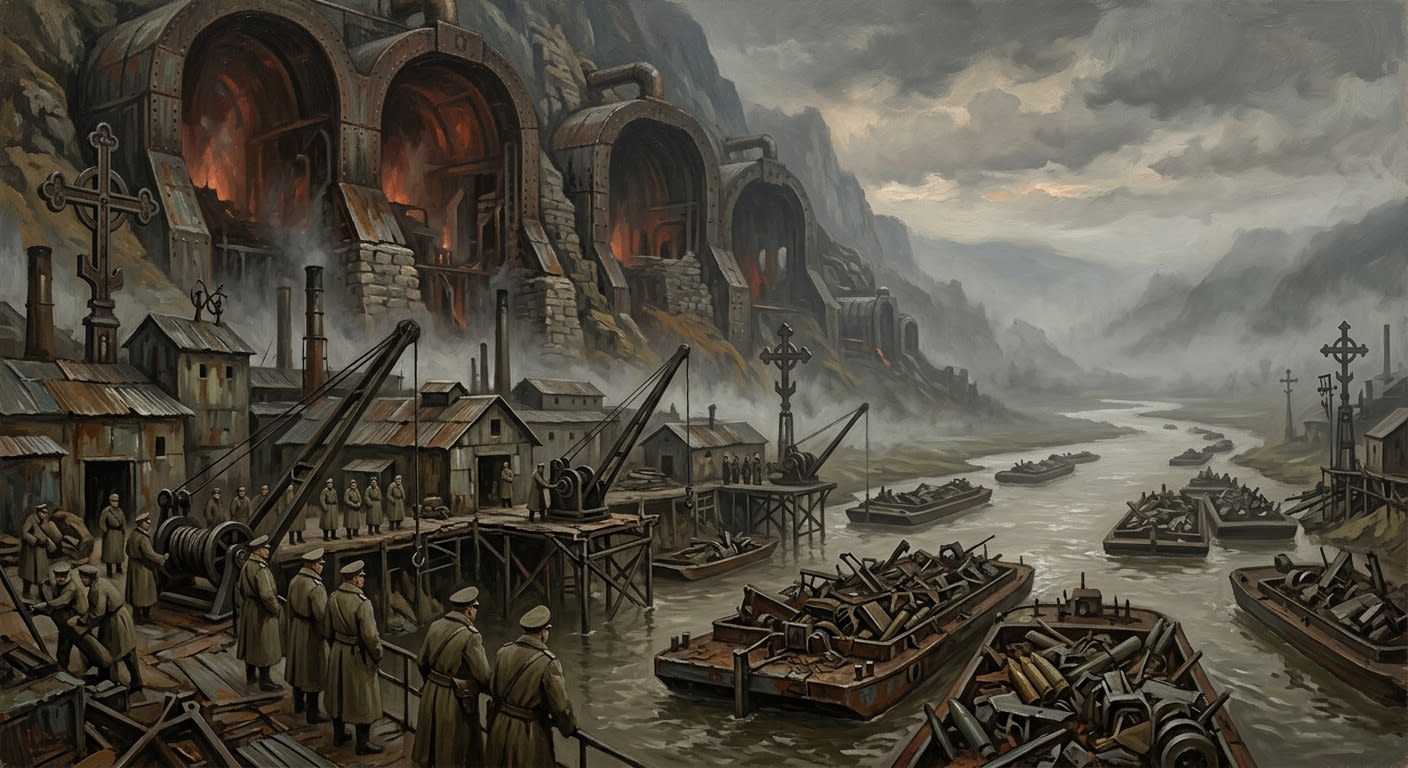
The mountains of Serbia are riddled with caverns that belch sorcerous fire. This phrase appears in early refugee testimony, later War abstracts, and one very reluctant Engineering appendix whose author attempted to replace sorcerous with thermochemical and was corrected by the loss of his eyebrows during demonstration.
Maldrake's pressure in Serbia differs from his open Thracian magnificence. Thrace is forge, slag, iron plain, bombardment, the Eternal Forges beating their anvils until the air itself seems conscripted. Serbia is subtler in the manner of a knife found under a pillow. Cave mouths glow at dusk. Old mine tunnels breathe heat when no venting system exists. Monastery cellars produce ash on feast days. Iron tools left overnight on certain ridges return warm, sharpened, and eager. A man who sleeps beside them dreams of grievances he did not own before lying down.
The Wrath-caves are not factories in the Thracian sense. They are mouths, vents, chambers where anger gathers because the stone remembers invasion, conscription, betrayal, taxation, and the thousand old injuries by which a border people become tinder. Maldrake does not need to invent Serbian fury. He only gives it draft.
There are reports of Ember-Soldiers emerging from shafts beneath ruined fortlets, their armour fused with local ore, their commands in a language half Serbian oath and half furnace crack. There are forge-beasts assembled from abandoned artillery in ravines where retreating batteries cut their wheels loose. There are shepherd tracks where hoofprints fill with iron filings. There are monasteries whose icons sweat soot instead of oil.
The Bureau of War calls the Serbian Wrath pressure discontinuous. This means patrols may cross ten miles safely, then lose half their number at a cave no map admits. A continuous danger can be fortified against. A discontinuous danger requires judgement. War despises judgement because it cannot be requisitioned by crate.
#On Sloth in the Valleys
Syrion's claim upon Serbia is older in silence than in conquest. The Vales of Stagnance include lands that were Serbia once, Hungary once, border country once, all now held in the grey grammar of stopped breath and missing years. Where Maldrake heats Serbian stone from beneath, Syrion cools the hour above it. Fire in the caves. Fog in the valley. A theological weather system arranged by committee in Hell.
The preserved villages of the Serbian fog-margin are among the Bureau of Medicine's least comforting files. Tables set. Bread gone hard but warm. Dogs standing in lanes with open eyes. A woman at a well holding the rope in both hands, bucket suspended halfway, arms unrotted after sixteen years. A schoolroom with chalk dust in the air and no child willing to finish falling asleep. Move the bodies and they return. Ring bells and they tilt their heads after the last note, as if the sound has arrived late.
SURVEY FRAGMENT — SERBIAN FOG-MARGIN, A.S. 181 Village designation: ███████. Population visible: 143. Population responsive: 0. One boy observed turning his head after six hours, seven minutes, or nineteen days by instrument conflict. Utterance recorded: “Tell the fire to wait.” Survey team withdrew after cook began setting places for persons not present.
The Maldrake-Syrion contact margin passes through the Balkan foothills like a quarrel between elements. Soldiers report frost on one side of a road and hot ash on the other. Rain falls upward and burns. A patrol may age three days walking through fog, then lose its eyebrows to a vent whose smoke smells like old cannon. At certain posts the watch schedule is written twice: once for clocks, once for men who return insisting the clocks are lying.
Serbia, then, is not merely lost territory. It is argument made land: fire demanding motion, fog demanding rest, mankind caught between the command to rise and the command to burn.
#On Novi Sad, Belgrade, and the Danube Lessons
The Danube gives Serbia its public wound. Mountain horrors can be denied by offices far from the climb; river cities send accounts downstream until denial clogs the customs house.
Novi Sad is the clearest instruction. The garrison died before its cannon crews finished loading. One recovered breechblock held a half-entered shell, crew ash fused around the wheel-rim, the order still legible: load, hold, wait. The War College teaches this as the Unfired Lesson. Artillerymen laugh too loudly when it is read. Laughter is how soldiers salute fear without being seen to kneel.
Belgrade's file is larger, redder, and less polite. Its early fall belongs to the same Serbian collapse, and its later place in Synodal memory is a knot of miracle, rearguard action, river crossing, and Bureau rivalry. The Routing at Belgrade in A.S. 120 broke a Wrath host on the Danube and gave the West one of its cherished proof-texts: saints above artillery emplacements, Maldrake's line recoiling, a river city refusing to be only a grave. The victory cost enough men to make the hymn honest for once.
Between those two names lie ferries, burnt piers, broken tollhouses, island batteries, grave-shanties, illicit crossings, and river fog that carries either Sloth or ordinary damp depending on who is paying the interpreter. The Danube did not cease to be useful after Serbia's fall. Usefulness is the quality by which dangerous places acquire clerks.
Certain school maps shade Serbia as uniform Charnel Land east of the Line.
Corrected for advanced instruction. Serbia contains fallen cores, contested margins, Wrath vents, Sloth valleys, river utilities, inhabited ruins, and routes used under protest by offices that publicly deny using them. A black wash teaches children fear. It does not teach officers where to die.
#On the Great Retreat Through Serbian Roads
The Great Retreat made Serbia into a corridor of abandonment before the word corridor had cooled enough for planners to draw it. From A.S. 48 to A.S. 65, columns moved west: soldiers, relic carts, widows, cattle, monks, artillery teams, wounded Rationalist officers, children with older faces than their mothers, and clerks carrying ledgers whose pages mattered because the bodies named in them no longer could.
Serbia's roads punished order. Mountain tracks broke wheels. Low roads vanished into fog. River passages filled with crowds holding valid claims to precedence: wounded first, relics first, children first, powder first, officers first, food first, bells first. Every answer killed someone. The Gatewarden profession, the passage notary, the armed queue, the stamp beside the club — all found early usefulness there. The Retreat did not invent cruelty. It gave cruelty a desk.
There were rearguards in Serbian passes whose names survive only in supply notations: ammunition issued, bread issued, absolution requested, no receipt returned. There were chapels burned to deny Maldrake shelter and bells buried to deny Syrion cadence. There were villages that sold the same mule to three columns and were forgiven because all three columns were dead by winter.
The Line was born when retreat ran out of permission. Serbia remained behind the new refusal: too far east to govern, too near to ignore, too broken to restore, too useful to relinquish entirely to silence and flame.
#On the Present Condition
As of A.S. 201, Serbia is held by no single tyrant in the clean sense schoolchildren prefer. Maldrake owns the hot places by appetite of flame. Syrion owns the slow places by patience. Local dead own the grave roads. Refugees own memory. Brokers own crossings until someone with a larger gun disputes the lease. The Synod owns every inch by Doctrine and many fewer inches by boot.
Field access is licensed under layered restriction. War patrols enter for reconnaissance, denial, and occasional rescue. Bells teams test fog cadence from ridge posts. Engineering surveys vents until instruments soften or stop agreeing. Records copies names from stones, doors, bridge beams, and old toll ledgers. Purity burns gifts found on roads. Mercy receives the returned and calls them patients when they have pulse enough for the word.
The country still produces witnesses. A shepherd walks west from a valley recorded as empty since A.S. 73, carrying fresh cheese and asking why the toll road has moved. A deserter found near the Morava has boot soles charred from below and frost in his hair. A patrol dog returns to Irongate with a child's ribbon tied to its collar, the ribbon warm, the dog asleep while walking. A monastery bell rings under mud on feast days. No excavation is authorised. The bell keeps better time than several approved clocks.
Public doctrine names Serbia a wound-country of the Charnel Lands. Private instruction names it a warning against tidy categories. It is the place where fire and fog both made claims, where the Retreat learned to count by absence, where the Danube carried ruin west, where roads stopped confessing, and where men still go because maps, wars, and Bureaus are all addicted to the same vice: the belief that what kills us can be made useful if only the right office handles the form.