

#On Jurisdiction
The Bureau of Heraldry keeps the Armorial of the Faithful. It ratifies colours, registers banners and has opinions about the bevel of every seal in the Church. Somewhere inside that apparatus sits the Seventh Directorate. I decline to name the corridor, partly because the sources do not name it and partly because the Directorate prefers they do not. Its jurisdiction is narrower and wetter than its parent's: the licensed mark on the living body, and the instruments that make it.
It licenses the Geometry Brand-Smith Corps. When a serialised brand-iron fails to come home, the audit ends at its desk in Strasbourg. Those two facts are all of its public charter that a reader of this Codex is entitled to know, and they are enough.
A Brand-Smith applies a triangle. Any butcher with a heated poker can apply a triangle. The Directorate exists to make the triangle answerable. A given mark on a given cheek must trace back to a licensed hand, an approved geometry, a named set of witnesses, an entry in a ledger and an iron with a number on it. Remove any one of these and the scar remains, but it is no longer evidence. It is merely an injury, and the Synod has no administrative use for injuries.
#On the Licensed Hand and the Recorded Iron
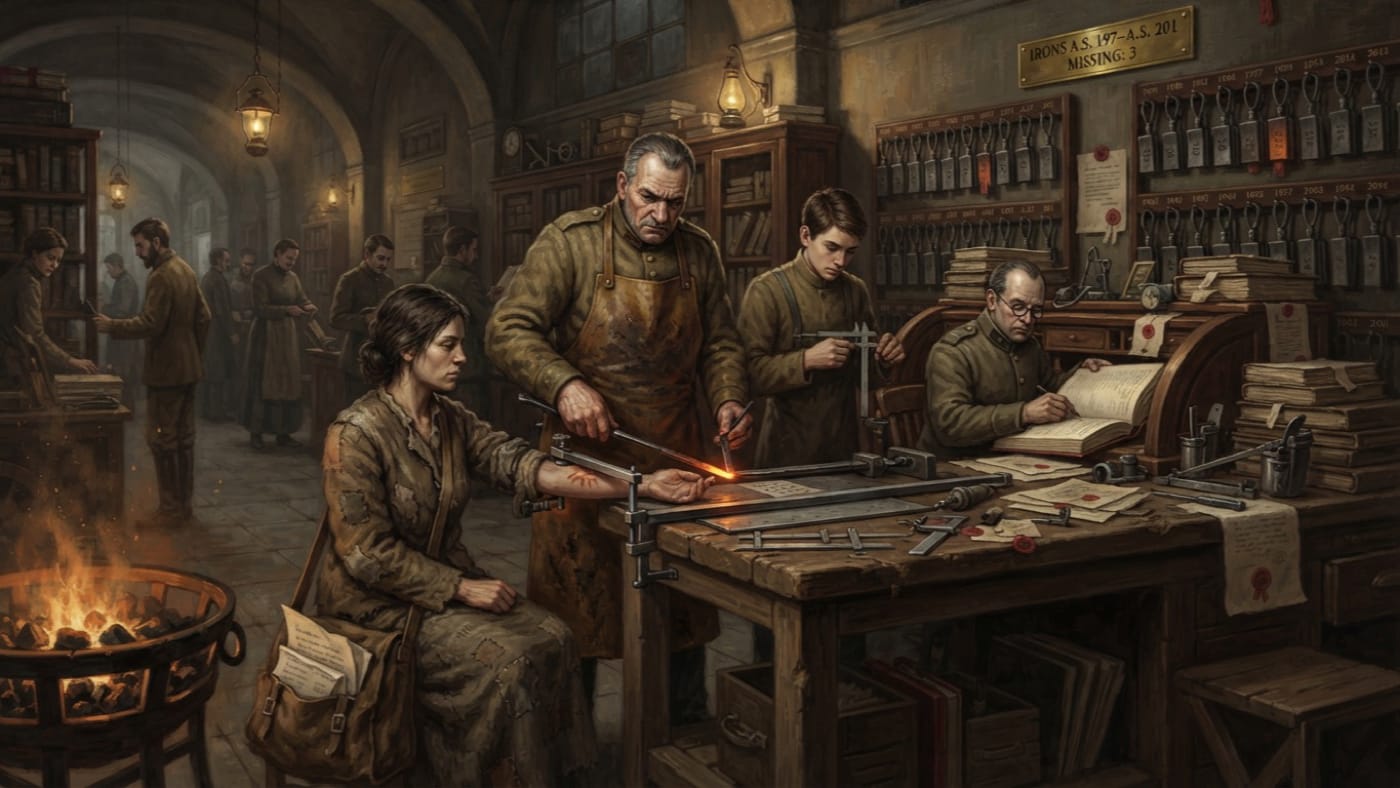
Follow a single mark. A woman comes to a forward chapel with a sponsor's letter and a transit paper. The Directorate trusts these documents exactly as far as it trusts paper, which is until the iron cools. Her identity claim is heard, and a mark class is chosen to match it. The Frame-Hand clamps the measuring frame and sets the angles against the swatch plate, whose proportions belong to the Directorate and to nobody else. Witnesses observe and seal. The Ledger-Scriber records three particulars: where the mark sits on the body, what class it is and the serial of the iron that made it. A follow-up inspection is scheduled to confirm that the mark has healed true and that nobody with a knife has helped it along.
Each step exists because something once went wrong without it. The identity claim fixes who lied, if anyone did. The frame and plate make the geometry read the same at Przemyśl as at Shipka. The witness seals fix who was in the room. The serial identifies the iron, and the iron identifies its custodian.
Downstream, nobody reads the ledger. The gate sergeant reads the cheek. The ration clerk reads the wrist. The levy officer reads the forearm and counts. The ward-sister reads the inner arm of a child sent on by the Orphanage Registrars. All of their confidence is borrowed from a record they will never open, held under a custody they have never inspected. That borrowed confidence is what the Directorate actually produces. The burn is incidental.
Master Brand-Smiths hold tool custody and answer for standards. When an audit comes, it starts with the irons: are the serials present, intact and where the books say they are? Next the ledger is reconciled against the witness record. Last, inspectors go into the street and look at faces to see whether the work still holds. The order is deliberate. Flesh can wait. Iron can walk.
#On the Extension of Marking
The Corps was constituted in A.S. 104, during the Catechism Third Revision. I give the Corps' date because I possess it. I do not give the Directorate's, because I do not possess it, and I have been reprimanded before for supplying dates out of enthusiasm.
The pressure behind the Corps is older than either. During the Great Retreat, a refugee's identity was whatever paper they could produce, borrow or forge. The Church came out of those years permanently suspicious of anything written by hand on something that burns. The first use of the standardised geometry was heresy marking, in three categories graded by guilt: a single triangle on the left cheek, an inverted double on the right forearm, and the Triune Knot, inverted and broken, across the brow.
In A.S. 112 came the Paper Plague. Two hundred refugees under false identities passed the western perimeter of Bastion-Przemyśl. The breach cost eighty-seven garrison dead and held the district in lockdown for three days. The Bureau of Heraldry's conclusion was typically brief: paper had failed.
The Compulsory Marking Decree followed in A.S. 113. Everyone passing a forward-zone checkpoint was to carry a tri-mark of identity class: civilian, military, clerical, ward, penitent, pilgrim or condemned. These seven classes are kept strictly apart from the three heresy categories, though a soldier with a second-category mark on his forearm may find the gate unmoved by the distinction. The Corps tripled. Every new hand needed a licence, and every licence needed someone to stand behind it.
Earlier editions of this Codex attributed the Compulsory Marking Decree to the Bureau of Purity.
The decree originated with the Bureau of Heraldry. The Bureau of Purity enforces it. The Bureau of Rites supplies the invocation that turns the burning into a sacrament. The Bureau of Records keeps the paper the decree was written to replace. None of these Bureaus answers to the Seventh Directorate, and each of them has at some time behaved as though the Seventh answered to it.
#On Correction and Liability
In A.S. 119, during a Purity sweep of southern Bastion-Irongate, a miscalibrated iron in hastily trained hands put inverted doubles where identity singles belonged. Fourteen hundred civilians received second-category heresy marks, most of them with clean confession records. By the time anyone measured, the Lictors had detained three hundred. Forty-seven had been sent to the Paper Mines of Ulm. Eleven had been executed under Standing Order 22-D, which treats the mark as self-executing evidence.
Observe that the procedure worked. Every Lictor read every mark correctly. The marks were wrong, and the procedure carried the error faithfully from forearm to scaffold. It was a perfectly lawful mistake.
The remedy was a new specialist, the Re-inspection Brand-Smith. This officer compares existing marks against the ledger and, where the two disagree, burns a corrective overlay onto the faulty geometry. The tolerance is two degrees of arc. Outside it, the amendment reads as a second offence, and the bearer gets a fresh accusation in place of a remedy.
Liability then climbs through the paper. Which iron? The serial says. Whose custody? The Master's books say. Who watched? The witness seals say. The irons had always carried their numbers. After Irongate, someone was obliged to follow those numbers back to their custodians.
#On Missing Instruments and Moving Marks
The Directorate's certainty is threatened from two directions. In the first failure, the iron escapes the record. In the second, the mark escapes the shape the record gave it.
The first is the simpler. A lost or stolen brand-iron starts an audit chain that climbs from the Brand-Smith's immediate superior to the Seventh Directorate in Strasbourg. It stops there, because no higher office exists to which an iron can be reported missing. In A.S. 200, three serialised irons were reported missing, and every account agrees on that figure. The later returns do not agree with one another on how many have been recovered and how many are still at large. I will not reconcile them by inventing the dates on which they began to disagree. An iron outside custody can put a licensed mark on an unlicensed body, and no gate sergeant alive can tell the difference.
The second failure is the one Brand-Smiths do not discuss before supper. There are reports of marks that were properly applied, properly witnessed and properly recorded beginning to drift: the angles unequal by dusk, a single triangle growing a fourth point. Since A.S. 147, two classifications have stood side by side. Purity files the phenomenon as Demonic Interference with Heraldic Instruments, Category Two. Heraldry files it as Geometric Instability, Under Investigation. Neither has withdrawn its classification. The Bureau of Doctrine has offered interpretations, and I report only that it has offered them.
The practitioner's conduct is governed by Standing Order 14-G, revised in A.S. 199. A Brand-Smith who sees drift in a mark applied within the preceding seventy-two hours must seal the subject, notify Purity and make no further examination until an Inquisitor of the Third Degree has cleared it. The accompanying Form 14-G asks for the drift to be described. A great many are filed as "unclassifiable."
#On the Present Return
For A.S. 201 the Corps reports roughly 6,400 licensed Brand-Smiths across Zones 1 to 5. In the fifth zone that means contested forward sites, where the Church holds the chapel and little else. Roughly 800 unlicensed practitioners work the Warrens of Constantinople, the trench-works of Bastion-Shipka and any cellar with a brazier. These figures count practitioners. Nobody has told me how many clerks the Directorate itself employs.
The Licensed Chapel hands want sanctioned premises and full witnessing. The Quick Burners in the levy carts want the line to move. The Mercy Branders downgrade marks quietly, which is the one kind of correction that never reaches the Directorate on paper. Beyond all three, Shadow Angle crews sell altered classes and unbrandings to anyone who can pay. Every successful forgery is one the ledger will vouch for for the rest of the bearer's life.
Disposition, as of this survey: the three irons of A.S. 200 remain on the books as an irregularity. Moving marks remain under two classifications. This Codex has no record of the Directorate's founding date, its Director or its door.
The triangles stay where they were put. Most of them.