
#On the Designation
The Eastern Theatre is a heading before it is a place. It appears at the top of reports: the Bureau of War's Eastern Theatre Sighting Abstract, the ledger line that opens my account of the maternal logistics cells, the casualty cross-files out of Debrecen, the ash-monitoring returns from Thrace, and the manifests that carry the eastern war-dead west for burial. A clerk who writes those two words is telling his reader where the paper came from and which desk must answer it. He is not citing a charter.
There is no charter. The Bureau of Records holds no founding instrument for the Eastern Theatre. It holds no surveyed perimeter, no theatre headquarters and no supreme commander whose seal closes the Theatre's business. The registry also carries a Northern Theater and a Southern Theater as sector designations, each with its own bastions and its own miseries. No document I have found says whether those sectors sit inside the older heading, beside it, or across it.
A province has a governor to blame. The Eastern Theatre has an inbox.
#On the Front and Its Depth
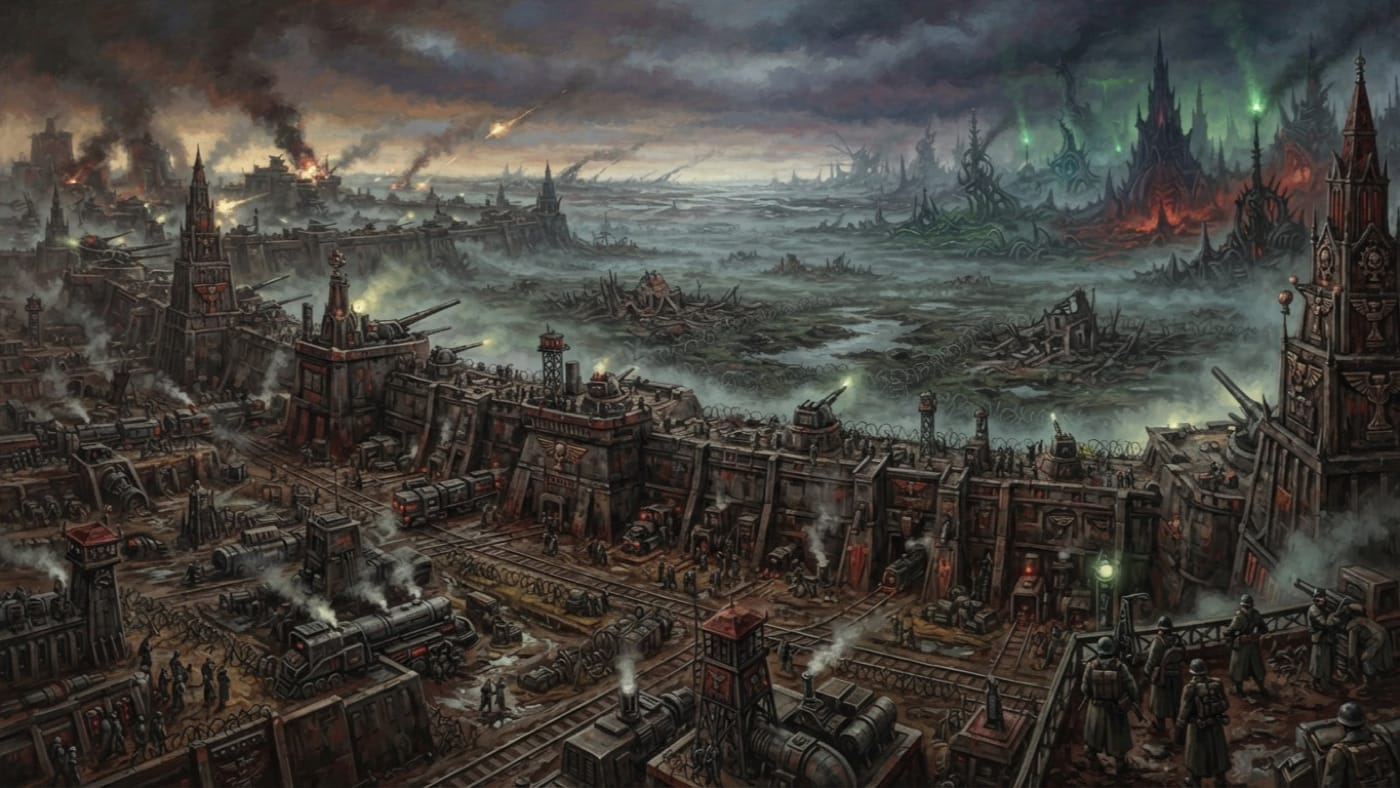
The Sagittal Line runs north to south. It begins at Bastion-Königsberg on the Baltic, where the Masurian lakes break any advance into a maze of water and reed. It crosses the Bug River at Bastion-Brest, holds the Carpathian passes at Bastion-Przemyśl, and closes the long middle gap on the Transylvanian Alps at Bastion-Sibiu. It chokes the Danube gorge at Bastion-Irongate, bars the Balkan passes at Bastion-Shipka, and ends at Bastion-Constantinople on the Bosphorus. That is roughly two thousand miles of Zone 4. The figure belongs to the Line. Nobody has measured the Theatre, and a clerk who quotes the Line's length as the Theatre's has been copying from the wrong drawer.
East of the bastions lies Zone 5, No-Man's-Land. It is the contested strip of wire and crater, full of villages that nobody has struck from the map because nobody agrees they are gone. The Lore Book's chapter on its climate records what the ground does there: gas that sings, bells soured by what the troops call prayer-jam, and flesh-mud, which officers file as "anaerobic slurry" and soldiers describe as earth that drags men down for company. I note these as the source notes them and go no further. This is a plate, not a bestiary.
Beyond the strip lies Zone 6, the Charnel Lands. This is the fallen East proper, where the registry's measurements stop agreeing with one another.
Each sector faces a different enemy. Atheron crowns the Carpathian ridges opposite Przemyśl with spires. Velmora works the Transylvanian veins and the Romanian approaches opposite Sibiu, whose garrison intercepts more bribed convoys than it repels assaults. Morwen comes up the Danube approaches against Irongate. Syrion holds the highlands below Shipka in time-fog and sleep-plague, and the garrison there rotates every four months because longer tours produce men who can no longer count days. Constantinople faces two enemies at once: Kargath's hunger by way of the Black Sea and the Thracian approaches, and Maldrake's campaigns out of Thrace. Velkara holds no assigned sector, and her influence turns up in small doses all along the Line.
The northern sectors face enemies that have no name at all. The Grey lies opposite Königsberg and the Nameless Tide opposite Brest. Both are held under Absolute Suppression, and neither is to be promoted into an eighth seat of the Shadow Court by an enthusiastic copyist.
The sea is the last flank. The Black Sea is a demonic attack lane against Constantinople, and the Black Sea Reliquary Flotilla patrols it.
Behind all of this lies the rear: depots, hospitals and rail yards that serve the Theatre without lying inside the enemy's country. West of the spine does not mean safe. The registry records fallen and contested pockets on the wrong side of every tidy longitude, and the eastern districts of Budapest have been contested since their abandonment after A.S. 120.
The Line's western anchor is Bastion-Lorraine, and the front runs from the Carpathians to the Aegean.
This wording survives in older general overviews and is withdrawn. The Line runs north–south, from Bastion-Königsberg on the Baltic to Bastion-Constantinople at the Bosphorus. "Lorraine" is a retired nickname for the southern anchor and never named a western one. The Aegean was never a terminus. The correction is filed here because readers in the Eastern Theatre are the ones most likely to be shot for believing the old version.
#On the Making of the Theatre
No founding year can be given, and I will not invent one to please the indexers. There are only stages.
The Eastern Silence of A.S. 38 / 1748 CE was an omen. It came seven years before the Sundering of 1 November A.S. 45 / 1755 CE, and the Ledger does not permit the two to be confused. After the Sundering the Church came into public view and the retreat westward began, unevenly and town by town, with no single order behind it. A provisional council was governing by about A.S. 50 and gathered offices as it went. A defensible Line stood by about A.S. 65–68 / 1775–1778 CE, though it was not yet complete, and the practices along it were standardized between about 68 and 72. The formal Synod begins only with the constitutional settlement of A.S. 90 / 1800 CE.
Every Bureau that now files Eastern Theatre reports describes its earlier work under titles it did not yet hold. The Codex permits this, provided the reader knows it is being done.
#On the Enemy's Replenishment
The enemy's armies are mostly mortal. The dedicated lore on the demonic hosts and the Legions of Sin taxonomy give incompatible proportions, and I will not referee figures that cannot both be right. Both agree that men far outnumber demons in the eastern ranks. That is the figure the logistics officers must feed into their models.
The models fail. Enemy regiments replenish faster than any levy, conscription or capture can explain. The Bureau of War accounts for the difference in a footnote: "Supplementary mortal generation (Ref: Classification 7-F)."
The footnote refers to the Ash-Mothers. The Lore Book describes captured women held in pits and the births taken from them, some children for mortal auxiliaries and some for sorcerous consumption. It also records maternal ashes scattered afterward on the enemy's mustering grounds. In Kargath's country the pits are hidden in the Blightmarsh, the same marsh that hides the Cauldron Citadel. In Maldrake's they lie within his furnace territory. The women are prisoners, and their children are prisoners from birth. Nothing in the Ledger, including the parts the Bureau of Doctrine would rather I had not read, shows that either owes the enemy anything beyond the use he has made of their bodies.
The Pit of Debrecen is the clearest case on file. Radiant Fusiliers found seventy captive mothers there during a push into Blightmarsh territory. The Fusiliers' own logs disagree on the date, so the discovery stands as A.S. 78–83 / 1788–1793 CE, and the interval is kept. The men who made the find served the provisional order a decade before the Concordat of Strasbourg gave it a formal name. Their commander, Captain Elias Brekke, was reassigned in A.S. 84.
#On Reports and Countermeasures
The Order was issued jointly by War and the Bureau of Medicine in A.S. 134 / 1844 CE and revised in A.S. 158 / 1868 CE and A.S. 194 / 1904 CE. It requires that a discovered installation be secured by Radiant Fusilier or Shield-Paladin units with reliquary support. Surviving mothers are to be extracted under medical supervision and moved to rear facilities of the Bureau of Mercy. Infants are to be assessed by the Bureau of Purity. The Bureau of Records files whatever comes back.
The two clearances are separate. Third Tier admits a reader to the Ash-Mother dossier. Clearance Four governs who may receive the Order itself. An officer holding one and not the other knows what the pits are without knowing what he must do about them, or the reverse, and both conditions occur.
The Order does not say what becomes of every child. The addendum may. I have no authority to tell you which.
Since A.S. 134 the Bureau of Doctrine's public position has been that these installations are "isolated instances of enemy barbarism." In the same years, War's replenishment models have carried the footnote quoted above. Both documents are current, and both are correctly stamped.
#On the Present Condition
As of A.S. 201 the Line holds. Every bastion from the Baltic to the Bosphorus reports itself manned, belled and supplied, and some of these reports are true. The contested strip stays contested. Surveys of Zone 6 come back with distances that do not close, so the Bureau of Cartography files each as provisional and asks for another.
The number of active Ash-Mother installations east of the Line is classified. The Bureau of War's Chief Logistician has declined to give it to me, and that refusal is the most precise figure the Theatre currently produces.
No Eastern Theatre command will be convened to settle any of this, because none exists. The reports will continue to arrive under a heading nobody chartered, and they will be answered by the desks they are addressed to.